Hiring developers for startups is tough, especially with limited funds. By 2026, 73% of startups report struggles finding technical talent, and 14% of founders cite team issues as a top reason for failure. Competing with tech giants offering $220K+ salaries is daunting, but startups can attract talent by focusing on what developers value most: impact, autonomy, and growth opportunities.
Here’s how to hire developers without breaking the bank:
- Offer equity: Developers at startups often receive 0.1%-0.5% equity, structured with a 4-year vesting schedule.
- Highlight non-monetary perks: Flexible work options, ownership of projects, and mentorship opportunities appeal to candidates.
- Leverage alternative sourcing methods: Use platforms like GitHub, Reddit, or Wellfound to find engaged developers. Attend hackathons and explore open-source contributions.
- Streamline hiring: Keep the process under 3 weeks, provide clear timelines, and use paid trial projects to evaluate skills.
- Consider freelancers or co-founders: Freelancers are ideal for short-term projects, while technical co-founders can provide expertise in exchange for equity.
Startups can’t outspend big tech, but they can stand out by offering meaningful roles, clear growth paths, and a chance to shape the company’s future.
The Startup Hiring Landscape
::: @figure 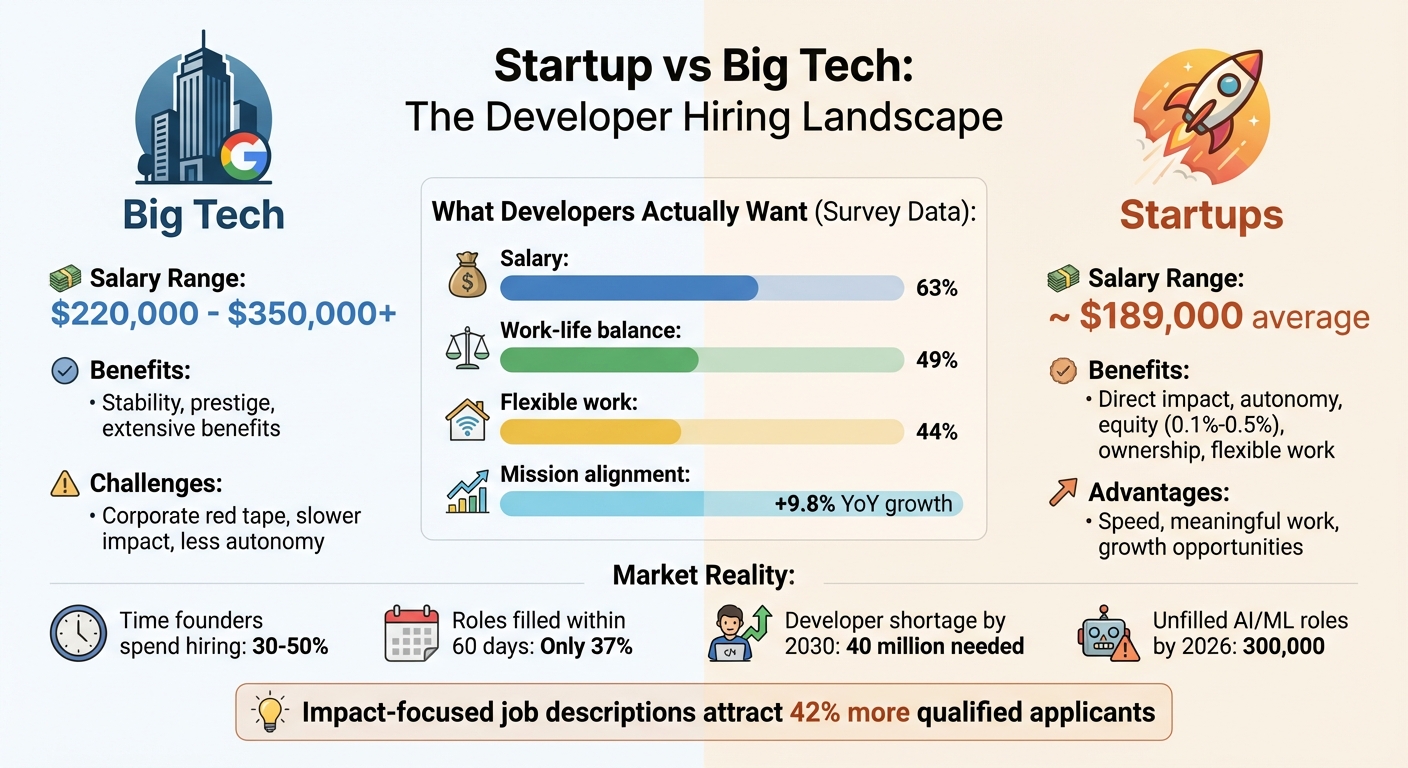 {Startup vs Big Tech: Developer Hiring Comparison - Salary, Benefits & What Developers Value}
Why Startups Can't Compete on Salary Alone
The numbers tell a tough story. Senior engineers at tech giants like Google or Meta earn total compensation ranging from $220,000 to over $350,000 . In contrast, startup engineers average about $189,000 . And it’s not just about the paycheck - big tech offers stability, prestige, and extensive benefits, making it even harder for startups to compete.
Remote work has made the situation trickier. Developers in lower-cost areas now have access to Silicon Valley-level salaries without needing to move . Combine this with a looming developer shortage - 40 million developers by 2030 and 300,000 unfilled AI/ML roles by 2026 - and the hiring market becomes fiercely competitive, with demand far outweighing supply.
On top of that, recruiting drains valuable time. Early-stage founders often spend 30% to 50% of their time trying to hire talent , leaving less room for building products or growing the business. And with only 37% of tech recruiters managing to fill senior engineering roles within 60 days , the hiring process can drag on for months, stalling progress on key initiatives. This makes it clear: startups need to understand what developers value beyond just money.
What Developers Want Beyond Money
Sure, salary matters - 63% of candidates rank it as their top priority - but it’s not the whole story. For example, 49% of developers prioritize work-life balance, and 44% value flexible work setups . The gap between pay and these other factors is shrinking, giving startups an opportunity to stand out in ways that don’t involve outspending big tech.
Developers increasingly seek direct impact and autonomy. They want to take ownership of projects, see their work go live quickly, and play an active role in decision-making - rather than getting bogged down in corporate red tape . Mission alignment is also gaining importance, with interest in company values rising 9.8% year-over-year in the U.S. by 2025 .
Startups can capitalize on this by shifting how they present roles. Job descriptions that focus on the impact of the work, rather than listing endless requirements, attract 42% more qualified applicants . This is where startups shine: offering speed, ownership, and purpose - qualities that large companies often struggle to deliver. Instead of competing on salary, highlight the unique opportunities for growth and influence that only a startup can provide.
Hiring engineers?
Connect with developers where they actually hang out. No cold outreach, just real conversations.
How to Structure Compensation on a Limited Budget
Startups often face the challenge of competing with big tech salaries, but that doesn’t mean you’re out of options. By combining equity and meaningful, low-cost benefits, you can create a compensation package that appeals to developers looking for both immediate value and long-term rewards. Let’s break it down.
Designing Equity Packages That Matter
For startups, equity is a smart way to attract talent without draining cash reserves. It’s especially appealing to developers who want to be part of something impactful. Typical equity offers for developers in startups range from 0.1% to 0.5%, while specialized roles, such as AI/ML engineers, might see equity in the 0.2% to 0.7% range . The key is to structure equity in a way that feels meaningful rather than arbitrary.
A common approach is a four-year vesting schedule with a one-year cliff . Here’s how it works: no equity is earned in the first year, but after 12 months, 25% vests. The remaining equity then vests monthly over the next three years. This setup encourages long-term commitment while protecting the company from early departures.
"Equity compensation can be a powerful tool for attracting top talent when cash is tight. You can offer stock options that vest over time, encouraging long-term commitment while preserving immediate cash flow." – Quickly Hire Team
Transparency is crucial when offering equity. Include equity ranges when you write developer job descriptions to attract candidates who are excited about startup potential while naturally filtering out those who aren’t. When extending an offer, explain the equity’s potential value clearly. Share your company’s growth plans, how the candidate’s role impacts valuation, and what milestones could make the equity more valuable.
For added flexibility, consider offering candidates a choice: a higher salary with less equity or a lower salary with more equity . This lets candidates align the offer with their personal financial priorities and risk tolerance.
Benefits That Don't Require Big Budgets
Equity isn’t the only way to stand out. Thoughtful, low-cost benefits can make your offer even more appealing. For example, offering remote or hybrid work options is a no-cost perk that nearly half of developers prioritize for better work-life balance . Plus, it broadens your hiring pool to include talent from anywhere.
Another way to attract developers is by letting them make an impact right away. Give them ownership of meaningful projects from day one, allowing them to see their work go live quickly and influence key product decisions . This level of autonomy is something many large tech companies struggle to provide.
Invest in their growth by setting aside time for learning, open-source contributions, or attending virtual conferences. Pair junior developers with senior team members or founders for mentorship . These efforts show you’re invested in their future, not just their current output.
Lastly, build a workplace culture that fosters trust and experimentation. Developers should feel safe to take risks, fail, and learn without fear of blame . Regular one-on-one meetings, open discussions about company metrics, and involving developers in strategic decisions can create the kind of loyalty that money alone can’t buy.
Where to Find Developers Without Paying Recruiter Fees
Recruiter fees can eat into your startup's budget, so finding skilled developers through alternative, budget-friendly methods is essential. The key? Go where developers already hang out. By engaging with them in their own spaces, you’re more likely to connect with individuals who are genuinely excited about your vision - not just the paycheck.
Finding Developers in Online Communities
Developers often gather in online spaces to share knowledge and network. Platforms like Reddit are great starting points, with subreddits like r/forhire and r/startups hosting developers interested in early-stage projects and mission-driven work. Similarly, Wellfound (formerly AngelList) is specifically designed to connect startups with tech talent eager to join new ventures.
Don’t overlook niche communities, either. Specialized Slack groups or Discord servers centered around specific programming languages or startup interests can be goldmines for finding engaged candidates. The trick here is to participate genuinely - answer questions, share your expertise, and build trust before starting any recruitment conversations.
Social media platforms like LinkedIn and X (formerly Twitter) are also valuable tools. Directly reaching out to developers with startup experience can yield great results, especially if you focus on regions with lower living costs - such as Latin America or parts of Europe - where candidates might be more open to remote work. Personalize your messages by highlighting the growth opportunities and technical challenges your startup offers. A tailored approach stands out far more than a generic pitch.
And for a deeper understanding of a developer’s skills, open-source platforms can provide valuable insights.
Recruiting Through Open Source Contributions
Platforms like GitHub offer a behind-the-scenes look at how developers think and work. By reviewing a candidate’s contributions, you can assess their problem-solving abilities and technical expertise. Look for qualities like clean, readable code, detailed comments, and the use of automated tests - these are signs of maintainable and thoughtful work.
Focus on developers whose projects align with the challenges your startup is tackling. When reaching out, lead with your mission and explain the technical impact of the role rather than jumping straight to salary discussions. To ease into a working relationship, consider offering a small, paid test project (2–4 hours) to evaluate their skills and fit without making an immediate long-term commitment. For senior developers, framing the opportunity as a "passion project" or part-time advisory role can also be a great way to gauge interest before moving toward full-time involvement.
If you’re looking for face-to-face connections, hackathons can provide a dynamic environment to meet talented developers.
Using Hackathons to Meet Developers
Hackathons give you direct access to developers while showcasing their skills in real time. Whether you sponsor, compete, or simply attend, hackathons let you see how candidates handle pressure, collaborate with others, and tackle unfamiliar challenges. For startups with tight budgets, this live evaluation can be a game-changer when making hiring decisions.
Local startup clubs and community events also offer great opportunities to meet developers who are naturally drawn to entrepreneurial ventures. These in-person interactions often build trust and rapport faster than online outreach.
At hackathons, focus on building relationships instead of pushing for an immediate hire. Stay in touch by sharing updates about your startup’s progress and inviting their input on technical decisions. Over time, these connections can naturally grow into hiring conversations when the timing aligns for both parties.
Technical Co-Founder vs First Hire vs Freelancers
Choosing between a technical co-founder, freelancer, or full-time hire depends on your startup's stage, available cash, and equity considerations. Each option has its own costs and levels of commitment, making the right choice critical for long-term growth.
When You Need a Technical Co-Founder
A technical co-founder is ideal when your budget is tight - between $0 and $10,000 - but you've already validated demand for your product. This partner typically takes 20–50% equity, vested over four years with a one-year cliff. When funds are limited, this arrangement provides the technical expertise needed to support fundraising efforts.
Take Sarah, for example, the founder of DocFlow, a healthcare SaaS. With 50 letters of intent and $250,000 in pre-orders but no cash, she partnered with James, an ex-Google engineer, splitting equity 50/50. James built the MVP in just 12 weeks, which led to a $15 million Series A and an $80 million valuation. As Sarah explained:
"James' 50% of an $80M company is worth way more than my 100% of nothing. And I couldn't have built it without him."
However, co-founder relationships can be tricky - 65% of startups fail due to co-founder conflict . To mitigate risks, start with a small project to test compatibility and clearly define decision-making roles (e.g., business decisions for the CEO, technology for the CTO). Always use a four-year vesting schedule with a one-year cliff to protect the company if a partner leaves prematurely.
Once your startup hits $5,000 to $20,000 in monthly recurring revenue, you might consider hiring a senior developer at market salary and offering a smaller equity grant (around 5%) instead of giving away a large equity share to a co-founder .
When your technical needs are short-term or project-specific, other hiring models may be more suitable.
Freelancers vs Full‑Time Developers
Freelancers and full-time hires serve different purposes depending on your startup's stage and goals.
Freelancers are a great option during the idea validation phase, especially when the project scope is well-defined, and you need quick results. Hiring a freelancer to build your MVP typically costs between $8,000 and $25,000 and can be completed in weeks. This approach lets you retain 100% equity, unlike full-time hires, which come with higher upfront costs - typically 1.3× to 1.5× the base salary . Freelancers are best for focused tasks like creating a landing page or a simple prototype, where long-term involvement isn’t necessary.
Mike, the founder of FitTrack, a fitness app, had $50,000 in savings and 15 paying coaches lined up. Instead of bringing on a co-founder, he hired a senior developer for $38,000 to build his MVP in 10 weeks. By maintaining 100% ownership, Mike later sold the company for $4.2 million. As he put it:
"If I'd given away 40% equity to a co-founder, that acquisition would have cost me $1.68M. I paid $38K to hire. Best $38K I ever spent."
Full-time hires, on the other hand, are a better fit once you've achieved product-market fit and have sustainable revenue. The first-year cost of an in-house developer ranges from 1.3× to 1.5× their base salary, factoring in taxes, benefits, equipment, and recruitment fees . In the U.S., base salaries for developers typically fall between $90,000 and $140,000 .
For more financial details, check out our contractor vs full‑time developer hiring guide.
Ultimately, the right choice depends on your current growth phase and available resources. Align your hiring model with your startup's needs to maximize progress while balancing costs and securing the right talent.
Building Your Employer Brand With No Budget
When it comes to attracting developers, startups often think they need a hefty marketing budget. But here's the reality: developers are drawn to startups not for flashy perks but for the chance to make an impact and tackle meaningful challenges. If you can’t compete on salary, your story becomes your greatest asset.
Leading With Mission and Impact
Your company’s story should focus on the problem you’re solving and the real-world difference it makes. Skip the corporate buzzwords - speak in the same language your team uses. Developers who resonate with your mission are often willing to accept competitive pay over the sky-high salaries of established tech giants .
Take Corgi Insurance, for example. In April 2026, they used the Y Combinator job board to recruit for specialized roles, emphasizing their mission of "building an AI financial infrastructure company" while offering salaries as high as $300,000 .
"Your company culture isn't just about ping pong tables or casual Fridays - it's about shared values and work approach," which is essential for retaining top engineering talent."
– The Quickly Hire Team
Having your CEO or COO personally interview candidates can make a big impression. It shows commitment and allows you to share your vision directly. Be open about where your company stands and the challenges you’re facing. Developers aren’t looking for a polished facade - they want to see the potential to help shape the company’s future .
Equally crucial is showcasing the substance of the work. Highlight how the technical challenges your startup offers can drive personal and professional growth.
Highlighting Technical Problems to Solve
One of the biggest reasons developers choose startups over established companies is the opportunity to grow and make meaningful contributions . So, shine a spotlight on the engineering challenges your team is tackling - whether it’s building complex systems, making pivotal tech decisions, or solving unique problems.
Be specific about the skills candidates will gain and how their roles can evolve as your company grows. With 83% to 97% of tech companies offering learning and development opportunities, outlining clear paths to leadership and autonomy can often outweigh the appeal of a higher paycheck .
"If both companies offer a similar position with similar responsibilities, I'd choose the startup. Not because of the salary but because of the growth opportunities."
– Carlos Azaustre, JavaScript Developer
Running a Fast, Respectful Interview Process
In the fast-paced world of startups, where every hire can shape the future of the company, a quick yet respectful interview process can set your employer brand apart. The reality is, top developers are often snapped up in just a few days, making speed a crucial factor.
Keeping the Interview Process Short
For pre-seed startups, aim to wrap up the entire hiring process - starting from the first conversation to offer acceptance - within 14 to 21 days . Dragging out interviews to 45 days or more, especially for senior roles, could mean missing critical growth milestones . The key to moving quickly lies in having a clear plan from the beginning. Define what success looks like, decide who has the final say, and identify the specific skills and qualities you're assessing .
"The real trade-off isn't speed vs precision. It's: Speed without clarity vs speed with clarity."
– Olga Fedoseeva, Founder, UnitiQ
Streamline the process by combining interview stages where possible. For example, involve your CTO or technical advisor early on to evaluate both technical skills and cultural fit in a single meeting . Consider using paid trial projects - lasting one to two weeks at the candidate's standard rate - to get a real sense of their capabilities . Tripcents, for instance, successfully used this approach in 2024 to onboard a lead developer. Within just over 60 days, they went from hiring to launching an Alpha product .
To maintain momentum, set internal Service Level Agreements (SLAs) for your hiring team. For instance:
- Review resumes within 24 hours.
- Provide interview feedback within 48 hours.
This 48-hour feedback rule can cut candidate drop-offs between later stages from 28% to 14% . On day one, give candidates a one-page brief outlining the role's first 90 days, salary expectations (e.g., $150,000 to $200,000 for senior full-stack developers in the U.S. ), and the interview timeline .
Hold a quick, 15-minute weekly stand-up to address any bottlenecks in the hiring process. This ensures offers are made promptly and minimizes wasted time for founders, who already face high opportunity costs .
While speed is important, treating candidates with respect and transparency is equally critical.
Treating Candidates Like Partners
Respect begins even before the first interview. Be upfront about compensation in your job postings so candidates can self-select. Also, share details about any technical debt or challenges in your codebase . Developers value honesty - it shows you respect their ability to make informed decisions.
"If your interview process takes four weeks, the best candidates will accept other offers before you make a decision. Aim for two weeks from first contact to offer. Three at most."
– Nimrod Kramer, CEO, daily.dev
Standardize your interview questions to focus on specific competencies, such as how candidates handle pressure or how quickly they learn . This consistency not only reduces bias but also speeds up decision-making. Evaluate candidates based on real work products - like coding simulations or strategy presentations - rather than relying on abstract exercises like whiteboard puzzles . Remember, professionalism starts long before day one. It’s reflected in how you communicate with candidates throughout the hiring process .
How daily.dev Recruiter Helps Startups Compete for Talent
For startups with limited budgets, traditional recruiting methods like cold emails, pricey job boards, and recruiter fees can quickly eat up resources without guaranteeing results. daily.dev Recruiter offers an alternative by connecting you with developers in a space they already trust and use for professional growth.
The platform’s double opt-in system ensures that both parties express interest before any contact is made. Instead of sending out generic job postings to countless candidates, you can share targeted job briefs directly with pre-qualified developers who meet your specific needs. This approach eliminates wasted interviews and cold outreach, which are often costly and time-consuming for small teams. It’s a smarter way to focus on building a tech talent pipeline without draining your resources.
What sets daily.dev Recruiter apart is its connection to an active developer network, giving you access to passive talent - skilled engineers who aren’t actively job hunting but are open to opportunities that align with their passions. These developers are already engaged with the platform, consuming technical content and participating in the community. This engagement leads to higher response rates when your role matches their interests.
Additionally, the platform integrates seamlessly with your existing ATS, automating data transfers and status updates. This reduces administrative tasks by 20-30%, allowing your team to spend more time building meaningful relationships with candidates rather than managing logistics. For startups that need to move quickly, this streamlined process helps tackle hiring delays, cutting down on the costs associated with unfilled positions.
Summary
Hiring developers on a startup budget isn't about trying to match the high salaries offered by FAANG companies. Instead, it's about focusing on what those big companies can't provide. Highlight the unique engineering challenges your team is tackling. Developers drawn to early-stage startups are often motivated by impact, autonomy, and equity.
For senior roles, offering equity in the range of 0.1% to 0.5% with a standard 4-year vesting schedule can be a strong incentive. Be transparent by including salary ranges and your latest 409A valuation to build trust. Including salary ranges in job postings can increase applications by 30% , and emphasizing the specific impact a new hire will have can boost qualified applicants by 42% .
After defining compensation, focus on finding the right talent. Seek out developers where they already spend their time - whether that's contributing to open source projects, participating in hackathons, or being active in developer communities. Move quickly with a streamlined and respectful interview process. Employee referrals can also speed up hiring and improve retention .
When budgets are tight, building strong relationships with passive candidates becomes even more important. These developers are often drawn to the technical challenges they’ll face and the mission behind your product. If you can’t compete on salary, stand out with speed, transparency, and the opportunity to build something meaningful from the ground up.
Startups that thrive on limited budgets understand that developers care about more than just money - 49% value work-life balance, and 44% prioritize flexible work arrangements . Showcase what sets your startup apart: the exciting problems to solve, the equity potential, and the chance to shape both the product and the team from the very beginning.
FAQs
How much equity should I offer my first engineer?
Offering equity to your first engineer generally falls between 0.5% and 2%. The exact percentage depends on factors such as their level of experience, where they’re located, and how your startup is valued. This equity should complement a well-rounded compensation package that also includes cash, balancing their contributions with the risks involved. Offering a meaningful share can appeal to skilled engineers who are open to trading higher salaries for the chance to have ownership and make an impact at an early-stage company.
How do I explain equity value to candidates?
Startup equity is essentially a slice of ownership in a company. Its value isn’t fixed - it grows (or shrinks) based on the company’s success. For example, if the startup gets acquired or goes public through an IPO, your equity could turn into a significant payout. But until those milestones are hit, its worth remains largely theoretical.
A few key factors influence the value of equity:
- Dilution: When a company raises more funding, it often issues additional shares, which can reduce the percentage of ownership tied to your equity.
- Current Valuation: The company’s present valuation plays a big role in determining the potential worth of your shares.
- Long-Term Potential: The real value lies in the company’s ability to grow and achieve its goals over time.
Equity isn’t a quick win - it’s a long-term investment. By owning a piece of the company, you’re not just working for a paycheck; you’re contributing to something you have a personal stake in. It’s a way to align your success with the company’s growth.
What’s the fastest interview process that still works?
The quickest way to run an effective interview process is to find the right balance between speed and thoroughness. Begin with a short phone or video call to evaluate the candidate's motivation and fundamental skills. Then, follow up with a targeted technical assessment, such as a coding challenge, to dig deeper into their abilities. Keep the process brief - one or two stages at most - and aim to wrap it up within a few days. This approach respects the candidate's time while still ensuring a solid evaluation.
.png)