Hiring DevOps and Site Reliability Engineers (SREs) in 2026 is more competitive than ever. With 85% of enterprises relying on cloud solutions and infrastructure becoming more complex, these roles are critical for deployment speed, system reliability, and developer productivity. However, many companies struggle to fill these positions due to skill gaps and high demand.
Key Takeaways:
- Role Differences:
- DevOps Engineers: Focus on CI/CD pipelines and deployment automation.
- SREs: Ensure system reliability using engineering principles like SLOs and error budgets.
- Platform Engineers: Build tools to simplify developer workflows.
- Skills to Look For:
- Technical: Kubernetes, Terraform, CI/CD, programming (Python, Go), and observability tools.
- Soft: Communication, incident command, and collaboration.
- Salaries:
- Senior DevOps: $195,000–$265,000.
- Senior SREs: $215,000–$300,000+.
- Where to Find Talent: GitHub, Kubernetes meetups, KubeCon, SREcon, and tools like daily.dev Recruiter.
- Common Mistakes: Misunderstanding roles, poor communication about on-call duties, and slow hiring processes.
Speed, clarity, and understanding role-specific needs are critical to hiring success. Let’s dive deeper into how to secure the best talent for your team.
DevOps vs. SRE vs. Platform Engineering: What Recruiters Need to Know
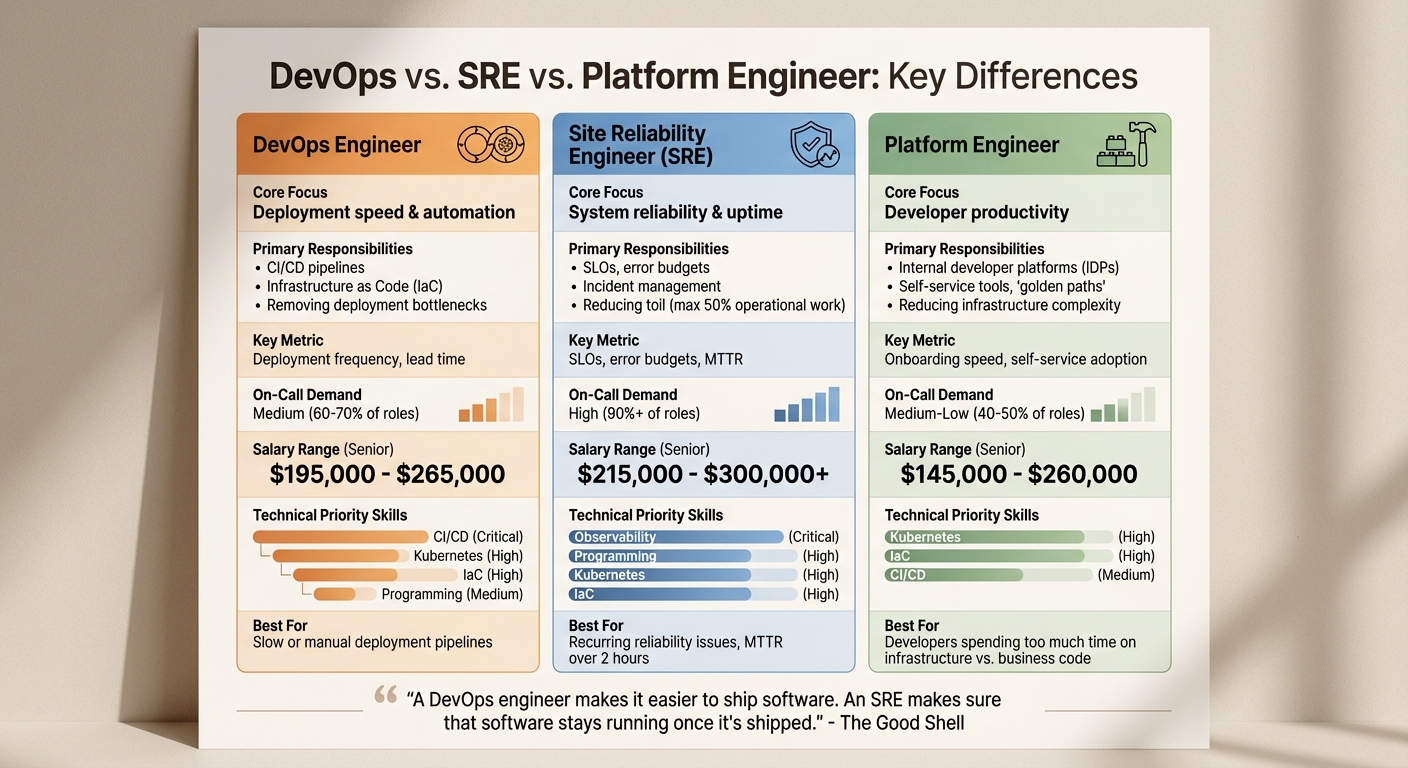
Choosing between hiring a DevOps Engineer, Site Reliability Engineer (SRE), or Platform Engineer can feel like navigating a maze. While these roles often overlap in tools - think Kubernetes, Terraform, and cloud platforms - their goals are distinct.
Getting these distinctions right is crucial. It’s the difference between hiring someone to streamline deployments and someone who ensures your systems don’t crash at 2 a.m.
What Each Role Actually Does
DevOps Engineers focus on deployment. Their job is all about automating CI/CD pipelines, managing infrastructure as code (IaC), and removing bottlenecks in deployment processes. Their success is measured by how quickly and efficiently new code gets deployed .
Site Reliability Engineers (SREs) are all about keeping systems stable and reliable. They use engineering principles to set Service Level Objectives (SLOs) and manage error budgets, which balance uptime with the speed of new development. Google emphasizes that SREs should spend no more than 50% of their time on operational tasks, dedicating the rest to building tools that reduce repetitive work .
"A DevOps engineer makes it easier to ship software. An SRE makes sure that software stays running once it's shipped." - The Good Shell
Platform Engineers focus on making developers’ lives easier. They build internal developer platforms (IDPs) and create standardized, self-service tools - often called "golden paths" - that let developers deploy code without needing to master the underlying infrastructure. Their success is tied to how quickly new developers get up to speed and how widely self-service tools are adopted .
Here’s a side-by-side look:
| Role | Core Focus | Key Metric | On-Call Demand |
|---|---|---|---|
| DevOps Engineer | Deployment speed & automation | Deployment frequency, lead time | Medium (60–70% of roles) |
| SRE | System reliability & uptime | SLOs, error budgets, MTTR | High (90%+ of roles) |
| Platform Engineer | Developer productivity | Onboarding speed, self-service usage | Medium-Low (40–50% of roles) |
This table can help you match the right expertise to your team’s specific challenges.
Which Role Does Your Team Need?
The right hire depends on your current pain points:
- DevOps: When your deployment pipeline is slow, manual, or unreliable .
- SRE: When system reliability is a recurring issue, or production incidents eat up too much of your team’s time. This is especially true if your Mean Time to Recovery (MTTR) is over two hours .
- Platform: When developers are bogged down in managing Kubernetes manifests or cloud configurations instead of writing business-critical code .
It’s worth noting that DevOps automation should come first. Without it, the effectiveness of an SRE can be severely limited.
"An SRE without a functioning CI/CD pipeline is like hiring a Formula 1 engineer to fix a car that doesn't have wheels yet." - The Good Shell
Finally, consider compensation. SREs generally earn 15–25% more than DevOps engineers due to their coding expertise and higher on-call demands . As of 2026, senior DevOps engineers in the U.S. earn between $195,000 and $265,000, while senior SREs command salaries ranging from $215,000 to $300,000+ . Factor these differences into your hiring decisions to align expectations with your budget and team needs.
Skills to Look for in DevOps and SRE Candidates
Finding the right DevOps or SRE professional goes beyond scanning a resume for buzzwords. The ideal candidate combines technical know-how with strong interpersonal abilities, creating a balance that can't be fully captured on paper.
Technical Skills
Infrastructure as Code (IaC) is a must-have skill. Tools like Terraform dominate the field for multi-cloud provisioning, while Pulumi is gaining popularity with teams that prefer programming languages like TypeScript or Python over HashiCorp Configuration Language (HCL). These tools help maintain consistent environments across development, staging, and production, avoiding the chaos of manual infrastructure adjustments .
Kubernetes expertise is non-negotiable in 2026. With Gartner predicting that 75% of enterprises will adopt formal SRE practices by 2027, most of these will involve containerized workloads . But don’t stop at Kubernetes - look for candidates familiar with Helm for package management, Argo CD for GitOps workflows, and Istio for managing microservices through service meshes.
Observability is what separates a good hire from a great one. Basic monitoring - like checking if a service is "up" - is no longer enough. Ideal candidates should be able to design Service Level Indicators (SLIs) and Service Level Objectives (SLOs), manage error budgets, and work with the "three pillars of observability": metrics (Prometheus/Grafana), logs (ELK/Loki), and traces (OpenTelemetry) .
For SRE roles, programming skills are especially critical. These aren't just ops engineers who occasionally script; they should be proficient in languages like Python or Go, capable of building tools that eliminate repetitive tasks (or "toil", as Google terms it).
"SRE is what happens when you ask a software engineer to design an operations function" - Ben Treynor Sloss, Google
CI/CD expertise goes beyond pushing code through a pipeline. Candidates should be able to design parallel jobs, implement matrix builds, integrate security scanning, and configure automated rollbacks using tools like GitHub Actions or GitLab CI. With AWS holding a 33% market share in 2026, familiarity with AWS, followed by Azure and GCP, remains highly sought after .
| Skill Category | DevOps Priority | SRE Priority | Key Tools |
|---|---|---|---|
| Infrastructure as Code | High | High | Terraform, Pulumi |
| Container Orchestration | High | High | Kubernetes, Helm, Argo CD |
| Observability | Medium | Critical | Prometheus, Grafana, OpenTelemetry |
| Programming | Medium | High | Python, Go |
| CI/CD Pipelines | Critical | Medium | GitHub Actions, GitLab CI |
| Cloud Platforms | High | High | AWS, Azure, GCP |
While technical skills lay the groundwork, soft skills are just as essential for thriving in fast-paced environments.
Soft Skills
Technical expertise alone isn’t enough. Strong communication and leadership abilities are vital for bridging the gap between development and operations teams.
Cross-functional communication is key. DevOps and SRE professionals often act as a bridge between development, operations, security, and business teams. They need to translate technical issues - like deployment failures or capacity constraints - into terms that non-technical stakeholders, such as product managers or executives, can understand .
Incident command is especially important for SREs. During high-stakes moments like a 2 a.m. production outage, you need someone who can not only handle the technical side but also coordinate responses across teams and maintain clear communication under pressure. Candidates should be able to share examples of incidents they’ve managed, showcasing their ability to lead rather than just troubleshoot .
Empathy and collaboration are crucial for fostering a positive work environment. The best infrastructure engineers work alongside developers to address failures without assigning blame. They focus on making everyone’s job easier, avoiding the "us vs. them" mentality that can arise between dev and ops teams .
Lastly, continuous learning is non-negotiable. The DevOps landscape evolves rapidly, with tools like OpenTofu emerging as open-source alternatives to Terraform following recent licensing changes . Candidates who stay curious, experiment with new tools, or contribute to open-source projects demonstrate the adaptability needed to keep pace .
Where to Find DevOps and SRE Talent in 2026
DevOps and SRE professionals thrive in specialized spaces, often contributing to open-source projects, engaging in niche communities, and attending focused industry events. Understanding where they spend their time and how to connect with them can make a huge difference in your recruiting efforts.
Online Communities and Open Source Projects
Top-tier infrastructure engineers are often active contributors in the open-source ecosystem. GitHub remains a key platform for spotting talent, with contributions to projects like Kubernetes, Terraform, and Helm standing out. Pay attention to the quality of their pull requests, discussions around issues, and their work on documentation. These contributions often reveal technical expertise and collaboration skills that are hard to gauge otherwise.
Additionally, attending Kubernetes and cloud-native meetups can help you observe how these professionals engage within their communities. These gatherings serve as an excellent precursor to more personal interactions at major conferences.
Conferences and Events
Despite the rise of digital networking, in-person connections still hold weight. Events like DevOpsCon, the Platform Engineering Summit, KubeCon, and SREcon are essential for meeting engineers who specialize in cutting-edge infrastructure.
- KubeCon is particularly notable, drawing engineers focused on containerized infrastructure.
- SREcon, hosted by USENIX, is a hub for reliability engineers from tech giants like Google, Netflix, and Meta.
These events aren’t traditional job fairs, so skip the generic pitches. Instead, bring along technical team members who can engage in meaningful conversations about architecture challenges. This approach helps you identify candidates who align both technically and personally with your team.
In this competitive hiring landscape, speed is critical. According to KORE1, "The company that moves fastest wins - even when they're not the highest bidder" . Ideally, aim to progress from the first conversation to a signed offer within three weeks, as top candidates often juggle multiple offers .
Using daily.dev Recruiter to Connect with Infrastructure Developers

While online communities and events are effective, targeted digital platforms like daily.dev Recruiter offer another way to connect with infrastructure developers. This platform focuses on developers who are actively engaged with technical content, such as articles on Terraform, Kubernetes, and other infrastructure-related tools.
What sets daily.dev Recruiter apart is its ability to identify developers based on their reading habits and tech stack engagement. For example, if an engineer frequently reads about observability, Infrastructure as Code (IaC), or CI/CD pipelines, it signals both interest and expertise. The platform uses a double opt-in system, ensuring that both you and the developer agree to connect. This eliminates the noise often associated with unsolicited outreach.
Here’s how it compares to traditional outreach:
| Metric | Warm Introductions | Unsolicited Messaging |
|---|---|---|
| Reply Rate | 50–80% | < 10% |
| Candidate Trust | High (trusted network) | Low (unsolicited) |
| Likelihood of Hire | 4x higher | Significantly lower |
| Context | High-context, tailored | Low-context, generic |
Instead of sending out hundreds of generic messages, daily.dev Recruiter focuses on quality connections. This approach shifts recruiting from cold, impersonal outreach to a trust-driven process. By targeting developers who are genuinely interested in opportunities, you can build meaningful relationships without endless screening calls or low response rates.
How to Assess DevOps and SRE Candidates
Evaluating infrastructure engineers requires a different lens compared to traditional software development interviews. Tasks like whiteboard puzzles often fall short in measuring the practical, system-level expertise these roles demand. Instead, focus on exercises that reflect their daily responsibilities - debugging broken deployments, designing pipelines, or spotting gaps in monitoring systems .
The key is to prioritize systems thinking over rote tool knowledge. Sure, an engineer can pick up a new CI/CD tool in a couple of weeks, but the ability to architect dependable systems takes years to hone . Look for candidates who approach complex problems thoughtfully rather than relying on tool-specific experience. Let’s dive into practical ways to evaluate their skills.
Hands-On Technical Tasks
To truly understand candidates' capabilities, give them scenarios rooted in real-world infrastructure challenges. For instance:
- Kubernetes roles: Test their ability to manage scaling or roll back deployments in a live cluster.
- Terraform assessments: Ask them to provision a multi-cloud environment and explain strategies for managing state files across teams .
- CI/CD architecture: Challenge them to design a pipeline that includes automated testing, security scanning, and graceful rollbacks. Focus on their reasoning behind the architecture rather than specific tool configurations.
For SRE candidates, the focus should shift to reliability. Ask them to define Service Level Indicators (SLIs) and Service Level Objectives (SLOs) for a specific microservice, like a payment system. Strong candidates will discuss metrics such as latency percentiles and error rates, balancing reliability with the need to deliver features quickly. You can also test their observability instincts by asking them to identify monitoring blind spots, like uninstrumented database connections, rather than just tracking high-level API latency .
Live Debugging Scenarios
Live debugging exercises are excellent for assessing how candidates handle pressure and uncertainty. Present scenarios like a service that’s running but inaccessible to users, or unexplained latency spikes despite "green" dashboards. Watch how they approach the problem - do they systematically review logs, analyze network configurations, and correlate metrics across systems?
Beyond technical troubleshooting, observe their incident command skills. This is particularly critical for SRE roles. During a live scenario, pay attention to how candidates communicate their thought process, update status pages, and decide when to escalate issues to other teams. Candidates who can later critique their own incident handling often stand out as strong hires .
You can also use error budget scenarios to assess decision-making under constraints. For example, ask if they’d move forward with a risky database migration when the monthly error budget is nearly depleted. This reveals how they balance reliability with business needs .
Finally, while live interviews are helpful, they can’t fully replicate the stress of a 2 AM incident. For critical SRE roles, consider a 90-day contract-to-hire arrangement. This offers a chance to see how candidates perform during real on-call rotations .
DevOps and SRE Salary Benchmarks for 2026
DevOps engineers earn an average of $126,240, while SREs bring in around $142,600. When factoring in equity and bonuses, top-tier roles can surpass $350,000 . SRE roles, in particular, often come with higher pay due to the complexity of their on-call duties .
With 81% of organizations embracing DevOps , demand continues to outstrip supply, keeping salaries on the rise . Companies that grasp the impact of specialization, location, and cloud expertise on pay are better equipped to attract top talent. Below, we break down how compensation evolves with experience and specialization.
Salary Ranges by Role and Experience
Base salaries for DevOps and SRE roles vary widely depending on experience. Entry-level DevOps engineers typically earn $85,000 to $110,000, while mid-level professionals see salaries between $120,000 and $160,000 . Senior DevOps engineers command $145,000 to $220,000+, and staff or principal roles can go as high as $240,000 to $320,000+ .
SREs tend to have higher earning potential. Mid-level SREs earn $105,000 to $135,000, while senior SREs range from $145,000 to $185,000 . At the staff and principal levels, compensation can exceed $184,000, with some professionals at top firms earning total packages above $343,000 . For instance, in April 2026, a Principal SRE at Okta in San Francisco reported a total package of $343,000, which included a $196,000 base salary, $127,000 in stock, and a $20,000 bonus, backed by 12 years of experience .
Specialization adds a premium to salaries. DevSecOps engineers and Platform Engineers often earn 10–20% more than general DevOps roles . For example, DevSecOps engineers in the U.S. can expect salaries between $149,736 and $198,700, depending on experience . Meanwhile, Platform Engineers, who blend DevOps speed with SRE-level reliability, often enjoy competitive pay and better work-life balance compared to traditional SRE roles .
| Experience Level | DevOps Engineer (Base) | SRE / Platform Engineer (Base) |
|---|---|---|
| Entry-Level (0–3 years) | $85,000 – $110,000 | $75,000 – $140,000 |
| Mid-Level (4–6 years) | $120,000 – $160,000 | $105,000 – $200,000 |
| Senior (7+ years) | $145,000 – $220,000+ | $145,000 – $260,000 |
| Staff / Principal (8+ years) | $240,000 – $320,000+ | $184,000 – $320,000+ |
What Affects DevOps and SRE Compensation
Understanding the factors that influence compensation can help companies secure top DevOps and SRE talent.
Location still plays a big role, although remote work has reduced some disparities. For example, mid-level DevOps engineers in San Francisco can earn up to $199,000, while senior roles may exceed $218,000 . In Seattle, mid-level DevSecOps engineers earn between $160,455 and $195,986, with senior roles ranging from $172,418 to $212,924 . Remote roles typically pay $15,000 to $25,000 less than positions in major tech hubs, with national remote salaries for mid-level roles landing between $132,408 and $163,684 .
Cloud expertise is another key factor. While AWS dominates with 47% market share , recruiters often prioritize deep knowledge of one platform - AWS, Azure, or GCP - over general familiarity with multiple clouds . Kubernetes is particularly sought after; candidates without experience managing production Kubernetes environments often miss out on higher-paying roles . Similarly, Terraform expertise is highly valued, as Infrastructure as Code remains central to modern DevOps workflows .
Certifications can help candidates stand out during early screenings. Credentials like AWS Certified DevOps Engineer, Certified Kubernetes Administrator (CKA), and HashiCorp Certified Terraform Associate are often viewed favorably. However, real-world achievements - such as reducing deployment times from 45 minutes to 3 minutes or managing multi-region Kubernetes clusters - carry more weight in salary negotiations .
Industry trends are also shifting. While tech companies have traditionally led in compensation, industries like healthcare, financial services, and insurance are now competing aggressively for DevOps talent to drive digital transformation . Additionally, engineers with MLOps experience are seeing increased demand as organizations work to operationalize AI models and build infrastructure for machine learning pipelines .
"IT leaders who combine market insights with data-driven decision-making will be best positioned to build teams - and careers - that are ready for what's next."
– James Vallone, President, Motion Recruitment
Speed matters in today’s hiring market. Top DevOps candidates often juggle multiple offers. Companies that can move from the first interview to an offer within three weeks are more likely to secure their preferred candidates, even if their offer isn’t the highest . By understanding these factors, you can craft competitive offers that align with both market trends and candidate expectations.
Common Mistakes When Hiring DevOps and SRE Talent
Hiring and keeping DevOps and SRE professionals can be tricky for many companies. The challenge often isn’t about budget - it’s about not fully understanding what these roles require. Misjudging their responsibilities or overlooking team dynamics can lead to hiring errors. Let’s break down some of the most common mistakes and how to sidestep them.
Treating DevOps as Just Ops or Just Dev
One of the biggest misconceptions is thinking of DevOps as traditional system administration. But here’s the truth: DevOps is all about automation and Infrastructure as Code (IaC), not just patching servers or managing outdated systems . If your job description focuses on server maintenance, you’re likely to attract candidates with the wrong skill set and discourage those with automation expertise.
"DevOps is not system administration. ... If that's what you publish, you'll attract sysadmins and repel the automation-focused, infrastructure-as-code people you need."
– KORE1
Instead of listing every tool under the sun, focus on a handful of core skills. Systems thinking and debugging abilities are far more valuable than knowing every specific tool. For example, someone familiar with one CI/CD platform can usually adapt quickly to others .
Another common mistake? Hiring an SRE when what you really need is someone to lay the groundwork for DevOps. Before bringing in SREs to focus on reliability, ensure you have DevOps engineers to build a solid CI/CD pipeline . Misunderstanding these roles can create confusion and disrupt the collaborative culture essential for success.
Ignoring the On-Call Factor and Culture Fit
Transparency about on-call duties and team culture is critical. Many DevOps engineers leave roles within 18 months because the job turns out to be different from what they were promised . To avoid this, be upfront about technical debt, on-call rotations, and maintenance tasks.
For SRE roles, clearly define Service Level Objectives (SLOs) and error budgets. This helps candidates understand when they’ll need to shift from feature development to ensuring system reliability . For reference, Google’s SRE model limits manual work - or "toil" - to 50% of an engineer’s time. If your role demands more, burnout becomes a real risk .
Collaboration is just as important as technical skills. DevOps is about breaking down silos between development, operations, and security. Even the most technically skilled engineer can become a roadblock if they lack communication skills . Use practical assessments to evaluate how candidates explain trade-offs to non-technical teammates .
Lastly, speed matters. Top candidates often have multiple offers, and a slow hiring process can cost you the best talent. Moving quickly - from the first interview to the final offer - shows confidence and can make all the difference .
"The company that moves fastest wins. Even when they're not the highest bidder. Speed signals confidence. Delays signal dysfunction."
– KORE1
Conclusion
Hiring DevOps and SRE talent in 2026 takes more than just posting a job listing - it starts with clearly defining the role. Ask yourself: Do you need a DevOps engineer to build and optimize your delivery pipeline, or an SRE to ensure system reliability once everything is up and running? It’s critical to establish a strong CI/CD foundation before bringing in SREs, so they can focus on what they do best: maintaining reliability .
Once you’ve nailed down the role, speed and communication become key. Top candidates are often already employed and juggling multiple offers. A hiring process that drags beyond three weeks could mean losing out. Be upfront about on-call responsibilities and the balance between working on new projects and maintaining legacy systems.
A developer-first approach isn’t just a nice-to-have - it’s a must. Cold outreach typically gets less than a 10% response rate, while warm, trusted introductions can lead to 50–80% engagement . Tools like daily.dev Recruiter can help you make double opt-in connections with infrastructure-focused developers, ensuring your outreach feels personal and meaningful instead of adding to inbox clutter.
For DevOps engineers, autonomy and a collaborative culture often matter more than flashy perks. Use practical assessments that reflect real-world tasks, keep your interview process efficient, and act quickly when you find the right fit. A streamlined approach shows you understand the fast-paced world these professionals thrive in.
As the industry continues to evolve, companies that treat hiring as a thoughtful matchmaking process will be the ones to secure the talent needed to scale their infrastructure with confidence.
FAQs
How do I choose between DevOps, SRE, and Platform Engineering?
Choosing between DevOps, SRE, and Platform Engineering depends on what your organization is aiming to achieve.
- DevOps emphasizes collaboration across teams, automation, and setting up CI/CD pipelines to streamline software delivery.
- SRE (Site Reliability Engineering) focuses on ensuring systems are reliable, maintaining uptime, and handling incident response effectively.
- Platform Engineering creates internal platforms that simplify infrastructure management, making life easier for developers.
If your organization needs both improved system reliability and better developer productivity, combining elements of these roles might be the best approach.
What interview tasks best predict DevOps/SRE job performance?
When it comes to evaluating DevOps and SRE candidates, the most effective interview tasks focus on practical, real-world abilities. These tasks often include:
- Explaining and designing CI/CD pipelines: This tests a candidate's understanding of continuous integration and delivery, as well as their ability to optimize workflows.
- Solving coding problems tied to infrastructure and reliability: These exercises assess their ability to write code that supports system stability and performance.
- Performing hands-on assessments: Tasks like scripting, troubleshooting, and system design give insight into how candidates handle key challenges in automation, observability, and cloud platforms.
These types of tasks provide a clear picture of a candidate's readiness to tackle the complex demands of DevOps and SRE roles.
How should I set on-call expectations to avoid burnout?
To prevent burnout, focus on maintaining clear communication and implementing structured on-call practices. Start by clearly defining responsibilities and setting boundaries to avoid overwhelming team members with excessive alerts or unrealistic demands. Incorporate automation tools to cut down on unnecessary notifications and false alarms, which can drain energy and focus.
Make sure on-call duties are distributed evenly across the team, and offer resources to support those handling these responsibilities. Encourage team members to fully disconnect after their shifts, promoting a healthy work-life balance. Avoid creating an environment where constant availability feels mandatory.
By fostering transparent and fair practices, you can help protect your team's well-being and create a healthier, more sustainable work environment.
.png)