Hiring mobile developers can be challenging due to specialized skills, high demand, and competition. Here's what you need to know:
- Platform-Specific Skills: iOS developers use Swift, Android developers rely on Kotlin, while cross-platform developers leverage tools like Flutter or React Native.
- Market Trends: iOS dominates in the U.S. with higher revenue potential, while Android leads globally, especially in emerging markets.
- Cross-Platform Growth: Frameworks like Flutter, React Native, and Kotlin Multiplatform reduce development time and costs while maintaining performance.
- Key Skills to Assess: Look for expertise in architecture, memory management, app store navigation, and collaboration.
- Where to Find Talent: Developers are active on Reddit, GitHub, and platforms like daily.dev, not just LinkedIn.
- Salary Expectations: U.S. mobile developers earn $80K–$271K annually, depending on experience and specialization.
Quick Tip: Focus on real-world problem-solving during interviews, and offer competitive perks like equity, flexible work, and proper tools to attract top talent.
Mobile Developer Market Overview
The mobile developer market is shaped by the unique characteristics of iOS, Android, and cross-platform ecosystems. Each platform comes with its own set of demand drivers, salary trends, and availability of skilled developers. Getting a clear picture of these factors is essential for building an effective hiring strategy - whether you're deciding which roles to prioritize or identifying regions with the best talent pool.
iOS vs Android: Platform Demand by Region
In the United States, iOS dominates with a 65% market share , making it the go-to platform for companies targeting American consumers. This dominance is even more pronounced in tech hubs like New York, where iOS accounts for 72.6% of the market, and California, where it holds 66.23% . Additionally, the revenue generated by the Apple App Store is projected to reach $161 billion by 2026, far surpassing the $72 billion expected for Google Play .
Spending patterns highlight this revenue gap even further. iOS users in the US spend an average of $10.40 per month on apps, compared to just $1.40 for Android users . This makes iOS a logical first choice for startups aiming to capture high-income professionals or Gen Z audiences, where 79% prefer Apple devices .
Globally, however, Android leads the way, particularly in emerging markets. For example, Android holds a 95% market share in India and 85% in Brazil . For companies with international growth in mind, offering support for both platforms is often a necessity.
These regional and platform-specific trends provide a strong case for exploring cross-platform development strategies.
"The pendulum that swung hard toward cross-platform solutions is now finding a balance. Companies are adopting hybrid strategies where performance-critical features are implemented natively while shared business logic leverages cross-platform frameworks." - Priya Sharma, CTO, AppFusion Solutions
Cross-Platform Development Growth
Cross-platform development has made significant strides in recent years. Flutter leads the market with a 46% share, followed by React Native at 35-38% . These frameworks now offer 80-95% of native performance , which is more than sufficient for most business applications. Tools like React Native's "Fabric" renderer and Flutter's "Impeller" engine ensure smooth performance at 120fps, further enhancing their appeal .
Kotlin Multiplatform (KMP) is also gaining traction, with 120% year-over-year growth in enterprise projects as of 2026 . This approach lets developers share business logic while maintaining fully native user interfaces, offering a practical middle ground for companies with complex needs.
In terms of talent demand, React Native continues to lead in the US and Canada. As of February 2026, there were 6,800 React Native job openings, compared to 3,200 for Flutter . This disparity is largely due to the JavaScript talent pool being 3-4 times larger than Dart's .
Cross-platform solutions are particularly appealing for businesses aiming to reduce development time. They can cut development time by up to 70% , making them ideal for MVPs and apps with tight deadlines. For instance, the Texas-based automotive platform Caristas achieved 5x sales growth within 12 months in 2025 by using a shared backend with native UIs for iOS and Android. This approach reduced their time-to-market by 35% .
Hiring engineers?
Connect with developers where they actually hang out. No cold outreach, just real conversations.
Skills to Assess in Mobile Developers
Hiring mobile developers is about much more than just their familiarity with Swift or Kotlin. What truly sets candidates apart is their grasp of architecture, their ability to optimize performance, and their knack for delivering production-ready apps that users genuinely enjoy.
Technical Skills Beyond Swift and Kotlin
The best mobile developers go beyond coding - they understand architecture patterns like MVVM, MVC, and Clean Architecture . They also know how to use state management tools such as Redux, MobX, and Combine , which are vital for keeping code maintainable over time.
Modern frameworks like SwiftUI for iOS and Jetpack Compose for Android are now the standard, replacing older methods. Developers should also be skilled in performance optimization techniques, including memory management, image compression (e.g., WebP), and lazy loading. These strategies are key to maintaining smooth 60fps interactions . In fact, apps built with platform-optimized languages can see a 30% boost in performance compared to cross-platform alternatives .
Experience matters too. Developers who have launched at least one production app bring invaluable knowledge, especially when it comes to navigating App Store and Play Store processes like certificate management, versioning, and staged rollouts. Well-designed apps with over 99% crash-free sessions often achieve 23% better user retention .
For example, in 2025, a HealthTech company drastically improved its App Store rating from 3.2 to 4.6 stars and increased development speed by 30% within six months by forming a "mobile excellence" team focused on CI/CD and performance improvements . Similarly, a FinTech company cut mobile app startup time by 78% through better architecture .
"The reason your mobile hiring process fails isn't because you're not asking the right Swift questions. It's because you're solving the wrong problem entirely... [filter for] how they think, not what they know." - Full Scale
Testing technical skills is crucial. Use code review exercises that include intentional performance or security flaws, and have candidates identify and fix them . Another effective test is presenting a crash log from a specific device model and asking candidates to explain their debugging process .
While technical expertise is critical, collaboration and adaptability are just as important in today’s agile development environments.
Soft Skills for Team Collaboration
Strong technical skills alone don’t guarantee success. Developers also need excellent soft skills to thrive in a team setting. One way to evaluate this is by having candidates participate in a 45-minute project code review with your team. This exercise reveals how well they share knowledge, provide feedback, and adapt to new ideas .
Ask candidates how they’d approach a problem like users abandoning a checkout flow. This can prompt them to suggest analyzing user research data or conducting A/B tests . Be cautious of "Platform Purists" or "Framework Fanatics" who rigidly insist one technology is always superior. These individuals might struggle to balance technical ideals with business needs. The best developers are those who challenge designs that, while technically possible, could harm the user experience .
Real-world examples highlight the importance of soft skills. For instance, an e-commerce startup grew its team from 2 to 8 developers by prioritizing learning ability and user-focused thinking over specific framework expertise. This approach led to a 300% increase in mobile revenue within six months and improved App Store ratings from 3.2 to 4.7 stars . Another FinTech company saved $120,000 in recruitment costs by focusing on problem-solving abilities rather than platform-specific trivia .
Finally, ask candidates about their most challenging production incident and how they resolved it. This question uncovers their ability to handle pressure, take accountability, and learn from mistakes . Assessing these soft skills can lead to stronger teams and faster delivery of high-quality mobile apps.
Where Mobile Developers Spend Their Time
Recruiters often turn to LinkedIn to find candidates, but top mobile developers prefer specialized communities where they can learn, troubleshoot, and share their expertise.
Developer Communities and Forums
Some of the most vibrant mobile developer communities thrive on Reddit. For instance:
- r/androiddev: Home to 271,000 members discussing Android tools and libraries.
- r/iOSProgramming: A gathering spot for 144,000 developers focused on Swift and Xcode.
- r/FlutterDev: A hub for 180,000 cross-platform developers working with Flutter.
- r/reactnative: A space for 90,000 developers exploring React Native.
These subreddits are more than just discussion boards - they’re where developers stay ahead of API changes, sometimes even before official documentation is updated. Beyond Reddit, GitHub is invaluable for sharing repositories, contributing to open-source projects, and showcasing creative solutions. Meanwhile, Stack Overflow remains a go-to for formal Q&A, though many developers lean on Reddit for broader conversations about architecture and tools.
Niche communities like r/SideProject (503,000 members) and r/alphaandbetausers (24,000 members) also offer insights into independent projects and early-stage tool testing. Active participation in these forums often demonstrates technical skills more effectively than a traditional resume. Recurring threads, such as "Show-off Saturday" or "Moronic Monday", can highlight innovative thinkers and respected mentors. For recruiters, understanding these spaces is crucial to connecting with both active and passive talent.
These communities provide a foundation for platforms that go beyond traditional profiles to reveal deeper engagement.
Finding Passive Candidates Through daily.dev
Platforms like daily.dev focus on engaged developers by analyzing their reading habits and preferred tech stacks. For example, frequent reading on topics like Swift optimization or Kotlin Multiplatform indicates a developer’s current expertise.
The platform uses a double opt-in model, meaning developers must approve connections before being contacted. This eliminates the impersonal cold outreach common in traditional recruiting. By tailoring outreach - referencing specific frameworks or architectural patterns that align with a candidate’s interests - and being upfront about the role, team dynamics, and technical challenges, recruiters can build trust. This approach ensures connections with developers who are genuinely interested and aligned with the opportunity.
Hiring Cross-Platform Developers: React Native, Flutter, and Kotlin Multiplatform
::: @figure 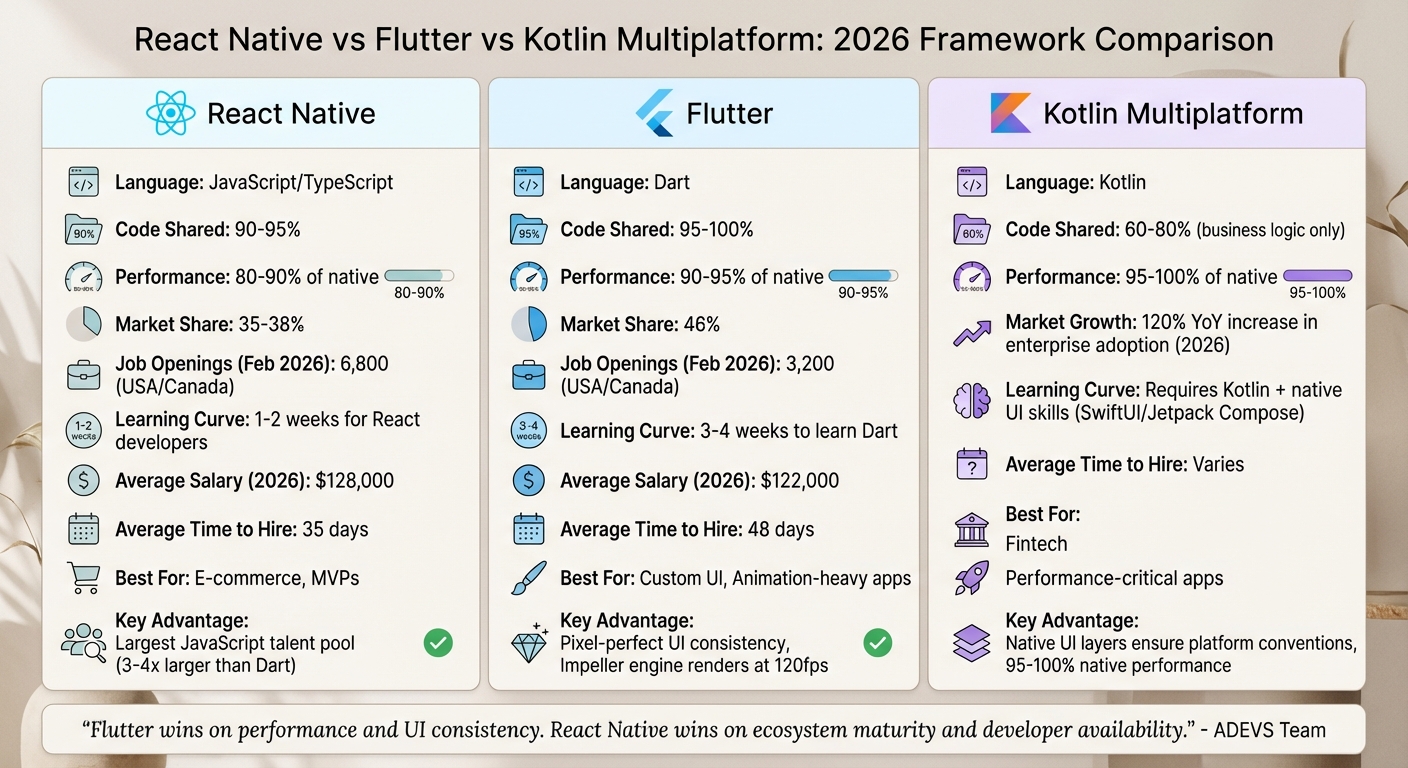 {React Native vs Flutter vs Kotlin Multiplatform: Framework Comparison 2026}
When scaling a development team, understanding cross-platform frameworks like React Native, Flutter, and Kotlin Multiplatform is crucial. Each of these frameworks tackles the challenges of cross-platform development differently, influencing how you hire and how quickly your team can deliver results.
React Native vs Flutter vs Kotlin Multiplatform
React Native relies on JavaScript or TypeScript to render native components using an updated bridge with JSI and Fabric. Developers with React experience can typically adapt to React Native in just one to two weeks. The JavaScript talent pool is significantly larger than Dart’s, with North America offering three to four times more JavaScript developers. In February 2026, there were 6,800 React Native job listings across the USA and Canada compared to 3,200 for Flutter . React Native delivers strong code reuse and competitive performance .
Flutter, on the other hand, uses Dart and renders UI through its own engine, Impeller, which paints pixels directly rather than relying on native components. This results in 95–100% code sharing and 90–95% native performance . As of early 2026, Flutter holds about 46% of the cross-platform market. However, developers may need three to four weeks to become proficient in Dart . Flutter shines in projects requiring animation-heavy or brand-focused apps where pixel-perfect UI consistency is a priority.
Kotlin Multiplatform (KMP) focuses on sharing business logic - around 60–80% of the code - while maintaining native UI layers with SwiftUI for iOS and Jetpack Compose for Android . This approach ensures 95–100% native performance since it operates natively under the hood . By early 2026, KMP saw a 120% year-over-year increase in enterprise adoption, especially in industries like fintech, where performance and adherence to platform conventions are non-negotiable . However, this framework requires Kotlin developers skilled in managing separate native UI layers.
Here’s a quick comparison to help you choose the right framework for your needs:
| Framework | Language | Code Shared | Performance | Best For | Avg. Time to Hire |
|---|---|---|---|---|---|
| React Native | JavaScript/TypeScript | 90–95% | 80–90% | MVPs, E-commerce | 35 days |
| Flutter | Dart | 95–100% | 90–95% | Custom UI, Animations | 48 days |
| Kotlin Multiplatform | Kotlin | 60–80% (logic only) | 95–100% | Fintech, Performance-critical | Varies |
"Flutter wins on performance and UI consistency. React Native wins on ecosystem maturity and developer availability." – ADEVS Team
Benefits of Cross-Platform Teams
Cross-platform teams break down the silos that often exist between iOS and Android development groups. This approach can cut development effort by 40–70%, enabling startups to roll out MVPs in weeks instead of months . A single developer can take ownership of a feature across both platforms, reducing iteration time and avoiding communication gaps.
Another benefit? Cost efficiency. Cross-platform specialists typically earn 10–15% less than native developers. For instance, in 2026, the average salary for a React Native developer in the U.S. is around $128,000, while Flutter developers earn about $122,000 . A team of three cross-platform developers can often replace five or six native specialists without compromising on quality . This setup also minimizes handoffs, speeds up decision-making, and ensures a unified user experience - all at a lower cost.
With the mobile app market projected to surpass $780 billion by 2029, cross-platform development offers a way to reach both iOS and Android users without doubling your engineering expenses . For fast-moving industries like social apps or consumer fintech, adopting a cross-platform approach provides a clear competitive edge. By aligning your hiring strategy with these frameworks, you can maximize efficiency while keeping up with market demands.
Salary Benchmarks and Offer Strategies
Hiring mobile developers comes with its own set of challenges, and understanding salary expectations and what motivates candidates is key to staying competitive.
US Salary Ranges for Mobile Developers
Salaries for mobile developers are influenced by experience, location, and specialization. On average, mobile developers in the U.S. earn around $110,000 annually .
Experience plays a big role in determining pay. Junior developers with 0–2 years of experience typically earn between $80,000 and $95,000, though in tech hubs, this can climb to $100,000–$140,000. Mid-level developers (3–5 years) generally see salaries ranging from $100,000 to $125,000, with specialized roles reaching $140,000 to $197,000. For senior developers with six or more years of experience, salaries start around $125,000–$160,000, but in competitive markets, they can soar to $195,000–$271,000 .
Location matters, too. Major tech hubs such as San Francisco ($145K–$180K), Seattle ($140K), New York ($138K), and Austin ($130K) offer higher salaries. Even mid-sized cities like Chicago ($124K) and San Diego ($121K) provide attractive compensation .
Specialization also impacts pay. Native iOS developers, for instance, earn an average of $106K, which is higher than Android developers at $88K . Developers skilled in JavaScript for mobile can see salaries as high as $182K, while expertise in frameworks like Dart or Unreal Engine often brings averages near $160K . Cross-platform developers using tools like React Native or Flutter tend to earn 10–15% less than native specialists .
| Experience Level | General US Range | High-End/Specialized Range |
|---|---|---|
| Junior (0–2 years) | $80,000 – $95,000 | $100,000 – $140,000 |
| Mid-Level (3–5 years) | $100,000 – $125,000 | $140,000 – $197,000 |
| Senior (6+ years) | $125,000 – $160,000+ | $195,000 – $271,000 |
Perks That Attract Passive Candidates
To attract top-tier talent, especially those not actively seeking new roles, offering the right perks can make all the difference. Salary alone often isn’t enough. Acting quickly is crucial, as delays could mean losing out on the best candidates .
Equity and leadership opportunities are particularly appealing in startup settings. Candidates are drawn to roles with clear pathways to leadership positions, like Mobile Tech Lead or Engineering Manager, paired with equity packages that reflect their contributions . Investing in professional growth also stands out - offering budgets for certifications (e.g., Apple App Development with Swift or Google Play Store Listing Certificate) or training on emerging frameworks signals long-term commitment to their development .
Another important factor is providing the right tools. A surprising 50% of mobile developers report they lack adequate tools for their work . Offering a tech stipend or consulting candidates about their preferred setup can go a long way. High-performance Macs for iOS developers, Android testing devices, and licenses for specialized software show you're serious about enabling their success.
"Half of mobile developers feel they don't have the right tools for their jobs. If you've found someone great, ask what tools or setup they need... it shows you're invested in setting them up for success." – Hayden Cohen, Hirewithnear
Flexibility is another major draw. Remote work options and the chance to work on greenfield projects - building new applications rather than maintaining older ones - rank highly on developers' wish lists . Additionally, allowing time for contributing to open-source projects can enhance a developer's professional reputation while also boosting your company's visibility in the tech community .
These strategies for competitive compensation and perks naturally set the stage for creating an effective interview process tailored for mobile roles.
Interview Framework for Mobile Roles
Mobile developers often reject interview tasks that demand excessive time, like building an entire app over a weekend. A thoughtful interview process values their time while effectively gauging the skills that matter most. The focus should be on how candidates tackle real-world mobile challenges, rather than testing their ability to memorize syntax or solve abstract puzzles.
Technical Assessments That Respect Developers' Time
Start with a review of their published app portfolio. Candidates with three or more published and maintained apps in the App Store or Play Store should be prioritized over those with only a strong resume . Publishing apps is no small feat - Apple, for example, rejects around 40% of first-time app submissions . Successfully navigating this process shows a candidate understands the complexities of releasing and maintaining an app.
Next, conduct a 30–45 minute screening focused on platform fundamentals like app lifecycle, memory management, offline functionality, and basic security. Replace generic exercises with a 30-minute debugging challenge inspired by real issues your team has faced . For example, you could present a scenario where an app crashes on a specific iOS version or a battery drain issue occurs on certain Android devices. Pay attention to how candidates systematically investigate the problem rather than rushing to provide quick guesses.
"The reason your mobile hiring process fails isn't because you're not asking the right Swift questions. It's because you're solving the wrong problem entirely." – Full Scale CTO Framework
If take-home projects are part of your process, limit them to a manageable 3–5 hour task, such as creating a simple list/detail screen that interacts with an API . Assignments requiring more time may discourage top-tier candidates. Follow this with a 45-minute team code review session, where the candidate works with your team to examine existing app code and discuss architectural decisions . This exercise not only tests their technical skills but also their ability to communicate and collaborate effectively.
Avoid algorithmic puzzles altogether, as they fail to predict the quality of mobile development work .
Once technical skills are confirmed, shift the focus to understanding the candidate's practical experience and teamwork style.
Behavioral Questions for Mobile Experience
Behavioral questions specific to mobile development can reveal how candidates handle the unique pressures of shipping live apps. For example, ask them to recount their worst production incident - exploring how they diagnosed the issue, communicated with stakeholders, and ensured it wouldn’t happen again .
Probe their experience collaborating with designers on Figma handoffs, negotiating API contracts with backend developers, or working with QA teams during staged rollouts . Mobile development requires constant cross-functional collaboration, so it’s essential to assess how well candidates navigate these interactions.
To evaluate user empathy, present a scenario like: "Checkout conversion dropped 15% on Android but remained steady on iOS. How would you investigate?" . Strong candidates will consider factors like device performance, network conditions, and OS-specific behaviors before diving into code. You could also ask how they’ve dealt with OS deprecations or managed staged rollouts to gauge their broader understanding of the mobile ecosystem .
Encourage candidates to structure their answers using the STAR method (Situation, Task, Action, Result) . This approach ensures their responses are detailed and grounded in real experiences. Look for candidates who ask thoughtful questions about the broader business impact - like how an issue affects retention - or who show concern for users on slower devices or limited data plans .
Conclusion
Hiring mobile developers in 2026 requires a focused and well-thought-out approach. The competition for talent is fierce, the required skills are highly specialized, and the best developers are often not actively seeking new roles. To succeed, you'll need to master three key areas: finding the right talent, evaluating their skills effectively, and acting quickly with offers that stand out.
Begin by clarifying your platform strategy early on. Decide whether you'll need native development expertise - Swift for iOS or Kotlin for Android - or if a cross-platform framework like Flutter or React Native better fits your needs . Expand your search beyond typical job boards. Developers are often active in niche spaces like r/iOSProgramming, r/androiddev, and professional events like Droidcon. Platforms such as daily.dev are also great places to connect with developers who are constantly honing their skills . A strong candidate will often have a portfolio of published apps - a clear indicator of their ability to navigate the challenges of app store requirements .
Once you've identified potential candidates, focus on refining your evaluation process. Go beyond surface-level coding skills and assess their understanding of critical areas like app lifecycle management, offline functionality, memory optimization, and teamwork. Replace outdated interview techniques with practical tests that reflect real-world scenarios. For example, offer 3–5 hour take-home projects or 30-minute debugging tasks that simulate actual production challenges. These approaches align with the preferences of 66% of developers, who favor hands-on tasks over theoretical puzzles .
Compensation is another critical factor. Senior mobile developers in the U.S. typically earn between $195,000 and $271,000 annually. However, hiring remote developers globally—particularly in regions like Latin America or Eastern Europe—can cut costs by 40–60% without sacrificing quality . Beyond salary, developers increasingly value flexible work hours, ownership over their projects, and access to the right tools. These are essential considerations, especially since half of developers feel they lack adequate support in their current roles . Streamlining your hiring process to just 2–3 stages can also make a big difference in securing top talent quickly .
The key to hiring success lies in speed, precision, and respect. Define your needs clearly, connect with developers in their preferred spaces, assess their practical skills, and craft offers that genuinely reflect their value. By aligning your sourcing strategies, evaluation methods, and interview processes with these principles, you’ll be well-positioned to build a high-performing mobile development team capable of delivering exceptional products.
FAQs
Should I hire native iOS/Android developers or go cross-platform first?
The decision comes down to what your project needs and aims to achieve. Cross-platform development tools like React Native and Flutter let you deploy faster, save costs, and simplify maintenance by using a single codebase. On the other hand, native development is ideal if your app demands platform-specific performance, advanced capabilities, or tight integration with the operating system.
Some companies take a phased approach - starting with cross-platform development to test their ideas and later bringing in native developers to add specialized features. You might also consider a hybrid strategy to balance efficiency and flexibility.
What interview tasks best predict real mobile app skills without wasting time?
The most effective interview tasks for evaluating mobile app skills are those rooted in practical, hands-on scenarios. For example, you can ask candidates to share details about tough technical challenges they've tackled in mobile development. Alternatively, structured coding exercises or code reviews based on real-world app problems can provide valuable insights. These methods highlight a candidate's problem-solving skills and practical experience, steering clear of abstract or overly theoretical questions that don't showcase their actual capabilities.
How can I reach great mobile developers who aren’t actively job hunting?
To reach skilled mobile developers who aren't actively job hunting, you need to think beyond typical job boards and LinkedIn. Personalized, community-focused engagement and clear, honest communication can make a big difference in capturing their attention. Look for platforms where developers are actively participating, such as technical forums or platforms that showcase their reading habits and contributions. Engaging authentically in these spaces shows genuine interest, making it easier to connect with passive candidates who aren't openly searching for new opportunities.
.png)