Hiring mobile developers in 2026 is more challenging than ever, with increased demand, complex technologies, and a global talent shortage. Here's what you need to know:
- Demand and Salaries: iOS developers earn more than Android developers, with salaries ranging from $195,000 to $271,000 for senior roles. Cross-platform developers, skilled in frameworks like Flutter and React Native, earn slightly less but are highly sought after for cost-effective development.
- Native vs. Cross-Platform: Native development is ideal for apps requiring advanced hardware integration (e.g., fintech, healthcare), while cross-platform frameworks like Flutter and React Native are perfect for startups and e-commerce projects needing faster deployment and feature parity.
- Key Skills: Look for developers with production app experience, strong platform fundamentals, and expertise in performance optimization, offline-first architecture, and declarative UI frameworks. Communication and team collaboration are equally crucial.
- Where to Find Talent: Use platforms like GitHub, Stack Overflow, and vetted talent networks (e.g., Toptal, Arc.dev) to connect with skilled developers. Avoid relying solely on LinkedIn or traditional job boards.
- Efficient Hiring: Respect candidates' time by focusing on practical assessments, such as debugging challenges or portfolio reviews, instead of lengthy take-home projects.
Hiring the right developer means balancing technical expertise, industry needs, and a streamlined recruitment process. Whether you're building native apps or exploring cross-platform solutions, prioritizing experience and collaboration will help you secure top talent in a competitive market.
The Mobile Developer Market in 2026
By 2026, hiring mobile developers will demand careful consideration of whether to prioritize native or cross-platform expertise. It's not realistic to expect one developer to handle all platforms effectively. As KORE1 aptly states:
The technology choice and the hiring choice are the same choice, and most companies make the technology choice by accident .
A global deficit of 1.4 million specialized mobile developers highlights the growing technical demands across various frameworks and platforms . Native development remains critical for apps requiring advanced hardware integration, such as augmented reality (AR), Bluetooth functionality, or sensor data. On the other hand, cross-platform frameworks like React Native and Flutter have become the "smart default" for startups and enterprise MVPs, helping to reduce costs and speed up development timelines .
The cross-platform mobile development market alone is projected to reach $25.6 billion in 2026 . Flutter leads with a 46% market share, while React Native follows with around 35–40% . Kotlin Multiplatform (KMP) is also gaining traction, with adoption jumping from 7% to 23% between 2024 and 2025 . Companies like Netflix and Cash App are leveraging KMP to share business logic while retaining native UI layers for superior performance .
iOS vs Android vs Cross-Platform Demand
Salaries for mobile developers vary significantly depending on the platform. iOS developers in the United States earn roughly $23,000 more annually than their Android counterparts . Senior iOS developers can expect salaries ranging from $195,000 to $271,000, while senior Android developers earn between $190,000 and $255,000 . Cross-platform developers, by comparison, earn slightly less, with salaries between $128,000 and $175,000 .
The type of app being developed often dictates the demand for specific skill sets. For instance, fintech apps requiring biometric security and hardware-level encryption necessitate native specialists. Meanwhile, e-commerce platforms that prioritize feature parity across iOS and Android benefit from cross-platform development. In the United States and Canada, React Native job openings double those for Flutter (6,800 vs. 3,200), largely due to the larger pool of JavaScript developers compared to Dart developers .
Adding to the complexity is the rise of AI-native engineering. Analyst del_rosario explains:
Now, hire technical architects who optimize for AI Retrieval and Zero Click environments .
This shift means developers must now design apps that cater to AI agents, not just human users.
Industries Hiring Mobile Developers
The choice between native and cross-platform development often depends on industry needs. For example, fintech and banking companies typically opt for native development due to strict security requirements, hardware encryption, and the need for premium user experiences . Similarly, healthcare demands native specialists for secure data handling and deep sensor integration with tools like HealthKit .
On the other hand, e-commerce and retail companies favor cross-platform frameworks like Flutter or React Native. These tools allow for consistent features across platforms while ensuring quick updates . A notable example is BMW, which used Flutter in February 2026 to create a pixel-perfect design system across iOS, Android, and embedded car displays, maintaining brand consistency . Microsoft also utilized React Native to scale its mobile productivity suite, including Office and Skype, by leveraging its extensive JavaScript talent pool .
SaaS and enterprise companies increasingly rely on cross-platform teams to build tools like internal apps, logistics automation, and real-time ERP systems . For instance, in early 2026, a logistics company partnered with API Pilot to automate 60% of manual dispatching tasks by assembling a team to develop a custom ERP mobile module . Meanwhile, AI startups are creating new opportunities by seeking developers who can design LLM-native apps optimized for agent-based environments .
Here's how industry needs align with developer expertise:
| Industry | Primary Mobile Need | Preferred Developer Type |
|---|---|---|
| Fintech | Biometric security, hardware encryption | Native (iOS/Android) or KMP |
| Healthcare | Sensor integration, secure data storage | Native (iOS/Android) |
| E-commerce | Feature parity, rapid updates | Cross-platform (React Native/Flutter) |
| SaaS/Enterprise | Internal tools, ERP integration | Cross-platform (React Native/Flutter) |
| AI/Startups | LLM-native apps, agentic optimization | AI-ready cross-platform or native |
Skills to Look for in Mobile Developers
When hiring mobile developers, prioritize those with real-world production app experience over mere framework knowledge. This means they’ve successfully navigated the process of deploying apps to the App Store or Play Store and maintaining them post-launch. Why does this matter? Because Apple rejects about 40% of first-time app submissions . Developers with this experience understand the practical challenges of mobile development, from submission hurdles to ongoing app maintenance.
A poor hiring decision can cost between $40,000 and $150,000 when you factor in technical debt and the expense of re-recruiting . That's why it's essential to assess how candidates handle real-world mobile constraints, not just their familiarity with frameworks.
Technical Skills Beyond Swift, Kotlin, and Java
Start by evaluating a candidate's grasp of platform fundamentals. This includes knowledge of app lifecycles (like backgrounding and termination), memory management (e.g., ARC for iOS or garbage collection for Android), and security practices such as using keychain/keystore and certificate pinning [1,10]. These are must-haves for anyone building production-ready apps.
Another key area is performance optimization. Developers should be comfortable using tools like Flutter DevTools, Flipper, or Instruments to identify and fix performance bottlenecks [8,16,17]. As Genie InfoTech puts it:
Optimization without measurement is guessing.
Ask candidates to walk you through a specific performance issue they’ve tackled in the past, focusing on their problem-solving approach.
In 2026, offline-first architecture is a baseline requirement. Apps need to function seamlessly without constant connectivity, leveraging tools like Room, SQLite, Hive, or Realm for local data storage and sync queues [1,10,16]. Additionally, candidates should have strong API integration skills, including RESTful/GraphQL integration, handling authentication flows (OAuth 2.0, JWT), and response parsing with serialization [2,16].
Modern mobile development has shifted toward declarative UI frameworks. Look for experience with SwiftUI (iOS), Jetpack Compose (Android), or Impeller-based rendering in Flutter [9,16,17]. Candidates should also understand the importance of null safety - codebases lacking this feature are outdated from the start .
For cross-platform roles, React Native developers should know the "Bare" workflow and how to build native modules using Swift or Kotlin. Flutter developers should demonstrate expertise in state management tools like Riverpod or Bloc [10,16]. These skills are essential for managing live apps effectively and ensuring smooth deployments.
Communication and Team Collaboration
Technical skills alone won’t cut it if a developer struggles to communicate effectively. Poor communication can lead to costly delays, with companies losing an average of $420,000 annually due to project miscommunication . Moreover, 57% of project failures are linked to communication breakdowns .
Hire developers who can clearly explain architectural decisions without overwhelming stakeholders with jargon [18,2]. For example, ask them to justify choosing Flutter over React Native for a project, and see if they can articulate trade-offs in terms that a product manager or non-technical team member would understand.
Active listening and empathy are equally critical. Strong candidates paraphrase others’ points, ask clarifying questions, and consider the workload of the entire team . Teams practicing active listening report a 25% increase in project completion rates . During interviews, observe how candidates handle code reviews - do they provide constructive feedback or dominate the conversation?
Transparency in time management is another green flag. Developers who set realistic timelines and proactively communicate blockers help avoid unnecessary delays . Ask for examples of feedback they’ve received in the past and how it helped them grow. This reveals whether they view code reviews as opportunities to improve or as personal critiques [18,2].
For remote teams, also evaluate written communication skills. Review their GitHub repositories for meaningful comments, thorough README files, and disciplined commit messages [10,16]. A candidate’s public code often reveals more about their approach than their resume.
| Category | Green Flags (Hire) | Red Flags (Avoid) |
|---|---|---|
| Feedback | Welcomes criticism; sees reviews as learning | Gets defensive or takes feedback personally [2,16] |
| Communication | Explains trade-offs clearly; uses shared terms | Relies on jargon; guesses silently on requirements |
| Team Integration | Enhances discussions; considers team input | Dominates conversations; blames others |
| Accountability | Admits mistakes; shares lessons learned | Avoids discussing failures; vague about contributions |
Portfolio and Past Projects
A developer’s portfolio is where their skills and experience come to life. As Genie InfoTech notes:
A developer with 3 published apps and an active GitHub beats a developer with 10 certifications and no portfolio every single time. Certifications prove learning; portfolios prove doing.
Download and test their apps on actual devices rather than relying on screenshots or simulators, which can hide performance issues [1,5]. Look for candidates who provide direct App Store or Play Store links. Portfolios filled with "in-progress" projects or mockups are red flags .
Strong portfolios showcase apps that go beyond basic CRUD functionality. Look for indicators of complexity, like 1,000+ downloads, offline-first architecture, or integration with hardware sensors . Check their GitHub for frequent commits and high-quality pull requests. Contributions to open-source libraries for Flutter or React Native signal seniority and a deeper commitment to the developer community [10,16].
During portfolio reviews, ask about their specific contributions to each project. Listen carefully to how they describe their role - do they use "we" or "I"? This can reveal their sense of accountability within a team [2,16].
Be cautious of portfolios filled with "To-Do" apps or clones of popular platforms like Netflix. These often indicate tutorial-based learning rather than practical problem-solving [10,16]. A useful rule of thumb: prioritize candidates with at least three published and actively maintained apps. This demonstrates they’ve moved beyond the beginner stage and understand the full lifecycle of mobile development .
Where to Find Mobile Developers
Finding top-tier mobile developers requires more than just posting job ads. According to Dan Johnston, Founder:
The best candidates aren't on job boards - they're already employed and engaged. This is especially true for senior roles and specialized positions .
To connect with these skilled professionals, you need to shift your approach. Rather than waiting for candidates to come to you, start engaging in the spaces where developers actively contribute, learn, and collaborate.
Developer Communities and Networks
GitHub: This platform is a goldmine for spotting mobile development talent. Look for developers who consistently commit to Swift, Kotlin, Flutter, or React Native projects. Pay attention to open-source contributors and those maintaining repositories with significant stars and forks - these are often indicators of both skill and dedication.
Stack Overflow: Here, you can identify problem-solvers who actively engage with technical challenges. Search for developers answering questions tagged with "swift", "kotlin", "flutter", or "react-native." High-reputation users often have extensive experience and a knack for explaining complex topics clearly.
daily.dev: This platform offers a unique way to find mobile developers by tracking their engagement with technical content. It connects you with candidates who are not only skilled but also actively learning and staying updated. Unlike static platforms like LinkedIn, daily.dev Recruiter provides real-time connections through warm, opt-in introductions.
Vetted talent networks: Platforms like Toptal, Arc.dev, and Lemon.io specialize in connecting companies with pre-screened mobile developers. These networks are particularly useful when you need senior-level talent fast, often matching you with candidates within 24–48 hours. However, be prepared for premium rates: Toptal developers typically charge $60–$150/hour, while mid-level talent on other platforms ranges from $55–$85/hour .
Developer conferences and meetups: These events are an underused resource for recruiting. Look at speaker lists from major mobile conferences to identify experts who combine technical know-how with strong communication skills . In the U.S., cities like San Francisco, Los Angeles, Boston, New York, and Chicago are hotspots for developer meetups and networking opportunities .
Now let’s explore why traditional platforms like LinkedIn often fall short when it comes to hiring specialized mobile developers.
Why LinkedIn Isn't Always the Answer
LinkedIn may not be the best tool for connecting with mobile developers. Many profiles are outdated, and the platform is saturated with recruiter activity. Developers often feel inundated by generic messages that fail to acknowledge their specific expertise.
Instead of relying solely on cold outreach, start by engaging with a developer's work. Comment on their GitHub projects, share their blog posts, or interact with their Stack Overflow answers. This approach builds rapport and shows genuine interest in their skills . When you do reach out, make it personal - reference a specific project or post they've worked on to demonstrate that you’ve done your research.
Freelance marketplaces: Platforms like Upwork and Fiverr are great for short-term projects or minimum viable products (MVPs). Rates range from $15 to over $100 per hour . While these marketplaces are ideal for one-off tasks, they aren’t the best option for building a core mobile development team .
For longer-term needs, consider working with agencies that specialize in dedicated teams. Agencies like Mobilunity and Remotebase provide pre-vetted developers for multi-year projects or complex architecture . This approach can significantly reduce the typical hiring timeline of 3–6 weeks , giving you quicker access to skilled professionals who are ready to contribute.
Cross-Platform Developers: An Expanding Talent Pool
In today's fast-paced mobile app market, cross-platform development offers a clear edge by enabling faster, unified app delivery. By 2026, businesses are realizing that hiring developers who can build for both iOS and Android simultaneously isn't just cost-effective - it accelerates timelines and ensures consistent features across platforms.
Cross-platform teams can roll out features in 60–70% of the time it takes for native development, keeping both platforms aligned right from the start . Maintenance costs are also slashed by 40–60% since updates only need to be applied to a single codebase . For startups and growing companies launching apps on both platforms, this approach has become the go-to strategy. Here's a breakdown of how Flutter, React Native, and Kotlin Multiplatform each bring their own strengths to the table.
React Native, Flutter, and Kotlin Multiplatform
Flutter leads the pack with 46% adoption among cross-platform developers, followed by React Native at 32% and Kotlin Multiplatform at 8% . As of early 2026, over 1 million apps have been created using Flutter .
React Native stands out for its vast talent pool. If your team already uses JavaScript or TypeScript, onboarding new developers becomes much easier. Its "New Architecture" improves JavaScript-to-native performance by 40x compared to earlier versions . For example, Discord achieves a 99.9% crash-free rate while sharing 98% of its code across platforms using React Native .
Flutter shines when it comes to branding-heavy user interfaces and custom animations. Its Impeller rendering engine delivers smooth 120fps performance, making it nearly indistinguishable from native SwiftUI . As Geminate Solutions highlights:
For 90% of business apps, the performance difference between native and Flutter is invisible to end users .
Kotlin Multiplatform (KMP) focuses on sharing business logic while preserving native UI. Companies like Stone, a fintech firm, have achieved 61% code sharing with KMP, speeding up feature delivery by 40% . Eleftheria Drosopoulou, a Business Analyst, explains:
The companies that get the most out of KMP - Stone, Duolingo, Google Workspace - consistently describe a pattern: shared layer for all non-UI code, native UI for platform-specific feel .
| Framework | Language | Best For | Key Benefit |
|---|---|---|---|
| Flutter | Dart | Branded UI, MVPs | Pixel-perfect consistency |
| React Native | JS/TS | Content/E-commerce | Massive talent pool |
| KMP | Kotlin | Logic-heavy apps | Native UI fidelity |
These frameworks highlight the flexibility and efficiency of cross-platform development, making a strong case for hiring developers with expertise in this area.
Benefits of Hiring Cross-Platform Engineers
The financial difference is striking. A dual-native project typically costs between $100,000 and $250,000, while cross-platform projects range from $55,000 to $160,000. Maintenance costs are nearly halved: $20,000–$45,000 annually for cross-platform versus $40,000–$80,000 for dual-native codebases .
Cross-platform development also tackles the issue of feature parity. Managing separate iOS and Android codebases often results in one platform lagging behind. A single codebase ensures simultaneous feature updates, keeping users on both platforms equally satisfied .
Quality assurance becomes more efficient too. Cross-platform projects require 40% less testing time since most bugs appear on both platforms due to shared code, reducing the complexity of the testing process . Even hiring becomes faster - finding cross-platform developers typically takes 5–12 weeks, compared to 8–16 weeks for native iOS specialists. This streamlined process helps meet the demand for speed and consistency in recruitment .
The talent pool varies by framework. React Native developers are abundant thanks to the massive JavaScript/TypeScript community, while Flutter specialists come from a smaller but rapidly growing group . On the other hand, Kotlin Multiplatform developers often command a 10–20% salary premium due to their expertise in both mobile and backend development, as well as platform-specific interoperability .
Salary Benchmarks for Mobile Developers
Average Salaries by Platform and Seniority
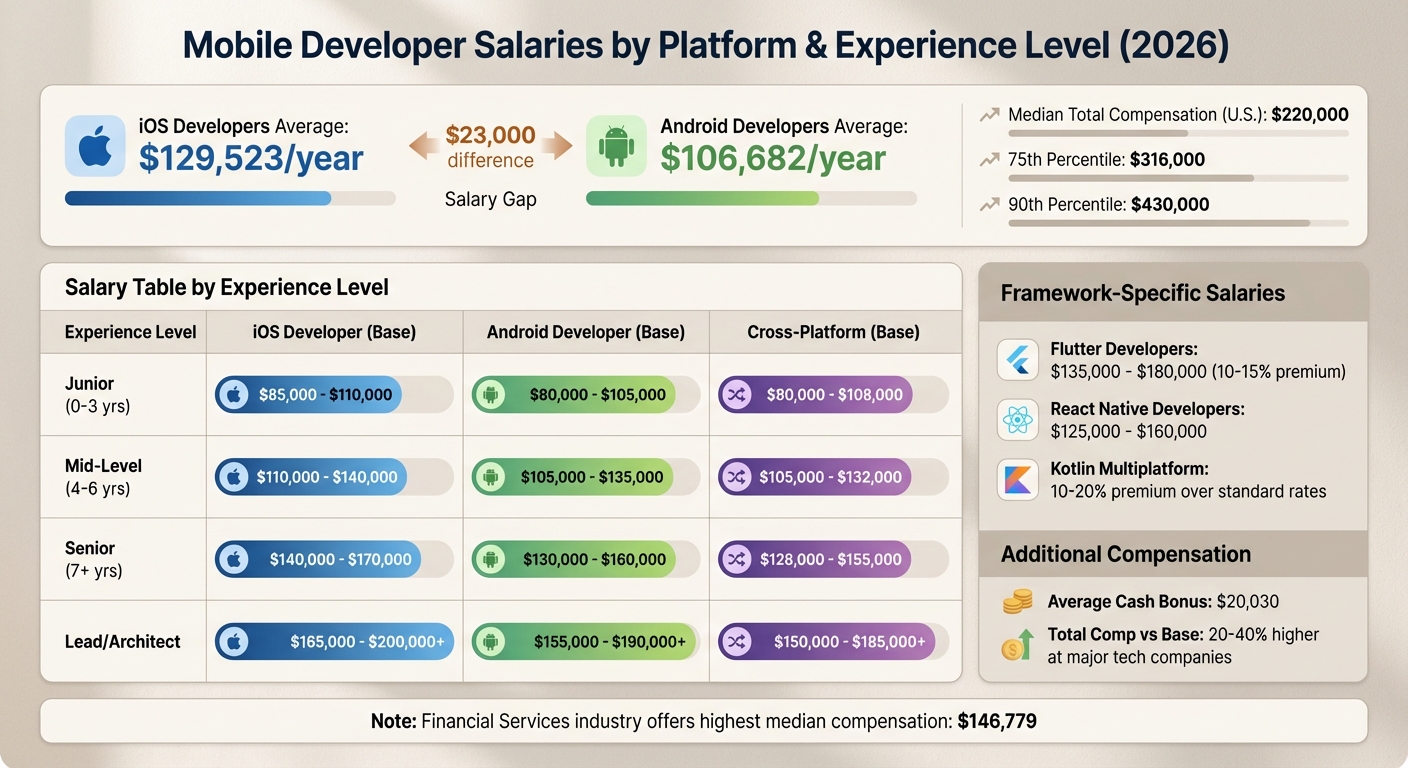
As of early 2026, iOS developers are earning an impressive average of $129,523 annually, while Android developers fall slightly behind at $106,682 - a difference of about $23,000 . Developers specializing in cross-platform frameworks typically fall between these two ranges, but salaries can vary depending on the framework in question. For instance, Flutter developers are in high demand, earning 10–15% more ($135,000–$180,000) than React Native developers ($125,000–$160,000) due to a shortage of Flutter talent .
Looking at the broader picture, the median total compensation for a Mobile Software Engineer in the U.S. climbs to $220,000 as of April 2026. For those at the top of their game, the 75th percentile reaches $316,000, while the 90th percentile soars to $430,000 .
Here’s a breakdown of base salaries by experience level:
| Experience Level | iOS Developer (Base) | Android Developer (Base) | Cross-Platform (Base) |
|---|---|---|---|
| Junior (0–3 yrs) | $85,000 – $110,000 | $80,000 – $105,000 | $80,000 – $108,000 |
| Mid-Level (4–6 yrs) | $110,000 – $140,000 | $105,000 – $135,000 | $105,000 – $132,000 |
| Senior (7+ yrs) | $140,000 – $170,000 | $130,000 – $160,000 | $128,000 – $155,000 |
| Lead / Architect | $165,000 – $200,000+ | $155,000 – $190,000+ | $150,000 – $185,000+ |
Source:
Location plays a huge role in salary differences. Cities like San Francisco, New York, Seattle, and Austin lead the way with the highest pay, while up-and-coming tech hubs such as Denver, Nashville, and Raleigh-Durham are quickly gaining traction . Among industries, Financial Services takes the top spot for mobile developer pay, with a median total compensation of $146,779 .
Building Competitive Compensation Packages
To attract and retain top mobile development talent, competitive offers must go beyond just the base salary. At major tech companies, total compensation packages - including equity and performance bonuses - can exceed base salaries by 20–40% . For example, Android developers often receive an additional average cash bonus of $20,030, a trend seen across most mobile specializations .
Flexibility with remote work has shifted from being a perk to a standard expectation. Companies that offer fully remote or flexible arrangements fill positions 40% faster and experience 23% higher retention rates . In fact, 83% of software professionals now consider remote work a top priority when weighing job offers .
Investing in professional development also pays off. Allocating $1,000–$2,000 annually per engineer for certifications or conferences has been linked to a 24% increase in retention rates . Similarly, providing a one-time home office stipend of $500–$1,200 for ergonomic equipment can boost productivity by 17% . For native development, budgeting $3,500–$6,000 for high-end Macs is a smart investment .
To stay competitive, companies should benchmark salaries quarterly using real-time data from platforms like Levels.fyi or Glassdoor . Avoid applying uniform merit increases across the board. Instead, focus on rewarding high performers and those in high-demand roles with targeted raises. For 2026, average merit increase budgets are projected at 3.2%, with remote workers seeing slightly smaller increases (3.6%) compared to the overall average (4.0%) .
How to Interview Mobile Developers
Portfolio Reviews and Live Coding Sessions
When evaluating mobile developers, start by testing their published apps on actual devices. This gives you a feel for the app's user interface, performance, and how well it handles errors. It's a practical way to assess their work beyond just reading a resume . Look for candidates with at least three published apps, as this demonstrates hands-on experience .
During portfolio reviews, ask the candidate to walk you through specific sections of code from a previous project. Focus on their individual contributions and the decisions they made, including trade-offs. This approach resonates with many developers - 75% of candidates prefer discussing real-world projects over abstract technical questions .
For live coding sessions, keep them concise - around 60 minutes. Focus on tasks that reflect actual mobile development, like implementing infinite scrolling, managing offline data, or handling platform-specific UI quirks. Avoid generic puzzles that don’t relate to day-to-day mobile development . If you assign a take-home project, provide a starter template (e.g., Expo or Bare workflow) to save candidates the hassle of setting up an environment .
The goal here is to gauge how well candidates can tackle real-world mobile challenges and their ability to architect solutions effectively.
System Design and Architecture Questions
Once you've reviewed their app work, dig deeper into their architectural skills. System design questions should focus on mobile-specific challenges, not abstract theory. For example, ask about design patterns like MVC, MVVM, or MVP - 68% of successful candidates are familiar with these frameworks . You can also explore how they manage state during lifecycle changes, such as app backgrounding or termination, or how they decide between native and cross-platform solutions for different business needs .
Instead of "build from scratch" exercises, consider debugging challenges. A 30-minute session where the candidate diagnoses a crash log or solves a performance issue in an existing codebase can reveal a lot about their problem-solving skills . Another option is a 45-minute code review exercise using your team’s actual codebase. This helps you assess their ability to provide constructive feedback and navigate existing architectures .
Respecting Developers' Time
While technical assessments are vital, it’s equally important to respect candidates’ time. Avoid lengthy, weekend-consuming projects. Instead, keep technical tests under two hours to avoid discouraging strong candidates who may have multiple offers . It's worth noting that 42% of developers spend over 20% of their time debugging, so practical debugging exercises can feel relevant and familiar .
Mobile developers value interview processes that acknowledge their expertise and focus on real-world scenarios. Keeping assessments brief and practical not only respects their time but also helps you stand out in a competitive hiring market. Developers skilled in solving real-world coding challenges are 50% more likely to land a job .
Common Hiring Mistakes to Avoid
In a competitive market where mobile developers prioritize efficiency and respect for their craft, steering clear of common hiring mistakes is crucial. These errors can directly affect both your hiring timeline and the quality of your app.
Focusing Only on Framework Experience
Evaluating candidates solely on their years of experience with Swift or Kotlin can be misleading. A developer with three years of experience using modern practices often outperforms someone with seven years stuck in outdated methods. By focusing too much on framework experience, you risk missing what truly matters: the "mobile mindset." This mindset prioritizes user-focused problem solving, performance awareness, and the ability to adapt when business needs evolve .
"The reason your mobile hiring process fails isn't because you're not asking the right Swift questions. It's because you're solving the wrong problem entirely." - Full Scale
Here's a real-world example: a fintech company spent 16 weeks searching for native specialists based purely on framework experience. After one hire left within three months, they shifted their focus to problem-solving and user-first skills. This adjustment allowed them to fill positions in six weeks and launch their app ahead of schedule .
Don’t mistake web development experience for mobile expertise. For instance, assuming React web developers can seamlessly transition to React Native overlooks the specialized knowledge required for mobile development. Key skills like writing custom Swift or Kotlin bridges for native modules are critical, and developers with this expertise often command a 15% to 20% higher salary than those limited to managed workflows like Expo .
While technical skills are important, they’re not the only factor. A developer’s ability to integrate with your team is just as vital.
Overlooking Team Fit
Once technical skills have been assessed, it’s essential to evaluate how well a candidate will fit within your team. Technical expertise won’t matter if a developer struggles to collaborate effectively. For example, "platform purists" who insist that one approach is superior often over-engineer solutions, creating friction when pragmatic compromises are needed . Similarly, hiring someone with excellent framework knowledge but no experience shipping production-ready apps can lead to major setbacks .
Be mindful of warning signs like "the desktop mindset" (treating mobile like a scaled-down web page) or "perfectionist paralysis" (delaying releases to achieve perfection across all devices) . Instead, look for positive indicators. Developers who ask questions like "How does this affect retention?" show they understand business impact, while those who consider factors like battery life and data usage demonstrate empathy for users .
How candidates approach testing can also reveal their team compatibility. For example, relying solely on simulators during testing may indicate a lack of attention to platform-specific bugs and performance issues that could frustrate users . A practical way to assess fit is through a 45-minute code review session using your team’s actual codebase. This often provides deeper insights into a candidate’s communication style and architectural thinking than a lengthy take-home assignment .
How daily.dev Recruiter Helps You Hire Mobile Developers
daily.dev Recruiter takes mobile hiring to the next level by focusing on respectful, targeted outreach. It connects you with mobile developers where they’re already active - engaging with technical content and staying updated on industry trends. The result? A hiring process that’s both effective and considerate.
Using Developer Activity and Stack Preferences
The platform pinpoints relevant mobile developers by analyzing their real-time engagement with technical topics and tools. For instance, if a developer is consistently reading about Flutter performance tweaks, React Native architecture, or Swift concurrency, it’s a clear signal of their expertise and interests. Looking for a React Native developer? You’ll find candidates already immersed in that stack. Need an iOS engineer? The platform connects you with developers exploring SwiftUI. The same applies for Android specialists diving into Kotlin Multiplatform.
Double Opt-In Introductions
daily.dev Recruiter ensures every introduction is double opt-in, meaning developers review your job brief before deciding to engage. This approach respects their time and guarantees that your conversations are with candidates who are genuinely interested in your role.
Instead of sending out countless unsolicited messages and hoping for replies, you’ll only connect with developers who have already shown interest in your opportunity. This leads to focused, productive conversations that move your hiring process forward efficiently.
Conclusion
Hiring mobile developers in 2026 will require moving beyond outdated approaches and embracing strategies that align with modern needs. Focus on a "Mobile Mindset" that prioritizes user-centric design, cross-platform flexibility, and performance-driven insights, rather than simply evaluating candidates based on years of experience with Swift or Kotlin . Start by determining your technology stack - whether it’s native iOS and Android or cross-platform frameworks like Flutter and React Native - since each requires distinct expertise .
Streamlined and respectful hiring processes are key. Long, weekend-spanning app builds should be replaced with targeted assessments, such as 30-minute debugging tasks that reflect real-world production challenges . If you require more extensive take-home projects, ensure candidates are compensated and have a proven history of delivering and maintaining apps on platforms like the App Store or Google Play.
Cross-platform talent offers growing potential, with frameworks like Flutter now utilized by 46% of developers worldwide . Kotlin Multiplatform has also emerged as a strong option for enterprises, enabling shared business logic while maintaining native UI. However, hiring these developers often comes with a 10–20% higher salary expectation . Despite this, they can significantly reduce development costs by 10–15% and speed up time-to-market .
With the mobile app market expected to hit $626 billion by 2030 and 68% of enterprise mobile initiatives delayed due to talent shortages , the stakes are high. Traditional hiring methods already take an average of 74 days to fill senior roles . Companies that adapt by valuing production experience, framework-specific expertise, and efficient, respectful interview practices will have a competitive edge in securing top talent while others fall behind.
FAQs
Should I hire native or cross-platform developers?
Deciding whether to hire native developers or cross-platform developers comes down to the needs of your project.
If you're building a high-performance app - think augmented reality (AR) applications or financial tools - native developers are the way to go. These specialists use platform-specific languages like Swift for iOS or Kotlin for Android, ensuring the app runs smoothly and takes full advantage of the device’s capabilities.
On the other hand, cross-platform developers work with frameworks like React Native, Flutter, or Kotlin Multiplatform to create apps that function on both iOS and Android. This approach saves time and money, making it a great option for faster deployment. However, cross-platform solutions might encounter some hardware or performance limitations compared to native apps.
Your choice should depend on factors like the app's complexity, performance requirements, and your target audience.
How can I verify real production mobile experience?
To assess real-world mobile development experience, find out if candidates have successfully launched and maintained live apps on the App Store or Play Store. Look for direct involvement in tasks like app store submissions, regular updates, and performance improvements. This demonstrates they’ve handled the complexities of live app management, setting them apart from those with only academic or small-scale project experience.
What’s the fastest fair way to interview mobile developers?
The quickest and most balanced approach to interviewing mobile developers is by using a structured process that prioritizes practical, hands-on experience. This means focusing on a few key areas:
- Technical screenings: Test candidates on relevant frameworks like React Native, Flutter, Swift, or Kotlin to ensure they have the right skills for the job.
- Portfolio reviews: Dive into their past work to see examples of live apps they've shipped and the challenges they've tackled.
- Live coding tasks: Use exercises that mimic real-world scenarios to evaluate their problem-solving and decision-making skills.
Avoid asking candidates to spend their weekends building apps for tests - this can often be unfair and unproductive. Instead, focus on assessing how well they can handle tasks like making architecture decisions, solving complex problems, and delivering functional, live applications. This approach not only respects their time but also gives you a clearer picture of their capabilities.
.png)