Hiring software developers can be challenging, especially if you lack a technical background. Here's a quick guide to help you navigate the process:
- Understand developer roles: Learn the differences between frontend, backend, full-stack, and DevOps roles, including their tools, languages, and responsibilities.
- Build basic technical knowledge: Familiarize yourself with key terms like APIs, CI/CD, and databases (SQL vs. NoSQL) to communicate effectively with candidates and engineering leads.
- Collaborate with engineering leads: Work closely with technical teams to define job requirements, evaluate candidates, and create clear scoring rubrics.
- Write clear job descriptions: Be specific about the tech stack, responsibilities, salary, and growth opportunities to attract qualified candidates.
- Evaluate candidates effectively: Review GitHub portfolios for project quality, use top developer assessment tools, and assess both technical and communication skills during interviews.
Developer Roles and What They Do
::: @figure 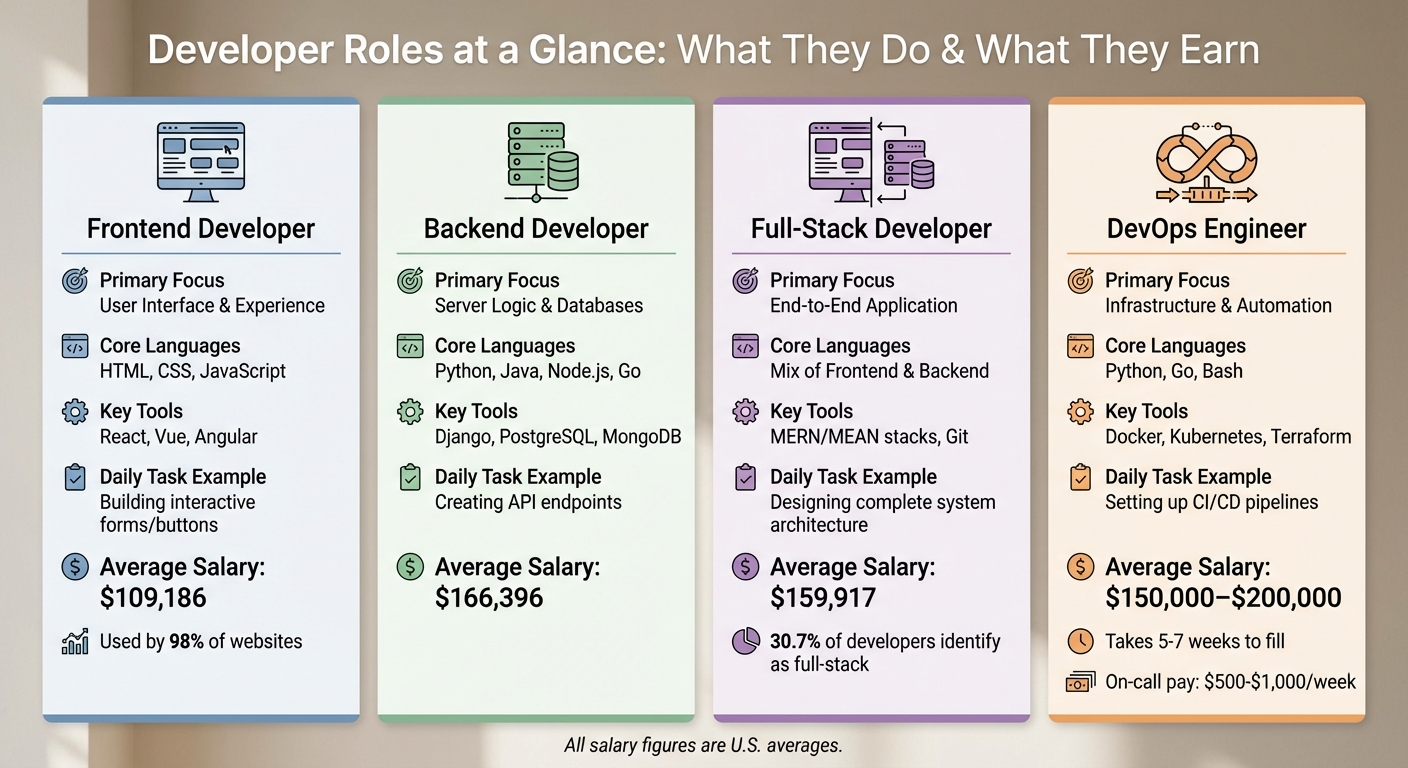 {Software Developer Roles Comparison: Responsibilities, Tech Stack, and Salaries}
Understanding the various developer roles sheds light on how each contributes to building functional and efficient applications.
Frontend, Backend, and Full-Stack Developers
Frontend developers are responsible for creating the parts of a website or app that users interact with directly. They take design prototypes and turn them into functional code, ensuring that buttons work, forms validate inputs, and layouts adjust smoothly across devices. Their toolkit typically includes HTML, CSS, and JavaScript - used by nearly 98% of websites on the client side . Frameworks like React, Vue, and Angular are common in their workflow. On average, frontend developers earn about $109,186 annually .
Backend developers focus on the "behind-the-scenes" work, managing the server-side operations that support the frontend. They design APIs to move data between the server and browser, handle database management, secure APIs, and manage user authentication. While frontend developers prioritize user interfaces, backend developers deal with the logic and data that power those interfaces. They often work with Python, Java, Node.js, or Go, and use databases like PostgreSQL or MongoDB. The average salary for a backend developer is approximately $166,396 per year .
Full-stack developers combine the skills of both frontend and backend developers, enabling them to work on every layer of an application. They can handle tasks ranging from creating user interfaces to managing databases. About 30.7% of developers identify as full-stack, with an average salary of $159,917 annually . However, as teams grow, companies often prefer specialists over generalists due to the complexity of modern applications .
Next, let’s look at how DevOps engineers ensure smooth operations and deployments.
DevOps Engineers
DevOps engineers act as a link between development and operations, ensuring that code transitions seamlessly from development to production. They automate deployments, manage cloud infrastructure (like AWS or Google Cloud), and set up CI/CD pipelines to enable quick and secure code releases. They also monitor production systems to prevent outages. Tools like Docker and Kubernetes are vital for managing containerized applications. This role emphasizes shared accountability for maintaining production environments .
Due to their specialized expertise, DevOps roles typically take 5–7 weeks to fill . In the U.S., senior DevOps engineers earn between $150,000 and $200,000 annually, with additional on-call pay ranging from $500 to $1,000 per week . A newer trend in this field is platform engineering, where DevOps teams create internal tools to streamline deployment processes and enhance developer independence .
Developer Role Comparison Table
| Role | Primary Focus | Core Languages | Key Tools | Daily Task Example | Average Salary (US) |
|---|---|---|---|---|---|
| Frontend | User Interface & Experience | HTML, CSS, JavaScript | React, Vue, Angular | Building interactive forms/buttons | $109,186 |
| Backend | Server Logic & Databases | Python, Java, Node.js, Go | Django, PostgreSQL, MongoDB | Creating API endpoints | $166,396 |
| Full-Stack | End-to-End Application | Mix of Frontend & Backend | MERN/MEAN stacks, Git | Designing complete system architecture | $159,917 |
| DevOps | Infrastructure & Automation | Python, Go, Bash | Docker, Kubernetes, Terraform | Setting up CI/CD pipelines | $150,000–$200,000 |
These distinctions help hiring teams craft impactful job descriptions and evaluate candidates effectively. Using a developer hiring checklist can further streamline this process.
Hiring engineers?
Connect with developers where they actually hang out. No cold outreach, just real conversations.
How to Build Technical Knowledge as a Recruiter
You don’t need to be a software engineer to recruit one effectively, but having a basic understanding of technical concepts can make a significant difference. With software developer jobs expected to grow by 16% between 2024 and 2034 - much faster than the 3% average for all occupations - and 95% of employers saying it's harder to find qualified candidates now than it was three years ago, technical know-how has become more important than ever .
Technical Terms You Need to Know
Understanding some key technical terms can boost your confidence when assessing developer skills. Here’s a quick breakdown:
- Programming languages: These are the core tools developers use to write instructions for computers. Common examples include Python, JavaScript, Java, and Go.
- Frameworks: These offer pre-built templates to help applications scale effectively, such as React for frontend development or Django for backend systems.
- Libraries: Think of these as prepackaged toolkits that simplify coding tasks. Popular examples include jQuery and NumPy .
It’s also helpful to know the difference between frontend, backend, and full-stack development. Frontend focuses on the visual interface users interact with, backend handles the system’s logic and data processing, and full-stack combines both .
For more advanced roles, you’ll encounter terms like CI/CD (Continuous Integration/Continuous Deployment), which refers to automated systems for testing and deploying code efficiently. Microservices describe a way of building applications as smaller, independent services rather than one large system. Tools like Git allow developers to track and manage changes to their code .
When it comes to databases, you’ll want to recognize the difference between SQL databases (structured, like PostgreSQL) and NoSQL databases (flexible, non-tabular, like MongoDB) .
Looking ahead, fluency in AI tools will become increasingly relevant. By 2026, many companies will expect developers to use tools like GitHub Copilot or Cursor to enhance productivity while maintaining the ability to identify and address errors .
With these terms in your arsenal, you’ll be better equipped to collaborate effectively with engineering teams.
Working with Engineering Leads
Once you’ve built a foundation of technical knowledge, working closely with engineering leads can elevate your hiring process. Not only does technical fluency help you evaluate candidates more effectively, but it also fosters trust with technical teams.
Start by drafting a clear hiring brief that outlines the role, technical requirements, and compensation. This document ensures everyone is on the same page and helps avoid "scope creep", which can contribute to the already lengthy 43-day average time-to-hire for software engineers .
When speaking with candidates, try the "Explain to Me" method. Ask them to break down their work and technical decisions in simple terms. If they struggle to explain complex concepts in an accessible way, it could signal potential communication challenges .
When reviewing resumes with engineering leads, focus on measurable impact rather than just a list of technologies. For example, look for statements like "improved API response time by 40%" or evidence of increasing responsibility and familiarity with relevant tech stacks .
Finally, understanding salary benchmarks can help set realistic expectations. Here’s a general guide:
- Junior developers (0–2 years): $75,000–$120,000
- Mid-level developers (2–5 years): $105,000–$165,000
- Senior developers (5+ years): $155,000–$220,000
Writing Job Descriptions That Attract Developers
A well-crafted job description is key to drawing in top developer talent. On average, job seekers spend only 14 seconds skimming a job post before deciding whether to explore further . Including a salary range alone can boost click-through rates by 75%, and specifying the technology in the job title can increase application rates by around 25% .
Use a conversational and approachable tone. Phrases like "we" and "you" can make the post feel more personal and engaging . Avoid trendy buzzwords like "rockstar" or "ninja", as these can come across as disconnected from developers' professional culture . Instead, focus on technical details, clarity, and signals about your work environment that help candidates decide if the role suits them. This approach aligns your technical needs with candidates' expectations.
What to Include in a Developer Job Description
Be Specific About the Tech Stack
Start by listing the exact tools and technologies your team uses. For example, instead of saying "modern JavaScript", be precise: React 18, Node.js 20, AWS Lambda, PostgreSQL 15 . Developers want to know exactly what they'll be working with from the outset.
Describe the Development Environment
Paint a clear picture of your team's workflow. Share details like deployment frequency, code review practices, and testing approaches. If you use Agile or Scrum, mention it, and include specifics like, "We deploy to production 3–5 times per week using CI/CD pipelines" . This gives candidates a sense of your team's pace and processes. It's also a good time to consider questions about their career values to ensure long-term alignment.
Focus on Outcome-Oriented Responsibilities
Define responsibilities in terms of impact. Replace vague phrases like "write clean code" with actionable goals such as "improve API response time and reduce database query load for 2 million monthly active users" . Developers want to see the tangible outcomes of their work.
Highlight Growth Opportunities
A "Where You'll Grow" section shows candidates that your company values professional development . Mention perks like education budgets, tech talks, or time for open-source contributions. Since 66% of candidates say company culture heavily influences their decision to accept a job, this can make a big difference .
Be Transparent About Pay and Process
Include a salary range and outline the interview process, complete with timelines. This demonstrates respect for candidates' time and sets clear expectations. Additionally, define success benchmarks for the first 30, 60, and 90 days to give candidates a clear roadmap for the role .
Encourage Self-Selection
Use phrasing that helps candidates evaluate their fit. For example, "humble leadership and support" appeals to team players, while "you don't mind a little bit of chaos" attracts those comfortable in fast-paced environments . As Software Architect Sean Killeen puts it:
"The art of a good job post is candidate self-selection. I want to inspire candidates who would be a great fit to self-select in the role, and I want candidates who wouldn't be a fit to self-select out."
Keep It Short and Scannable
Concise writing matters. Comprehension drops from 100% for sentences with 8 words to just 10% for sentences with 43 words . Use bullet points sparingly, keep paragraphs brief, and avoid gendered language like "assertive" or "competitive", which can discourage applications from women .
Job Description Templates by Role
Here are templates for common developer roles. Tailor the tech stack, responsibilities, and growth sections to fit your team's needs.
Frontend Developer
About the Role
We're seeking a Frontend Developer to create responsive, accessible web apps for our 500,000+ monthly users. You'll collaborate with design and product teams to release features 2–3 times weekly.
Tech Stack
- React 18, TypeScript 5.0, Next.js 14
- Tailwind CSS, Storybook
- Jest, React Testing Library
- GitHub Actions for CI/CD
What You'll Do
- Build and maintain user-facing features that cut page load time by 30%+
- Collaborate with designers to create accessible, user-friendly interfaces
- Write automated tests to maintain 80%+ code coverage
- Participate in code reviews and mentor junior developers
Where You'll Grow
- $2,000 annual education budget and monthly tech talks with industry experts
- Opportunity to lead frontend architecture decisions within 12 months
Compensation & Process
- Salary: $105,000–$145,000
- Interview process: 30-minute recruiter call → 60-minute technical screen → 3-hour onsite (2 technical, 1 behavioral interview) → offer within 5 business days
Backend Developer
About the Role
Join our backend team to build scalable APIs and microservices that power our platform's core features. You'll manage services handling over 10 million requests daily.
Tech Stack
- Node.js 20, Python 3.11, Go 1.21
- PostgreSQL 15, Redis, RabbitMQ
- Docker, Kubernetes, AWS (Lambda, RDS, S3)
- GitHub, Jenkins for CI/CD
What You'll Do
- Design and implement RESTful APIs and GraphQL endpoints
- Optimize database queries to reduce response time by 40%+
- Build and maintain microservices with 99.9% uptime
- Collaborate with frontend and DevOps teams on system architecture
Where You'll Grow
- Pair programming with senior engineers twice weekly
- Ownership of a microservice within your first six months and a clear path to senior engineer
Compensation & Process
- Salary: $115,000–$155,000
- Interview process: 30-minute recruiter call → 90-minute technical screen (live coding + system design) → 4-hour onsite → offer within 5 business days
Full-Stack Developer
About the Role
We’re looking for a Full-Stack Developer comfortable working across the entire stack - from database design to user interface. You'll deliver end-to-end features that shape our product roadmap.
Tech Stack
- Frontend: React 18, TypeScript, Next.js 14
- Backend: Node.js 20, Express, GraphQL
- Database: PostgreSQL 15, MongoDB
- Infrastructure: AWS, Docker, GitHub Actions
What You'll Do
- Build complete features from database schema to UI components
- Improve application performance across frontend and backend
- Collaborate with product managers to define technical requirements
- Participate in on-call rotation (1 week every 6 weeks, with comp time)
Where You'll Grow
- Exposure to both frontend and backend architecture decisions with mentorship from specialized engineers
- Flexibility to specialize or stay generalist based on your interests
Compensation & Process
- Salary: $110,000–$160,000
- Interview process: 30-minute recruiter call → 90-minute technical screen (full-stack coding challenge) → 3-hour onsite (frontend + backend + system design) → offer within 5 business days
DevOps Engineer
About the Role
We’re hiring a DevOps Engineer to enhance our deployment pipeline, infrastructure reliability, and developer experience. You'll work with engineering teams to automate workflows and maintain 99.95% uptime.
Tech Stack
- AWS (EC2, ECS, Lambda, RDS, CloudFormation)
- Kubernetes, Docker, Terraform
- Jenkins, GitHub Actions, ArgoCD
- Prometheus, Grafana, ELK Stack
What You'll Do
- Build and maintain CI/CD pipelines that deploy code 20+ times daily
- Automate infrastructure provisioning and configuration management
- Monitor system performance and respond to incidents (on-call rotation)
- Improve developer tooling to cut deployment time by 50%+
Where You'll Grow
- Lead infrastructure projects within your first year
- $2,500 annual budget for certifications (AWS, Kubernetes, etc.) and opportunities to mentor developers on DevOps best practices
Compensation & Process
- Salary: $120,000–$170,000
- Interview process: 30-minute recruiter call → 90-minute technical screen (infrastructure design + troubleshooting) → 3-hour onsite (system design + behavioral) → offer within 5 business days
Finding and Evaluating Developer Candidates
Once you’ve nailed down your job description, the next step is finding qualified developers and assessing their skills. This can feel overwhelming, especially for non-technical recruiters, but focusing on portfolio work, collaboration habits, and contribution patterns can help you gauge a candidate's technical abilities and work ethic.
How to Review GitHub Portfolios
GitHub is like a developer's portfolio on display, showcasing their work, contributions, and coding habits. Even if you don’t have a technical background, there are clear signs you can look for to evaluate their skills and professionalism.
Start with Pinned Repositories
The pinned repositories at the top of a profile often represent a developer’s best work. Focus on original projects rather than forked ones, as forks are frequently used for experimentation or learning.
The README Signal
A well-written README file is a goldmine for recruiters. It shows how effectively a developer can document their work and explain technical details. Look for READMEs that include an overview, a list of technologies used, installation instructions, and even architecture diagrams. Strong documentation reflects solid communication skills.
Check for Consistency and Recent Activity
The commit history can tell you a lot about a developer’s dedication. Regular, recent commits suggest they’re actively honing their skills, while long periods of inactivity might raise questions about their current expertise.
Look for Community Validation
Projects with 20+ stars or forks often indicate that the developer’s work has practical value or is recognized within the community. This can be a good indicator of their relevance in the field.
Examine Collaboration Evidence
Dive into pull requests and issue threads to see how the developer interacts with others. Frequent contributions, thoughtful feedback, and active participation in community projects signal strong teamwork skills.
Red Flags to Watch For
Empty profiles, repositories with only boilerplate code, or profiles with prolonged inactivity are potential warning signs.
| GitHub Indicator | What It Reveals to Recruiters |
|---|---|
| Commit Frequency | Work ethic and consistency |
| Code Quality | Readability, maintainability, and discipline |
| Documentation | Communication skills and code accessibility |
| Stars and Forks | Community recognition and project impact |
| Pull Request Comments | Teamwork and feedback responsiveness |
While GitHub portfolios provide insight into practical skills and collaboration, coding tests offer a more structured way to evaluate technical abilities.
Using Coding Tests to Assess Skills
Coding tests are a great way to objectively measure a developer’s problem-solving skills. They complement portfolio reviews and interviews, giving you a clearer picture of how candidates might handle real challenges.
Keep Tests Relevant and Realistic
Tailor tests to reflect the actual work the candidate would be doing. For instance, if the role involves API development, ask them to design a simple RESTful endpoint. Avoid abstract puzzles unless they’re directly tied to the job.
Set Clear Expectations
Let candidates know how long the test should take (ideally 1–3 hours), what tools they can use, and how their performance will be evaluated. Clear guidelines help keep the process focused and fair.
Partner with Engineering Leads
Work with your engineering team to design and review the tests. Their input ensures the challenges are aligned with the role’s requirements and accurately assess the candidate’s technical skills.
Sourcing Developers Through daily.dev Recruiter
Finding the right developers isn’t just about evaluating their skills - it’s also about reaching the right talent pool. daily.dev Recruiter connects you with pre-qualified developers through a unique, opt-in approach.
How It Works
Your job brief is integrated directly into the daily.dev platform, where it’s seen by developers actively engaged in learning and professional development. Interested candidates can opt in to connect with you, ensuring you’re only speaking with those genuinely interested in the opportunity.
High-Context, High-Intent Matches
Developers review your job brief on their own terms, gaining a clear understanding of the role and tech stack. This creates a trust-driven process, eliminating the need for outdated profiles or unsolicited outreach.
Pre-Qualified and Passive Talent
The platform gives you access to a global network of developers who aren’t actively job hunting but are open to the right opportunity. This allows you to screen candidates against specific criteria with greater precision.
Seamless Integration
daily.dev Recruiter integrates with your existing ATS and sourcing tools, making it easy to manage candidates and focus on building relationships. With straightforward pricing and a user-friendly interface, you can spend less time chasing leads and more time connecting with top talent.
Running Effective Developer Interviews
The interview phase goes beyond just evaluating technical abilities - it’s about assessing both technical expertise and soft skills to ensure a well-rounded hire. To make this process effective, it's important to structure interviews so that every team member knows their role and candidates are evaluated fairly.
Technical Screening with Engineering Partners
Engineering leads typically handle the technical evaluation, using methods like live coding exercises, architecture discussions, or in-depth project walkthroughs. As a recruiter, your job is to keep the process running smoothly. This includes scheduling interviews, briefing the engineering team on what to assess, and ensuring feedback is submitted independently before any group discussion. Independent feedback is key to avoiding bias during evaluations.
Research shows that structured interviews are far more reliable than unstructured ones. They have a predictive validity coefficient of 0.51 compared to just 0.20–0.38 for "gut feeling" interviews . To improve consistency, collaborate with your engineering team to create clear scoring rubrics. Define what "Strong", "Meets Bar", and "No Hire" mean for each competency, so everyone evaluates candidates using the same standards .
While technical skills are critical, assessing communication and teamwork abilities is just as important.
Evaluating Soft Skills and Team Fit
Soft skills like communication, adaptability, and conflict resolution often determine how well a developer integrates into a team. Use the STAR method (Situation, Task, Action, Result) to ask specific developer soft skills questions about past challenges. For instance: "Tell me about a time you disagreed with a teammate on a technical decision. What was the situation, what did you do, and what was the outcome?" This approach helps you understand how they solve problems and handle interpersonal dynamics .
Pay attention to red flags, such as candidates who struggle to explain their past work, blame others for failures, or give vague answers about technical details . On the other hand, strong candidates can clearly articulate their contributions, take responsibility for mistakes, and show curiosity about your team’s challenges.
Next, shift the focus from generic resume keywords to a deeper exploration of their actual work.
Discussing Portfolio Work Instead of Resume Keywords
Skip the buzzwords and dive into real projects. Instead of asking, "How good are you with React?" ask candidates to walk through a specific piece of code they’ve written. Have them explain the problem they solved, the decisions they made, and the measurable results. For example, they might describe how they reduced API response times from 2 seconds to 500 milliseconds .
Look for signs that they’ve delivered real results, such as shipping production systems or working with a tech stack that matches your team’s needs. Candidates who can discuss trade-offs and decisions in detail often provide a much clearer sense of their abilities than any list of programming languages on a resume .
Conclusion
To pull everything together, start by aligning your hiring strategy with the specific expertise your team needs. Build a basic understanding of technical concepts like API, Git, and CI/CD. Partner with engineering leads to conduct technical assessments, while you focus on identifying candidates with strong communication skills, a sense of ownership, and alignment with your team’s values.
Use tools like portfolio reviews and technical screenings to evaluate candidates effectively. Instead of relying on flashy resume language, dig into their GitHub portfolios, apply coding tests for scalable screening, and ask behavioral questions to uncover their problem-solving and teamwork abilities.
Make sure your job descriptions are clear and detailed. Include the tech stack, specific responsibilities, and competitive salary ranges (e.g., $120,000–$160,000 for full-stack roles). For sourcing, consider platforms like daily.dev Recruiter, which can connect you with qualified talent through warm, double opt-in introductions. This approach has been shown to cut time-to-hire by 30–50% compared to traditional methods .
Collaboration is key. Work closely with your engineering team to create clear scoring rubrics and standardized screening processes. This ensures hiring decisions are grounded in data. Track important metrics like response rates, candidate quality, and retention to continuously improve your process. By following these strategies, non-technical recruiters can confidently attract top developer talent and build teams that propel your organization forward.
FAQs
How do I pick the right developer role to hire?
Selecting the right developer role starts with pinpointing your project's main requirements. Are you focusing on crafting user-friendly interfaces, handling server-side operations, or streamlining deployment processes? Each of these tasks aligns with a specific role:
- Front-End Developers: They specialize in building user interfaces and typically work with tools like HTML, CSS, and JavaScript to bring designs to life.
- Back-End Developers: These developers focus on server-side logic, working with programming languages that manage databases and application functionality.
- DevOps Engineers: Their expertise lies in deployment and automation, using tools to ensure smooth integration and delivery pipelines.
To make the best choice, collaborate with engineering leads to match the role to your project's objectives and the technologies in your stack. This ensures your team is equipped to meet your goals effectively.
What should I check on a GitHub profile?
When you're looking at a GitHub profile, here are some key things to keep an eye on:
- Commit activity: Frequent commits indicate steady involvement and dedication to coding.
- Code quality: Assess how clear and well-organized the code is, along with the use of meaningful comments.
- Open-source contributions: Contributions to open-source projects highlight teamwork and the ability to tackle real-world problems.
- Projects: Explore the repositories to see a variety of work and how relevant it is to the skills you're evaluating.
- Community recognition: Metrics like stars and followers can hint at the developer's influence and reputation within the coding community.
These factors give you a solid glimpse into someone's technical abilities and their potential for growth.
How do I run fair, structured developer interviews?
To ensure developer interviews are fair and well-organized, start by establishing clear evaluation criteria. Use the same set of questions for all candidates, and rely on an objective scoring system to evaluate their responses. Be upfront with candidates about the evaluation process - this builds trust and transparency.
It's also important to assess both technical skills (like coding and problem-solving) and soft skills (such as communication and teamwork). This gives you a more complete picture of each candidate's abilities. By following this structured approach, you can reduce bias, maintain consistency, and create a better overall experience for candidates.
.png)