Hiring developers for startups without a big-name brand is challenging but not impossible. Here's how you can compete with tech giants like Google or Meta:
- Focus on your startup's strengths: Highlight equity, growth opportunities, and direct impact instead of trying to outspend larger companies.
- Personalized outreach: Reference candidates' specific work (like GitHub projects) to stand out from generic recruiter messages.
- Leverage developer platforms: Use tools like daily.dev Recruiter to connect with developers in their natural spaces, ensuring higher engagement and trust.
- Streamlined hiring process: Keep evaluations short (2 weeks max) with practical tasks and founder involvement to attract and secure talent quickly.
- Effective onboarding: Help new hires feel connected early by setting clear goals, offering quick wins, and gathering feedback to refine the process.
Define What Makes Your Startup Different
Without the deep pockets of big tech, your startup has something they often can't offer: equity, direct impact, and fast-paced growth. The challenge is to identify what makes your business stand out and communicate those advantages clearly. Research shows that 69% of job seekers consider a company's mission and values when deciding where to work, while 83% of talent leaders say employer branding plays a major role in attracting top talent .
To start, craft your Employee Value Proposition (EVP) using the "4 P's" framework: People, Purpose, Place, and Product . Be upfront about your startup's current stage, runway, challenges, and goals. High-caliber candidates value honesty over vague promises. For example, if you're bootstrapped and profitable, emphasize that you offer "infinite runway" with no pressure to pivot from investors - a major selling point for seasoned engineers who want to avoid the burnout of VC-funded hypergrowth . The sections below highlight how to leverage these unique traits.
Show Your Mission and Impact
Your startup's purpose can be a powerful differentiator. Developers want to feel that their work makes a difference. Tie your product to a broader impact - whether it’s advancing sustainability, empowering communities financially, or driving innovation. This resonates especially with Millennials and Gen Z, who increasingly prioritize meaningful work over just a high paycheck . Highlight that every line of code directly shapes the product architecture and that developers will have direct access to founders - a level of influence and connection that large corporations simply can't provide .
Focus on Growth and Learning Opportunities
Startups offer something corporate environments rarely can: rapid career growth. At an early-stage startup, an Engineer #1 could realistically grow into a VP of Engineering role within three years . Frame your company as the ideal environment for fast skill-building and career advancement. Stress the autonomy developers will have to make technical decisions instead of just submitting proposals for approval . The best candidates aren’t chasing stability - they’re looking for opportunities to tackle complex challenges and build something meaningful from the ground up.
Provide Developer-Focused Benefits
Salary matters, but benefits tailored to developers can set your startup apart. Offer equity (typically 0.5% to 2.0% for senior roles) and be transparent about what those shares could realistically mean in an exit scenario . If you're bootstrapped, consider profit-sharing (10-25% of annual profits), which provides immediate financial rewards compared to uncertain future equity . Pair these with perks like remote work stipends, wellness and learning budgets, flexible schedules, and generous parental leave. These benefits, combined with a strong company culture, can make your startup a standout option - especially since 40% of professionals cite culture as a top factor when deciding to apply .
Write Personalized Messages That Build Trust
Personalized messaging is a powerful way for startups to compete with larger companies. Generic outreach often gets lost in the sea of templated messages, but personalized efforts can stand out. Developers, for instance, are bombarded with dozens of LinkedIn messages and emails every week, most of which go unanswered. To grab their attention, startups need to show genuine interest in their work. By referencing specific contributions or achievements, you demonstrate that you've done your research. This approach can boost open rates by 30–50% and improve reply rates by 20–40% compared to generic emails . personalization not only makes your message more compelling but also aligns seamlessly with what developers want from recruiters.
Reference Candidates' Work and Projects
Start by exploring candidates' profiles on platforms like GitHub, Stack Overflow, or their personal blogs. Look for recent commits, popular repositories, or insightful articles they've written. Then, craft your outreach around these findings. For example, you might say:
"I noticed your pull request on [specific GitHub repo] tackling scalability issues - great work!" or "Your blog post on React performance tips really caught my attention, especially as we're rethinking our frontend strategy."
By referencing specific contributions, you show that you value expertise beyond the resume . This not only establishes credibility but also signals that your outreach is intentional and well-informed.
Use Stories to Present Opportunities
Instead of listing job requirements, frame your opportunity as a story that highlights a real technical challenge. Stories make your startup more memorable and help developers picture the impact they could have. Use a simple three-part structure - challenge, solution, outcome - to illustrate the role's significance. For instance:
"During a recent user surge, we hit bottlenecks with our legacy code. Our lead developer refactored the system, improving performance by 300%. Based on your GitHub work in microservices, we think you'd thrive in solving similar challenges."
Keep these stories concise - three to five sentences - and tailored to the candidate's interests. One startup saw a 25% increase in response rates by using narrative-driven messages instead of generic ones . This kind of personalized engagement builds trust and sets the stage for leveraging developer platforms, paving the way for warm introductions in the next step. This approach is a cornerstone of learning how to hire in developer communities effectively.
Use Developer Platforms for Warm Introductions
Once you've tailored your outreach, the next step is to meet developers where they already spend their time. Developers often gather in communities where they learn, share knowledge, and stay updated. Reaching out in these familiar spaces feels natural, making warm introductions far more effective than traditional cold outreach. This is especially important for startups, which often need to rely on building genuine connections rather than leaning on brand recognition.
Why Warm Introductions Outperform Cold Emails
Cold emails and generic LinkedIn messages tend to get lost in the shuffle. Developers are bombarded with templated recruiting pitches every week, making it hard for your message to stand out. On the other hand, warm introductions come with built-in context and mutual interest. When a developer voluntarily engages with an opportunity, they're already signaling openness. This trust and intent make warm introductions eight times more effective, reducing time-to-hire by 40–60%. You avoid wasting time on uninterested candidates or sifting through irrelevant cold leads.
Instead of pitching an opportunity to someone who might not care, warm introductions connect you with developers who have already shown interest based on their skills and focus areas. This eliminates the "spammy" vibe and ensures every conversation starts with genuine curiosity. Platforms like daily.dev Recruiter are designed to facilitate these trust-based connections.
How daily.dev Recruiter Simplifies Warm Introductions
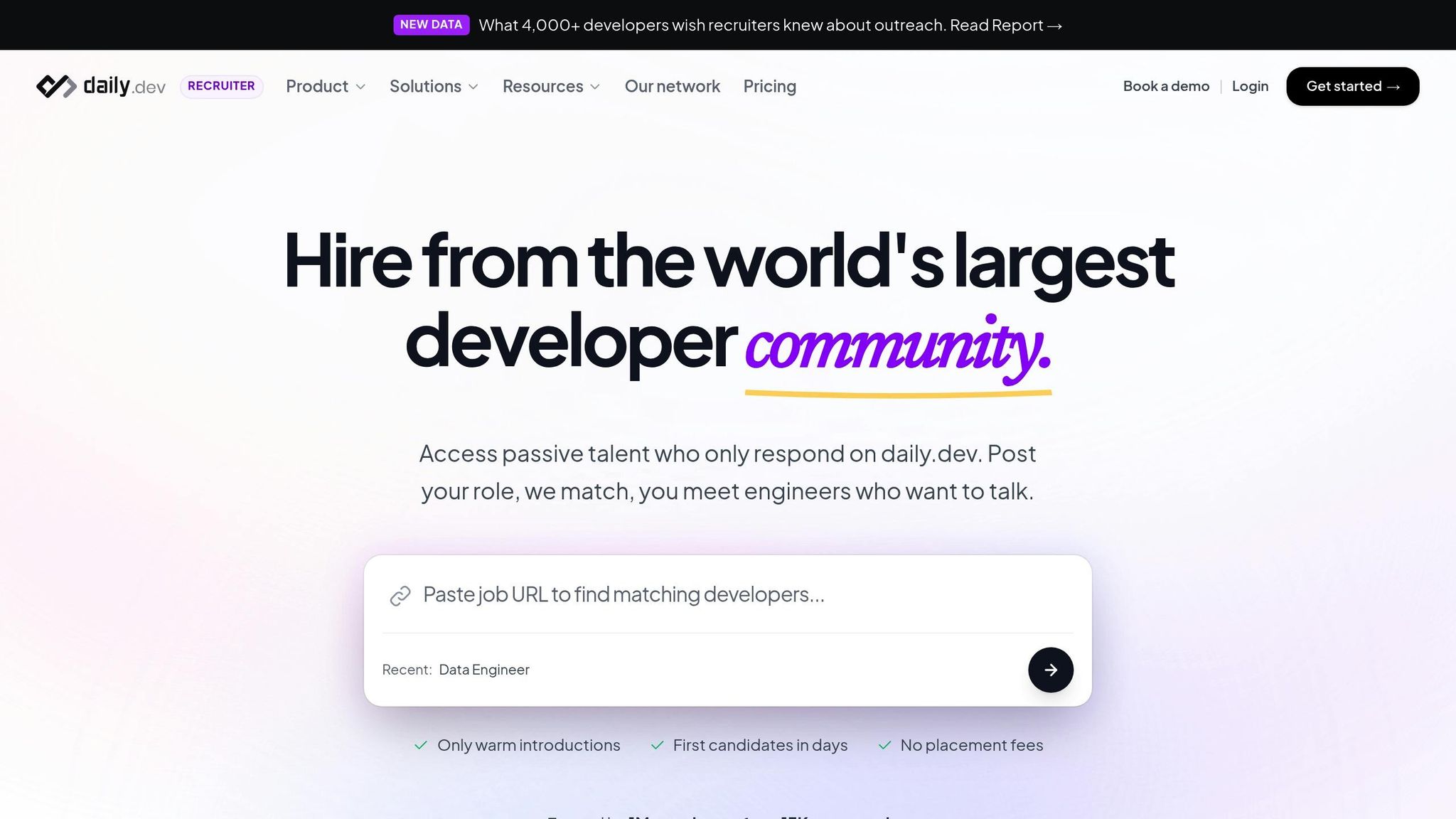
daily.dev Recruiter takes this approach to the next level by seamlessly integrating into developers' daily routines. Forget outdated resumes - this platform connects you directly with engaged developers as they browse articles, explore new technologies, and interact with content on daily.dev. With over 1 billion developer sessions hosted on the platform, it serves as a dynamic community rather than a static database.
Here’s how it works: You provide a role description, which is transformed into a developer-friendly brief. This brief is then privately pitched to relevant developers within their content feed, appearing naturally alongside the articles and resources they already consume. Developers who are interested answer a set of custom screening questions to confirm both technical fit and genuine interest. This double opt-in process ensures you're only speaking with candidates who are eager to engage.
The numbers are compelling. 90% of developers on daily.dev won’t respond to outreach anywhere else, and 40% of the talent pool consists of senior individual contributors or technical leaders. Even better, you’ll typically get your first qualified introductions within just a few days. Nimrod Kramer, CEO and Co-Founder of daily.dev, sums it up perfectly:
"We built a place where engineers can turn off the noise. To enter this space, you don't need a hack. You need trust".
For startups that lack brand recognition, this trust-based model levels the playing field, granting access to highly skilled, passive talent that even large corporations struggle to reach.
Create a Structured Evaluation Process
To hire effectively, especially as a startup, it's crucial to create a structured evaluation process that checks both technical skills and alignment with your company's mission. For startups that lack big-name recognition, aim to keep the hiring process within two weeks, with around 3–4 key interactions. This approach not only respects candidates' time but also reflects the fast-paced nature of startup culture.
Your process should balance technical evaluation with assessing how well a candidate fits into your team and vision. Start with a 15–30 minute screening call to understand their motivation and confirm they meet basic qualifications. By days 3–5, introduce a technical task that requires 2–4 hours of effort - something practical like building a simple API endpoint or optimizing a database query. These tasks are far more effective at showcasing problem-solving skills than abstract exercises like whiteboarding. If you're not technically inclined, tools like HackerRank can help you assess the results.
Finally, wrap up with a 30–45 minute conversation with a founder. This is your chance to evaluate their enthusiasm for your mission and their readiness to thrive in a startup environment. Use this time to ask questions like, "Can you share a project where you had to pivot significantly, and how did you handle it?" or "How do you balance speed with scalability when resources are tight?" These questions help uncover whether the candidate can navigate the fast-moving, unpredictable world of startups.
Test Technical Skills with Practical Tasks
When evaluating technical abilities, focus on tasks that mirror the actual work candidates will do at your startup. Assign a small, practical coding project that takes no more than 2–4 hours. For instance, you could ask them to contribute to a fork of an open-source repository or build a feature with specific constraints. This not only tests their problem-solving skills but also gives them a feel for the kind of work they’ll encounter.
Pair programming sessions (lasting 60–90 minutes) can further reveal how candidates approach collaboration, technical decisions, and feedback. For an even lighter initial screen, reviewing their GitHub contributions can provide insights into their technical skills and passion for coding.
Once technical skills are confirmed, shift your focus to cultural fit and their ability to thrive in a startup environment.
Check for Startup Mindset and Culture Alignment
While technical skills are essential, a startup-ready mindset often determines long-term success. Startups need more than employees - they need team members who are motivated by impact and ready to help shape the company's future. Look for candidates who thrive on ownership and flexibility.
Behavioral questions are a great way to assess this. Try asking, "Can you describe a time when you had to juggle multiple roles on a team?" or "What would your first 30 days here look like?" These questions help identify candidates who are proactive and comfortable with uncertainty. Be cautious about individuals who seem overly reliant on rigid processes; startups demand generalists who can make decisions even with incomplete information.
Founder involvement is critical at this stage. Every candidate should meet with a founder to discuss the company’s vision and ensure alignment. Share candid stories about your startup’s challenges, pivots, and runway. This honesty builds trust and allows candidates to assess whether they genuinely align with your mission. As daily.dev wisely puts it:
"Skills can be developed; motivation and mindset can't."
Comparison: Cold Outreach vs. Warm Network Introductions
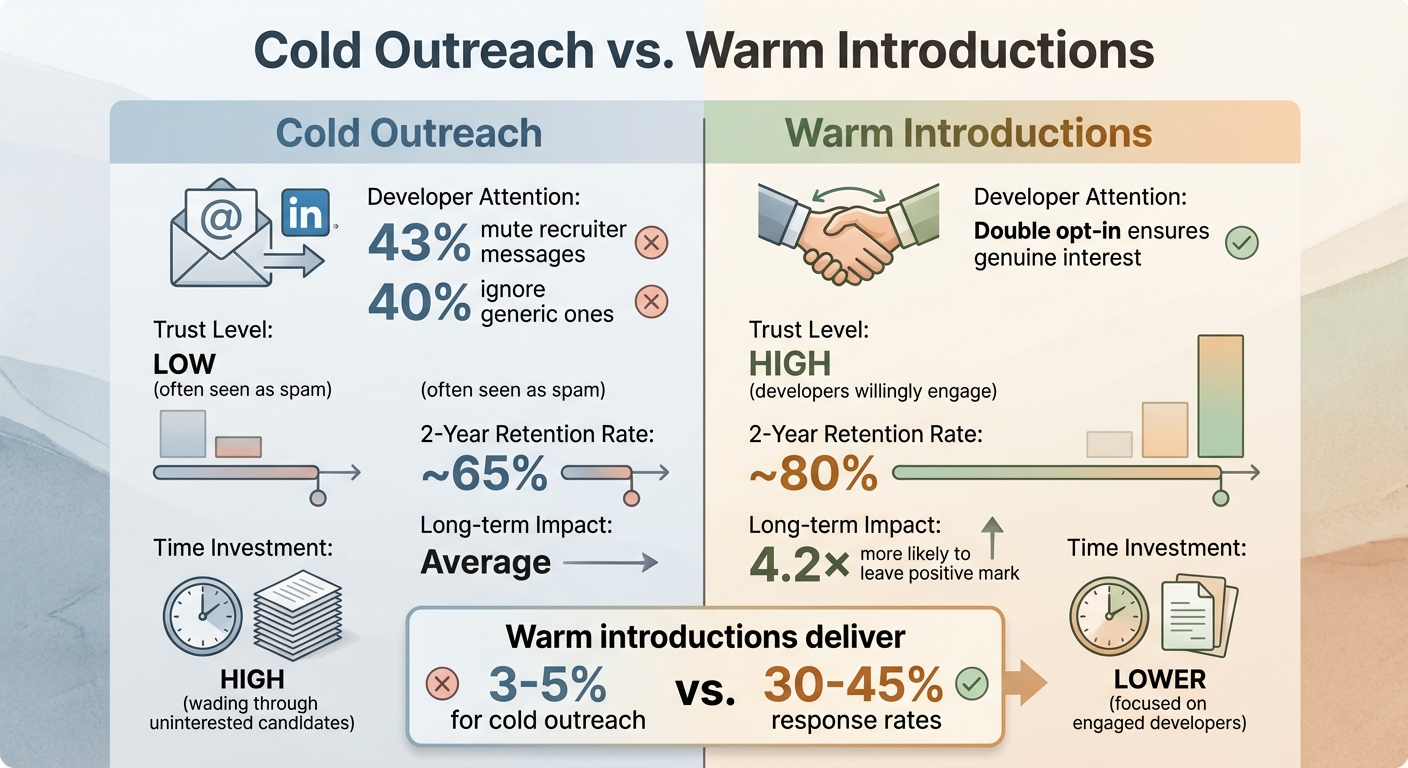
When you're reaching out to developers without the backing of a big-name brand, how you initiate contact can make or break your recruitment efforts. Cold outreach - like mass emails or LinkedIn messages - throws you into the same crowded space as countless other recruiters vying for attention. Warm introductions, on the other hand, connect you with developers who are already open to exploring new roles, creating a much stronger starting point.
The statistics paint a clear picture: 43% of developers mute recruiter messages they see as spam, and 40% ignore generic messages outright, leaving you with an uphill battle to build trust right from the start. Here's a closer look at how warm introductions stack up against cold outreach.
Warm introductions completely change the game. Developers referred through warm connections are 4.2 times more likely to make a lasting positive impact on your team compared to those sourced through cold outreach. Retention data backs this up: developers hired through warm introductions stay at their jobs 80% of the time after two years, compared to just 65% for those brought in via cold outreach.
Comparison Table
Here’s a quick breakdown of the key differences:
| Metric | Cold Outreach | Warm Introductions |
|---|---|---|
| Developer Attention | 43% mute recruiter messages, 40% ignore generic ones | Double opt-in ensures genuine interest |
| Trust Level | Low - often seen as spam | High - developers willingly engage |
| Retention (2-year) | About 65% | About 80% |
| Long-term Impact | Average | 4.2× more likely to leave a positive mark |
| Time Investment | High - wading through uninterested candidates | Lower - focused on engaged developers |
For startups with tight budgets or lean recruiting teams, warm introductions are a no-brainer. Instead of wasting time chasing developers who aren’t interested, you can focus on meaningful conversations with those who are genuinely open to new opportunities. This approach not only saves time and money but also helps you build stronger, longer-lasting relationships with your hires - even if your brand isn’t yet widely recognized.
Onboard New Developers for Long-Term Success
Hiring a skilled developer is just the starting line - keeping them engaged and productive is what ensures they stick around. The stats don’t lie: 20% of new hires quit within their first 45 days, often because of a poor onboarding experience . On the other hand, developers who go through a positive onboarding process are 70% more likely to stay for at least three years . For startups that lack big-name recognition, a well-thought-out onboarding process can be your secret weapon to retain top talent.
Help New Hires Feel Connected Early
The onboarding process should begin long before the first day. Send their equipment early, share insights from the founders, and give them access to your company’s culture. Pairing new hires with an onboarding buddy and setting a goal for a small code deployment in the first week can make a huge difference. Why? Because 63% of remote workers feel undertrained during onboarding, and 60% of new hires report feeling lost in their first few weeks .
Encourage new developers to deploy something - anything - in their first week, even if it’s just fixing a minor bug or updating documentation. These "quick wins" not only build confidence but also help them feel like they’re making an impact right away. Ted Goas, Senior Engineer at Stack Overflow, highlights the importance of structure:
"We now have an onboarding process that spans a new hire's first month, broken out by week. Everyone now knows what's expected from a new hire after their first week, after their second, and so on."
In remote or hybrid teams, it’s easy for new hires to feel disconnected. Schedule informal 1:1 coffee chats with team members to replicate the kind of casual conversations that naturally happen in an office. Also, centralize your documentation, FAQs, and tools in one place - whether it’s Notion or an internal developer portal. This allows new hires to find answers independently, reducing interruptions and helping them get up to speed faster.
Collect and Act on Employee Feedback
Building early connections is just step one. To truly refine your onboarding process, you need consistent feedback. Structure this feedback by setting up automated check-ins using a 30-60-90 day plan. Keep these surveys short - just a few questions - to respect your developers’ time while still gathering valuable insights.
- At 30 days, ask if they found the development environment setup clear.
- At 60 days, check if they feel equipped to contribute to code reviews.
- At 90 days, confirm that the role and tech stack align with what was promised during hiring.
Think of your onboarding process as a product that evolves over time. When developers point out friction - whether it’s unclear documentation, missing tools, or mismatched expectations - act on their feedback quickly. This not only improves the process but also shows your commitment to making their experience better. Continuous iteration is the key to long-term success.
Conclusion
Startups can attract top developer talent by prioritizing what truly matters. Focus on your mission, the impact your company aims to create, and the growth opportunities you offer - not just salary figures. Developers want to see the difference they’ll make and the unique experiences they’ll gain. Be upfront about the risks involved and transparent about equity. After all, with 90% of startups failing, candidates are often drawn to your vision, not just the paycheck .
Taking a personalized approach to outreach helps build trust. Referencing a candidate’s specific work or achievements shows you’ve done your homework and establishes credibility before the first conversation even begins.
For startups that lack a well-known brand, leveraging warm introductions through developer-focused platforms like daily.dev Recruiter can make a huge difference. These platforms deliver response rates of 30% to 45%, compared to the meager 3% to 5% seen with cold outreach . Plus, candidates who actively choose your opportunity through deliberate engagement are more likely to stick around long-term.
A streamlined evaluation process is key to finding candidates who not only have the technical skills but also the mindset to thrive in a startup. Keep the process focused and efficient, testing for both technical aptitude and adaptability. Once hired, ensure your onboarding process fosters a sense of belonging and connection from day one.
Building a strong team doesn’t stop at hiring. Treat your early hires like true partners by offering clear equity terms, transparency around outcomes, and direct access to founders . When you get these basics right, you’re not just hiring employees - you’re assembling a team that believes in your vision and is committed to seeing it through.
FAQs
How do I make equity feel real to candidates?
To make equity resonate with candidates, offer clear and transparent information about its potential value. Break down projections for company growth, expected valuation, and how their equity stake could evolve over time. Be honest about topics like dilution, timelines for liquidity events, and share examples of success stories from similar startups. When you position equity as an investment in the company’s future, it helps candidates understand its real-world benefits and how it aligns with their financial and career aspirations.
What should I include in a great first message?
When reaching out to a developer, your message should be short, tailored, and upfront. Mention something specific about their work, like a project on GitHub, and include details that matter - such as the tech stack and salary range. Keep it under 125 words to respect their time. Your goal is to build trust by offering meaningful information, outlining clear next steps (like scheduling a quick chat), and steering clear of generic phrases. This approach can significantly boost your chances of getting a reply.
How do I screen developers fast without scaring them off?
To connect with developers efficiently and respectfully, prioritize trust and personalized communication. Start with warm introductions or leverage mutual connections to build credibility. Be upfront about key details - like the role, salary range, and tech stack - so there’s no ambiguity. Engage with developers in spaces they already frequent, such as GitHub or Stack Overflow. Use permission-based outreach to ensure they feel respected and valued, making it easier to gauge their suitability without overwhelming them.
.png)