Hiring engineers can be slow and frustrating, but it doesn't have to be. The biggest bottlenecks? Scheduling interviews, repetitive evaluations, and inefficient hiring processes. These delays not only waste time but also risk losing top candidates to faster-moving companies. Here’s how you can fix it:
- Write clear job descriptions: Focus on outcomes and must-have skills to attract the right candidates.
- Use technical hiring tools for pre-screening: Automated assessments save time by filtering unqualified applicants early.
- Simplify interviews: Reduce redundant rounds and focus on skill-based evaluations.
- Leverage tools like daily.dev Recruiter: Connect directly with pre-qualified, engaged engineers.
- Build a skills-based talent pipeline: Pre-evaluate candidates for future roles to reduce time-to-hire.
These steps can cut interview loads, improve decision-making, and help you hire faster without sacrificing quality.
The Problem: Interview Bottlenecks Slow Down Engineering Hiring
The biggest challenge in engineering hiring isn't a lack of candidates - it’s the struggle to align interview schedules. With a typical four-person interview panel, there are usually only 2–3 overlapping time slots available each week. Add to that indecision during post-interview debriefs, and the process slows down even more . On top of scheduling issues, many companies bog down hiring with excessive and redundant interview rounds.
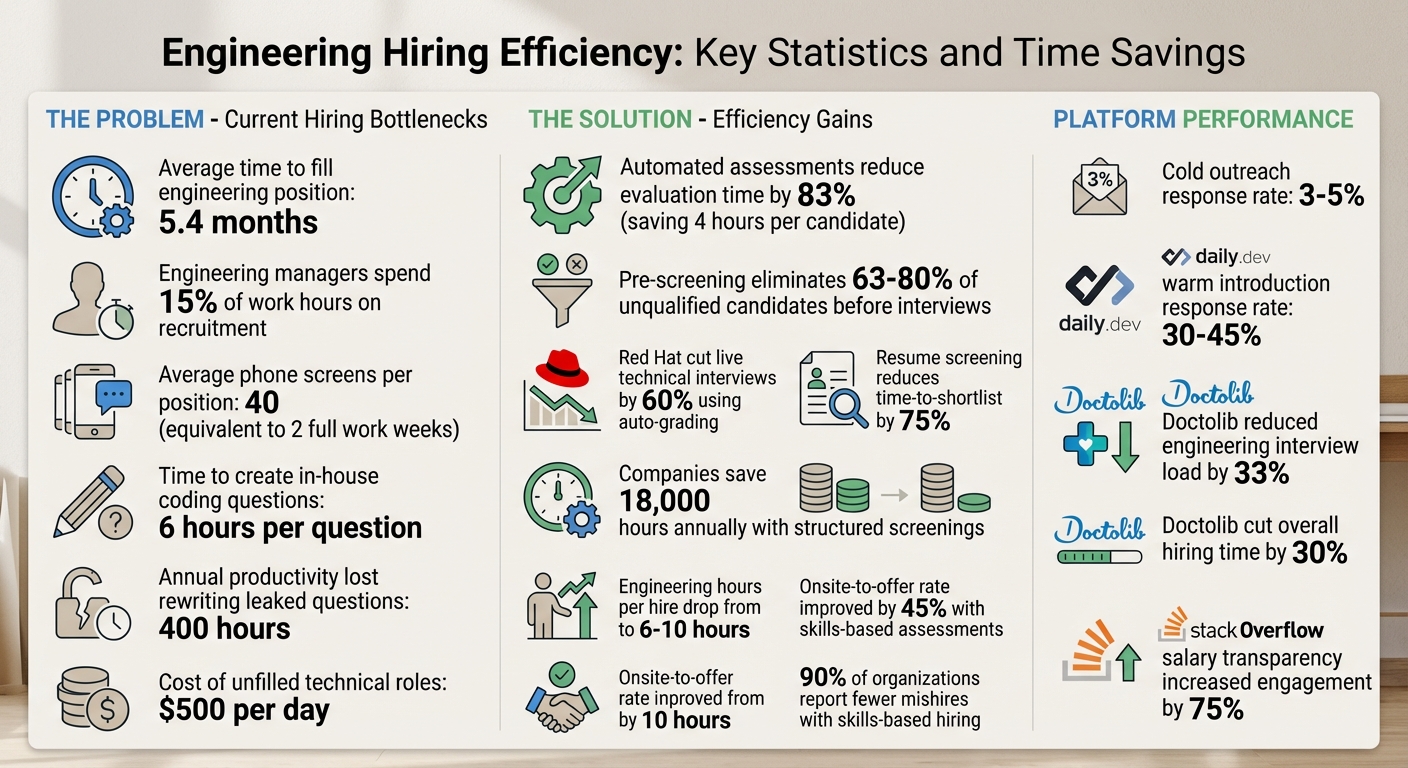
These extra rounds often test the same skills repeatedly - think multiple coding tests, executive meetings for every role, and manual code reviews. All of this eats up time without offering much new insight . For example, in 2025, Red Hat streamlined its process by cutting live technical interviews by over 60%. They introduced an auto-grading platform to score candidate assessments automatically, which eliminated 63% of phase-one candidates during the initial screening stage. This change drastically sped up their hiring process .
The costs of these delays go beyond just time. Engineering managers often spend up to 15% of their working hours on recruitment tasks, pulling them away from product development. On average, filling a single position requires about 40 phone screens - equivalent to two full work weeks of an engineer’s time. Creating in-house coding questions takes up to six hours per question, and companies frequently rewrite these questions quarterly due to leaks, leading to about 400 hours of lost productivity annually .
"Engineering teams are stretched thin by spending too much time interviewing unqualified candidates. This often happens when you have a high volume of applicants... and you're relying on resume review as your initial screening step."
- Team CodeSignal
The problem doesn’t stop there. Vague job descriptions attract mismatched candidates, adding to the screening workload . When unqualified applicants make it to the interview stage, teams waste precious time, leading to burnout and dragging the hiring process out to an average of 5.4 months . Fixing these inefficiencies is crucial for speeding up hiring without compromising on the quality of new hires.
Write Better Job Descriptions to Attract Qualified Candidates
Crafting better job descriptions is a crucial step in streamlining the hiring process and reducing time-to-hire by cutting down on interview bottlenecks. A poorly written description often leads to an influx of unqualified applicants. When job postings are filled with buzzwords and vague requirements, they fail to guide candidates in determining whether they’re a good fit. This lack of clarity can result in a mismatch between applicants and the role. Shifting the focus to specific outcomes and expectations can make a significant difference in attracting the right talent.
Instead of relying on rigid requirements like "5+ years of C++ experience", highlight the real-world impact the candidate will have. For example, you could say, "Develop and scale microservices capable of handling 10 million requests per day" . Osman, in The Holloway Guide to Technical Recruiting and Hiring, puts it perfectly:
"If your job description is built around checklists of requirements, it will be a lot less compelling to candidates than if it is built around the challenges and impact of the work - the outcomes."
Focus on Skills and Deliverables
Shift the emphasis to the specific outcomes and deliverables you expect from candidates. Replace vague phrases like "work with databases" with actionable tasks such as "design and optimize queries for high-traffic applications." Define success in measurable terms - like maintaining 90% test coverage or taking part in three code reviews each week.
It’s also essential to separate must-have skills from nice-to-have ones. Research indicates that qualified candidates, particularly women, may hesitate to apply if they don’t meet every listed requirement . By clearly distinguishing between essential and bonus skills, you can encourage more qualified applicants to apply.
Adopt Clear, Neutral Language
The language you use in job postings matters. Avoid jargon and gendered terms that might alienate potential candidates. Instead of over-the-top phrases, opt for clear descriptions like "design and implement REST APIs using Python and Django" . Using inclusive pronouns such as "they/them" can also signal a welcoming and equitable environment.
Transparency is another powerful tool for attracting serious applicants. Including salary ranges in your job postings not only builds trust but also boosts engagement. Stack Overflow’s A/B testing revealed that job ads with specific salary ranges saw a 75% increase in click-through rates. Even roles with salaries under $100,000 experienced a 60% rise in engagement . These numbers highlight the importance of being upfront about compensation to draw in motivated and qualified candidates.
Use Pre-Screening Tools and Automated Assessments
Pre-screening tools serve as an essential first step, helping filter out candidates who lack the basic coding skills necessary for the role. This approach prevents your engineering team from spending time on unqualified applicants, streamlining the hiring process. Automated assessments can reduce the time engineers spend evaluating candidates by 83%, saving about four hours per candidate . Considering that unfilled technical roles cost companies an average of $500 per day , these tools not only save time but also have a direct financial impact.
Another advantage of automated assessments is their ability to ensure consistency. Unlike manual reviews, which can be prone to bias or subjectivity, these tools apply standardized criteria to every candidate. For example, modern platforms use AI-powered plagiarism detection with 85–93% precision to identify AI-assisted coding submissions . By introducing such consistency, pre-screening tools create a solid foundation for more targeted evaluation methods.
Resume Parsing and Keyword Matching
Automated resume screening is another powerful tool in the pre-screening arsenal. These systems can cut down the time-to-shortlist by as much as 75% for roles with high application volumes . They scan resumes for specific technical skills, programming languages, and experience markers that align with the job requirements, allowing recruiters to hone in on candidates who meet the baseline qualifications.
To make the most of these tools, it’s important to establish clear, measurable criteria from the outset. For instance, you might set a scoring threshold - like a minimum score of 8/10 on coding fundamentals - with input from your engineering team . Some platforms even offer "QuickScreen" features to filter out unqualified candidates before they enter your Applicant Tracking System, significantly reducing the manual workload .
Skill-Based Quizzes and Coding Challenges
While resume screening helps narrow the field, skill-based quizzes and coding challenges provide a deeper evaluation of a candidate's abilities. Short technical assessments, lasting about 10–15 minutes, can effectively filter out less qualified applicants, leaving only the strongest candidates for more comprehensive project-based evaluations [23,28]. Research shows that 66% of developers prefer practical challenges that reflect real-world scenarios [8,23]. These could include debugging APIs, addressing security vulnerabilities, or building small-scale features.
Platforms equipped with auto-grading capabilities can further streamline the process, cutting manual code review time by 80% . The best tools assess multiple dimensions - not just functionality but also code quality, performance, complexity, and adherence to style guidelines. As Joseph Sirosh, Former CTO at Compass, noted:
"Karat's Interviewing Cloud has been a game-changer for us. We've gotten back over 25,000 hours of developer time that we're able to spend innovating and building products" .
For smaller teams, platforms like HackerRank offer accessible pricing, starting at $165 per month . These tools not only validate technical skills but also provide a structured, efficient way to identify the strongest candidates.
Streamline Talent Sourcing with daily.dev Recruiter
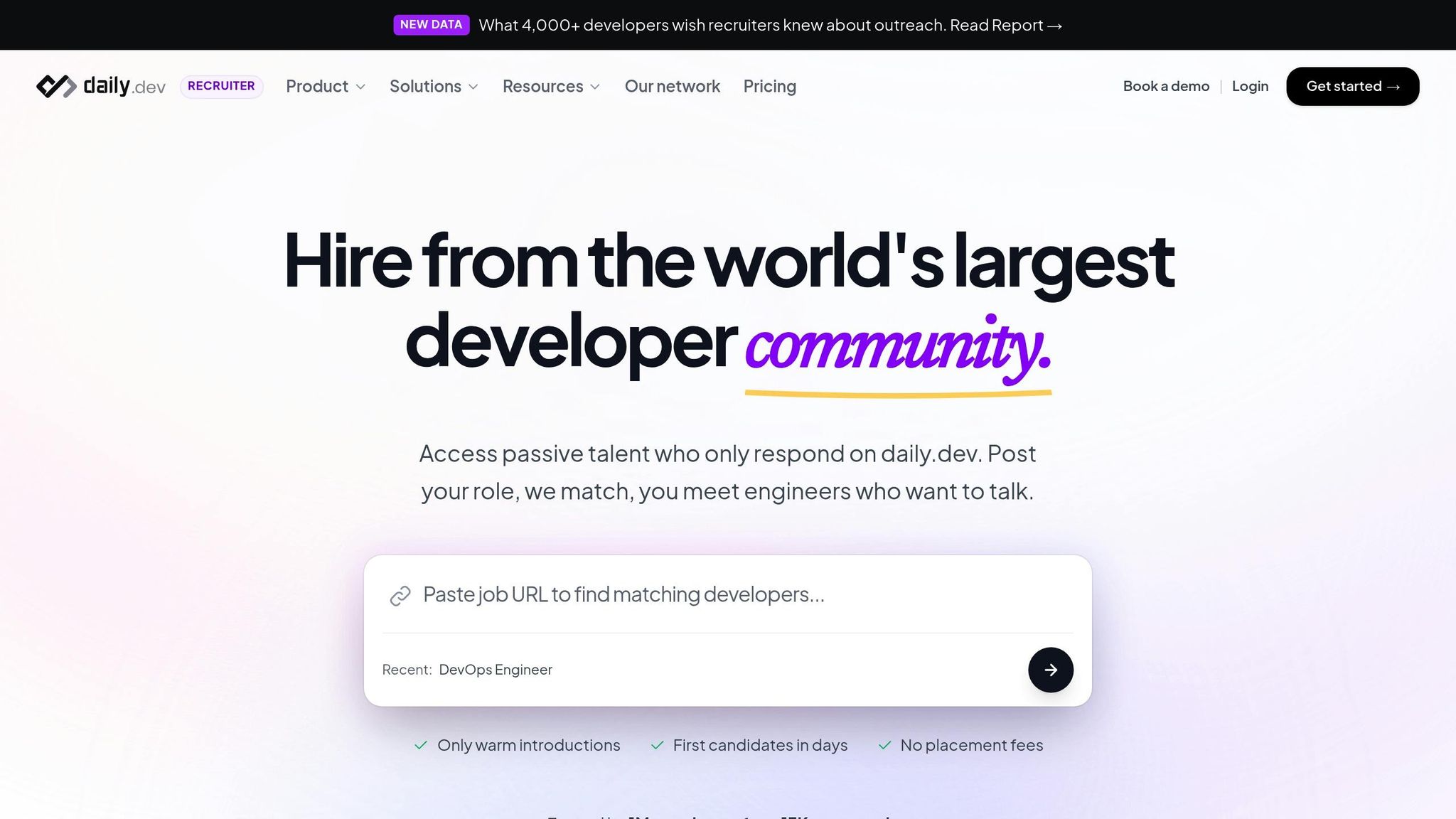
After pre-screening, the next challenge is finding candidates who are not just qualified but also actively engaged. That’s where daily.dev Recruiter stands out. Instead of relying on traditional methods, it connects you with developers immersed in a vibrant professional community. This approach ensures access to a talent pool that’s both technically skilled and genuinely engaged.
Access Passive, Pre-Qualified Talent
Unlike platforms that depend on static resumes, daily.dev Recruiter analyzes real-time developer behavior - tracking the content engineers interact with - to identify candidates based on their actual interests and expertise . This behavioral matching captures pre-intent signals, helping you spot top talent before they officially enter the job market. Impressively, 40% of the talent pool comprises senior contributors or engineering leaders, and the platform has logged over 1 billion developer sessions, reflecting its integration into developers’ daily workflows .
What makes this approach unique is its double opt-in system. Job opportunities are pitched privately to developers who meet your criteria, and you’ll only see candidates who’ve reviewed the job details and actively expressed interest . As Nimrod Kramer, CEO & Co-Founder of daily.dev, puts it:
"We built a place where engineers can turn off the noise. To enter this space, you don't need a hack. You need trust."
By focusing on candidates who self-select based on genuine interest, daily.dev Recruiter reduces the burden of initial screening and aligns with a more streamlined interview process.
Eliminate Cold Outreach
Cold outreach vs. warm intros often reveals why the former yields dismal response rates - typically around 3–5% . daily.dev flips the script with warm, double opt-in introductions that achieve 30–45% response rates . Developers on this platform have already shown interest in engaging, which eliminates ghosting and low-quality interactions. In fact, 90% of developers say they won’t respond to recruitment outreach anywhere else .
The platform takes care of the heavy lifting by pre-screening candidates for timezone, location, tech stack, and seniority before they ever reach your desk . Interested developers also answer up to three custom screening questions, and their expertise is validated through "Verified Signals" based on community reputation and reading habits . Plus, with seamless integrations into ATS tools like Greenhouse, Lever, and Ashby, qualified candidates are automatically synced to your system, saving time and avoiding manual data entry .
daily.dev Recruiter operates on a pay-for-results model, meaning there are no placement fees or monthly commitments. You only pay when you successfully connect with qualified candidates, keeping the process efficient and cost-effective .
Build Skills-Based Recruitment Pipelines
Refining your recruitment process with a skills-based approach can significantly improve how you evaluate candidates. Traditional hiring often focuses on credentials like degrees or previous employers, but these don’t always reflect actual abilities. For example, a resume stating "3 years of Python experience" doesn't clarify whether the candidate worked on complex system designs or just minor updates to legacy code . Skills-based assessments fill this gap, offering a clearer view of technical abilities. They can filter out 80–90% of unqualified candidates before they even reach your engineering team, reducing interview workloads and speeding up the hiring process.
Here’s a real-world example: In 2024, a prominent tech company saved 18,000 engineering hours annually across 100 technical hires by shifting to structured technical screenings. This change not only cut engineering team costs by $3 million but also improved the onsite-to-offer rate by 45% . Companies using automated technical assessments for initial screenings typically see engineering hours per hire drop from 15–25 hours to just 6–10 hours . Moreover, 90% of organizations that use skills-based hiring report fewer mishires .
Use Portfolio Reviews and Technical Tests
Evaluating candidates through portfolio reviews and technical tests offers a deeper understanding of their abilities without requiring lengthy interviews. Take Zapier, for instance. Since 2018, they’ve used a 4-hour take-home test that mimics real-world challenges. This test allows candidates to demonstrate their skills in a practical setting, replacing the pressure-filled 45-minute live pair-programming session. By providing clear instructions and an automated GitHub repository setup, Zapier created a process that not only reduces stress but also provides better insights into a candidate's problem-solving and execution skills .
The key to success here is realism - assessments should reflect actual tasks, like navigating existing codebases or implementing features, rather than abstract algorithmic problems [22, 36]. Structured scoring rubrics further enhance consistency across evaluators. For example, in June 2024, Byteboard introduced realistic assessments at Lyft, doubling the onsite-to-offer rate from 25% to 53%. This change also helped Lyft fill 78% of open positions in just two months, compared to 50% previously .
As Jerry Sagmaquen, Senior Manager of Talent Acquisition at Slalom, wisely points out:
"Processes that candidates see as unreasonable can result in disengagement or withdrawal from the process, especially among high-performing individuals" .
By focusing on practical, well-designed evaluations, companies can better identify top talent while maintaining candidate engagement.
Build a Talent Pipeline
Establishing a pool of pre-evaluated candidates is a smart way to streamline future hiring. When you’ve already assessed developers through portfolio reviews or technical tests, you can quickly revisit this pipeline as new roles open up. This proactive approach reduces time-to-hire and ensures you’re prepared to act swiftly on strong candidates. Instead of scrambling to fill urgent openings, you’ll have a ready network of qualified talent to draw from, keeping your hiring process both efficient and effective.
Integrate ATS and Data-Driven Targeting
By combining skills-based pipelines with your ATS and coding assessments, you can dramatically speed up candidate filtering. When your ATS integrates with coding assessment tools, it automatically filters and ranks candidates based on their test results. This means you're working with a pool of candidates who have already proven their abilities, saving recruiters from sifting through unqualified applicants. This setup not only simplifies the hiring process but also ensures a more objective and precise approach to tracking candidates.
Track and Score Candidates
Modern ATS platforms take things a step further by using coding assessments to score, rank, and filter candidates automatically. These systems rely on standardized metrics like code quality and problem-solving skills, with predefined thresholds ensuring only the most qualified candidates move forward. For instance, in 2025, Doctolib integrated CoderPad's automated assessments into their hiring process to streamline their engineering recruitment. This integration led to a 33% reduction in engineering interview load and cut overall hiring time by 30% .
When candidates complete technical assessments, their results - such as code quality, problem-solving strategies, and completion times - are automatically added to your ATS. This allows you to quickly filter and prioritize candidates, focusing on those who meet your criteria. With these tools, companies have reported up to a 33% drop in engineering interview load, demonstrating how automation can save time without compromising on quality .
Target Specific Developer Networks
Data-driven targeting shifts your focus from casting a wide net with generic job postings to engaging directly with developer communities where your ideal candidates are active. Instead of reaching out broadly, you can connect with developers who have the exact skills you’re looking for. This approach not only improves response rates but also ensures you’re talking to people who are genuinely a good fit for the role.
Platforms like daily.dev Recruiter make this process even easier by linking you with developers who are already part of professional communities. These candidates are pre-qualified and open to discussions about new opportunities. This precision reduces wasted interactions and leads to more meaningful conversations with candidates who align with your needs. The result? Fewer unnecessary interviews and a shorter time-to-hire. By focusing your efforts where they matter most, you streamline the hiring process and improve overall efficiency.
Conclusion: Key Takeaways for Faster, Efficient Hiring
Streamlining your hiring process doesn't mean compromising on quality - it means working smarter. Start by crafting precise job descriptions to attract genuinely qualified candidates. Use pre-screening tools and automated assessment tools to weed out unqualified applicants before they even reach the interview stage. Skills-focused pipelines, like portfolio reviews or coding challenges, help you assess actual capabilities, while ATS integration automates scoring and ranking, ensuring only pre-qualified candidates make it to your interview schedule.
These strategies are essential for building an efficient hiring process. In fact, 75% of companies report that improving their recruitment workflows significantly reduces time-to-hire . Tactics like limiting interview rounds, implementing five-business-day decision deadlines, and monitoring time-to-hire metrics can speed up the process without sacrificing quality.
Tools like daily.dev Recruiter simplify this further by connecting you with passive, pre-qualified developers from active professional communities. Instead of relying on cold outreach, it facilitates warm, double opt-in introductions, saving time and reducing unnecessary interviews.
To stay ahead, review your hiring process monthly. Experiment to uncover what works and eliminate stages that don't add value . Keep an eye on key metrics like offer acceptance rates and time-to-productivity to refine your approach. With clear communication, data-driven targeting, and innovative tools like daily.dev Recruiter, you can fill engineering roles faster while freeing up your team to focus on what matters most.
FAQs
What’s the fastest way to cut interview rounds without lowering hiring quality?
Streamline your hiring process by cutting out repetitive steps. For instance, instead of conducting several coding rounds, opt for a single, well-structured technical assessment. Leverage data-driven evaluation methods to pinpoint the best candidates quickly, all while ensuring the quality of your hiring decisions remains intact.
How do I choose a pre-screening assessment that predicts on-the-job performance?
When choosing tools to evaluate job-specific skills, prioritize those that are backed by research and data. For example, assessments that test coding or system design should use standardized criteria to minimize bias. It's also crucial to select tools that simulate real-world scenarios, as these provide a more accurate measure of a candidate's abilities. Focus on platforms designed to predict success in the role and ensure they align closely with the skills the job demands.
How can daily.dev Recruiter reduce cold outreach and speed up hiring?
daily.dev Recruiter transforms the hiring process by prioritizing trust and developer-first practices, cutting down on ineffective cold outreach. Its double opt-in introductions ensure developers show interest before any connection is made, leading to higher engagement rates. On top of that, the platform uses data-driven insights, such as tracking developer activity, to spot top candidates early in the process. This focused strategy not only reduces unqualified leads but also simplifies communication and speeds up hiring - all while maintaining high standards for candidate quality.
.png)