Slack communities are a goldmine for connecting with developers, especially those not actively job hunting. But recruiting in these spaces requires a respectful, thoughtful approach to avoid coming across as intrusive. Here's how to do it right:
- Understand the culture: Slack groups thrive on trust and collaboration. Spammy behavior or aggressive pitches will alienate members.
- Find the right groups: Use tools like Slofile.com or ask your team for recommendations. Focus on active, niche communities relevant to your hiring needs.
- Respect the rules: Post job opportunities only in designated channels like #jobs or #hiring. Observe and adapt to the group’s tone before engaging.
- Engage meaningfully: Contribute by answering questions, sharing resources, or discussing relevant technical topics. Build relationships before pitching roles.
- Personalize outreach: Reference specific work or contributions (e.g., GitHub commits, blog posts) when contacting members. Keep messages concise, professional, and respectful.
Recruiting on Slack isn’t about quick wins - it’s about building genuine connections that lead to long-term success. Respect the community, offer value, and approach potential candidates with care.
::: @figure 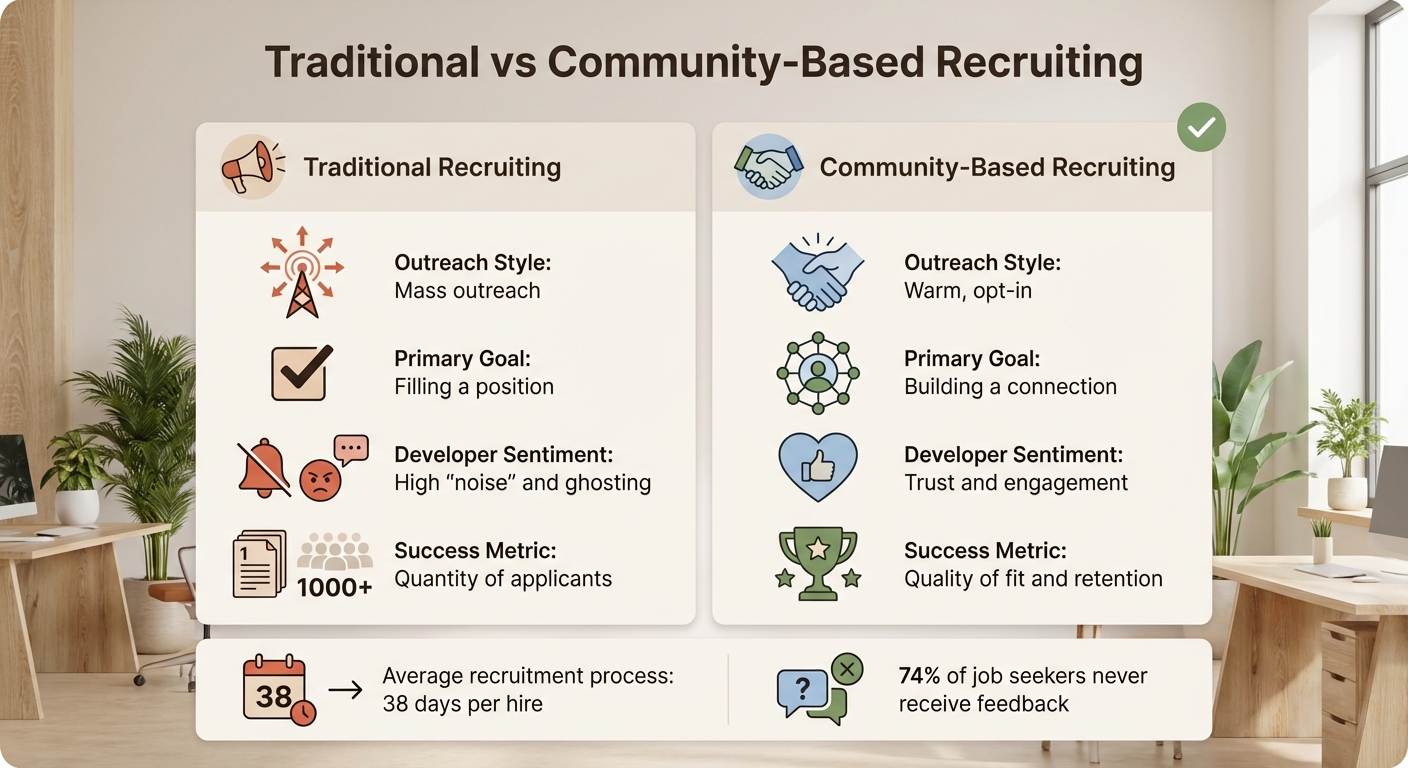 {Traditional vs Community-Based Recruiting: Key Differences and Impact}
Finding the Right Slack Communities for Developer Recruitment
How to Research Developer-Focused Slack Groups
To start, explore specialized directories like Slofile.com, Disboard.org, and Chit Chats. These platforms help you discover public Slack workspaces organized by technology or specific interests. You can narrow your search by programming languages, frameworks, or industries, making it easier to find communities where your target candidates are active.
Your engineering team can also provide valuable insights. Ask them about niche Slack groups they participate in - they're likely already part of high-quality communities with engaged members and meaningful discussions. Additionally, check subreddits like r/rust or r/reactjs for sidebar links to Slack groups, or visit websites for major tech events like PyCon or KubeCon. These often feature links to dedicated Slack communities for attendees and enthusiasts.
Focus on niche groups rather than broad tech forums. For instance, a Slack workspace centered on React will connect you with frontend experts, while a Fintech-focused group will attract developers with specific domain knowledge. Look for communities with consistent activity - daily or weekly engagement and quick responses are good indicators of an active and valuable group. Large, inactive forums won’t provide the same level of connection or relevance.
Finally, before diving in, review each community’s rules and norms to ensure your approach is respectful and aligned with their culture.
Understanding Community Rules and Culture
Once you’ve identified promising Slack groups, take the time to learn their rules and tone. Start by reading the community guidelines and observing conversations to get a feel for both the formal rules and the unwritten norms. Many groups have strict rules about recruitment - some only allow it in specific channels, like #jobs, #hiring, or #work-opportunities. Posting job ads in general discussion areas can lead to a quick ban.
Pay attention to how members interact, what topics resonate, and who the key contributors are. Some communities lean toward technical and formal discussions, while others embrace a more casual, even humorous, vibe. Take this "lurking" phase seriously - it will help you understand the dynamics and avoid missteps that could harm your credibility.
Joining as a Real Participant
Once you’ve familiarized yourself with the group’s culture, become an active and authentic participant. Start by filling out your profile with a professional photo and a concise bio that highlights your role and expertise. Be upfront about being a recruiter - developers can spot one quickly, and trying to hide it will only hurt your credibility. Instead, position yourself as someone who’s there to contribute meaningfully.
Engage by answering technical questions or sharing helpful resources, such as industry news or useful tools. These actions demonstrate that you’re there to add value, not just to take. Referencing a member’s pull request or project in your interactions shows you’ve done your homework and genuinely appreciate their work. Avoid overused terms like "rockstar" or "ninja" - they come across as inauthentic and can damage your reputation. Focus on building trust through meaningful contributions.
Hiring engineers?
Connect with developers where they actually hang out. No cold outreach, just real conversations.
Building Trust and Credibility Within Slack Communities
How to Engage Genuinely With Developers
The best way to connect with developers is to start by offering genuine value. Answer their questions, help solve technical challenges, and share your insights without focusing on recruitment right away. Whether it's providing constructive feedback on code or troubleshooting an issue, these actions show you're there to contribute meaningfully.
Think of your approach as twofold: micro and macro strategies. On a micro level, focus on helping individuals with specific problems in real-time. On a macro level, take those recurring questions or challenges and turn them into reusable resources - like a guide or tutorial. This not only helps the community but also shows your commitment to their growth beyond just hiring.
Be transparent about your role as a recruiter. Developers can spot ulterior motives quickly, and pretending to be something you're not will only harm your credibility. If you're not well-versed in a particular topic, admit it. Offer to connect them with someone on your team who is more knowledgeable. This honesty goes a long way in earning their respect and trust, laying the groundwork for deeper engagement.
Showing Knowledge and Expertise
Show that you’re in tune with the community’s interests by sharing relevant industry updates - like news about new frameworks, security issues, or emerging trends. You can also share real examples of technical problems your team has tackled, such as scaling an API to handle millions of daily requests. This kind of transparency builds trust without coming off as overly promotional.
Another way to establish credibility is by actively supporting the community. Sponsor meetups, host workshops, or contribute to open-source projects. Even smaller efforts, like improving documentation or helping triage issues, demonstrate that you value the work developers do. When engaging with individuals, reference their specific contributions - whether it’s a GitHub pull request, a technical blog post, or a talk they gave at a conference. This shows that you’ve taken the time to understand and appreciate their work.
Avoiding Spam and Self-Promotion
While building trust, it’s just as important to avoid actions that could harm your reputation. Always post recruitment-related messages in designated channels, like #jobs or #hiring, to respect the community’s rules. Spend time observing the tone and culture of the workspace before jumping in with recruitment posts - each Slack community has its own unwritten norms.
Avoid sending unsolicited direct messages. It’s intrusive and often unwelcome. If you want to reach out to someone individually, establish a connection in public channels first. Then, when you do message them, make it personal by referencing their work or contributions. This approach feels more genuine and respectful.
| Activity | Credibility Impact |
|---|---|
| Sharing Expertise | Positions recruiter as a helpful, informed participant |
| Sponsoring Events | Shows a long-term investment in the community |
| Using #jobs Channels | Respects community boundaries and norms |
| Admitting Knowledge Gaps | Builds trust through honesty |
| Referencing Specific Work | Demonstrates genuine interest and preparation |
Crafting the Right Outreach Message
Respectful engagement in Slack communities starts with authentic interactions, and your outreach message should mirror this approach.
Personalizing Your Approach
When reaching out, reference specific work - like a GitHub pull request, a technical blog post, or a recent conference talk. This shows you’ve taken the time to understand their contributions. It’s not just about saying you’ve reviewed their work but proving it with details.
Use the 80/20 rule: customize one or two key elements, such as mentioning a recent project or addressing a specific challenge they’ve tackled, while keeping the rest of the message templated . Avoid vague compliments - they come off as insincere. Developers can spot shallow flattery instantly, and it often feels manipulative .
Include at least three specific details to show genuine interest. Maybe it’s a bug fix they committed, a framework they helped develop, or a dashboard module they built. The goal is to make them think, "This person actually took the time to look at my work," instead of dismissing your message as another generic pitch.
Once you’ve nailed personalization, focus on keeping the message concise and professional.
Keeping Messages Professional and Concise
Developers value brevity. Keep your outreach message between 75–125 words - three to five clear, focused sentences.
Make sure to include the "Big Three" details developers care about most: the specific tech stack (e.g., React 18, Go, Kubernetes), the salary range, and the work model (remote, hybrid, or onsite). Steer clear of buzzwords like "rockstar", "ninja", or "fast-paced environment", as these phrases can be immediate turn-offs. Instead, use a conversational and respectful tone that treats them as peers.
Wrap up with a low-pressure call to action. Rather than asking for a resume upfront, invite them to a brief, 15-minute technical discussion. Always offer a simple opt-out option, like: "Reply 'no thanks' if you're not interested." This small gesture respects their time and autonomy, building trust even if they decline.
Examples of Good and Bad Outreach
The difference between effective and ineffective outreach often lies in how specific and transparent your message is. Let’s break it down:
| Outreach Element | Bad Approach | Good Approach |
|---|---|---|
| Opening Line | "I saw your profile and was impressed" | "I noticed your pull request fixing the authentication bug in [Project Name]" |
| Job Details | "Modern tech stack, competitive pay" | "React 18, Go, Kubernetes stack; $140,000–$170,000 range" |
| Call to Action | "Please send your resume ASAP" | "Interested in a 15-minute chat about the role?" |
| Tone | "We're looking for a rockstar developer!" | "We're building a team to tackle [specific technical challenge]" |
Finally, limit follow-ups to four messages. Engagement tends to drop off after the fourth attempt, and sending too many messages can harm your reputation and erode trust.
Well-crafted outreach messages not only reflect your professionalism but also reinforce the trust you’re building within Slack communities.
Tools and Techniques to Simplify Slack Recruitment
Recruiting through Slack can feel overwhelming, especially when juggling multiple conversations. But with the right tools and strategies, you can stay organized without losing the personal touch. Let’s look at how Slack's features can streamline your recruitment process.
Using Slack Features for Recruitment
Slack's built-in tools, designed for collaboration, can also work wonders for recruitment when used thoughtfully:
- Threads: Keep discussions about candidates organized and separate from the main channel noise. This makes it easier to track feedback without cluttering conversations .
- Emoji reactions: Gather quick input from stakeholders without lengthy back-and-forth replies . For example, a simple thumbs-up can signal approval on a candidate.
- Search function: Quickly locate discussions about specific skills, frameworks, or technical challenges to identify potential candidates .
- Pinning messages: Pin important details like job descriptions or candidate profiles so your team can find them easily .
- Automated reminders: Use the
/remindcommand to schedule follow-ups with candidates, ensuring you stay responsive without manually tracking every interaction . - Huddles: For quick, real-time syncs with your hiring team, huddles replicate spontaneous office conversations, making it easier to align on candidates .
Tracking and Managing Conversations
To keep recruitment efforts organized, Slack's flexibility is key:
- Private channels for each role: Create dedicated channels to centralize discussions, feedback, and candidate records for a specific position. This keeps everything searchable and in one place .
- Channel archiving: Once a role is filled, archive the channel. This keeps your workspace tidy while preserving a searchable history for future reference .
- Slackbot reminders: Automate follow-up reminders for promising candidates, ensuring no one slips through the cracks .
Considering that the average recruitment process takes 38 days per hire and 74% of job seekers report never receiving feedback , staying organized in Slack can make a big difference. To manage conversations across multiple communities, consider using a simple spreadsheet or integrating Slack with an ATS. This helps you track which developers you’ve contacted, their responses, and the next steps.
Using Platforms Like daily.dev Recruiter
Efficient Slack management frees up time to explore platforms like daily.dev Recruiter, which complements Slack by connecting you with developers already interested in new opportunities. Unlike cold outreach vs. warm intros on Slack, daily.dev Recruiter offers warm, double opt-in introductions to pre-qualified candidates actively engaging with the platform .
The platform integrates seamlessly with ATS tools like Greenhouse or Lever, syncing candidate data across your recruitment systems . This means you can manage Slack conversations alongside daily.dev introductions without duplicating efforts or losing track of candidates.
Think of daily.dev Recruiter as a way to reduce the need for cold Slack outreach. With warm introductions, you can focus your Slack efforts on building relationships and engaging developers who might not be actively job hunting but could be open to the right opportunity.
Conclusion
From community research to thoughtful outreach, the strategies we've discussed highlight a clear path forward for effective Slack recruitment.
Key Takeaways for Successful Slack Recruitment
Recruiting on Slack thrives on building relationships and delivering genuine value. Start by immersing yourself in targeted communities and contributing meaningfully. Trust is earned through consistent, authentic engagement - well before discussing job opportunities. When it’s time to approach candidates, keep your messages personal, concise, and professional.
The contrast between job boards and developer networks shows why this shift matters:
| Feature | Traditional Recruiting | Community-Based Recruiting |
|---|---|---|
| Outreach Style | Mass outreach | Warm, opt-in |
| Primary Goal | Filling a position | Building a connection |
| Developer Sentiment | High "noise" and ghosting | Trust and engagement |
| Success Metric | Quantity of applicants | Quality of fit and retention |
Candidates increasingly expect transparent communication, making respectful engagement a non-negotiable part of the hiring process . How you interact on Slack reflects your company culture and can significantly influence whether top talent sees your organization as a desirable place to work .
The Long-Term Value of Community-Based Hiring
The benefits of this approach extend far beyond filling immediate roles. By fostering authentic connections within Slack communities, you're building a lasting talent pipeline. Developers talk, and when they share positive experiences, your reputation grows organically. Showing up consistently with value and professionalism ensures you’re remembered for the right reasons.
This strategy also streamlines recruitment. Instead of chasing cold leads, you can focus on strategic hiring efforts . Tools like daily.dev Recruiter help by connecting you with developers who are already open to new opportunities, allowing you to spend more time cultivating relationships instead of managing administrative tasks. Combining these tools with genuine community engagement creates a recruitment process that benefits both developers and your company for the long haul.
FAQs
How do I join a Slack community as a recruiter without annoying people?
Engaging with Slack communities requires a respectful and genuine approach. Your goal should be to add value rather than push an agenda. Participate in conversations thoughtfully, share helpful insights, and tailor your interactions to the context of the group.
Avoid sending spammy or overly aggressive messages - this can harm your credibility. When reaching out to individual members, keep your messages short, clear, and focused on building a connection rather than making a hard pitch.
Patience is key. Consistently contribute in ways that are meaningful and relevant, and work on earning trust over time. This will help you connect with developers in a way that feels professional and non-intrusive.
When is it OK to DM someone about a role in Slack?
When reaching out to someone on Slack about a role, timing and approach matter. It's best to DM only after you've built a genuine connection with them and contributed meaningfully to the community. Always make sure you have their consent before sending a direct message. Keep your outreach personalized, respectful, and non-intrusive to maintain a professional tone and build trust.
What should my first outreach message include to get replies?
Your first outreach message needs to be short, tailored, and to the point. Mention something specific about their work or achievements to show you've done your homework. Clearly outline the role details - like the salary range and the tech stack - so they know what to expect. Keep it brief to respect their time, and focus on building trust by expressing genuine interest in their expertise.
.png)