Recruiting DevOps professionals has shifted away from outdated methods like Boolean searches and cold outreach. Today, the best hires are found using trust-based, relationship-driven approaches. Here's how you can attract top-tier talent:
Focus on clear role requirements: Define technical skills (e.g., Kubernetes, Terraform, AWS) and soft skills (e.g., communication, problem-solving).
Engage on developer platforms: Use tools like daily.dev to connect with passive candidates based on their real-time activity and interests.
Build trust: Use warm introductions and transparent communication, sharing salary ranges and job specifics upfront.
Participate in professional communities: Add value by contributing to forums, GitHub projects, or Slack groups.
Evaluate effectively: Use live debugging exercises and problem-solving questions to assess candidates' skills.
These methods prioritize meaningful connections over impersonal outreach, resulting in higher response rates (85–90%) and better retention (20–30% higher over two years). The key is to meet candidates where they are and respect their time and expertise.
::: @figure 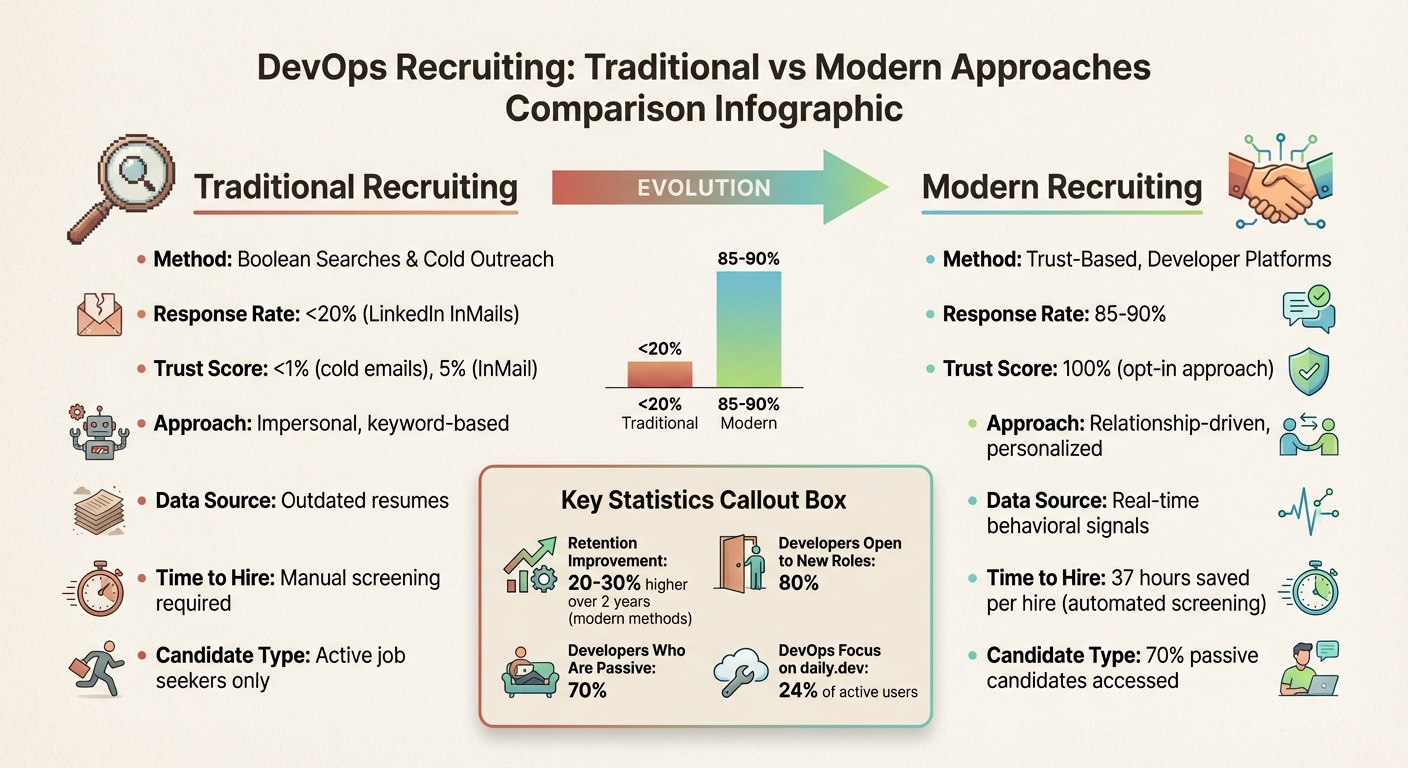 {Traditional vs Modern DevOps Recruiting Methods Comparison}
Define DevOps Role Requirements
Defining clear role requirements for DevOps positions is essential to attracting the right candidates. Being specific about what the job entails not only sets expectations but also builds trust with potential hires. This approach eliminates the need for generic messaging or cold outreach, making recruitment more engaging and effective.
Identify Key Technical Skills
DevOps roles can vary greatly depending on the size and stage of the organization. Here’s a breakdown:
Startups (around 30 engineers): Generalists are key here. These candidates should be able to build infrastructure from scratch, handle basic security tasks, and oversee the entire deployment lifecycle.
Scale-ups (50-200 engineers): Specialists are more suitable for this stage. They focus on creating internal developer platforms and standardizing operational practices.
Enterprises (200+ engineers): These organizations typically require highly specialized roles, such as:
Site Reliability Engineers (SREs): Focus on reliability metrics.
Platform Engineers: Build self-service tools for developers.
Security Engineers: Manage compliance and advanced security needs.
When it comes to technical expertise, there are some universal skills to look for:
Familiarity with cloud platforms like AWS (EKS, RDS, S3) or Azure.
Proficiency in Infrastructure as Code tools such as Terraform or Pulumi.
Experience with containerization tools like Docker and orchestration tools like Kubernetes.
Building CI/CD pipelines using tools like GitHub Actions or GitLab CI.
Observability tools, including Datadog, Prometheus, and Grafana.
Security tools like HashiCorp Vault, Snyk, or Trivy for vulnerability scanning.
One of the most critical abilities is troubleshooting and debugging, which makes up about 80% of a DevOps engineer’s daily work. Hands-on production experience often outweighs certifications in value. For example, asking candidates about handling specific failure scenarios, such as differences between load balancers during outages, can help identify those with real-world experience versus those who are merely certified.
Prioritize Soft Skills
Technical know-how is crucial, but it’s not the whole picture. DevOps thrives on collaboration, as its core goal is to bridge gaps between development and operations teams. This makes strong interpersonal skills just as important.
"The primary role of every tech department is to support the business" .
The ideal candidate should be able to simplify complex technical concepts for non-technical stakeholders and take ownership of the entire application lifecycle - not just their specific tasks. During interviews, ask them to explain architectural trade-offs or handle scenario-based questions like, "What would you do if a deployment brought down production?" Look for candidates who stay calm and process-focused under pressure.
A good technique is the "CARC" formula:
Challenge: Identify the problem.
Action: Explain the steps taken.
Result: Share the outcome.
Connection: Relate it to the role at hand.
These types of questions can help gauge both communication skills and adaptability.
Write Developer-Friendly Job Briefs
Generic job descriptions don’t stand out. DevOps engineers want to know exactly what challenges they’ll face and the scale they’ll be working at. For example, include specifics like “managing 50+ microservices” or “processing 2.3 million deployments per month.” These details not only attract qualified candidates but also show respect for their expertise.
Transparency is key here. Include salary ranges - senior DevOps roles in the U.S. often pay between $150,000 and $200,000, with SRE positions typically earning 10-15% more due to the demands of on-call duties. Many companies also offer additional compensation for on-call work, such as $500 to $1,000 per week, plus per-incident fees like $200 per incident.
Write job briefs with the developer in mind. Focus on what they’ll learn, build, and achieve, rather than just listing requirements. This approach will resonate more with candidates and make the role more appealing.
With these requirements in place, the next step is finding these candidates on platforms where developers actively engage.
Use Developer-Centric Platforms for Passive Talent Discovery
Once you’ve nailed down the specifics of the role, the next step is to connect with passive candidates where they naturally spend their time. Here’s the thing: the best DevOps professionals aren’t scrolling through job boards. In fact, roughly 70% of developers are passive candidates - they’re not actively hunting for jobs but are open to the right opportunity if it comes their way . That’s where developer-centric platforms come into play. These platforms meet engineers where they’re already learning, reading, and engaging.
Unlike traditional recruiting tools that rely on outdated resumes or self-reported profiles, these platforms analyze real-time behavior. They track what developers are reading, building, or discussing, offering a more accurate picture of their expertise. For instance, someone exploring Kubernetes or Platform Engineering isn’t just a keyword match from years ago - they’re actively honing their skills today . Platforms like daily.dev highlight this shift. On their network, 24% of active users focus on DevOps and Cloud technologies, with many diving deeper into Kubernetes and infrastructure-as-code .
Use Warm, Trust-Based Introductions
Let’s face it - cold outreach often misses the mark because it feels impersonal. Even though 80% of developers are open to new roles, only 43% respond to generic cold messages . Throw in a templated message that skips key details like salary, and you’ve already lost their interest.
Instead, focus on warm, trust-driven introductions. This approach can achieve response rates of 85–90%, far outpacing the sub-20% rates of traditional LinkedIn InMails . Nimrod Kramer, CEO of daily.dev, captures this sentiment perfectly:
"We're done letting spam define tech recruiting. Developers deserve better, and so do the people trying to hire them. daily.dev Recruiter is how we rebuild trust in hiring - one real connection at a time."
Start by offering value before making any hiring ask. Share technical insights or content that aligns with their interests. When you do reach out, be upfront - mention salary ranges, specific tools they’ll work with, and what a typical day looks like. This transparency respects their time and boosts your chances of meaningful engagement .
Target Role Visibility via Developer Platforms
Once you’ve built trust, the next step is to ensure your job openings are visible in the places developers already frequent. Posting on job boards isn’t enough. Developer platforms embed job opportunities into the content engineers consume daily for professional growth . By integrating roles directly into their feeds, your job listing appears alongside relevant technical articles - right when a DevOps engineer might be open to exploring new opportunities.
What sets these platforms apart is their ability to go beyond basic filters. Tools like daily.dev Recruiter use behavioral signals to identify developers actively upskilling in areas like Go for cloud-native development or Rust for systems work. This approach, known as "pre-intent sourcing", allows you to discover talent weeks before they update their resumes .
Additionally, these platforms streamline the hiring process by automating candidate screening. They verify factors like timezone, location, tech stack expertise, and seniority level before surfacing candidates . This eliminates the need for initial screening calls, saving an average of 37 hours per hire . By leveraging this level of precision, you’re not just finding candidates - you’re finding the right candidates.
Eliminate Cold Outreach Through Pre-Screened Connections
Stick to trust-building by engaging only with candidates who’ve already shown interest in connecting. Pre-screened passive candidates yield better results because they’ve opted in, eliminating the frustration of sending countless unsolicited messages.
This method flips the traditional recruiting script. Instead of blasting hundreds of cold emails and hoping for a few responses, you focus on candidates who are already open to conversations. The payoff? Higher-quality matches and faster hiring timelines. While onboarding passive candidates can take 6–10 weeks (compared to 3–5 weeks for active candidates), the extra time is worth it. These candidates are often top performers who need time to weigh their options and manage notice periods .
To keep the process low-pressure, start by sharing a role document or team overview instead of immediately requesting a call . This gives candidates the space to evaluate the opportunity on their own terms, fostering trust and increasing the chance they’ll respond when they’re ready.
Build Engagement in Professional Networks
Building trust within developer communities is a powerful way to enhance your recruiting efforts. The best DevOps hires often come from consistent, meaningful interactions in trusted spaces like GitHub repositories, Reddit's r/devops, Stack Overflow, or Discord servers focused on Kubernetes and Terraform. However, simply lurking in these spaces without contributing won't get you far.
Take this example: A recruiter dedicated six months to answering questions about Prometheus monitoring setups on GitHub. No sales pitches, no job offers - just helpful advice. The result? Their efforts led to organic referrals and a 40% faster hiring process compared to traditional job boards. This kind of sustained engagement showcases technical expertise and builds credibility. Here’s how you can do the same.
Participate in Developer Communities
Start by identifying niche platforms where your target candidates are active. For DevOps roles, this could mean joining the CNCF Slack for Kubernetes discussions, HashiCorp's forums for Terraform users, or Dev.to for cloud-native topics. The key is to focus on adding value. Aim for a 10:1 ratio of helpful contributions to job-related posts. For instance:
Answer technical questions or troubleshoot issues.
Contribute pull requests to open-source projects.
Share detailed case studies, like "How we scaled CI/CD pipelines with GitHub Actions."
By consistently offering valuable insights over a few months, you'll establish credibility. Only then should you casually mention job openings or opportunities.
Share Relevant Insights and Opportunities
When sharing job openings, make them part of a broader conversation. Instead of a generic post, try something like: "We're exploring edge computing with eBPF - has anyone tackled similar scaling challenges?" This not only sparks meaningful dialogue but also positions your company as genuinely interested in the community's expertise.
You can also share blog posts on technical challenges your team has faced. For example: "DevOps at scale: Handling 1M+ container deployments", backed by anonymized metrics showing improvements like 30% faster deployments. This approach has been shown to generate 25% more inbound applications. Developers appreciate transparency and technical depth far more than flashy buzzwords.
Integrate ATS Tools for Better Communication
Once you've made connections, it’s essential to maintain and nurture them. Tools like daily.dev Recruiter can integrate with ATS platforms like Greenhouse and Lever, syncing candidate interactions - such as GitHub activity or content engagement - directly into your hiring pipeline. This makes follow-ups more personalized. For instance, you could say, "I saw your comment on our CI/CD post - here’s how it fits into our stack."
Tracking engagement metrics through these tools allows you to refine your strategy, aiming for response rates above 20%. The goal is to turn your participation in developer communities into meaningful, streamlined conversations that respect candidates’ time and preferences.
Screen and Evaluate for High-Quality Matches
Once you've established trusted, warm connections, it's time to dig deeper and assess candidates' true abilities. Traditional screening methods often fall short - they focus on surface-level knowledge rather than uncovering how candidates think, troubleshoot, and make decisions. The aim here is to find engineers who not only understand the tools but also grasp why they're used and when they might not be the best choice. This emphasis on problem-solving lays the groundwork for more in-depth technical evaluation.
Focus on Problem-Solving and Continuous Learning
Top-tier DevOps engineers excel at systems thinking - they see the big picture, understanding how code flows through the system and anticipating the ripple effects of changes. To evaluate this, ask candidates to explain their reasoning behind architectural decisions. For example, have them compare Application Load Balancers and Network Load Balancers or discuss when horizontal scaling is better than vertical scaling. These kinds of questions reveal their ability to think critically and make informed decisions, rather than just regurgitating facts from documentation.
Take a structured approach to problem-solving during interviews. Ask candidates to recount a specific production issue they encountered, the steps they took to resolve it, and the measurable impact - like reducing cloud costs by 35%. This method separates those who are strong on paper (with certifications and buzzwords) from those who are strong in practice - engineers who’ve faced and resolved real-world challenges. As DevOps expert Elias Abi Chakra aptly puts it:
"They don't want definitions. They want to see how you think. And if you actually CARE about what you're building."
Rather than relying on traditional coding tests, consider interviewing techniques like live debugging exercises. Present candidates with a broken CI/CD pipeline or a failing environment and observe how they identify and address the issue. This approach mirrors real-life scenarios and provides insight into their troubleshooting skills and ability to stay calm under pressure.
Use Data-Driven Quality Metrics
Modern screening methods are evolving. Instead of relying on resumes and keyword searches, platforms like daily.dev Recruiter leverage behavioral matching to analyze real-time signals. These include candidates' technical reading habits, community involvement, and open-source contributions - offering a clearer picture of what they're actively learning and building, rather than outdated information from their profile.
A double opt-in process ensures mutual interest between you and the candidate. Real-time dashboards provide visibility into your talent pipeline, helping you identify where high-quality candidates might be dropping off. This allows you to adjust your strategy and make smarter, data-informed decisions. By replacing gut instincts with actionable insights, you can streamline your screening process and improve accuracy.
Maintain Transparent Communication
While technical assessments and data-driven insights are crucial, transparent communication is what ties the entire evaluation process together. Being clear and honest throughout the hiring journey builds trust and creates a better experience for candidates. Developers value transparency - share realistic timelines, explain your evaluation criteria upfront, and provide feedback even if they aren’t the right fit. This approach not only fosters trust but also improves retention rates.
When reaching out, make your messages personal and relevant. Reference specific contributions they've made, articles they've engaged with, or projects they've completed. This shows you're genuinely interested and not just sending out generic messages. For context, the trust score for developer opt-in approaches is 100%, compared to less than 1% for cold emails and only 5% for InMail. By prioritizing respectful and personalized communication, you're not just filling a role - you’re creating a lasting professional relationship. Combining clear problem-solving assessments, data-driven tools, and open dialogue ensures your hiring process aligns with the principles discussed earlier.
Onboard and Retain DevOps Talent
Building a strong DevOps team isn't just about hiring the right people - it's about keeping them engaged and setting them up for success from day one. With the average tenure for software engineers hovering around 2–3 years , a well-thought-out onboarding and retention strategy is crucial for maintaining team stability and long-term performance. Trust and transparency aren't just recruitment buzzwords - they're essential during onboarding and in day-to-day collaboration.
Create a Smooth Onboarding Process
A solid onboarding process can make a big difference. It not only shortens the time it takes for new hires to get up to speed by 40% but also doubles their productivity ramp-up rate . Begin with a structured Day 1 orientation that introduces the team, defines role expectations, and sets the tone for their journey. Pair new hires with a senior DevOps mentor for their first 90 days. This "buddy system" helps with everything from architecture reviews to troubleshooting and career guidance, reducing the sense of isolation often felt in remote or hybrid roles. Companies that adopt this approach see 25% higher retention rates within the first year .
Make sure all essential tools - like AWS, GitHub, Jenkins, and Kubernetes - are ready within the first 24 hours. Google's onboarding playbook is a great example: they use pre-configured Docker environments and detailed documentation wikis to help new engineers hit 80% productivity in their first week . A 30-day checklist covering tasks like code reviews, CI/CD pipeline walkthroughs, and project shadowing ensures a smooth transition. Track metrics such as time-to-first-commit (aim for under five days) and 90-day Net Promoter Scores (shoot for 8/10 or higher) to evaluate onboarding success.
Encourage Collaboration and Knowledge Sharing
Collaboration is the glue that holds DevOps teams together. A simple daily 15-minute standup focused on blockers, accomplishments, and pipeline updates can work wonders. Atlassian found that this practice boosted deployment frequency by 35% while fostering a culture of psychological safety and knowledge sharing . Tools like Slack huddles or Zoom help keep these meetings short and efficient.
Another great practice is hosting bi-weekly "Demo Days", where team members share recent wins, challenges, or tools they've experimented with - like a Helm chart migration or a new monitoring solution. Keep these sessions to 45 minutes or less. GitLab's experience shows that this approach not only reduces silos but also drives a 28% increase in internal tool adoption . Record these sessions and store notes in a central repository like Notion or an internal wiki for future reference. Additionally, bi-weekly technical workshops on topics like Infrastructure as Code or observability can deepen the team's expertise and keep everyone sharp.
Promote Continuous Development and Retention
Investing in your team's growth is one of the best ways to keep them engaged. Offer annual stipends - up to $2,000 per year - for certifications like CKA or AWS DevOps Professional, and provide access to learning platforms such as A Cloud Guru or O'Reilly . Microsoft's approach, which ties personalized learning plans to promotion opportunities, has led to a 22% increase in skill depth in areas like GitOps and higher promotion rates . Dedicate 10–20% of sprint capacity to addressing technical debt and improving developer experience. This isn't just about fixing bugs - it's a clear signal that quality and long-term improvements matter.
Another key retention strategy is offering dual career tracks. Not every engineer wants to move into management, and forcing them to do so can lead to losing top talent. As noted in Engineering Retention Strategies: The Complete Guide:
"Many engineers want to deepen technical expertise rather than manage people. Companies that only offer management as the 'next step' lose their best individual contributors."
Recognition also plays a big role in retention. Peer-nominated "kudos" programs (like $50 Amazon gift cards), quarterly impact awards, and bonuses tied to metrics like deployment reliability show employees that their contributions matter. According to HubSpot, recognition programs can boost retention by 30% among engineers . Finally, conduct quarterly stay interviews to gather feedback with questions like, "What keeps you here?" and "What could make your job better?" Acting on this feedback quickly builds trust and strengthens team loyalty.
Conclusion
The shift from traditional Boolean searches and cold outreach to more effective, trust-based methods is transforming how top DevOps talent is identified and engaged. While cold outreach typically sees response rates below 20%, platforms like daily.dev Recruiter boast response rates of 85–90%. Why? Because they meet developers where they already spend their time and build trust through opt-in introductions. When developers review job briefs that align with their interests and choose to engage, conversations start with mutual intent rather than interruption .
Modern hiring practices also save time by removing the need for initial screening calls. Detailed candidate briefs provide all the necessary information upfront, while integrations with ATS tools like Greenhouse, Lever, and Ashby automate data syncing, eliminating tedious manual entry . This efficiency ensures a smoother, more respectful hiring process for both recruiters and candidates.
The double opt-in model, sometimes referred to as the "Tindev" approach, further enhances this process by ensuring mutual consent and eliminating cold outreach altogether. Developers' time and autonomy are prioritized, creating a more engaging and respectful experience .
Finally, pricing is straightforward and transparent, with a flat monthly fee per active role. This structure provides recruiters with predictable hiring costs, aligning with the modern emphasis on clarity and fairness .
FAQs
How do I find DevOps candidates without Boolean search?
Finding DevOps candidates doesn’t always require Boolean search techniques. Instead, you can connect with potential hires by tapping into developer communities and exploring alternative sourcing strategies. Platforms like GitHub and Stack Overflow are excellent places to start since they allow you to review candidates' open-source contributions and technical expertise.
By engaging authentically within these spaces, you can build trust and establish meaningful connections. Using behavioral insights from these trusted platforms can also help you identify top talent without relying on cold outreach or traditional keyword-based searches. This approach not only highlights a candidate's skills but also fosters a more natural and engaging recruitment process.
What should I include in a DevOps job brief to boost replies?
To attract more replies, focus on these key areas:
Technical details: Clearly outline the tech stack, tools, and technologies involved in the role. Candidates want to know what they'll be working with.
Salary range: Be upfront about compensation to set clear expectations. Transparency here can make a big difference.
Remote work options: Highlight flexibility, whether it's fully remote, hybrid, or on-site. Flexibility is a major draw for many professionals today.
Clear role description: Provide a detailed overview of the responsibilities, scope of the role, and the potential impact the candidate will have. This helps them envision themselves in the position.
Personalization: Tailor the job description to align with the skills and expertise of your ideal candidate. Make it feel like the role was designed with them in mind.
Trust-building language: Use respectful and transparent wording to convey the authenticity of the opportunity. This builds confidence in the role and the company.
By addressing these points, you'll make the opportunity more appealing and approachable for potential candidates.
What’s the best way to assess real DevOps skills in interviews?
The most effective way to evaluate real DevOps skills is by using techniques that mirror the challenges of the job. Some practical methods include:
Technical discussions: These help gauge a candidate's problem-solving abilities and communication skills, both of which are crucial in DevOps roles.
Portfolio reviews: Looking at GitHub contributions or open-source projects can provide insight into their hands-on experience and expertise.
Live pair programming sessions: These simulate real-world scenarios, offering a glimpse into how candidates collaborate and tackle tasks under realistic conditions.
These methods emphasize relevance, build trust, and create a smoother, more engaging experience for candidates.
.png)