Finding top tech talent isn't about sending generic messages to as many people as possible. Mass recruiting often wastes time and leads to poor candidate experiences. Instead, focus on quality over quantity by personalizing outreach, building relationships with passive candidates, and streamlining your hiring process.
Key takeaways:
- Personalized outreach works: Tailored messages can increase response rates by 32.7%.
- Define clear candidate profiles: Focus on skills and measurable outcomes, not arbitrary requirements like years of experience or degrees.
- Engage in the right spaces: Use platforms like GitHub, Stack Overflow, and developer communities to connect with talent.
- Speed matters: Top candidates often accept offers in 10 days, so streamline your process to stay competitive.
- Build long-term relationships: Stay connected with potential hires through valuable content and regular communication.
::: @figure 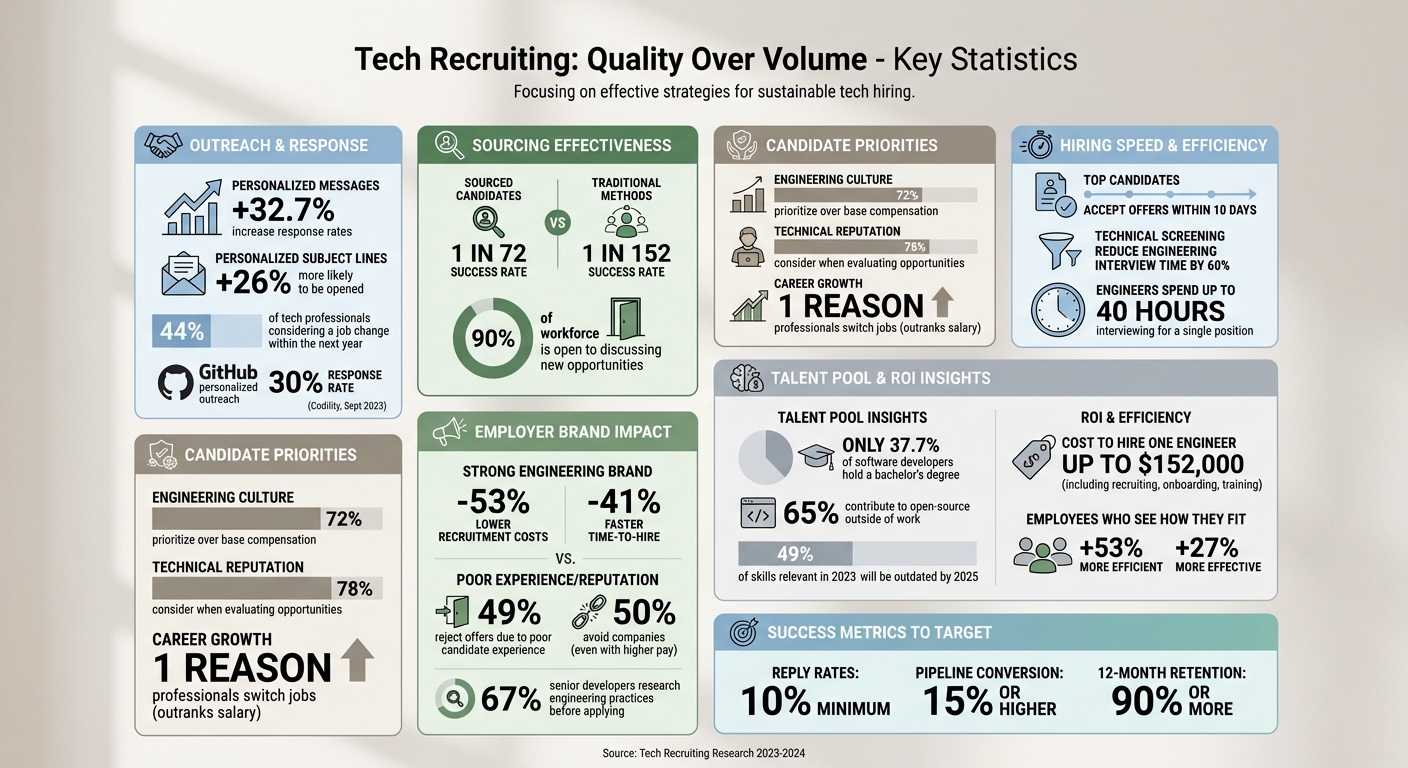 {Tech Recruiting Statistics: Quality Over Volume Approach}
Define Your Ideal Developer Profile
Crafting the ideal developer profile is like setting your recruiting compass - it guides you toward candidates who not only meet the technical requirements but also thrive in the role. Without this clarity, you risk wasting time on candidates who might look impressive on paper but fall short in practice.
Start by outlining what success looks like during the first 30, 60, and 90 days on the job. Forget vague experience requirements like "5+ years in the industry" and focus instead on concrete, outcome-based milestones. For instance, set goals like successfully onboarding a critical feature or delivering measurable performance improvements within the first month. These clear benchmarks help you identify the qualities you actually need - whether it’s quick problem-solving, adaptability, or expertise in distributed systems - rather than relying on arbitrary experience metrics.
Here’s a surprising stat: only 37.7% of software developers hold a bachelor’s degree . If you’re making a degree a hard requirement, you’re cutting out more than 60% of potential candidates right away. Instead, focus on skills and practical assessments that measure real-world abilities. Trimming unnecessary requirements - like education prerequisites - can help you broaden your talent pool while reducing bias. Remember, every "nice-to-have" requirement you list could unintentionally limit your reach.
Identify Technical and Cultural Requirements
Be crystal clear about the technical environment your team works in. Developers care deeply about the tools and frameworks they’ll use, whether it’s React versus Angular, monolithic versus distributed architectures, or tackling legacy systems versus starting fresh with greenfield projects. Use the skills of your top performers as a benchmark when defining your ideal candidate.
But technical skills are only half the equation. Cultural alignment is just as critical. Look for qualities like adaptability, strong communication, and problem-solving approaches that fit your team’s workflow. If you’re a remote-first company, prioritize candidates who excel at asynchronous communication and self-management. Reviewing open-source contributions - something 65% of professional developers engage in outside of work - can give you insight into their collaboration and communication skills in real-world contexts. Be upfront about challenges such as working with a lean team or managing legacy code so candidates with matching goals can self-select.
Beyond immediate technical and cultural fit, think about how candidates align with your team’s long-term direction and growth.
Consider Career Goals and Growth Potential
Career growth is the top reason professionals switch jobs - it even outranks salary . Ignoring a candidate’s long-term aspirations during the hiring process could lead to higher turnover. Ask yourself: does this role align with their career goals, both now and in the future? For example, if a candidate aspires to leadership but your company lacks a clear advancement path, they might leave sooner than expected.
Instead of focusing solely on technical expertise, prioritize candidates’ potential and mindset. Nearly 49% of the skills relevant in 2023 will become outdated by 2025 . While technical skills can be taught, qualities like adaptability and a growth-oriented mindset are much harder to cultivate. During initial conversations, explore their career trajectory - do they want to specialize in a niche area or take on cross-functional roles? Can your organization offer mentorship, upskilling opportunities, or internal mobility? When employees see how they fit into the bigger picture, they’re 53% more efficient and 27% more effective . Offering a clear growth roadmap during the hiring process can make a big difference in attracting the right talent.
Focus on High-Quality Sourcing Channels
Sourced candidates are over twice as effective, with a success rate of 1 in every 72 hires compared to 1 in every 152 through traditional methods . Interestingly, 90% of the workforce is open to discussing new opportunities, even if they’re not actively searching . The real challenge isn’t finding developers - it’s finding them in the right spaces. High-quality sourcing means identifying where developers naturally spend their time, rather than relying on cold outreach in places they rarely visit. These targeted channels pave the way for more meaningful and personalized outreach strategies.
Use Developer Communities and Networks
Start by focusing on platforms where developers actively contribute, learn, and build their reputations. GitHub and Stack Overflow are more than just repositories of code - they offer a glimpse into how developers think and work. For instance, a green GitHub contribution graph or repositories with over 100 stars can signal consistent activity and strong community recognition . But don’t stop at the code. Look at how developers handle bug reports, collaborate on pull requests, and communicate within projects. These interactions reveal communication and teamwork skills that aren’t always evident on a resume.
In September 2023, Codility's technical recruiting team achieved a 30% response rate on GitHub by personalizing outreach emails. They referenced specific technical challenges and tech stacks relevant to the candidates, showing that research into a developer’s actual work truly pays off .
Beyond GitHub, consider niche communities on Discord, Slack, and Reddit (such as r/programming or r/rust), where developers discuss frameworks, languages, and industry trends. Open-source projects like React, Kubernetes, or TensorFlow also offer direct access to developers deeply familiar with these technologies. Tools like daily.dev Recruiter take this a step further by connecting you with passive talent during their daily workflows - where they’re learning, reading, and engaging, rather than maintaining a static profile that’s rarely updated.
Attend Industry Events and Meetups
Face-to-face interactions at tech conferences, hackathons, and local meetups can build trust faster than any online message. While digital channels are competitive and crowded, attending events like PyCon, KubeCon, or React Summit puts you in front of developers who are actively honing their skills. These settings foster stronger, less competitive connections.
Hackathons, which typically last 24 to 48 hours, allow you to see developers in action - solving problems under pressure, collaborating with teammates, and tackling real technical challenges. Events like "Women in Tech" career fairs are also excellent for connecting with underrepresented talent and building a more diverse pipeline.
Hosting your own meetups can be another effective way to engage with developers. Encourage your engineering team to scout for talent when attending conferences; warm introductions from colleagues often lead to much higher response rates than cold outreach. Be sure to follow up quickly after meeting someone in person - while the conversation is still fresh. Speed is critical, as top technical candidates often accept offers within 10 days .
"The best engineers rarely apply through job boards. Sourcing strategies must be proactive, targeted, and people-first." – Samantha Troman-Mason, X-Team
Create Personalized and Impactful Outreach
Once you've identified developers, the next step is crafting messages that truly stand out. Personalized subject lines are 26% more likely to be opened, and with 44% of tech professionals considering a job change within the next year, the opportunity to connect is significant . By combining targeted sourcing with tailored outreach, you can turn initial interest into genuine engagement.
Research Candidates Thoroughly
Finding the right developers is just the beginning; understanding them is what sets your outreach apart. Dive into their work - whether it’s a GitHub repository, a blog post, or a presentation they’ve given. For example, referencing something specific like, "I really enjoyed your talk on GraphQL at JSWorld '24," shows you’ve taken the time to learn about them .
Don’t stop at their code. Look at how they communicate - do they write clear and thoughtful issue reports on GitHub? Are their contributions to projects like Django or React accompanied by well-written summaries? These details can reveal not just technical expertise but also collaboration and communication skills .
To ensure your outreach resonates technically, collaborate with your engineering team. A hiring manager’s input can help refine your message, replacing generic phrases like "modern JavaScript frameworks" with specifics such as "React 18, TypeScript, and Node.js" . This level of detail adds credibility and makes your message more compelling.
Show Genuine Alignment
Your message should reflect how the role aligns with the candidate’s career aspirations and interests. For example, if a developer has been actively contributing to Rust projects, highlight that your team is building infrastructure in Rust and explain why their experience would be a great fit . Including key details like the salary range and tech stack upfront shows transparency and saves time for both sides .
To make the outreach feel personal, mention leadership interest. For instance, noting that the CTO or hiring manager is eager to connect about their expertise can make the candidate feel valued . Instead of diving straight into a job pitch, start with a softer approach - invite them for a brief chat or coffee to discuss their goals and interests .
Avoid using gimmicky or overly casual language like "Hey buddy", as it can come across as unprofessional or insincere. A professional yet approachable tone works best, demonstrating respect for the developer’s varied communication preferences . If you don’t get a response right away, follow up politely after a week, and consider sending another note a few months later with a relevant update, like news about a product launch. Patience and consistent, respectful follow-ups can help build trust over time.
"The great software developers, indeed, the best people in every field, are quite simply never on the market." – Joel Spolsky, Chairman and Co-founder, Stack Overflow
Build and Maintain Long-Term Talent Relationships
After personalized outreach, the next step is nurturing long-term relationships to keep your talent pipeline thriving. This goes beyond just filling immediate roles - it's about creating a steady network of skilled professionals who may not be actively job hunting but could be open to future opportunities. Think of it as building a proactive recruiting system, sometimes referred to as Talent Architecture. When a role opens up, you'll already have a pool of pre-qualified engineers ready to engage.
"You can't out-spend Big Tech, but you can out-nurture them." – Index.dev
Stay Connected Without Overwhelming
Keeping in touch with developers doesn’t mean bombarding them with job offers. Instead, focus on sharing content that’s genuinely useful or interesting. For example, you could provide technical case studies like scaling Kafka to handle billions of messages, invite them to exclusive Slack groups for developers, or share updates on open-source projects.
Set up a rhythm for communication - maybe a technical insight one month, a roundtable invite the next, followed by a casual check-in. Let candidates choose how they want to stay in touch, whether through email, LinkedIn, or another channel, and respect their preferences for frequency. Using a CRM to group candidates by skills, experience level, and availability ensures your messages are tailored and relevant. This kind of thoughtful engagement builds trust over time.
Establish Trust and Credibility
Developers appreciate honesty and substance over flashy pitches. Be upfront about technical challenges, salary ranges, and company culture - vagueness or withholding details like compensation can be an immediate deal-breaker. When communicating, aim for an 80/20 balance: 80% of your outreach should focus on offering value, like industry insights or educational content, while only 20% should mention job opportunities.
Adopt a "give first" approach by contributing to the developer community without expecting immediate returns. This might include sponsoring meetups, supporting open-source initiatives, or hosting informal "ask me anything" sessions with your engineering leaders. These low-pressure interactions show your genuine commitment to the community and help establish credibility.
It’s worth noting that nearly half of candidates would avoid working for a company with a poor reputation, even if the pay is higher . Regularly survey your talent pool to identify and address any cultural concerns. When reaching out about a role, make it personal - reference a GitHub project, a conference talk, or a blog post they’ve authored. Don’t forget about “silver medalists” (candidates who made it to the final interview stages) or former interns; they’re already familiar with your company and could become valuable additions to your talent network .
Use Data and Tools to Support Human-Centered Recruiting
When it comes to personalized recruiting, leveraging data and advanced tools can fine-tune your approach. These resources not only help streamline repetitive tasks but also free up valuable time for what matters most: building genuine connections with developers. By focusing on meaningful metrics and automation, you can shift your energy toward creating a more human-centered recruiting experience.
Measure Key Recruiting Metrics
Rather than chasing sheer numbers, focus on tracking metrics that emphasize quality. For example, keep an eye on qualified candidates per opening - those who pass the initial screening - and monitor time-to-hire to spot bottlenecks like slow approvals or scheduling issues . Another crucial measure is the quality of hire, which reflects your process through retention rates and hiring manager satisfaction, ensuring you're bringing in developers who will succeed over the long term.
Take Talking Rain as an example. By analyzing their ATS data, they realized their heavy reliance on referrals was narrowing their candidate pool. Adjusting job descriptions and diversifying their job postings led to a significant shift: female applicants increased from 22% in 2020 to 50% in 2021, and BIPOC candidates rose from 32% to 41% .
Another insightful metric is candidate NPS (cNPS), gathered through post-interview surveys to evaluate the candidate experience. Spreetail, for instance, discovered through cNPS feedback that rejected candidates wanted more detailed responses. By implementing personalized feedback, they improved the candidate experience and successfully supported over 1,000 hires .
"It's not about perfection [when it comes to using talent acquisition insights]. It's about reviewing the data, adjusting accordingly, and keeping the train on the track."
- Christina Schmit, Director of Talent & Culture at Renewal by Andersen
Armed with these insights, advanced tools can further refine and simplify your recruiting process.
Use Advanced Sourcing and Screening Tools
Tools like ATS or CRM platforms, such as Lever or Greenhouse, are game-changers for centralizing candidate data, automating communication, and tracking the health of your talent pipeline . Atlassian, for example, used Lever to distribute a bi-monthly newsletter that grew their talent community by 47.5% annually. This effort reached 13,000 active members, achieved a 62% open rate, and led to nearly 300 hires .
For technical roles, platforms like CodeSignal help streamline the screening process by objectively evaluating skills early on. This approach has been shown to reduce engineering interview time by over 60% . Considering engineers often spend up to 40 hours interviewing candidates for a single position , this kind of efficiency is invaluable. Similarly, Cogent Biosciences used Lever's Visual Insights to speed up hiring and improve offer acceptance rates .
When sourcing passive talent, Boolean search techniques can be a powerful tool. For example, you can use queries like site:github.com machine learning or site:angel.co backend engineer to find developers active on niche platforms . Tools like daily.dev Recruiter take this a step further by facilitating warm, double opt-in introductions, ensuring your outreach feels welcome rather than intrusive.
Align Recruiting Efforts with Your Employer Brand
Tying your recruiting efforts to your employer brand strengthens your ability to attract top talent. Think of your employer brand as the natural extension of your recruiting strategy - it showcases your engineering culture, values, and technical environment. When done well, it resonates with developers who share your mission and vision. And the numbers back this up: 72% of developers prioritize engineering culture and practices over base compensation, while 78% consider a company's technical reputation when evaluating opportunities . Companies that focus on building a strong engineering brand also see tangible benefits, including 53% lower recruitment costs and a 41% faster time-to-hire .
The trick lies in balancing honesty with ambition. Developers can spot overly polished messaging instantly. In fact, half of candidates reject companies with a poor reputation . Instead of glossing over challenges like technical debt or limited resources, be upfront about how you're addressing them. This kind of transparency not only builds trust but also sets clear expectations, which can lead to better retention in the long run.
Use Real Employee Stories
Generic messaging doesn’t cut it - real stories from your team make a much bigger impact. Take Alloy Financial, a fintech company with 270 employees, as an example. In 2024, they shared their journey of transitioning from a monolith to microservices. This detailed account of their engineering challenges and solutions led to a 127% increase in qualified applicants, an 87% improvement in offer acceptance rates, and 18 unsolicited applications from senior engineers at leading tech companies .
Creating content like "day-in-the-life" stories can also provide valuable insights. Show candidates how engineers spend their time - how much is dedicated to meetings versus deep work, how code reviews are structured, and how teams collaborate on production issues. Sharing stories about architecture evolution or production incident retrospectives on your engineering blog can help potential hires visualize their role and appreciate the depth of your team's problem-solving approach.
"Great developers don't just want jobs - they want to join engineering stories worth being part of." - Full Scale
Encourage your engineers to become ambassadors for your brand. Whether it’s speaking at conferences, contributing to open-source projects, or engaging on social media, these activities send a strong message. When candidates see your team actively participating in the tech community, it demonstrates a culture of growth and technical excellence. This personal element naturally connects with benefits that matter to developers.
Highlight Developer-Focused Benefits
For developers, technical challenges, learning opportunities, and clear career paths often outweigh salary considerations. Be specific about what you offer. Instead of vague promises about professional development, highlight tangible initiatives like conference budgets, mentorship programs, and dedicated learning time. Document your career frameworks with clear timelines for advancement, and make it easy for candidates to understand the paths available - whether they’re interested in technical leadership or management .
Be transparent about your technology stack and decision-making process. A simple table outlining your current stack, why you chose it, and where you’re headed can go a long way. This level of detail helps candidates assess whether your tools and philosophies align with their interests.
It’s also important to address work-life balance. Highlight policies like remote work, flexible hours, and strategies to protect focus time from excessive meetings. With 67% of senior developers researching a company's engineering practices before applying , make sure this information is easily accessible on your careers page. Include details like internal diversity statistics, core values, and FAQs to answer common candidate questions. These elements help round out your employer brand and make it more appealing to the developers you want to hire .
Conclusion
Building a recruiting engine that prioritizes quality over quantity transforms hiring from a reactive process into a proactive strategy. By keeping a "warm bench" of pre-qualified candidates who are already familiar with your mission and tech stack, you're not starting from scratch every time a position opens. This approach works hand in hand with targeted sourcing and relationship-building efforts.
The benefits are backed by numbers: personalized recruitment messages see response rates improve by 32.7% compared to generic ones , and 49% of tech candidates have turned down offers due to poor candidate experiences . When you factor in the potential cost of hiring a single engineer - up to $152,000 when including recruiting, onboarding, and training expenses - it's clear that focusing on quality delivers long-term value.
Tracking metrics like reply rates (aim for at least 10%), pipeline conversion (target 15% or higher), and 12-month retention rates (set a goal of 90% or more) helps ensure your strategy is on the right track . These benchmarks allow you to move beyond theory and put a high-impact recruiting strategy into action.
Quality recruiting doesn't demand an overnight transformation. It's about nurturing relationships, respecting candidates' time, and treating hiring as a critical driver of growth. Each step, from crafting detailed candidate profiles to sending personalized outreach, contributes to building a sustainable recruiting system. Start small - implement one change today and build momentum from there.
FAQs
How does personalized outreach help attract top tech talent?
Recruiters can build trust and credibility with developers through personalized outreach. By focusing on a developer’s specific skills, experiences, and career aspirations, tailored messages show genuine interest and make candidates feel appreciated. This approach is especially effective for engaging passive talent - those who aren’t actively searching for new opportunities.
Investing time to research and create thoughtful, relevant messages helps recruiters form stronger connections. This strategy doesn’t just improve response rates; it also lays the foundation for meaningful relationships. As a result, recruiters can attract top-tier tech talent without resorting to mass, impersonal outreach.
What makes an ideal developer profile?
An ideal developer profile is a blend of technical expertise, relevant experience, and personal qualities that align with your company’s objectives and workplace culture. On the technical side, this often means having a solid track record with specific programming languages or technologies. This could be demonstrated through coding tests, contributions to open-source projects, or a portfolio of past work. Active involvement in developer communities or platforms is another great indicator of a candidate’s commitment to continuous learning and passion for their craft.
But technical skills alone aren’t enough. Soft skills like problem-solving, adaptability, and clear communication are just as crucial. These abilities are vital for effective collaboration and navigating challenges, especially in team-driven environments. Beyond skills, a strong cultural alignment - shared values, a compatible work ethic, and a connection to your company’s mission - plays a key role, particularly in remote or hybrid work setups. Balancing technical know-how with interpersonal strengths creates the foundation for a truly standout developer profile.
Why is hiring for cultural fit essential in tech recruiting?
Hiring for cultural fit plays a crucial role in tech recruiting. It ensures that new team members share your company’s values, adapt well to its work style, and blend seamlessly with team dynamics. When employees feel in sync with the culture, they’re more likely to collaborate effectively, remain engaged, and contribute positively to the workplace.
Prioritizing cultural fit isn’t just about harmony - it’s a smart way to minimize turnover. By reducing the need for constant rehiring, you save both time and money. Plus, employees who feel a strong connection to their workplace tend to be more loyal, motivated, and productive. In the fast-moving tech world, hiring for cultural fit strengthens team bonds and encourages creativity, laying the foundation for sustained growth and success.
.png)