DevOps engineers often show interest in new roles without formally applying. They leave subtle clues through their online activities, such as contributing to open-source projects and developer communities, earning certifications, or engaging with company content. Recognizing these signals early can help recruiters connect with top talent before competition intensifies.
Key behaviors to watch for include:
- Open-source contributions: Consistent work on repositories like Kubernetes or Terraform.
- Forum activity: Increased participation in discussions about trending tools like GitOps or CI/CD workflows.
- Content engagement: Interacting with your blogs, webinars, or white papers.
- Publishing expertise: Sharing tutorials or thought leadership posts.
Using tools like daily.dev Recruiter, which tracks real-time developer engagement, can simplify identifying these signals. By focusing on personalized outreach using effective recruiter email techniques and engaging with developer communities, recruiters can build relationships with skilled engineers before they officially enter the job market.
How DevOps Engineers Show Interest Before Applying
DevOps engineers often leave subtle traces of interest in new opportunities without ever formally applying. These passive signals show up in their everyday online activities - things like commenting on discussions about infrastructure, starring repositories for Kubernetes, or updating their profiles with fresh AWS certifications. These actions reveal they’re exploring their options, but in a quiet, indirect way.
This is important because top DevOps talent isn’t usually active on job boards. They’re already employed, often content in their roles, but still open to the right opportunity. By observing their online habits, you can uncover what excites them professionally - whether it’s container orchestration, CI/CD pipelines, or cloud-native systems. Spotting these signals early gives you a chance to connect with them before they’re inundated with recruiter messages or noticed by your competitors.
Why Early Signals Matter in Recruitment
Catching these early, subtle activities can give you a real edge. It allows you to reach out with tailored, thoughtful communication before the flood of generic recruiter messages starts. Engaging with engineers while they’re still exploring new tools or technologies lets you build meaningful relationships early on.
This approach shifts recruitment from being a numbers game to a more strategic process. Instead of focusing on volume, you focus on quality - connecting with the right people at the right time. And the next step? Paying attention to their activity in developer communities for even more insights.
How Developer Communities Reveal Interest
DevOps engineers naturally gravitate toward communities where they can learn, share, and stay up to date with the latest tech. Their involvement in these spaces not only showcases their expertise but also highlights the tools and methodologies they’re passionate about. Whether they’re answering Terraform-related questions, discussing GitOps workflows, or sharing tips on monitoring, their activity says a lot.
If you notice an engineer suddenly becoming active in discussions about a specific technology, it’s often a sign they’re either working with it or considering roles that involve it. These interactions provide valuable insights that go hand-in-hand with the technical signals mentioned earlier. For recruiters who know where to look, this kind of engagement offers a clear advantage in identifying and connecting with top talent.
Hiring engineers?
Connect with developers where they actually hang out. No cold outreach, just real conversations.
4 Signals That Show a DevOps Engineer's Interest
::: @figure 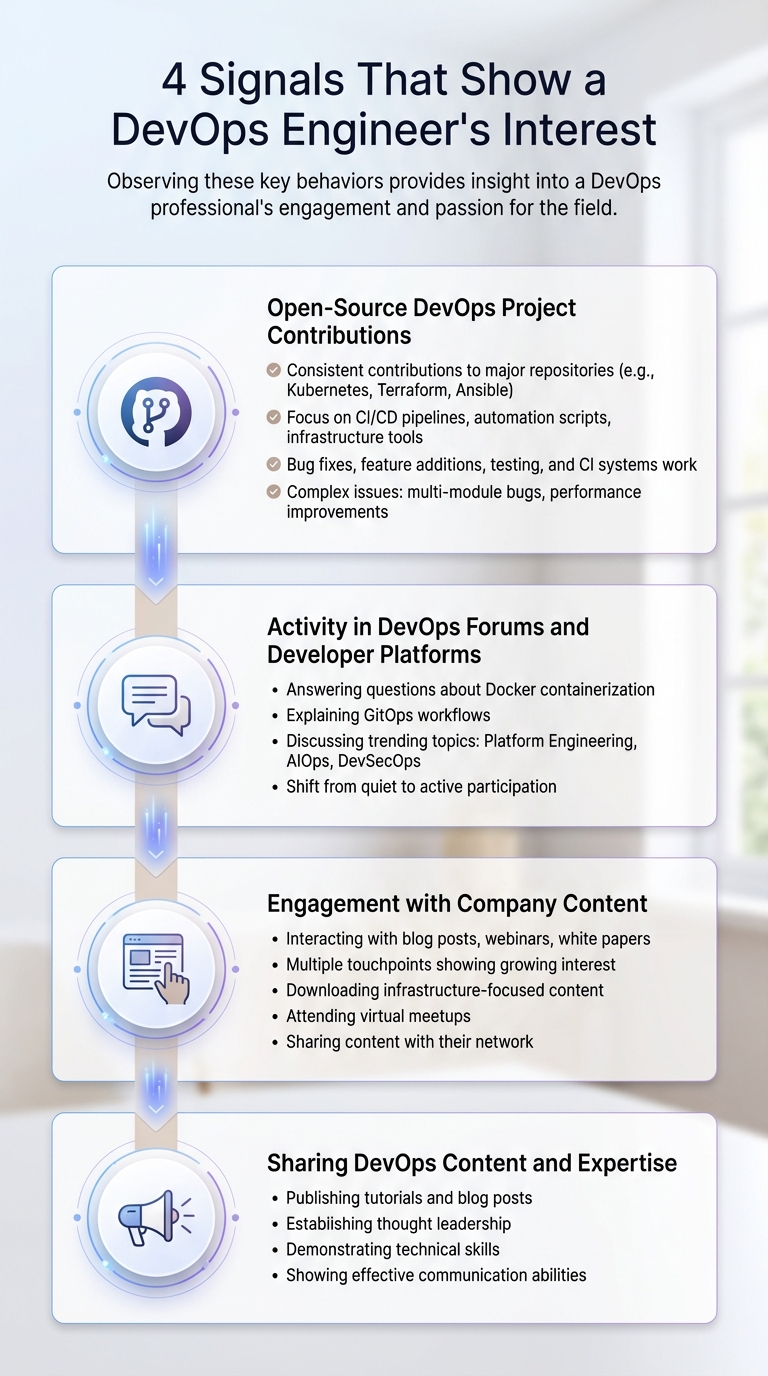 {4 Key Signals DevOps Engineers Show Before Applying for Jobs}
Now that you know where to focus, let’s dive into specific behaviors that can reveal when a DevOps engineer might be open to new opportunities. These signals go beyond casual curiosity and often point to active career exploration, giving recruiters a clearer picture of their intent.
Open-Source DevOps Project Contributions
When a DevOps engineer shifts from occasional fixes to consistent contributions in major repositories, it’s a strong indicator they’re building a professional portfolio. Look for work on projects like Kubernetes, Terraform, or Ansible, especially in areas like CI/CD pipelines, automation scripts, or infrastructure tools. The type of contribution matters - bug fixes and feature additions highlight technical expertise, while work on testing or CI systems reflects knowledge of professional workflows . Consistent, meaningful commits over time, particularly on complex issues like multi-module bugs or performance improvements (e.g., reducing latency or increasing throughput), suggest a deeper level of engagement and intent.
Activity in DevOps Forums and Developer Platforms
Active participation in forums and platforms can signal more than just expertise - it shows proactive networking. An engineer who was previously quiet but starts answering questions about Docker containerization or explaining GitOps workflows is likely increasing their visibility. Pay attention to discussions about trending topics such as platform engineering, AIOps integration, or DevSecOps . Their focus on these areas can provide insights into the technologies they’re passionate about and where they might want to grow their career.
Engagement with Company Content
When an engineer repeatedly interacts with your technical content - like blog posts, webinars, or white papers - it’s a clear sign they’re evaluating your tech stack and company culture. Multiple touchpoints, such as downloading an infrastructure-focused white paper, attending a virtual meetup, and sharing your content with their network, show growing interest. This creates an excellent opportunity for personalized outreach.
Sharing DevOps Content and Expertise
Engineers who start publishing their own technical content, like tutorials or blog posts, are actively establishing themselves as thought leaders. This kind of activity often aligns with career growth and a desire for professional collaboration. It also demonstrates not just technical skills but the ability to communicate effectively - qualities that are highly valuable in any team setting.
How daily.dev Recruiter Helps You Spot These Signals

daily.dev Recruiter simplifies the hiring process by gathering behavioral data from the platforms DevOps engineers use regularly. Manually identifying these early signals - like reading technical articles, participating in discussions, or honing skills - can be time-consuming. This platform does the heavy lifting for you.
Using Developer Engagement Data
Rather than relying on static profiles, daily.dev Recruiter tracks what developers are actively doing. For instance, when DevOps engineers engage with topics like Kubernetes, Infrastructure-as-Code, or Platform Engineering, the platform captures these actions in real time. This real-time tracking uncovers intent weeks before they update their resumes .
Currently, 24% of the active network is focused on DevOps and Cloud topics. Recent stats show a 12% growth in engagement with Kubernetes and Platform Engineering content . Instead of sifting through outdated LinkedIn profiles, you can see which engineers are actively learning the technologies your team needs.
Connecting with Passive, Pre-Qualified Developers
daily.dev Recruiter uses a double opt-in introduction system, ensuring that both you and the developer are interested before a conversation begins. Developers review key details about your role - such as the tech stack, salary range, and work model - and decide if they want to connect. This eliminates spammy cold outreach.
Thanks to this approach, introductions through daily.dev Recruiter achieve response rates of 85-90%, compared to less than 20% for LinkedIn InMails . You’ll only engage with DevOps engineers who’ve already shown interest in your opportunity.
Simplifying Your Recruitment Process
The platform pulls together all the scattered signals - like open-source contributions, forum activity, certification updates, and content engagement - into a single, actionable dashboard. Its AI matches candidates based on what they’re currently building and learning, while also verifying details like timezone, location, and seniority level. Plus, it integrates seamlessly with ATS tools like Greenhouse, Lever, and Ashby, so candidate data syncs automatically.
Companies report saving 37 hours per hire and doubling hiring speed . The pricing is straightforward too: a flat monthly fee per active role, with no placement fees or long-term commitments .
3 Ways to Engage DevOps Engineers Early
Engaging DevOps engineers before they even consider applying requires building authentic relationships. The secret? Offer value upfront and steer clear of anything that feels like a sales pitch.
Personalized Outreach Based on Their Activities
DevOps engineers tend to ignore generic messages. Instead, tailor your outreach by referencing specific actions they've taken - like a recent pull request, a forum comment, or even a new certification. For example, in early 2024, Netflix recruiters joined the CNCF Slack #kubernetes channel, participated in discussions about autoscaling, and shared a blog post on their observability stack using Prometheus. This strategy led to 12 direct conversations with passive DevOps engineers, resulting in 3 hires within 90 days - a 25% conversion rate .
Here’s an example of a strong, personalized message:
"Hi [Name], I saw your recent Terraform module contribution to [Repo] - great work on optimizing multi-cloud provisioning! At [Company], we're tackling similar scalability challenges with Ansible and GitHub Actions. I'd love to hear your thoughts on integrating Sentinel policies - can we chat briefly next week?"
This kind of message shows you’ve done your homework and frames the conversation as peer-to-peer rather than a recruitment pitch. Personalized messages referencing specific contributions achieve a 40% open rate and 15% response rate, compared to just 5% for generic outreach . By starting with this level of care and specificity, you set the tone for deeper engagement within the community.
Participating in Developer Communities
Joining and contributing to DevOps communities can establish credibility in a way that cold outreach never could. Spaces like Reddit’s r/devops, DevOps Discord servers, HashiCorp forums, and Kubernetes Slack channels are great starting points. Take the first 1–2 weeks just to observe. Understand the community norms before jumping in. Then, contribute by sharing helpful content - like a troubleshooting tip for Jenkins pipelines, a blameless post-mortem example, or advice on CI/CD challenges .
The numbers back this up: 74% of DevOps professionals participate in online communities weekly, making these spaces ideal for early engagement . Companies that actively engage in these communities report 2.5x faster hiring times for senior DevOps roles . The key isn’t to recruit directly in these spaces but to build trust by showing you understand their challenges and can speak their language. Sharing insights about your company culture can further strengthen these connections.
Sharing Your Company Culture and Opportunities
DevOps engineers value transparency. Instead of vague claims about your tech stack or workplace, share candid details. Post case studies on platforms like Medium or LinkedIn about real projects - such as "How We Reduced Deploy Time by 50% with Blue/Green Deployments via Argo" - and tag active community members for their input . 68% of DevOps engineers prefer companies that openly discuss failure stories and technical hurdles before they apply .
Be upfront about your stack (e.g., React 18, Go, Kubernetes), salary ranges ($140,000–$170,000), and cultural practices like blameless post-mortems or cross-team collaboration. Video tours showcasing team rituals, internal runbooks, or lunch-and-learn sessions can give engineers a clear picture of what it’s like to work with you . Providing these specific details allows candidates to assess whether they’re a good fit, making future conversations more productive.
Using these three strategies, recruiters can establish meaningful connections with DevOps engineers long before they even consider applying. This early engagement lays the groundwork for stronger relationships and better hiring outcomes.
Conclusion
DevOps engineers often signal their interest in subtle ways - through open-source contributions, active participation in forums, earning certifications, sharing content, or engaging directly with the community. Recognizing these passive signals gives recruiters a major edge, especially in a market where demand for skilled DevOps professionals far exceeds the available talent pool. With the shortage of top-tier engineers, using effective interviewing techniques for hiring DevOps engineers and identifying potential hires early can be the deciding factor between securing a great candidate or losing them to a competitor.
The secret lies in acting on these signals promptly and with authenticity. By monitoring GitHub activity, tracking certifications like AWS Certified DevOps Engineer, and participating in spaces like r/devops or Kubernetes Slack channels, recruiters can spot passive candidates who demonstrate both technical skills and a collaborative mindset. Interestingly, candidates sourced through these methods tend to stay longer - studies show retention rates are 20–30% higher when candidates make a thoughtful move rather than a reactive one. This proactive strategy ensures not just finding the right talent, but also building teams that last.
Tools like daily.dev Recruiter make this process seamless by leveraging real-time developer engagement data to connect recruiters with pre-qualified DevOps engineers. Instead of relying on outdated databases or impersonal outreach, this approach focuses on connecting with engineers who are actively learning and contributing. Every introduction is warm and double opt-in, ensuring that you're engaging with candidates who are genuinely interested in exploring opportunities.
FAQs
What signals best predict a DevOps engineer is open to a new role?
Recruiters can spot potential candidates by observing certain key behaviors. These include updating profiles, earning new certifications, contributing to open-source projects, and participating in developer forums or niche communities. Even more subtle signs, like increased activity on professional platforms, receiving endorsements, or sharing promotion updates, can signal career growth.
By paying attention to these patterns, recruiters can identify motivated candidates early - often before they publicly signal that they’re "Open to Work." This proactive approach can make all the difference in connecting with top talent.
How can I track these signals without violating privacy or trust?
To ethically track interest signals, focus on publicly visible actions like contributions on GitHub, participation in forums, or involvement in open-source projects. Be active in developer communities, engaging in authentic ways that show genuine interest. When reaching out, make your communication personal and respectful to build trust.
Avoid intrusive tactics or collecting private data without consent. Always be transparent about your intentions and how you plan to use any information. This approach not only respects privacy but also strengthens trust and aligns with ethical recruitment standards.
What should I say in a first message based on a signal?
When sending your first message after spotting a signal of interest, aim for personalization, relevance, and clarity. Mention something specific about their work - like recent projects or their tech stack - and tie it to the role you're offering. Be upfront about important details, such as the salary range or job expectations. Keep your message short (under 125 words) and propose a no-pressure next step, like a brief call. Showing that you’ve done your homework can make a big difference in getting a response.
.png)