Finding top frontend engineers requires moving beyond job boards and resumes. The best talent often showcases their skills through open-source contributions, developer forums, and specialized platforms like daily.dev. Here's how to connect with them:
- Developer Networks: Tools like daily.dev Recruiter track real-time developer activity, focusing on skills and interests instead of static resumes. Features like a double opt-in system ensure meaningful connections.
- Open-Source Contributions: Platforms like GitHub reveal coding ability, collaboration skills, and technical depth. Use advanced search queries to find developers with specific expertise.
- Coding Communities: Forums like Dev.to, Stack Overflow, and Discord offer insights into problem-solving, communication, and technical knowledge. Engage with developers based on their contributions.
- Virtual Events: Attend frontend-focused events to interact with engineers showcasing their skills in live coding sessions and discussions.
Using Developer Networks like daily.dev Recruiter
Why Developer Networks Work
Developer networks connect with engineers in their natural professional spaces - places where they go to learn, explore, and develop their skills. Unlike traditional recruiting methods that often feel impersonal, these platforms integrate seamlessly into the daily routines of developers. Engineers turn to these networks to stay informed, and job opportunities presented in this context feel like logical next steps rather than intrusive pitches. The result? A stronger sense of trust and authenticity.
Here’s a key insight: 80% of developers on daily.dev are open to new opportunities, but 43% rarely respond to generic outreach because it lacks credibility and connection . These networks bridge that gap by creating an environment where career moves happen naturally.
Let’s break down how daily.dev Recruiter uses this trust-first approach to connect you with top talent.
How daily.dev Recruiter Works
daily.dev Recruiter redefines hiring by focusing on behavioral signals rather than outdated keyword searches. The platform tracks real-time data - like what developers are reading (e.g., articles on Next.js or Astro), their coding habits, and their involvement in the community. This allows recruiters to identify qualified technical candidates in minutes even before they officially update their resumes .
A standout feature of the platform is its double opt-in system, known internally as "TinDev." Here’s how it works: both you and the developer must express mutual interest before any communication begins . This eliminates cold outreach and ensures that every introduction is with a developer who’s genuinely interested in the role.
This approach is particularly effective for frontend roles. Forty-two percent of developers in the daily.dev network specialize in Web and React technologies . The platform even tracks engagement with cutting-edge tools like React 18, ensuring matches are highly relevant. Once a match is made, the candidate’s profile integrates directly into your ATS - whether you use Greenhouse, Lever, or Ashby - saving time and eliminating manual data entry .
As for pricing, daily.dev Recruiter keeps it simple: a flat monthly fee per active role. There are no placement fees or long-term contracts, making it a flexible and efficient solution .
Hiring engineers?
Connect with developers where they actually hang out. No cold outreach, just real conversations.
Finding Talent Through Open-Source Contributions
Open-source platforms like GitHub provide a transparent window into the work of frontend engineers - a space where developers actively show their skills. While resumes might list technologies, repositories reveal actual coding ability, problem-solving approaches, and collaboration efforts. Want to know if someone truly understands React? You can see their real-world usage in production code.
The biggest advantage? You can evaluate technical skills before even reaching out. A developer's commit history shows their coding practices, pull requests highlight how they communicate, and their choice of projects reflects their interests and passions.
Searching for Specific Technologies
GitHub's advanced search tools make it easy to find the expertise you're after. For example, you can use queries like language:typescript "full stack" (node OR nextjs) or language:javascript location:"New York" followers:>50 topic:react to identify frontend developers skilled in specific technologies . The "Trending" section on GitHub is another great spot to find developers creating with newer frameworks .
Other platforms like CodePen, JSFiddle, and Glitch offer a different perspective. Instead of static code, you'll find polished visuals, UI demos, and creative approaches that showcase design and user experience skills . These are especially helpful for assessing aesthetic sensibility and how developers approach user interaction.
Reviewing Open-Source Work
When evaluating open-source contributions, start by looking at pinned repositories. These often highlight a developer's best work and can provide insights into their code quality, documentation practices, and how they explain pull requests . Avoid basic tutorials, cloned projects, or to-do apps - they don’t demonstrate originality or advanced skills .
Activity matters too. Developers with 50+ pull requests in the past year are likely actively engaged, rather than maintaining outdated or abandoned projects . Referencing a specific commit or pull request in your outreach can increase response rates by 60% .
| Metric | Minimum Metrics | Why It Matters |
|---|---|---|
| Stars on Repos | 500+ | Validates the code's usefulness to others |
| Forks | 100+ | Shows that others are building on their work |
| Followers | 1,000+ | Indicates influence and recognized skill |
| PRs (Past Year) | 50+ | Confirms consistent and current activity |
Connecting in Coding Communities and Forums
Online communities like Dev.to, Reddit's r/Frontend, and Frontend Mentor provide a window into how developers think, communicate, and solve problems. Unlike static resumes or portfolios, these platforms highlight engineers in action - helping others, sharing insights, and addressing technical challenges. A developer who consistently offers thoughtful answers or tackles intricate coding exercises showcases not only their technical expertise but also their ability to engage with others. Developers who explain their solutions in detail and consider edge cases stand out as effective collaborators.
On platforms like Dev.to and Hashnode, look for articles that go beyond surface-level tutorials. In-depth pieces on topics like React Server Components or TypeScript edge cases signal a deeper understanding. Similarly, on Stack Overflow, reputation points and top tags (e.g., React or TypeScript) reflect consistent, valuable contributions. Communities like Reddit's r/Frontend and various Discord servers also reveal real-time problem-solving, where developers troubleshoot issues and provide constructive feedback. For example, discussions such as "Roast My Startup" highlight how developers analyze and critique projects collaboratively.
Finding Talent in Discussions and Challenges
Platforms like Frontend Mentor offer coding challenges that simulate real-world scenarios. Developers who complete these challenges demonstrate practical skills, such as responsive design, accessibility, and clean code organization. Their solutions often include live demos and GitHub repositories, giving a transparent view of their workflow and technical approach. Observing these projects also opens the door to understanding how developers communicate and collaborate in live discussions.
Pay attention to developers who explain their thought process thoroughly, address potential edge cases, and break down complex technical concepts. On platforms like Reddit, contributors who regularly troubleshoot issues or engage in discussions about cutting-edge tools - like WebAssembly or React Server Components - showcase skills that are increasingly critical for senior frontend roles .
Building Trust in Developer Communities
Beyond technical skills, authentic engagement within developer communities is key to building trust. Developers often value their community spaces highly, and studies show that 40% trust job opportunities more when they originate from communities they actively participate in . Generic outreach messages can harm credibility, so it's important to approach thoughtfully.
When reaching out, reference specific contributions - such as a published article, a completed coding challenge, or a detailed comment - to demonstrate genuine interest. Avoid mass messaging or copy-paste templates, as developers can spot them instantly. Tailored communication that acknowledges their work is far more likely to resonate.
Finding Engineers on Specialized Frontend Platforms
Using Stack Overflow and Hashnode
Stack Overflow is a goldmine for identifying frontend talent. Developers' reputation scores in tags like React, TypeScript, Vue.js, and CSS showcase their technical expertise. A high score in these areas often reflects a commitment to tackling tough challenges, along with strong problem-solving and communication skills.
But don’t just stop at the numbers - dig into the quality of their answers. Developers who provide detailed explanations, include code snippets, or address edge cases demonstrate not only technical know-how but also a grasp of current trends and best practices.
On Hashnode, you can gauge a developer’s expertise through their published articles. Topics like state management, performance optimization, or accessibility often highlight their depth of knowledge. Consistent writing and active participation in discussions reveal an ability to break down complex concepts - an essential trait for senior-level frontend professionals.
These platforms go far beyond static profiles, offering a glimpse into how developers think and communicate in real time.
Finding Talent in Discord Servers
Specialized Discord servers add another layer to your search. Communities like Reactiflux and other framework-focused groups give you a front-row seat to how engineers interact, collaborate, and solve problems on the fly. In these candid discussions, you’ll find developers who stand out by offering thoughtful advice, sharing resources, or helping others debug issues. These are the people who often make great mentors and team players.
Before you reach out and connect, spend time observing the community. Developers value authenticity - nearly 40% trust job offers more when they come from communities they already engage with . Mentioning specific contributions, like a clever debugging tip or a well-reasoned comment from a discussion, shows that you’re paying attention and genuinely interested.
This approach highlights a shift in hiring: from static resumes to dynamic, observable demonstrations of skill and collaboration.
Meeting Talent at Virtual Events and Meetups
Attending Frontend-Focused Events
Virtual events are a fantastic way to engage with talented frontend engineers while getting a closer look at their skills in action. These events bring opportunities for face-to-face interactions that go beyond resumes, offering a more personal glimpse into technical expertise. Take Frontend Nation, for example. This event attracts 50,000 active developers and features multi-day tracks on trending frameworks. Scheduled for February 28–March 1, 2026, it boasts over 40 speakers and includes live coding challenges. These sessions are a goldmine for recruiters, as they showcase how developers solve problems in real time across different frameworks. Volunteering at such events can also provide insight into community norms and help build authentic relationships with attendees . After the event, reaching out to developers who stood out is a critical step in building meaningful connections.
Connecting with Attendees and Speakers
Turning event interactions into lasting relationships requires thoughtful follow-up. The key is to be proactive during the event and intentional afterward. Start by keeping an eye on chat discussions and Q&A sessions to spot developers who are actively contributing to technical conversations. Before the event, make sure your profile is polished - use a clear photo and include your social media handles for a professional yet approachable vibe. During the event, participate in chats and leverage official hashtags to expand your visibility.
As Michelle Frechette from Post Status wisely says, "Listening is not wasted time waiting to connect. It is connection" . Focus on listening attentively and encouraging others to share their experiences rather than diving straight into job pitches. After the event, follow up within 48 hours. Mention something specific from your previous conversation to show genuine interest and establish trust. These small but meaningful gestures can go a long way in building authentic professional relationships.
Comparing Different Sourcing Channels
::: @figure 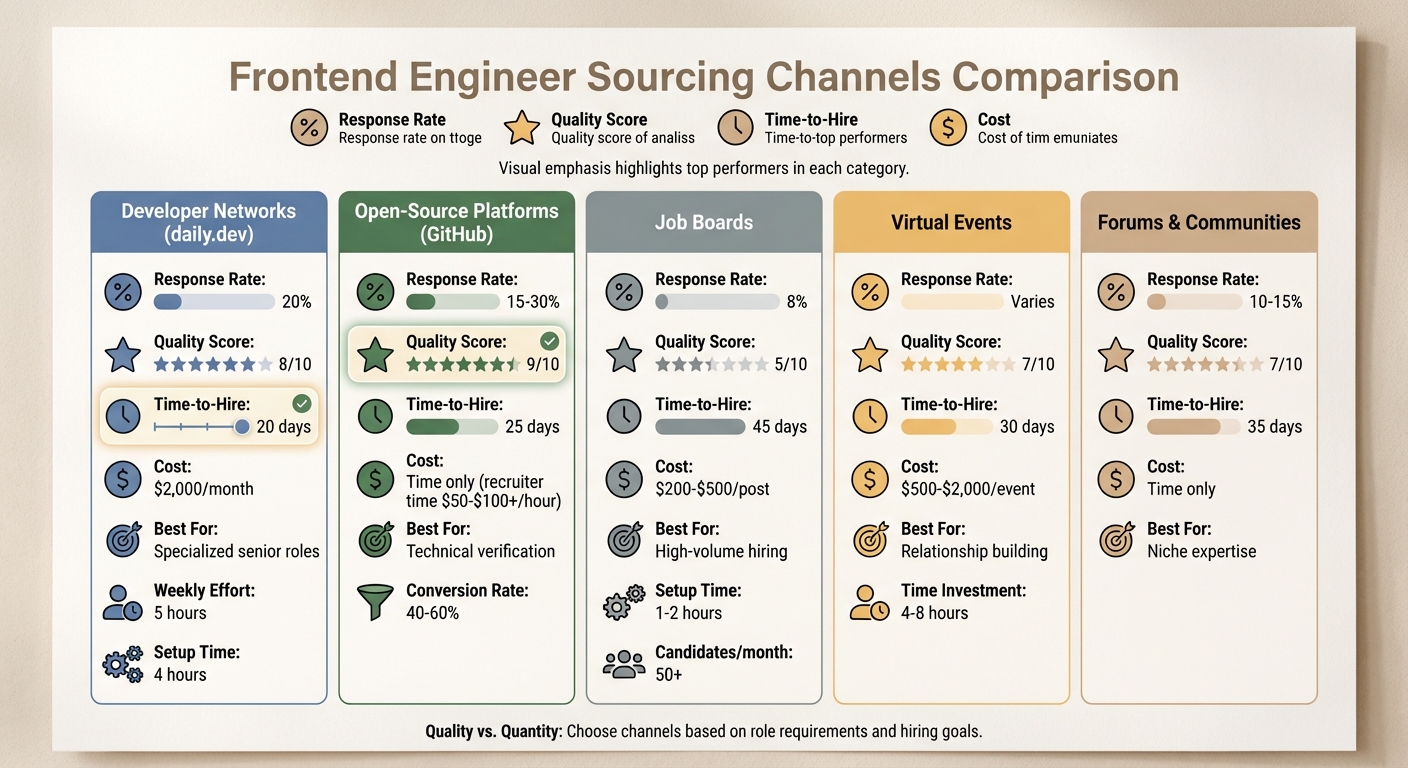 {Frontend Engineer Sourcing Channels: Response Rates, Quality Scores, and Costs Comparison}
Channel Comparison Table
Finding the right sourcing channel for frontend engineers is all about balancing quality versus quantity and time spent versus results achieved. Each option has its own set of pros and cons, which can directly impact your hiring strategy. The table below breaks down these differences across various channels.
Take developer networks like daily.dev Recruiter, for example. These platforms often yield 20% response rates, and candidates typically score 8/10 in quality assessments. Engaging with these networks requires around 5 hours of weekly effort, with an initial setup time of 4 hours. Monthly costs hover around $2,000. The payoff? Access to highly skilled engineers actively honing their expertise in areas like React, TypeScript, and web performance - making this a great choice for senior-level roles demanding deep technical knowledge.
On the other hand, open-source platforms offer a unique advantage: you can directly evaluate candidates’ coding skills and architectural thinking. While response rates range from 15-30%, conversion rates are much stronger at 40-60%, as the candidates who engage are often highly motivated. There’s little to no direct cost, but recruiter time - valued at $50-$100+ per hour - can add up quickly.
Traditional job boards, meanwhile, are quick and affordable to set up (1-2 hours and $200-$500 per post), generating over 50 candidates monthly. However, response rates drop to 8%, and the average quality score is just 5/10. Plus, the time-to-hire stretches to 45 days due to the sheer volume of applications to sift through.
Virtual events, though more expensive at $500-$2,000 per attendee, offer focused networking opportunities over 4-8 hours. These events are excellent for building relationships that can lead to multiple hires over time.
Here’s a closer look at how these channels stack up:
| Channel | Response Rate | Quality Score | Time-to-Hire | Cost | Best For |
|---|---|---|---|---|---|
| Developer Networks | 20% | 8/10 | 20 days | $2,000/month | Specialized senior roles |
| Open-Source Platforms | 15-30% | 9/10 | 25 days | Time only | Technical verification |
| Job Boards | 8% | 5/10 | 45 days | $200-$500/post | High-volume hiring |
| Virtual Events | Varies | 7/10 | 30 days | $500-$2,000/event | Relationship building |
| Forums & Communities | 10-15% | 7/10 | 35 days | Time only | Niche expertise |
If you’re hiring for roles that demand specialized tech skills, it’s worth prioritizing channels that emphasize quality. For instance, a $2,000 hire from a developer network who stays long-term often provides better ROI than a $300 hire from a job board with an 18-month tenure. By understanding these dynamics, you can confidently choose the channel that aligns with your hiring goals and priorities.
Conclusion
In this guide, we’ve delved into creative ways to discover genuine frontend expertise beyond traditional job postings.
The best frontend engineers aren’t waiting on job boards - they’re actively showcasing their skills on platforms like GitHub, Stack Overflow, and daily.dev. By connecting with developers where they naturally spend their time, you can tap into a pool of professionals who are constantly honing their craft.
Developer-focused networks such as daily.dev Recruiter encourage higher engagement, while open-source platforms provide an opportunity to verify technical skills right from the start. In fact, candidates in these spaces are 70% more likely to respond when approached with thoughtful, personalized messages . Once engaged, open-source evaluations often lead to impressive conversion rates of 40–60%.
Companies like Scribd and Roblox are already leveraging these strategies to streamline hiring and improve retention. Some studies suggest that validating candidate skills upfront can boost retention rates by 20–40% - a clear advantage in today’s competitive hiring landscape.
To get started, try dedicating 20% of your sourcing efforts to these non-traditional channels. Create a daily.dev Recruiter account for quick access to top talent, keep an eye on GitHub for developers using your tech stack, and join active Discord communities where frontend developers gather. Track engagement and quality metrics to identify the channels that consistently connect you with standout frontend engineers.
FAQs
How do I start sourcing frontend engineers without job boards?
To find frontend engineers without relying on job boards, focus on spaces where developers naturally gather and collaborate. Explore platforms like GitHub or GitLab to assess candidates' skills through their open-source contributions. Dive into forums such as Stack Overflow, Reddit, and Dev.to to engage with developers, participate in discussions, and build connections.
Take the opportunity to showcase your company’s strengths and culture in these spaces, creating a positive impression of your employer brand. Additionally, consider using specialized platforms that allow for personalized outreach, helping you connect with talented developers in their preferred environments.
What should I look for in a GitHub profile to assess frontend skill?
When reviewing a GitHub profile, pay close attention to the quality and complexity of their repositories. Check for recent commits and evidence of active contributions - these can reveal a lot about their consistency and dedication. Look for meaningful activity, like pull requests, issue tracking, or collaboration on open-source projects. These aspects showcase not only technical expertise but also teamwork and communication skills.
While metrics like stars and followers can offer some context, they shouldn't overshadow the actual quality of the work or the depth of engagement. Always prioritize substance over numbers.
How can I reach out in developer communities without sounding spammy?
To avoid coming across as spammy, focus on earning trust and providing real value. Tailor your outreach by mentioning specific projects or contributions they’ve made - this shows you’ve done your homework. Be upfront about key details like the tech stack, salary range, and remote work options.
Engage in a genuine way by joining conversations and offering thoughtful insights. Skip the generic, overly promotional messages. Instead, respect their time by keeping your communication relevant and meaningful. Prioritize building authentic connections over quick wins.
.png)