Hiring engineers quickly without compromising quality is possible. The key lies in optimizing your process through automation, structured assessments, and data-driven decisions. Here's how to do it:
- Automate repetitive tasks like resume screening, scheduling, and initial filtering using AI tools, cutting time-to-hire by up to 50%.
- Leverage platforms like daily.dev Recruiter to connect with pre-qualified developers who match your criteria, reducing wasted outreach.
- Use structured assessments and rubrics to ensure consistent evaluations while saving engineering time.
- Implement employee referral programs with clear incentives to tap into trusted networks for faster, high-quality hires.
- Track key metrics like time-to-hire, offer acceptance rates, and sourcing effectiveness to identify bottlenecks and improve efficiency.
::: @figure 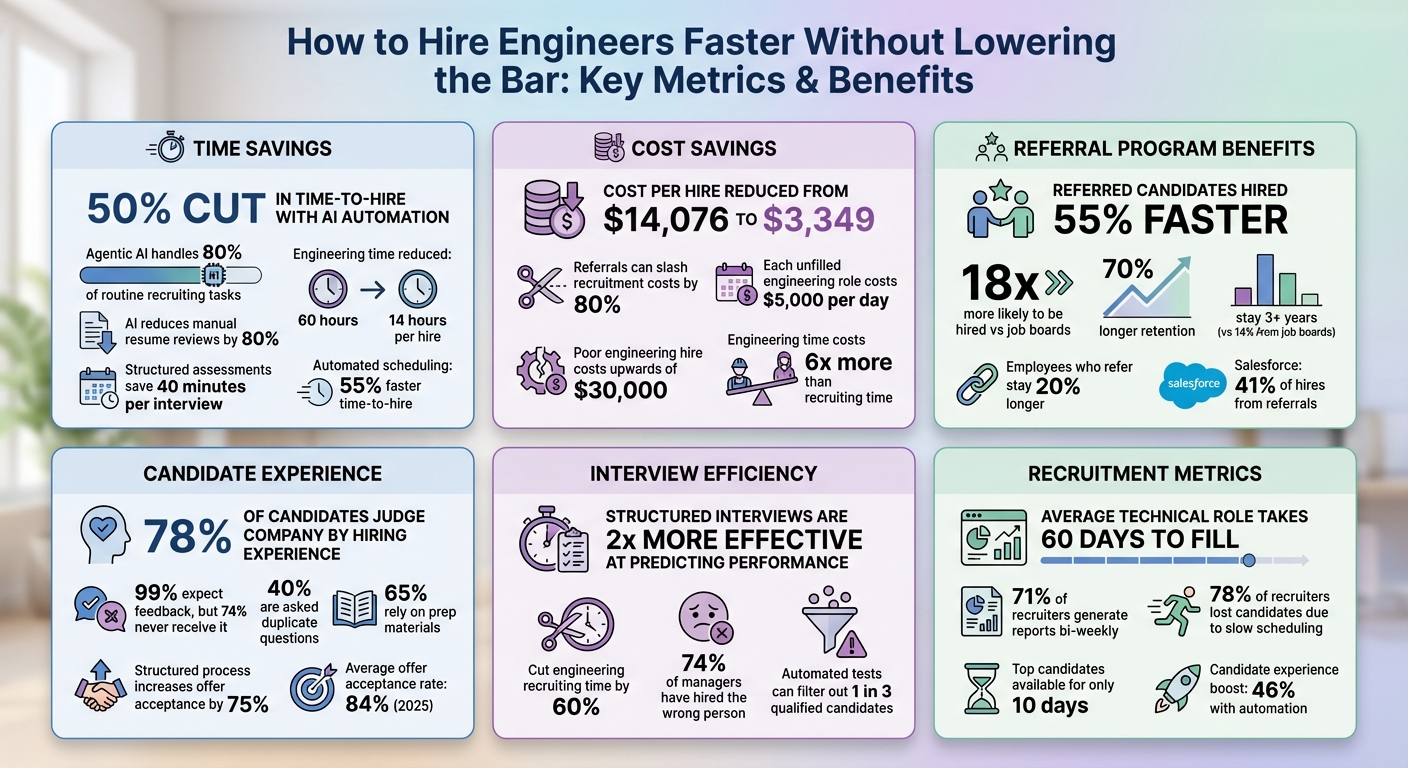 {Engineering Hiring Optimization: Key Metrics and Time Savings}
Connect with Pre-Qualified Developers Using daily.dev Recruiter
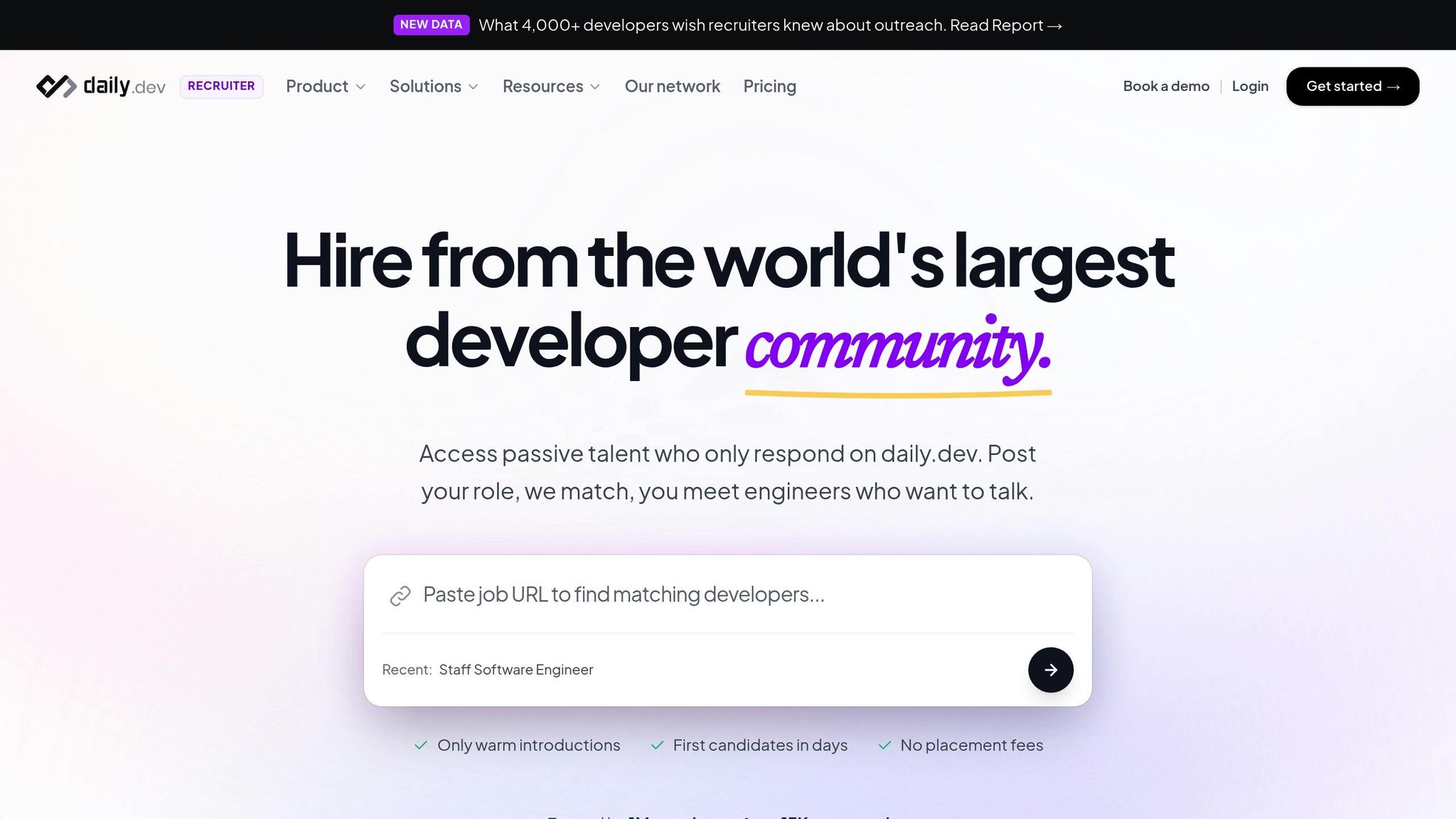
daily.dev Recruiter simplifies the hiring process by giving you direct access to pre-qualified, engaged developers.
Recruiting engineers often feels like an uphill battle. Cold emails, LinkedIn messages, and job boards can lead to unresponsive or unqualified candidates. daily.dev Recruiter changes the game by connecting you to a network of over 1,000,000 developers who are already active and engaged in their professional community.
Double Opt-In Introductions Build Trust
Cold outreach can be hit-or-miss, but daily.dev Recruiter takes a different approach. It introduces your job opportunities directly within the platform where developers are already spending time reading tech content and learning. Developers only engage if they’re genuinely interested in your role, thanks to a double opt-in system. This means every conversation begins with mutual interest - no more wasted time on candidates who aren’t truly engaged.
Screen Candidates with Custom Criteria
Before any introductions, you can define custom screening questions and technical requirements to filter candidates automatically. Looking for someone with Kubernetes expertise or experience at a Series B startup? Set those criteria upfront. This ensures only candidates who meet your technical expectations make it through, saving you hours of initial screening. By the time you’re speaking with a developer, they’ve already passed the first hurdles.
Get Higher Response Rates with a Developer-First Platform
daily.dev Recruiter connects with developers exactly where they are - engaged in a network focused on technology and career growth. The platform uses behavioral data to match opportunities with developers based on the technologies they’re actively exploring, not outdated resume keywords. By presenting clear technical briefs that highlight your tech stack, project scope, and salary ranges, you build trust and encourage self-selection. This transparency helps boost response and acceptance rates.
With these tools for engaging top talent, the next step is using technology to make your hiring process even more efficient.
Use Technology to Automate Hiring Tasks
Automation takes repetitive recruiting tasks off your plate, giving you more time to connect with candidates on a personal level. AI-powered tools can cut time-to-hire by as much as 50% , and 75% of hiring managers trust AI to assist in making hiring decisions .
The secret lies in knowing what to automate. Tools like Agentic AI can handle up to 80% of routine recruiting tasks . This includes everything from sourcing candidates and outreach to conducting adaptive pre-screening interviews that tailor questions based on candidate responses . The goal isn’t to replace human expertise but to complement it .
These AI tools fit naturally into the candidate screening process.
Screen Candidates with AI Tools
AI screening tools go beyond simple keyword matching. They analyze resumes and assess skills using data-driven methods, which can cut down manual resume reviews by over 80% . Some platforms even use realistic job simulations to evaluate how candidates might perform in real-world scenarios, moving beyond traditional credential-based assessments . To ensure fairness, these tools often include plagiarism detection for technical tests .
"AI helps me get up to speed on new roles faster – learning the job, drafting descriptions, building interview questions and even summarizing candidate feedback. It's a big help in setting a structured foundation before the human conversations begin."
- Shannon Castleman, Senior Talent Acquisition Manager, Greenhouse
To get the most out of AI, start by standardizing your job postings and interview scorecards. AI tools need a consistent framework to analyze effectively . A great example is Chipotle Mexican Grill, which cut its average time-to-hire from 14 days to just 4 days - a 67% reduction - by using a conversational AI assistant .
For even better results, integrate these tools with your Applicant Tracking System (ATS).
Integrate Your ATS for Better Workflow
Think of your ATS as the command center for your hiring process. By integrating it with job boards, scheduling tools, and communication platforms, you can eliminate the hassle of manual data entry . When everything runs through one system, you can automate email sequences, set up reminders, and keep candidates engaged with minimal effort .
Scheduling is a prime area for automation. Seventy-eight percent of recruiters have lost candidates due to slow interview scheduling , and top candidates are typically available for only 10 days . Self-service scheduling tools that sync with interviewer calendars in real time let candidates book interviews within 24 hours . Teams using automation report a 55% faster time-to-hire and a 46% boost in candidate experience .
To streamline further, set service level agreements like reviewing resumes within 48 hours or providing interview feedback within 72 hours . You can also integrate AI tools for interview support and skills assessments directly into your ATS. This creates a standardized, structured evaluation process that minimizes bias and speeds up decisions, tackling common hiring bottlenecks head-on.
Build Employee Referral Programs
Using employee referrals can speed up hiring while maintaining high standards. Employees often know skilled engineers who meet your criteria. In fact, referred candidates are hired 55% faster and are 18 times more likely to land the job compared to those from job boards . Employees act as a natural filter, recommending individuals who align with both technical needs and company values.
Referred hires tend to stick around longer - 70% more, to be precise. About 46% of these hires stay for over three years, compared to just 14% of job board hires . This longevity eases future hiring demands and can slash recruitment costs by as much as 80% . Plus, employees making referrals themselves tend to stay 20% longer .
"It allows you to turn your entire workforce into recruiters." - Kara Yarnot, President, Meritage Talent Solutions
Referrals also open doors to passive candidates - engineers who aren’t actively job hunting but are open to the right opportunity. These candidates make up 37% of the talent pool and are harder to reach through typical job postings . To maximize the benefits of referrals, consider offering structured incentives like referral bonuses.
Offer Referral Bonuses
Make the referral process simple - employees should only need to submit basic details like a name and contact information .
Consider splitting bonus payments: half upon the hire and the other half after a 90-day probation period . Typical bonuses range from $1,000 to $5,000, depending on the role’s complexity and seniority . A minimum bonus of $500 is recommended to encourage participation . For more specialized or executive roles, bonuses can climb as high as $50,000 .
Salesforce has built a referral-driven workforce, with 41% of its hires coming from referrals. They offer a $2,000 cash bonus for successful hires and have paid out $7 million in bonuses as of 2025. They even host "Recruitment Happy Hours", where employees can bring potential referrals to meet recruiters in a casual setting .
To promote diversity, you can include targeted incentives. For example, Glowforge offers a $5,000 referral bonus specifically for candidates from underrepresented backgrounds . Non-cash rewards can also be effective. GoDaddy, for instance, boosted its referral rate from 17% to 33% by replacing large cash bonuses with creative rewards, such as engraved mirrors encouraging employees to "reflect" on their networks .
PURE Insurance takes another approach, asking new employees to submit referrals within their first month. This strategy taps into their enthusiasm and personal networks, leading to 40–60% of hires coming from referrals .
Once your program is up and running, tracking its performance is key to keeping it effective.
Track Referral Program Performance
Focus on three main metrics to measure your program's success: employee participation, candidate quality, and hiring speed.
One critical metric is the referral quality rate - the percentage of referred candidates who pass initial screenings . If this rate is low, refine your guidelines by sharing detailed candidate personas that highlight the skills, traits, and experiences you’re looking for .
Participation rates across departments are another important indicator. Identifying which teams are actively referring candidates - and which aren’t - can help you target areas needing more encouragement . For example, Digital Ocean discovered that their top performers were more likely to refer high-caliber candidates, resulting in 40% of hires coming from referrals by the end of 2017 .
"The single worst mistake a company can make with its referral program is to not contact referred candidates when an employee expects them to." - Paul Petrone, LinkedIn
Keep employees in the loop about the status of their referrals. Automated notifications through your ATS can send updates like "application received", "interview scheduled", and "decision made." This builds trust and encourages future participation . Salesforce, for example, ensures all referrals are contacted within seven days, using a dedicated app to track progress .
Regularly review your program - ideally every quarter - to adjust incentives for hard-to-fill roles and update internal marketing materials . Schneider Electric improved their referral experience and raised their Net Promoter Score by 25.8 points through such efforts .
Improve Job Postings and Candidate Experience
Once you've streamlined candidate screening and automated repetitive tasks, it's time to shift focus to the candidate-facing side of things. Your job posting is often the first interaction a potential hire has with your company, and 78% of job seekers believe their experience during the hiring process reflects how a company values its people . A confusing job description or a frustrating application process can turn away top-tier engineers before you even get a chance to meet them.
Write Clear Job Descriptions
Start with straightforward, industry-standard job titles. Titles like "Backend Engineer" are much more effective than creative alternatives like "Code Ninja" or "Rock Star Developer." Engineers search for jobs using familiar terms, and generic titles improve your posting's visibility in search results .
Stick to essential skills only. Including too many secondary requirements can unnecessarily narrow your candidate pool, especially when tech unemployment is as low as 2.8%, as of June 2025 . Limit job responsibilities to no more than ten concise points, each no longer than two sentences . Avoid gender-coded language such as "aggressive" or "dominate", which can unintentionally discourage diverse candidates from applying .
Steer clear of company-specific jargon. Use terminology that candidates in the industry will instantly understand. Overly niche language can confuse even highly qualified engineers, causing them to overlook your opportunity . Also, consider including the hiring manager's name in the posting - candidates are 56% more likely to respond to a hiring manager than a recruiter .
Once you've captured interest with a clear and appealing job description, it's crucial to maintain a positive experience throughout the hiring process.
Improve Communication Throughout the Process
Timing is everything - each unfilled engineering role costs companies around $5,000 per day . Aim to follow up with candidates within 48 hours, even if it's just to confirm that you're still reviewing their application. This "Golden 48 Hours" rule helps keep candidates engaged and prevents them from moving on to other opportunities .
"Hiring should feel like momentum. If it starts dragging, candidates lose interest - and that's how great opportunities slip through your fingers." - Holt Engineering
Feedback is another key area. While 99% of job seekers expect feedback after interviews, 74% report they never receive any . Create standardized deadlines for providing feedback - ideally within 48 hours - to keep candidates in the loop. Use tools like Slack or Microsoft Teams to set up dedicated communication channels for each role, ensuring interviewers stay aligned and avoid redundant questions. This is especially important since 40% of candidates report being asked the same questions multiple times .
Give candidates a realistic preview of the role and your company culture during the process. Share what day-to-day responsibilities look like and what kind of environment they can expect. This transparency helps ensure a good long-term fit . Make interview prep resources easily accessible on your website, including details about check-in procedures and the types of questions you’ll ask. 65% of candidates rely on these materials to prepare . Lastly, simplify your application process by cutting unnecessary form fields and avoiding duplicate questions .
Hiring engineers?
Connect with developers where they actually hang out. No cold outreach, just real conversations.
Use Data to Improve Your Hiring Process
Crafting job postings and maintaining candidate communication are just part of the equation. Without leveraging data, your hiring process can lack direction. Did you know that 71% of recruiters generate recruitment reports at least every two weeks to enhance hiring outcomes? This data-driven approach brings structure to your process and opens the door to better efficiency.
"You can't improve what you don't measure." - Lorelei Trisca, Content Marketing Manager, Deel
Track the Right Metrics
Focusing on the right metrics can transform every stage of your hiring process.
Start with time-to-hire, which measures the number of days from a candidate's application to their offer acceptance. This metric offers insights into your candidate experience and highlights any delays that might be costing you top talent. For example, the average technical role takes roughly 60 days to fill . If you're consistently exceeding that, it's time to dig deeper. Similarly, track time-to-fill, which spans from opening a job requisition to successfully filling the position. Together, these metrics help pinpoint areas where automation or screening could be improved.
Another critical metric is quality of hire, which evaluates whether you're maintaining high talent standards. Assess this through performance reviews, retention rates, and manager satisfaction scores . For technical roles, monitor your technical interview passthrough rate - the percentage of candidates who successfully complete technical stages. A low rate might indicate sourcing issues or an overly stringent technical bar .
Your interview-to-offer ratio is another key indicator. A low ratio suggests inefficiencies in your screening process, meaning you're spending too much time interviewing unqualified candidates. This calls for better early-stage filters . On the other hand, your offer acceptance rate reflects how competitive your offers are. By 2025, the average acceptance rate is around 84%, compared to 81% in 2021 . Finally, track sourcing channel effectiveness to understand which platforms bring in the best hires, helping you reallocate your budget to the most productive channels .
Adjust Your Process Based on Data
Once you’ve identified the key metrics, use them to make meaningful changes. For instance, in 2024, Cogent Biosciences used "Visual Insights" analytics to evaluate their recruiting process. By analyzing their data, they uncovered inefficiencies in their workflow, leading to faster time-to-hire and improved offer acceptance rates .
From 2021 to 2025, Hot Topic leveraged automation and analytics to hire 1,500 employees per quarter. By refining communication and reducing application friction based on their data, they achieved a 300% reduction in candidate drop-off rates .
"It's not about perfection; it's about reviewing data and making adjustments." - Christina Schmit, Director of Talent & Culture, Renewal by Andersen
If your data reveals high time-to-hire, break down each stage to find bottlenecks. Delays in approvals or interview scheduling are common culprits that can lead candidates to drop out . A low interview-to-offer ratio? Add qualifying questions to your application process to filter out unqualified candidates early on . Set measurable goals like "reduce time-to-hire by 15% in six months" to turn insights into action . And consider using an Applicant Tracking System (ATS) to monitor metrics in real time - manual spreadsheets are not only time-consuming but also prone to errors .
Speed Up Interviews with Structured Assessments
Streamline your hiring process with structured assessments. These methods build on earlier steps like improved data analysis and candidate communication. On average, filling a single engineering role demands 40 hours of engineering time for interviews and screening . With structured assessments, you can significantly cut this time while maintaining - or even boosting - the quality of your hires.
Structured interviews are twice as effective at predicting job performance compared to unstructured, intuition-based conversations . They rely on standardized questions, scoring methods, and decisions . This consistency reduces bias and eliminates distractions from irrelevant factors .
"Structured interviews are one of the best tools we have to identify the strongest job candidates (i.e., predictive validity). Not only that, they avoid the pitfalls of some of the other common methods." - Dr. Melissa Harrell, Hiring Effectiveness Expert, Google People Analytics
Using clear rubrics and structured approaches, you can save an average of 40 minutes per interview , cutting total engineering time spent on recruiting by over 60% . These principles can also transform how you handle initial screenings.
Run Efficient Initial Screenings
Your first phone or video screening should quickly filter candidates while respecting everyone's time. Use a checklist covering experience, technical skills, achievements, and salary expectations . This approach ensures every candidate is evaluated consistently against the same criteria.
Focus on behavioral questions that highlight real-world problem-solving, like "Tell me about a time you debugged a critical production issue." These questions offer better insights than hypothetical ones . Avoid brainteasers like "How many golf balls fit in a 747?" - they have zero correlation with job performance .
Develop a grading rubric with clear examples of poor, average, good, and excellent answers. This ensures all interviewers share the same understanding of what defines a strong response . Replace vague terms like "rock star" with observable, measurable behaviors.
"If a competency is on the interview rubric it's signal. If it's not, then it's noise." - The Karat Team
Add Technical Assessments to Your Process
Technical assessments help confirm that candidates can perform the role's core tasks early in the process. These assessments should focus on essential skills, using simplified real-world scenarios that evaluate technical ability without requiring extensive setup or context .
For junior-level hiring, automated coding tests serve as an efficient initial filter. These tests provide objective rankings based on skill and speed, avoiding the biases of resume reviews that might overlook talented self-taught developers . However, note that automated tests can sometimes filter out up to 1 in 3 qualified candidates .
For senior roles, shift the focus to software architecture, design reviews, and business logic . A take-home project (lasting 2-4 hours and ideally paid) followed by a presentation is a great option. This allows candidates to explain their technical approach, showcasing both their expertise and communication skills.
Simulate real-world conditions by providing candidates with tools like an Integrated Development Environment (IDE) rather than text documents. Allow the use of documentation or AI tools if those are part of the job . For example, since 2018, Heap's engineering team has used a one-day onsite "feature build." Candidates receive an EC2 instance, sudo access, and starter code to create usable software. This setup tests debugging, self-management, and the ability to prioritize "done over perfect" .
Reduce Interview Rounds Without Losing Quality
Structured evaluations can also help you consolidate interview rounds, saving time for both your team and candidates. For example, you can use a take-home project as the foundation for a competency interview instead of scheduling separate meetings . This approach ensures thorough assessment while respecting everyone's time.
Train a core group of interviewers to use rubrics effectively and deliver questions with clarity and empathy . This ensures every candidate has a consistent, high-quality experience, regardless of the interviewer.
For final evaluations, consider inviting top candidates for a trial day where they work with the team for a few hours. This "test drive" often provides more insight than multiple traditional interviews . A well-structured and fair hiring process can increase offer acceptance rates by as much as 75% .
"An engineering team will converge to the skill level of the least effective engineer who can get through the interview process." - Dan, Author/Engineer, Heap
Keep in mind that 74% of managers report hiring the wrong person at some point , and a poor engineering hire can cost upwards of $30,000 (excluding compensation) . Structured assessments not only save time but also help prevent costly mistakes in the long run.
Conclusion
Speeding up the process of hiring engineers doesn’t have to mean sacrificing quality. The strategies shared here demonstrate how you can save both time and money while keeping - or even improving - your hiring standards. By streamlining your approach, it’s possible to cut the time engineers spend per hire from 60 hours to just 14 hours, and reduce your cost per hire from $14,076 to $3,349 .
The key lies in using the right tools and refining your processes. Platforms like daily.dev Recruiter can connect you with pre-qualified, motivated developers. Automation tools can handle time-consuming tasks like resume screening and scheduling, while data tracking can help you identify and fix bottlenecks quickly. Structured assessments ensure consistency in interviews and lead to better hiring decisions.
The financial benefits of these improvements are clear. Engineering time costs six times more than recruiting time for each technical hire . Every hour saved through smarter processes not only reduces costs but also allows your engineering team to focus on building and innovating, rather than navigating lengthy hiring cycles.
Start small - pick one or two strategies from this guide to implement, whether it’s rewriting job descriptions, launching a referral program, or standardizing your interview process. Track your metrics, make adjustments based on results, and fine-tune your hiring pipeline. The payoff? A faster, more efficient system that consistently attracts and secures top-tier engineering talent.
FAQs
How does daily.dev Recruiter ensure better candidate quality compared to traditional hiring methods?
daily.dev Recruiter helps you discover better candidates by emphasizing skills-based hiring, proactive sourcing, and practical assessments. These approaches go beyond traditional resume reviews, focusing on pinpointing top talent with accuracy.
By concentrating on actual skills and using advanced tools to simplify the hiring process, daily.dev Recruiter enables you to connect with highly skilled engineers more efficiently - without sacrificing quality or high standards.
What are the main advantages of using AI tools to hire engineers?
AI tools bring some solid benefits when it comes to hiring engineers. For starters, they can streamline candidate screening by assessing skills more objectively and cutting down on bias. This not only makes the process fairer but also speeds things up, helping recruiters zero in on the best candidates much faster.
Beyond screening, AI takes care of time-consuming tasks like scheduling interviews, managing communications, and sourcing potential hires from massive datasets. This means recruiters can shift from reactive hiring to building stronger, more prepared talent pipelines. Plus, it creates a smoother experience for candidates. By using AI, companies can hire quickly while maintaining high standards and quality.
How do structured assessments make engineering interviews more efficient and fair?
Structured assessments streamline engineering interviews by applying standardized criteria to evaluate every candidate. This approach ensures that all applicants are judged based on relevant skills and competencies, providing consistency and reducing bias. The result? A more equitable hiring process.
By emphasizing clear, objective metrics, structured assessments not only enhance fairness but also save time for both recruiters and candidates. Plus, they make it easier to identify top talent quickly, helping you speed up hiring decisions without sacrificing quality.
.png)