Most recruiters waste time on unqualified leads. Here's the fix: qualify intent before scheduling calls. By identifying genuine interest early, you can:
- Boost response rates from developers (those who show intent are more likely to engage).
- Shorten hiring timelines (focus on candidates ready to interview).
- Improve hire quality (align their goals with your team's needs).
Developers research your company before responding, so it’s your job to spot engagement signals, score candidates based on fit and intent, and ask the right questions to confirm their motivation. This approach saves time, builds trust, and ensures every conversation is worthwhile.
Key steps:
- Define your ideal candidate profile with clear success metrics.
- Analyze intent signals (e.g., GitHub activity, API doc visits).
- Build a scoring system to prioritize high-intent leads.
- Personalize outreach with tailored, intent-driven questions.
Results? Up to 90% reply rates, faster hiring, and better outcomes. Skip the guesswork - focus where it matters most.
::: @figure 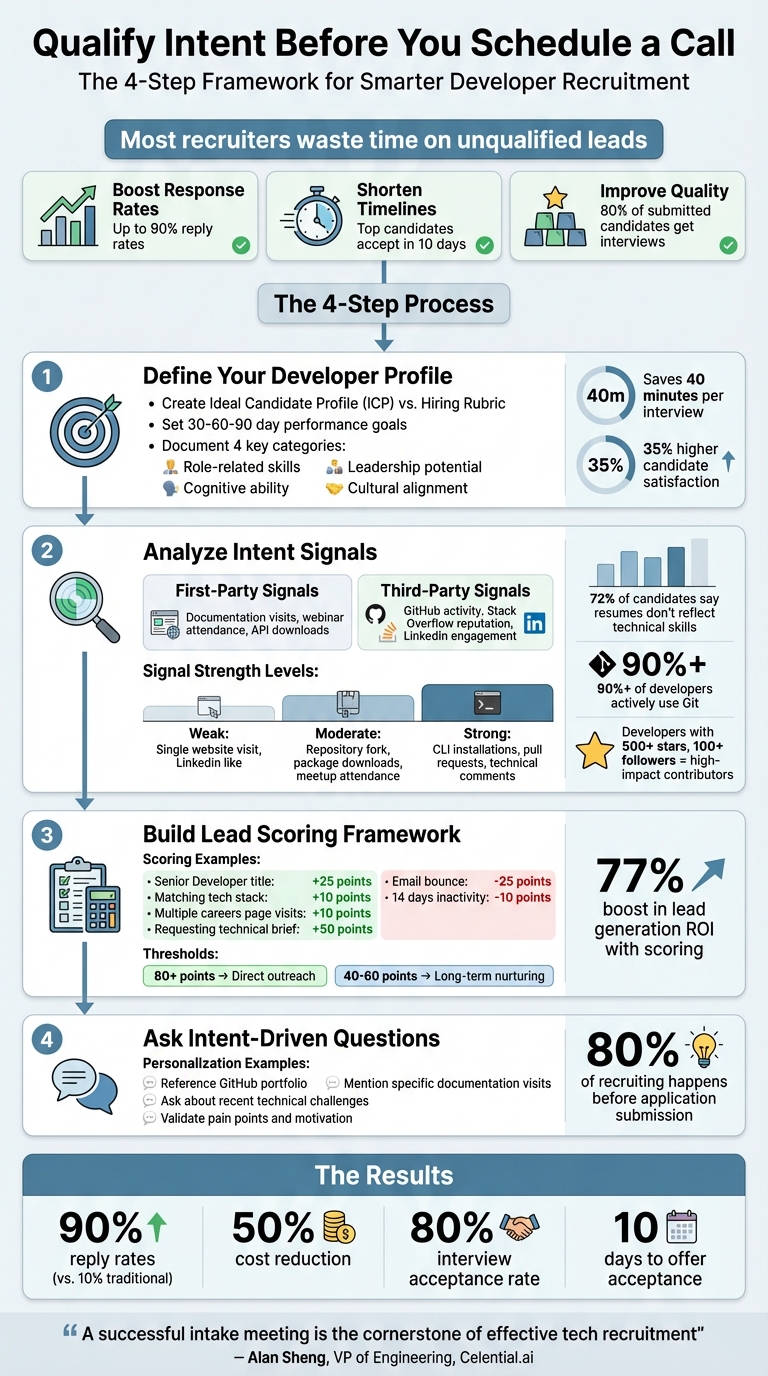 {4-Step Framework to Qualify Developer Intent Before Scheduling Calls}
Define Your Developer Profile and Qualification Criteria
Start by identifying your ideal candidate. This means creating a clear, shared understanding of success within your hiring team. It's important to distinguish between an Ideal Candidate Profile (ICP) and a hiring rubric: the ICP outlines who you're looking for (your strategic target), while the rubric focuses on how to evaluate them using specific, weighted criteria .
Set performance goals for the first 30, 60, and 90 days. What should this developer achieve during these periods? Instead of vague requirements like "5+ years of React experience", focus on tangible outcomes: "Deploy two customer-facing features within the first 60 days" or "Improve API response time by 15% within 90 days." This approach shifts the focus from static credentials to real-world results, helping you identify candidates who have successfully handled similar challenges in the past .
Document Required Skills and Experience
Break down your requirements into four key categories: role-related skills, cognitive ability, leadership potential, and cultural alignment. Here's how each plays a role:
- Role-related knowledge: Technical expertise such as proficiency in Go, AWS, or other relevant tools.
- General cognitive ability: Problem-solving skills and the ability to learn quickly.
- Leadership: The capacity for emergent leadership - stepping into and out of leadership roles as needed.
- Cultural alignment: Compatibility with your team's collaboration style and adaptability to uncertainty .
Google uses a similar framework, focusing on attributes that genuinely predict job performance instead of relying on arbitrary qualifications .
Compare these criteria with the traits of your current top performers. What makes them excel in your environment? For instance, if your leading backend engineer stands out because they can clearly explain complex technical decisions to non-technical stakeholders, make that a qualification criterion. Structured interview questions and rubrics based on these insights can reducing time to hire by an average of 40 minutes per interview while maintaining consistency .
Align Criteria with Hiring Team Expectations
Share your documented profile with the hiring team before you begin sourcing candidates. This avoids potential misalignment later in the process, especially when you're deep into interviews. Reaching consensus on success criteria upfront ensures you don’t waste time interviewing candidates who aren’t a good fit. Interestingly, candidates who go through a structured interview process based on clear criteria report being 35% more satisfied with their experience, even if they’re ultimately rejected .
Don’t forget to establish clear disqualification criteria as well. Clearly define your "must-haves" versus "nice-to-haves" to streamline screening and reduce bias . For example, if the role requires experience with distributed systems but is flexible on the specific cloud provider, make that explicitly clear. Regularly revisit and refine the profile with your team to ensure the "nice-to-haves" don’t overshadow more critical skills or that evolving priorities are reflected in your criteria .
With this groundwork in place, you’ll not only save time but also ensure that your hiring process aligns with your goals. Now, you're ready to assess candidate engagement signals in the next step.
Identify and Analyze Developer Intent Signals
After defining your ideal developer profile, the next step is to analyze signals that reveal genuine interest. Here's something to consider: 72% of candidates believe their resumes don't fully reflect their technical skills, so you need to dig deeper than just a PDF file . With over 90% of developers actively using Git, you have a direct window into their work .
Intent signals generally fall into two categories: first-party (interactions directly with your company) and third-party (external activity on platforms like GitHub or Stack Overflow). First-party signals include actions like downloading whitepapers, attending webinars, responding to personalized outreach, or engaging with your technical documentation . These interactions are particularly insightful because they show developers are actively researching your organization. On the other hand, third-party signals - such as GitHub contributions, Stack Overflow reputation, or LinkedIn activity - provide a broader view of their professional behavior and technical interests . Together, these signals help you categorize and evaluate intent with more precision.
Not all signals hold the same value. A single website visit or a LinkedIn like is considered a weak signal . Moderate signals might include forking a repository, downloading packages (like Docker pulls or npm installs), or attending technical meetups . Strong signals, however, are the most telling: CLI installations, running CLI commands, submitting pull requests, or leaving detailed technical comments on repositories .
"Developers won't necessarily put every little piece of technology that they work with on their LinkedIn... but if a developer has forked the source code for FastAPI, you know that they're using FastAPI" .
First-Party Signals: Direct Engagement Indicators
First-party signals come from direct interactions with your company's assets. For instance, when a developer downloads a proprietary research paper, logs into your product trial, or revisits your API documentation multiple times, they’re showing clear intent. Private actions, like accessing gated content, carry more weight than public actions, such as liking a social media post .
To define what qualifies as "warm" in your pipeline, consider this benchmark: candidates who provide at least two meaningful responses to outreach or content within six months are worth prioritizing . Documentation visits are another key metric - a single page view might be a weak signal, but two or more visits suggest active interest . If you offer product trials, track telemetry data - CLI command executions and frequent logins are strong indicators that a developer is seriously evaluating your technology .
Third-Party Signals: External Data Sources
GitHub stands out as your most valuable third-party signal source. Focus on unforked repositories - original projects where developers tackle complex problems and document their solutions . Be wary of false positives, such as repositories filled with LeetCode solutions, bootcamp exercises, or clones of popular apps like Facebook or Twitter. Instead, look for projects that address scalability or high-volume challenges .
Examine the GitHub contribution graph for consistent activity, but don’t be fooled by "green walls" of trivial commits . Developers with 500+ stars, 100+ followers, or 10+ repositories often indicate high-impact contributors . On Stack Overflow, reputation scores and the quality of answers can reveal problem-solving skills and technical expertise . LinkedIn is another useful platform - watch for developers engaging with competitor case studies or following technical hashtags; these are subtle buying signals . Once these third-party signals are identified, the next step is to quantify and prioritize them.
Score and Prioritize Intent Signals
To streamline your process, create a scoring system that ranks developers based on their level of intent. Focus on developers with at least two high-value activities within the past 180 days, giving more weight to recent engagements . For example, distinguish between a fork (exploration) and a pull request (active contribution) to better understand their level of interest .
Set up automated alerts for spikes in activity from developers who match your ideal profile . Keep an eye on competitor GitHub repositories as well - developers evaluating alternatives in your space are likely high-intent prospects . And don’t forget: top technical talent often accepts offers in as little as 10 days, so acting quickly on strong intent signals can give you a major edge . Segment developers by their funnel stage - those in "Building" or "Deployed" phases show far greater intent than those still in the "Awareness" stage .
Build a Lead Scoring Framework for Developers
Once you've identified intent signals, the next step is turning that data into a clear, actionable score. A lead scoring framework helps you identify qualified technical candidates by assigning a score based on their qualifications and behaviors. Businesses using lead scoring report a 77% boost in lead generation ROI compared to those that don’t . The secret lies in balancing two key factors: Fit (static attributes like job title or tech stack) and Intent (dynamic actions like page visits or downloads) .
Combine Candidate Fit with Behavioral Intent
To prioritize outreach effectively, you need to weigh both candidate fit and behavioral intent. Start by assigning scores to key attributes and actions. For example:
- +25 points for a Senior Developer title
- +10 points for a matching tech stack
- +10 points for multiple visits to the careers page
- +50 points for requesting a technical brief
On the flip side, deduct points for inactivity or negative signals:
- -25 points for an email bounce
- -10 points for every 14 days of inactivity
This approach ensures you’re not chasing inactive candidates. As LeadOps puts it:
"A good score is earned, not guessed... Effective scoring systems are implemented."
Keep Fit and Intent scores separate to maintain objectivity. For instance, a highly engaged candidate without the right skills shouldn’t outrank a qualified developer who just hasn’t interacted much yet . To avoid inflating scores from repetitive low-value actions, set caps - like limiting points from email opens to +10 . Also, give more weight to recent actions, as they’re more indicative of current interest .
Set Score Thresholds for Outreach
Thresholds are essential for guiding candidate progression through your pipeline. For example, candidates scoring 80+ can move directly to outreach . Those in the 40-60 range may be better suited for long-term nurturing workflows. These thresholds should align with your conversion data .
Automation can streamline this process. High-scoring candidates can be routed directly to interview scheduling, while borderline scores are flagged for manual review . Regular audits - ideally monthly - help refine your scoring model. Collaborate with your hiring team to adjust thresholds based on which high-scoring candidates actually converted . Keep in mind, only 47% of sales-accepted leads tend to become fully qualified leads, so continuous tweaking is vital .
Also, prioritize developers who have started new roles within the last 90 days. They often have fresh budgets and are eager to make an impact, which can signal higher urgency .
This structured scoring framework sets the stage for crafting more targeted and intent-driven qualification questions in the next steps.
Write Intent-Driven Qualification Questions
Once you've identified potential candidates through lead scoring, the next step is to craft personalized, intent-focused questions. your tech hiring stack and scoring system pinpoint who to engage with, but the way you frame your questions determines whether your outreach leads to meaningful conversations. Considering that up to 80% of recruiting happens before an application is even submitted , your initial questions need to confirm intent while respecting the candidate's time.
Personalize Questions Based on Engagement Signals
Generic outreach is a missed opportunity. Instead, tailor your questions to reflect the candidate's actions. For instance, if you notice someone frequently visiting your documentation page, you could ask, "I noticed you’ve been exploring our API docs - are you working on a specific integration challenge?" This approach not only highlights your attention to detail but also shows genuine interest in their work.
Before reaching out, take a few minutes to review their coding-focused candidate sourcing tools like GitHub or open-source contributions . Use dynamic tokens to personalize your message further by referencing their GitHub handle, recent blog post, or other unique contributions. For example, if they attended a webinar on microservices, avoid generic questions like "What are your interests?" Instead, ask, "What did you think of the service mesh strategies discussed in last week’s session?" This level of specificity demonstrates that you value their time and expertise, making your outreach stand out.
These tailored questions act as a bridge between raw data and meaningful dialogue, creating a strong foundation for understanding their goals.
Validate Pain Points and Motivation
After referencing their engagement, dive deeper to uncover their challenges and priorities. Avoid surface-level questions like "Why are you interested in this role?" Instead, focus on open-ended questions that encourage them to share real pain points. For example, you might ask, "Can you share a recent technical challenge you faced and what resources could have made it easier?" . Another option could be, "Where does solving this type of challenge rank on your current list of priorities?" . These questions help you identify whether your opportunity aligns with their needs and interests.
To gauge urgency, you could ask, "What happens if things stay the same for another quarter?" . This question helps distinguish between candidates casually exploring options and those actively seeking a change. For a deeper understanding of their personal motivations, try asking, "If you achieve your next career milestone, how will that impact your daily work or your team’s resources?" . This can reveal whether they’re driven by growth, autonomy, technical challenges, or compensation - insights that can shape how you present your role.
When faced with the common "send me more info" response, don’t let the conversation stall. Instead, ask, "What specific details would help you evaluate this opportunity?" . This direct follow-up often uncovers their true concerns - whether it’s about salary transparency, remote work options, or the tech stack - helping you qualify their intent before scheduling a deeper conversation.
Conclusion
Qualifying intent before scheduling a call isn’t just a time-saver - it’s a game-changer for recruitment. It ensures that every conversation counts. By defining clear candidate profiles, analyzing engagement signals, building a lead scoring system, and asking tailored questions, you move away from chasing uninterested leads. Instead, you focus on meaningful discussions with developers using a tech recruiting cheatsheet who are genuinely excited about your opportunities. The result? More efficient hiring and measurable improvements.
When hiring teams use intent-driven strategies, the benefits are clear. Statistics show that 80% of candidates submitted through these methods get accepted for interviews, all while cutting costs by an average of 50% compared to traditional approaches . Intent-based outreach doesn’t just save money - it boosts engagement too. Reply rates can soar from 10% to as high as 85–90%, and top candidates often accept offers in as little as 10 days .
"A successful intake meeting is the cornerstone of effective tech recruitment. It fosters strong partnerships between recruiters and hiring managers, making both of their jobs easier and paving the way for success." – Alan Sheng, VP of Engineering, Celential.ai
FAQs
How can I identify genuine interest in candidates before scheduling a call?
To gauge genuine interest in candidates, pay attention to behavioral cues that reveal their level of engagement and motivation. Actions like responding promptly to outreach, actively engaging in professional discussions, or frequently interacting with industry-related content can provide valuable insights. These behaviors often reflect a candidate’s enthusiasm for the role and alignment with its demands.
You can also evaluate their participation in job-related activities, such as simulations or practical exercises. These not only highlight their skills but also underscore their dedication and interest in the position. When you pair these observations with well-crafted, intent-focused outreach questions, you can more effectively spot motivated candidates and make the best use of your time.
What’s the difference between first-party and third-party intent signals?
The key distinction between first-party and third-party intent signals lies in where they originate and how closely they relate to your organization.
First-party signals come straight from your own platforms. These include actions like website visits, content downloads, email engagement, or product usage. Because these signals are tied directly to your company, they provide a clear and reliable indication of real-time interest in your offerings or role.
In contrast, third-party signals are collected from external sources. These might include interactions on social media, browsing activity on unrelated websites, or engagement with general industry content. While these signals can give you a broader understanding of a candidate's or buyer's overall interests, they don’t specifically reflect their interest in your organization.
Recognizing this difference allows you to focus on first-party signals for immediate, precise outreach, while leveraging third-party signals to spot broader trends or uncover potential opportunities down the line.
How can I tailor outreach questions based on a candidate's engagement?
To make your outreach questions more effective, pay attention to how candidates interact during your initial conversations. Look for clues in their responses, the effort they’ve put into researching your company, and their enthusiasm for the role. These observations can help you shape open-ended questions that invite them to share more about their experiences and aspirations.
For instance, you might ask, "What excites you most about this position?" or "How do you see yourself growing within our company?" These types of questions can reveal their motivation and level of commitment, helping you pinpoint candidates who are truly interested and aligned with the role.
.png)