Recruiting DevOps engineers in 2025 is less about finding talent and more about earning their trust. Developers are increasingly skeptical of recruiters, with 61% feeling they fall short and 40% ignoring outreach due to its generic nature. The solution? Transparency, technical accuracy, and personalized engagement. Here’s what works:
- Be upfront: Share details like tech stack, salary, and work model in your first message.
- Focus on skills: Prioritize candidates’ real-world experience with tools like Terraform, Kubernetes, and GitOps workflows over certifications.
- Use AI tools smartly: Platforms like daily.dev Recruiter identify candidates based on their current interests, making outreach more relevant.
- Engage with communities: Meet developers where they already participate, like trusted networks and learning platforms.
- Streamline hiring: Skip unnecessary interview rounds and focus on practical, scenario-based assessments.
Recruitment today is about building trust, not just filling roles. By aligning with what DevOps engineers value most, you can stand out in a competitive market.
::: @figure 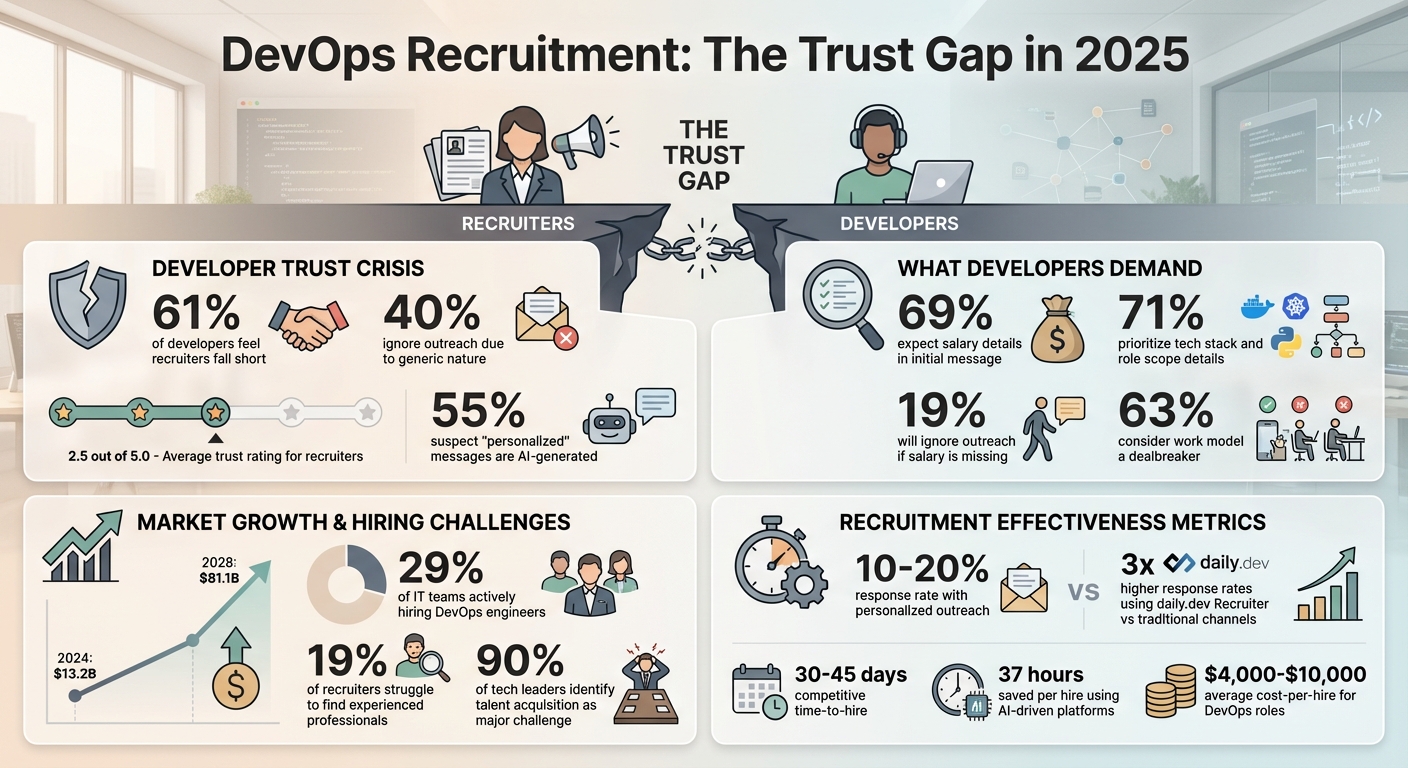 {DevOps Recruitment Statistics and Trust Metrics 2025}
Core Skills and Attributes of DevOps Engineers
Successful DevOps engineers bring a mix of technical know-how and interpersonal abilities to the table. Both aspects are equally important, but they’re often evaluated differently. This imbalance can lead hiring teams to focus too much on certifications, overlooking candidates with the production-ready skills that matter most. To build trust and hire effectively, it’s crucial to assess both hands-on technical expertise and the soft skills that help teams thrive.
On the technical side, DevOps engineers must master tools and systems used daily - like infrastructure automation, deployment pipelines, and cloud platforms. On the interpersonal side, they need to collaborate across teams, communicate clearly, and handle the inevitable chaos of production incidents. For example, someone might excel at writing Terraform modules but struggle to explain their decisions to non-technical stakeholders - or vice versa. A balanced evaluation should account for both.
Technical Skills for DevOps Engineers
Infrastructure as Code (IaC) is the backbone of DevOps work. Engineers should be proficient with tools like Terraform, especially in module design and state management, or alternatives such as Pulumi and CloudFormation. Junior engineers typically follow established patterns, while senior engineers focus on designing reusable modules .
Container orchestration is another must-have skill, with Kubernetes dominating the field - nearly half of organizations now use it to manage containerized environments . Look for candidates experienced with production tools like EKS, GKE, Helm charts, and Kustomize. CI/CD and GitOps expertise involves building automated pipelines using platforms like GitHub Actions, Jenkins, or GitLab CI, and implementing GitOps workflows with tools like ArgoCD or Flux.
Deep knowledge of cloud platforms such as AWS, GCP, or Azure is essential. Candidates should demonstrate mastery of compute, storage, networking, and IAM services. Programming and scripting abilities in languages like Go, Python, or Bash are also critical for automating tasks and building tools. Notably, demand for Golang in DevOps roles has surged, appearing in 18% of job postings by 2025, up from just 5% . Observability skills - working with tools like Datadog, Prometheus, or PagerDuty - are key to ensuring systems run smoothly, while DevSecOps capabilities, such as managing secrets with HashiCorp Vault and ensuring compliance with frameworks like SOC 2 or GDPR, have become non-negotiable .
When evaluating candidates, prioritize GitHub activity that showcases real-world experience with infrastructure tools like Terraform modules or Kubernetes operators. During technical assessments, focus on realistic scenarios, such as troubleshooting production issues or designing infrastructure, rather than abstract algorithm challenges.
Be mindful of yellow flags, such as candidates who collect certifications but lack real-world experience or those whose "DevOps" work is limited to manual system administration ("ClickOps") . On the flip side, green flags include designing CI/CD architectures for multiple teams, creating reusable IaC modules, or implementing custom observability solutions .
While technical skills are critical, the ability to communicate and collaborate effectively is what sets top-tier DevOps engineers apart.
Soft Skills and Team Fit for DevOps
Technical expertise might get candidates through the door, but collaboration and communication are what ensure long-term success. DevOps engineers act as a bridge between development and operations, translating complex technical challenges into clear, actionable steps for developers, security teams, and management. Empathy plays a big role here - engineers who treat developers as internal clients and design self-service tools to meet their needs align well with the growing Platform Engineering model .
Adaptability and resilience are equally important. DevOps engineers face constant challenges, from cloud outages to rollbacks and shifting business priorities. The best candidates stay composed under pressure, showing curiosity about why things work rather than just knowing how to implement them. Strong conflict management skills also stand out, especially during incident retrospectives. Top talent focuses on solutions rather than assigning blame, thriving in environments that embrace blameless postmortems.
To assess these qualities, use behavioral questions that encourage candidates to share specific examples - like how they built something under pressure or influenced the engineering culture at scale. Structured interviews with calibrated rubrics can help ensure consistent evaluations, while collaborative exercises like pair programming or design discussions reveal how candidates handle feedback in real time.
Gauge communication skills by asking candidates to explain a complex concept, such as Kubernetes, in simple terms. This demonstrates their ability to break down technical ideas for non-experts. Additionally, schedule interview debriefs within 24–48 hours to capture fresh impressions of team fit. Be upfront about on-call rotations, compensation (typically $500–$1,000 per week), and incident volume early in the process to build trust with senior candidates .
| Level | Key Differentiators |
|---|---|
| Junior/Mid | Writes CI/CD pipelines on one platform; manages IaC using existing patterns; debugs container issues |
| Senior | Designs CI/CD architecture for multiple teams; creates reusable IaC modules; leads incident response |
| Staff/Principal | Sets organizational infrastructure strategy; builds platforms to simplify complexity; drives changes in reliability practices |
This table highlights how technical and interpersonal skills evolve with experience, emphasizing the dual importance of both skill sets.
Hiring engineers?
Connect with developers where they actually hang out. No cold outreach, just real conversations.
Using AI-Driven Platforms for DevOps Recruitment
AI-driven platforms are reshaping how recruiters connect with DevOps professionals by focusing on real-time interests rather than outdated resumes. Sourcing passive DevOps talent has always been tricky - many top engineers aren’t actively job hunting, and traditional methods like cold outreach often fail to resonate. Instead of relying on static profiles, these platforms analyze current behavior. For example, if a DevOps engineer is reading about "Advanced Kubernetes Patterns" or engaging with CI/CD-related content, the system identifies their active interest, even before they update their profile.
This approach bridges the trust gap that has long plagued recruitment. By focusing on what candidates are currently exploring, AI platforms avoid spammy outreach and foster meaningful connections. Recruiters can engage with engineers based on their professional growth and current interests, leading to trust-based, warm introductions.
Warm Introductions via daily.dev Recruiter
The daily.dev Recruiter platform reinvents recruitment with a double opt-in system designed to build trust. Recruiters privately pitch roles, and candidates must opt in to start a conversation. This ensures every interaction begins with mutual interest - no unsolicited messages, no surprises.
"We built a place where engineers can turn off the noise. To enter this space, you don't need a hack. You need trust." - Nimrod Kramer, CEO & Co-Founder of daily.dev
The platform matches roles with candidates by aligning job requirements to their curiosity and learning patterns. For instance, if a Kubernetes expert has been engaging with content on platform engineering, the system highlights relevant opportunities directly in their feed. Interested candidates can choose to opt in and answer up to three custom screening questions, validating skills like Infrastructure as Code or CI/CD pipelines. This pre-qualification process saves recruiters significant time by ensuring they only connect with candidates who meet the technical requirements.
Companies using daily.dev Recruiter report saving 37 hours per hire and achieving response rates three times higher than traditional channels . The platform also integrates seamlessly with applicant tracking systems (ATS) like Greenhouse, Lever, and Ashby, syncing pre-qualified candidates and eliminating duplicate profiles in real time.
Advanced Targeting and Filtering Features
Beyond warm introductions, daily.dev Recruiter enhances precision with advanced targeting tools. Its AI engine goes beyond standard filters like job titles or experience, analyzing what developers are building, the technologies they’re exploring, and their standing in the community. This allows recruiters to identify DevOps engineers who are actively upskilling - such as those diving into Platform Engineering - long before they enter the active job market.
The platform supports over 240 specialized roles, including Site Reliability Engineer (SRE), Cloud Architect, and Kubernetes Expert. Recruiters can refine searches further by seniority, tech stack expertise, and even timezone or location, ensuring compatibility for remote roles. By analyzing real-time engagement, the system delivers intent-based matches that are highly relevant.
daily.dev Recruiter operates on a pay-for-results model - there are no placement fees or monthly subscriptions. Recruiters only pay when they successfully connect with a qualified candidate. With a 4.8/5 rating on Product Hunt and recognition as "Product of the Year", the platform has earned trust from both recruiters and developers alike .
Connecting with DevOps Communities and Networks
The best DevOps engineers don’t just work in isolation - they actively participate in dedicated communities to stay informed, share insights, and keep up with new technologies. Platforms like daily.dev serve as a go-to hub for millions of developers, acting as a browser homepage where recruitment feels more like a natural opportunity than an unwelcome interruption . These spaces emphasize trust and relevance rather than sheer volume, which is crucial in today’s recruitment landscape. As mentioned earlier, overcoming skepticism from developers means meeting them where they already engage. By utilizing these trusted spaces, recruiters can skip the awkwardness of cold outreach and instead foster authentic connections.
The key isn’t to shout louder - it’s to show up in places where trust is already established. Developers value transparency right from the start. For instance, 69% of developers expect salary details in the initial recruitment message. They also appreciate recruiters who understand the nuances of their world, like knowing the difference between Java and JavaScript without having to Google it . To build credibility, recruiters should always lead with the "Big Three": tech stack, salary range, and work model (remote or hybrid) from the very first interaction .
Building Trust in Developer-First Networks
Platforms that integrate seamlessly into developers' routines are changing how recruitment works. Instead of bombarding candidates with cold messages, these networks present job opportunities alongside developers’ daily content - like tutorials, technical articles, and industry news. When a job listing appears in a trusted feed, it feels like a natural fit, not spam. Nimrod Kramer, CEO & Co-Founder of daily.dev, explains it perfectly:
"Engineers already come to daily.dev to grow. They already trust the platform... When your role shows up inside that flow, it doesn't feel like outreach. It feels like an opportunity."
This approach tackles a core challenge: recruitment today is just as much about earning trust as it is about finding talent. Developer-first platforms also offer insights that go far beyond what a static resume can provide. For example, if you see a DevOps engineer engaging with content on Terraform modules or Kubernetes security, you’re witnessing real-time skill development and genuine interest. This dynamic data is far more valuable than relying on outdated keyword matches from traditional profiles .
Screening and Interview Processes for DevOps Roles
Once you've connected with promising candidates, the next step is evaluating their technical skills and how well they mesh with your team. In DevOps, where collaboration between development and operations is the backbone of success, this balance is critical. You're looking for individuals who can communicate clearly during high-pressure incidents, work seamlessly with developers, and challenge deployment strategies constructively.
Technical Assessments and Problem-Solving Tests
Forget traditional whiteboard coding - real-world scenarios are much better for assessing DevOps skills. Using hands-on environments, like cloud sandboxes or dedicated Linux VMs, lets candidates demonstrate their ability to spin up infrastructure, automate deployments, and troubleshoot live issues. For roles that focus heavily on Kubernetes, the evaluation should include tasks like managing clusters, deploying workloads (e.g., Pods and Services), and implementing security measures like RBAC and network policies .
Infrastructure as Code (IaC) is another area to test. Ask candidates to write scripts using tools like Terraform, Pulumi, or Ansible. This helps you gauge their accuracy in creating resources and their attention to security compliance . To go a step further, record their terminal activity during these tests. This not only verifies their solutions but also provides insights into their troubleshooting approach .
Companies like Zalora have streamlined their recruitment process by adopting standardized coding environments. In 2024, they cut their recruitment cycle in half by using automated scoring systems instead of manual code reviews, ensuring consistent evaluations .
While technical skills are essential, don't overlook the importance of team dynamics.
Evaluating Team Fit and Collaboration Skills
Being a DevOps engineer isn't just about technical know-how - it’s about working well with others. These roles require strong communication, the ability to influence decisions, and a willingness to share responsibility during incidents. Using behavioral questions based on the STAR method (Situation, Task, Action, Result) is a great way to assess these qualities. For example, you can ask candidates how they've handled technical disagreements or influenced decisions in the past .
To minimize bias, standardize scoring for both technical and interpersonal skills. Require interviewers to submit their feedback independently before group discussions. This ensures a more objective evaluation process .
Watch out for red flags: Candidates who blame others for past failures, take all the credit for team successes, or struggle to explain a colleague’s perspective during disagreements .
Look for green flags: Candidates who respect differing opinions during tough discussions and can thoughtfully reflect on past conflicts .
Lastly, be upfront about on-call responsibilities. Clearly outline rotation schedules and incident volumes early in the process. Transparency here builds trust, especially with senior candidates, and prevents misunderstandings down the line .
A well-rounded screening process not only identifies the right talent but also lays the groundwork for a strong and trusting relationship with potential hires.
Writing Job Briefs and Outreach for DevOps Engineers
Your job description is often the first interaction a DevOps engineer has with your company. By 2025, that description needs to be precise, transparent, and technically sound. A vague post like "seeking a DevOps engineer to manage our infrastructure" won’t stand out - especially when 71% of developers prioritize details about the tech stack and role scope as the most critical elements in a job description .
Think of it this way: just like a warm introduction builds trust in personal connections, a clear and specific job brief sets the tone for genuine engagement with candidates. To establish credibility right away, define what "DevOps" means in your context. Are you looking for a generalist to support a startup, a platform builder for a scaling company, or a specialist like an SRE for a larger enterprise? Each role has unique demands, and clarity helps candidates see where they fit .
Writing Clear Job Descriptions
Transparency is a trust-builder. Sixty-nine percent of developers want salary details upfront, and 19% will ignore your outreach if that information is missing . Beyond salary, include essential details like the tech stack and work model (remote, hybrid, or onsite) .
To help candidates visualize the role, provide concrete metrics. For example, instead of general statements, include specifics like: "50+ microservices across 3 AWS regions, 400+ Kubernetes pods, $180,000/month AWS spend" . This paints a clear picture of the scale and impact of the work.
Don’t gloss over on-call responsibilities. Be clear about how often the rotation occurs, the typical incident volume, and - most importantly - how it’s compensated. For instance, you might offer a $500 weekly stipend for primary on-call duties, $200 per incident requiring more than 30 minutes of work, and a compensatory day off after particularly demanding weeks . These details matter, especially since 63% of developers consider the work model a dealbreaker .
Highlight your commitment to modern tools and automation. Manual deployments or "ClickOps" are red flags for many engineers . Instead, showcase your use of tools like Terraform, Pulumi, GitOps workflows, and containerization. If the role involves cutting-edge areas like AI/ML infrastructure, GPU orchestration, or cost-optimization projects, make sure to mention that - these skills are increasingly in demand .
Once you’ve nailed the job description, the next step is crafting personalized outreach that resonates with candidates.
Personalizing Outreach to Passive Candidates
A great job description is just the start. To engage passive candidates, your outreach needs to feel genuinely personal. Forty percent of developers ignore messages that seem like generic spam, and 55% suspect even "personalized" messages are AI-generated . To stand out, show you’ve done your homework.
Reference specific details from their GitHub contributions, open-source projects, or technical blog posts. For example, instead of saying, "We’re impressed by your DevOps experience", try something like, "I saw your recent work on the Terraform AWS provider, especially your updates to the EKS module." This shows you’ve taken the time to understand their expertise.
Use clear, technical language. As one senior backend engineer shared in the daily.dev State of Trust Report:
"We want to skip the business BS and just have an honest conversation" .
Avoid buzzwords and jargon. Instead, focus on what you’re building, the challenges you’re tackling, and why their specific skills are a perfect match.
Finally, connect their current achievements to future opportunities. Show how the role aligns with their career goals and explain what makes your company’s technical challenges worth their time. With recruiters scoring an average trust rating of just 2.5 out of 5.0 among developers , personalized and technically accurate outreach can make all the difference in overcoming skepticism.
Key Metrics for DevOps Recruitment
Once you've fine-tuned your technical and outreach strategies, it's essential to measure recruitment performance to stay ahead in the race for top DevOps talent. With 29% of IT teams actively hiring DevOps engineers and 19% of recruiters struggling to find experienced professionals , tracking the right metrics can make all the difference. These metrics not only help you assess efficiency but also build trust throughout the recruitment process.
Start with response rates - the percentage of candidates who reply within 7–14 days. In 2025, personalized outreach achieves response rates of 10–20%, while generic messages fall short . If your response rate dips below 10%, it’s time to reevaluate your approach. Including key details like the tech stack, salary range, and work model upfront is critical, as over 70% of candidates won’t engage without clear compensation details .
Next, consider time-to-hire, which tracks the number of days from job posting to offer acceptance. For DevOps roles, the competitive range is typically 30–45 days . Delays in this timeline can result in losing top candidates to faster-moving competitors. Simplify your hiring process by reducing time-to-hire, cutting unnecessary interview rounds, and automating scheduling. Every extra week in the pipeline reduces your chances of securing high-caliber talent.
The quality of hire metric provides a deeper look at recruitment success. It's often calculated using this formula: (performance rating + retention rate + 6-month productivity score) / 3 . Aim for a retention rate of 85% or higher after one year, and collect feedback on tangible contributions like CI/CD improvements. With nearly 90% of tech leaders identifying talent acquisition and retention as a major challenge , remember that even the most skilled hires can fall short if they’re not a good fit for your team.
Lastly, assess sourcing channel effectiveness by dividing the number of hires by the number of candidates sourced through each channel. For example, niche platforms like daily.dev often deliver conversion rates between 20–30% for warm introductions . Additionally, track cost-per-hire, which averages between $4,000 and $10,000 for DevOps positions in 2025 . This ensures you're balancing quality hires with controlled expenses. Tools like ATS-integrated dashboards and quarterly performance reviews can help connect your recruitment efforts to broader outcomes, such as improved deployment speed.
Conclusion
Recruiting DevOps engineers in 2025 is all about earning both attention and trust. With 61% of developers rating recruiters poorly and an average trust score of just 2.5 out of 5.0 , outdated methods like cold outreach and generic messaging are no longer effective. Success lies in technical transparency and focusing on the "Big Three" that matter most to developers: tech stack, salary, and work model. Meeting developers where they already spend their time is equally crucial.
Modern tools are also changing how outreach works. Platforms like daily.dev Recruiter replace cold, impersonal messages with warm, double opt-in introductions. These connections are powered by real-time signals that show developers are actively learning and building. This approach not only improves response rates but also helps rebuild trust in a space where spam-like messages are often ignored .
To stand out, recruiters need to craft clear, concise job briefs that respect developers' time, avoid unnecessary interviews, and track key metrics like response rates and time-to-hire. As Nimrod Kramer, CEO of daily.dev, puts it: "This isn't a sourcing problem. It's a trust problem" . And the stakes are high - the market is projected to grow from $13.2 billion in 2024 to $81.1 billion by 2028 . With demand for DevOps talent continuing to rise, aligning your process with developers' expectations is essential for long-term success. This includes refining your ability to hire DevOps engineers who can own production and handle the complexities of modern infrastructure.
FAQs
What should I include in the first message to a DevOps engineer?
When reaching out for the first time, make your message specific and to the point. Mention something about their work or skills that caught your attention, reference relevant details like the tech stack or salary range, and provide a clear picture of what the role involves. Skip the generic approach - show you’ve done your homework. Keep it short (2-3 sentences max) and focus on building trust by respecting their time and being straightforward.
How can I quickly tell real DevOps experience from “ClickOps”?
To separate authentic DevOps expertise from what's often referred to as "ClickOps", focus on the candidate's ability to create scalable platforms and automate workflows. A true DevOps engineer will have experience writing production-level code, developing automation frameworks, and designing robust infrastructure. Key skills to look for include scripting, system architecture, and building continuous integration pipelines. On the other hand, "ClickOps" typically involves manual, repetitive tasks and basic tool usage without the depth of automation or platform-building knowledge that defines a skilled DevOps professional.
How do I reduce DevOps time-to-hire without lowering the bar?
Streamline your hiring process with AI-powered tools like daily.dev Recruiter, which can automate tasks such as candidate matching and outreach. To build a strong talent pipeline, focus on connecting with passive candidates in specialized communities like GitHub or developer forums. Incorporate skills-based assessments to evaluate candidates efficiently, and fine-tune your interview workflows to speed up decision-making. Above all, prioritize genuine engagement to build trust, ensuring you secure top talent quickly without compromising on quality.
.png)