Recruiting frontend engineers in 2025 is tougher than ever. Developers are no longer relying on job boards or LinkedIn to find opportunities. Instead, they’re active in open-source and developer communities, and developer platforms. Meanwhile, outdated hiring practices fail to connect with this talent pool. Here’s why:
- Frontend skills evolve fast: Resumes and LinkedIn profiles often lag behind a developer's current expertise.
- Trust in recruiters is low: 43% mute generic messages, and only 15% feel recruiters understand technical roles.
- Salary transparency matters: 69% of developers expect salary details in the first recruiter message.
- New tools are changing the game: AI-powered sourcing, GitHub analysis, and developer-focused platforms like daily.dev Recruiter are helping recruiters find and engage candidates more effectively.
To succeed, recruiters must focus on tailored outreach, clear communication, and real-world skill validation. Tools that analyze GitHub activity, enable double opt-in introductions, and prioritize transparency are now essential for finding top frontend talent.
::: @figure 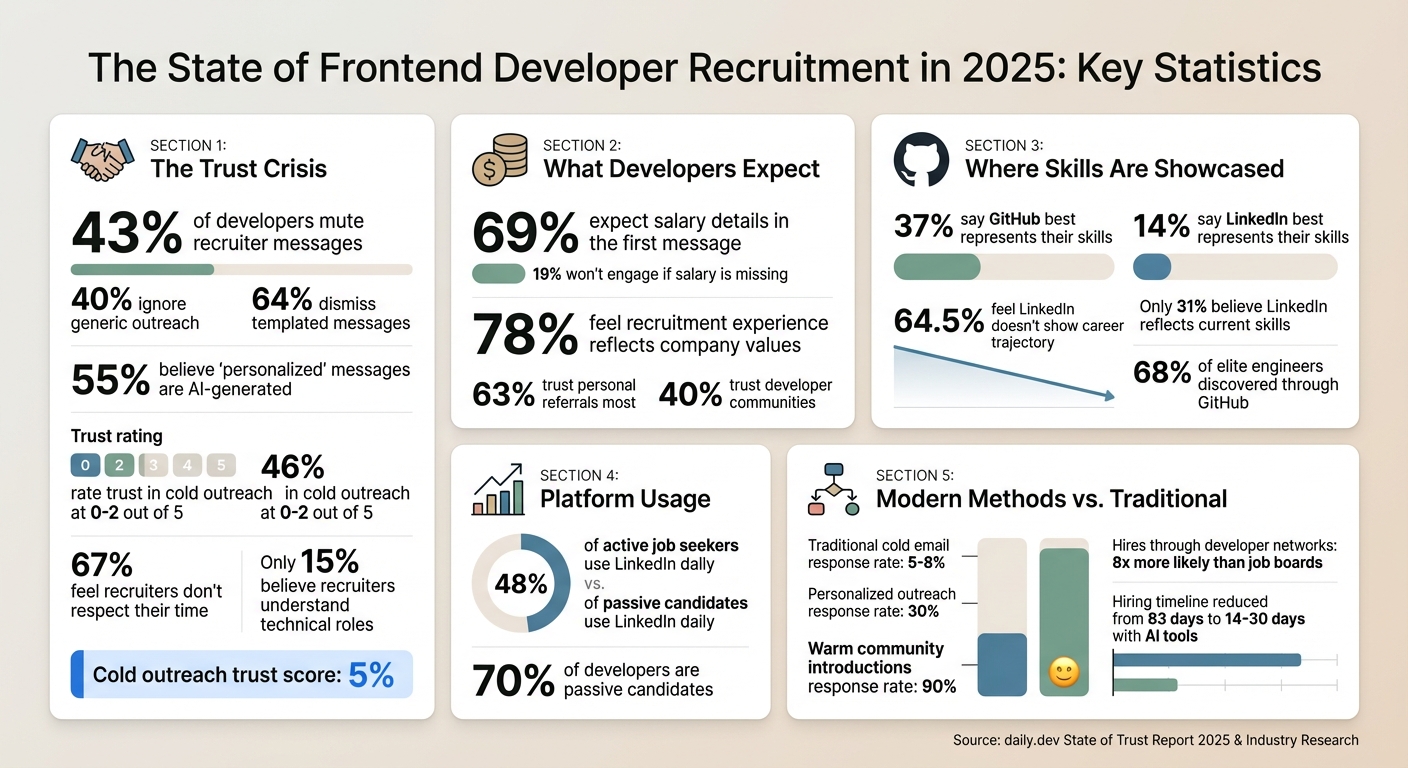 {Developer Trust and Recruitment Statistics 2025: Key Insights for Frontend Hiring}
Why Finding Frontend Engineers Is Harder Than Ever
Skills Change Faster Than Resumes Can Keep Up
Frontend development evolves so quickly that a developer's expertise in React last year might now be shifting toward newer frameworks. The challenge? Resumes and platforms like LinkedIn often fail to keep pace. Only 31% of developers believe their LinkedIn profile accurately reflects their current skills, and 64.5% feel it doesn't show where they're heading professionally . This gap leaves recruiters relying on outdated profiles, searching for keywords that no longer align with a candidate's current abilities or future trajectory. As skillsets evolve rapidly, there’s a growing need for platforms that can showcase up-to-date expertise.
Why Job Boards and Old Platforms Don't Work Anymore
Traditional job boards and platforms were designed for a different era. Today’s developers value proof of work over self-reported credentials. For instance, 37% of developers say GitHub is the best representation of their skills, compared to just 14% for LinkedIn . The top frontend engineers aren’t scrolling through career pages - they’re contributing to open-source projects, participating in developer communities, and waiting for roles that align with their technical depth. While 48% of active job seekers use LinkedIn daily, that drops to 29% for passive candidates . This shift in behavior highlights the limitations of older hiring methods.
Getting Passive Candidates to Respond
Engaging passive candidates is becoming increasingly difficult, especially as trust in recruiter outreach dwindles. Consider these numbers: 43% of developers mute recruiter messages, 40% ignore generic outreach, 64% dismiss templated messages, 55% believe "personalized" messages are AI-generated, and 19% won’t engage if salary details are missing . These stats reveal a significant trust gap. When recruiters fail to differentiate between technologies or levels of seniority, developers stop listening. In fact, 46% of developers rate their trust in cold outreach at just 0–2 out of 5, and 67% feel recruiters don’t respect their time . This erosion of trust is costing companies access to the very talent they need most. To succeed, recruiters need to rethink how to find passive developers without spamming, moving beyond outdated methods to build genuine, tailored engagement.
Hiring engineers?
Connect with developers where they actually hang out. No cold outreach, just real conversations.
How Recruiters Are Using Technology to Find Frontend Engineers
Recruiting frontend engineers has evolved significantly, with technology stepping in to address challenges like rapid skill changes and the need to build trust with developers. Modern tools focus on real-world skill validation, efficient communication, and matching opportunities to expertise. Here's how AI, developer networks, and open-source contributions are reshaping the hiring process.
AI Tools That Match and Screen Candidates
AI-powered sourcing tools are revolutionizing how recruiters identify and engage with frontend engineers. By analyzing data like GitHub activity, code contributions, and behavioral trends, these tools pre-screen candidates, significantly speeding up the hiring process - from an average of 83 days to just 14–30 days. This is particularly useful for reaching the 70% of developers who are passive candidates - those not actively job hunting but open to the right opportunity. Unlike traditional cold emails, which only achieve a 5% trust score, AI tools provide recruiters with targeted insights, improving both efficiency and trust.
Developer Networks Like daily.dev Recruiter
Recruiters are also turning to developer-focused platforms to overcome the "trust deficit" that plagues traditional methods. For example, only 15% of developers believe recruiters truly understand technical roles . Platforms like daily.dev Recruiter address this by facilitating double opt-in introductions, ensuring both recruiters and developers are genuinely interested in connecting. These interactions happen in spaces where developers are already active - engaging with technical content, learning, and collaborating. As noted in the daily.dev State of Trust Report 2025: "This isn't a sourcing problem. It's a trust problem." . By focusing on meaningful, spam-free connections, recruiters can build stronger relationships with candidates.
Finding Talent Through Open-Source Contributions
GitHub serves as a goldmine for identifying skilled frontend engineers, with 68% of elite engineers discovered through the platform, according to Stack Overflow surveys . Recruiters who understand how to evaluate GitHub profiles can spot top talent by examining key indicators: repositories with 500+ stars signal industry recognition, 100+ forks show practical utility, and 50+ pull requests in the past year highlight ongoing involvement . Advanced search filters like language:typescript stars:>100 pushed:>2025-01-01 help pinpoint active, high-performing developers . Additionally, referencing specific commits or pull requests in non-spammy outreach messages boost response rates by 60%, as it demonstrates genuine interest and respect for the developer's work .
These modern strategies are closing the gap between outdated hiring practices and the fast-paced world of frontend engineering recruitment.
What Actually Works When Recruiting Frontend Engineers
The current approach to recruiting frontend engineers often falls short. Traditional methods struggle to earn developers' trust or capture their interest. While technology has made sourcing candidates easier, the real game-changer lies in strategies that genuinely connect with developers. These tactics, when paired with tech-driven tools, can help recruiters engage and attract top frontend talent effectively.
Writing Job Posts That Developers Want to Read
A job post that resonates with developers is specific and outcome-focused. For example, successful recruiters outline deliverables for the first 60 days and set clear performance goals, such as achieving an LCP (Largest Contentful Paint) under 2.5 seconds . This level of detail helps developers visualize the actual work involved.
Clarity is essential because 78% of candidates feel the recruitment experience reflects how a company values its employees . Job descriptions should clearly define success metrics, career growth opportunities, and available learning programs . For frontend roles, it's important to highlight accessibility requirements, like ARIA standards and keyboard navigation expectations . Also, don't skip the salary range - 69% of developers want to see it in the very first message .
Connecting with Developers in Their Communities
Developers rely heavily on their peers for job opportunities. In fact, 63% trust personal referrals from friends or colleagues the most, and 40% trust developer communities they're already part of. Cold outreach, on the other hand, ranks at the bottom of the trust scale . This means recruiters need to meet developers where they already are.
Platforms like daily.dev Recruiter make this easier by enabling warm, double opt-in introductions within spaces where developers actively engage with technical content. The difference is striking: hires through developer networks are 8 times more likely than those from traditional job boards . Smart recruiters participate in active forums, contribute to discussions, and build relationships over time by demonstrating real technical knowledge.
Using Skills Tests to Evaluate Candidates
Attracting attention is only half the battle; assessing skills objectively is just as important. 37% of developers say GitHub is the best representation of their skills, compared to only 14% who say the same about LinkedIn . This highlights the value of practical skills assessments for frontend candidates.
One effective method is the "fix-it-to-apply" model, where application forms are replaced with short, 15–30 minute coding challenges . This approach saves time for both parties while offering a clear view of a candidate's problem-solving and coding abilities. Even for frontend roles, there's growing demand for "full-stack fluency", which includes familiarity with Node.js, CI/CD pipelines, and secure coding practices . Additionally, experience with AI-powered tools like GitHub Copilot is becoming a key differentiator .
Old Methods vs. New Methods: What's Different
The shift from old to new recruitment methods isn't just about incorporating technology - it’s about building trust. As the daily.dev State of Trust Report 2025 explains:
"This isn't a sourcing problem. It's a trust problem" .
Modern recruitment tools are designed to tackle these trust issues head-on by focusing on transparency and authentic engagement, addressing the core challenges that traditional approaches have struggled to overcome.
What Modern Recruitment Tools Offer
Today’s platforms bring a fresh approach to recruitment by using data-driven methods and prioritizing genuine connections. One standout feature is the use of real-time data to showcase a candidate’s current skills and activity, moving beyond outdated profiles that fail to reflect a person’s true capabilities.
Take platforms like daily.dev Recruiter, for example. Instead of relying on impersonal cold outreach - which typically results in response rates of just 5–8% - these tools leverage double opt-in introductions. This method ensures both the recruiter and the candidate agree to connect, boosting response rates to 30% for personalized outreach and up to 90% for warm, community-based introductions .
Traditional recruitment methods often rely on mass emails and keyword searches. In contrast, modern tools tap into real-time data sources like GitHub contributions and community participation. This ensures recruiters are matched with developers who are genuinely open to new opportunities, creating a more targeted and effective process.
Transparency is another area where modern tools excel. Developers have specific expectations - 69% want salary details included in the initial message, and 19% will ignore outreach entirely if this information is missing . To meet these expectations, modern platforms require recruiters to provide the "Big Three" details upfront: tech stack, salary range, and work model (remote or hybrid) .
Beyond building trust, these tools also streamline the recruitment process. Features like ATS integration vs. manual processes eliminate tedious data entry and automatically deduplicate candidates . This allows recruiters to spend less time on administrative tasks and more time fostering meaningful connections with pre-qualified talent.
Conclusion
Frontend recruitment in 2025 is all about earning the attention - and trust - of developers. With skepticism running high, old-school methods are falling flat.
To succeed, recruiters need to put developers first. This means being upfront with key details like the tech stack, salary, and work model, while assessing skills through real, meaningful projects. (The same principles apply when hiring a backend developer). Platforms that encourage authentic and respectful interactions make this shift possible.
Take modern tools like daily.dev Recruiter, for instance. They move away from impersonal cold outreach and focus on warm, double opt-in connections with developers who are already interested in exploring opportunities. This approach turns recruitment into a trust-focused process where both sides are genuinely eager to engage.
By embracing community-driven strategies and leaving outdated tactics behind, recruiters can stay competitive. Transparent communication paired with smart tech for skill validation is the foundation of a trust-based hiring process. Those who adapt will find themselves connecting with qualified talent, while those clinging to old methods risk being left behind in a market that's more discerning than ever.
The tools are here - will you make the leap?
FAQs
What should I look for on GitHub to spot strong frontend engineers fast?
To spot talented frontend engineers on GitHub, pay attention to their activity and contributions. Look for patterns like regular, well-structured code commits and thoughtful pull requests that address real issues or improve functionality. Engagement in repositories related to frontend technologies is another good sign of their expertise. Also, check for involvement in collaborative projects - this often reveals their teamwork and communication skills.
What should my first message include to get replies from passive candidates?
Your initial message needs to stand out and genuinely connect with passive candidates. Focus on highlighting their skills or recent work to show you've done your homework. Be upfront with key details about the role, like salary range, tech stack, or unique perks, and make it clear why this opportunity is worth their attention. Lead with something valuable - whether it’s insights, industry trends, or a useful resource they’d appreciate. By putting real effort into your outreach, you’ll not only grab their attention but also build trust, making them more likely to respond.
How can I validate frontend skills without long, unpopular take-home tests?
You can assess frontend skills through methods that are both practical and time-efficient. Options like technical conversations, portfolio reviews, or short, targeted projects that simulate real-world tasks can be effective. These approaches usually take 2-3 hours or less, making it easier to evaluate problem-solving abilities, code quality, and hands-on skills without overburdening candidates. Additionally, reviewing GitHub contributions or open-source projects offers concrete proof of technical knowledge and teamwork capabilities.
.png)