Finding senior backend engineers in 2025 is harder than ever. Here’s why: demand for software developers is skyrocketing, but only a small percentage of applicants meet the qualifications. Recruiters face two major challenges: filtering through unqualified candidates and attracting top-tier engineers who aren’t actively job hunting.
Key takeaways:
- Senior backend engineers now need skills in Python, Go, Rust, cloud platforms, DevOps, and AI integration.
- Passive talent dominates the market, with many ignoring generic outreach messages.
- Effective recruiting requires personalized communication, transparent job details (salary, tech stack, work model), and practical assessments.
To succeed, recruiters must shift from cold outreach to trust-based platforms and focus on real-world skills during evaluations. This guide explains how to adapt your hiring process to meet these challenges.
Technical Skills Recruiters Screen for in Senior Backend Engineers
The expectations for senior backend engineers have grown significantly over the years. By 2025, 62% of developers identify as backend or full-stack , making this a highly competitive field. These engineers are no longer just feature developers - they're system architects who design scalable infrastructure, integrate AI, and manage cloud environments.
Recruiters focus on three critical skill areas: core development expertise, cloud and DevOps knowledge, and security combined with AI integration. This shift highlights the transformation of senior engineers into adaptable professionals who can navigate evolving technologies. As Aditii Saxenaa, Staff Engineer, states:
"The fastest-growing engineering roles in 2025 are AI Application Engineer and AI Systems Integrator."
This evolution demands engineers who are not only specialists in their core skills but also capable of quickly adapting to new tools and trends.
Core Backend Development Skills
A solid foundation in programming languages and frameworks is non-negotiable. Today’s backend engineers need proficiency in Python, Java, Go, Node.js (TypeScript), and Rust . Each language serves specific purposes:
- Java: A staple for enterprise applications, particularly with frameworks like Spring Boot .
- Python: Ideal for rapid development and AI/ML tasks, using frameworks like Django, FastAPI, and Flask .
- Go: Popular for high-performance, cloud-native systems and microservices.
- Node.js with TypeScript: Essential for real-time applications.
- Rust: Emerging as a go-to for performance-critical services .
Backend engineers must also master API development, including REST, GraphQL, and gRPC, and understand authentication protocols like OAuth2 and JWT . Data handling expertise is equally important, spanning both SQL (PostgreSQL, MySQL) for structured data and NoSQL (MongoDB, Cassandra, Redis) for unstructured, high-volume data.
When evaluating candidates, practical exercises are more revealing than abstract puzzles. A task such as building a CRUD API with authentication and pagination within 45–60 minutes can demonstrate their hands-on skills. For senior roles, assess their ability to weigh architectural trade-offs, like choosing between microservices and monolithic designs or deciding on SQL versus NoSQL based on specific business needs .
DevOps and Cloud Platform Experience
Beyond core development, cloud and DevOps expertise is essential. With cloud services adoption projected to grow 20% annually through 2025 , senior engineers must be skilled in at least one major platform - AWS, Azure, or GCP - and know how to create scalable, resilient applications .
Key tools include Docker and Kubernetes for deployment reliability . Familiarity with Infrastructure as Code (IaC) tools like Terraform, Ansible, or CloudFormation is also critical . Additionally, experience with CI/CD pipelines ensures faster, more reliable development cycles .
Observability is another vital area. Senior engineers must design systems capable of handling real-world traffic, implementing strategies like hard timeouts, backpressure, and fallbacks . They should also be familiar with monitoring tools such as Prometheus, focusing on metrics like p95 and p99 latency rather than averages . As one senior engineer remarked:
"Green tests prove code works, not that systems survive."
Security Knowledge and AI/ML Integration
Security is no longer optional - it's a core responsibility. Engineers must design systems that are secure by design, employing encryption protocols and proactively addressing vulnerabilities . Recruiters should ensure candidates understand OWASP Top 10 principles and can identify issues like SQL injection or authentication flaws during code reviews .
AI and machine learning integration is equally important as companies rush to embed AI capabilities into scalable services . Tools like Cursor and GitHub Copilot have shifted the focus from writing code to understanding what to build and how to deliver it efficiently . As Zhi Sun, Founder, explains:
"The real challenge is knowing what to build, how to shape it, and how to ship it quickly."
To evaluate these skills, practical assignments work best. For example, a 24-hour project requiring candidates to use AI tools - along with a short video explaining their code, trade-offs, and AI usage - can provide valuable insights. Code review exercises that focus on security testing are also effective in assessing real-world problem-solving abilities.
The evolving demands of this role highlight the challenges recruiters face in identifying engineers who can thrive in dynamic, future-focused environments.
Where to Find Senior Backend Engineers in 2025
::: @figure 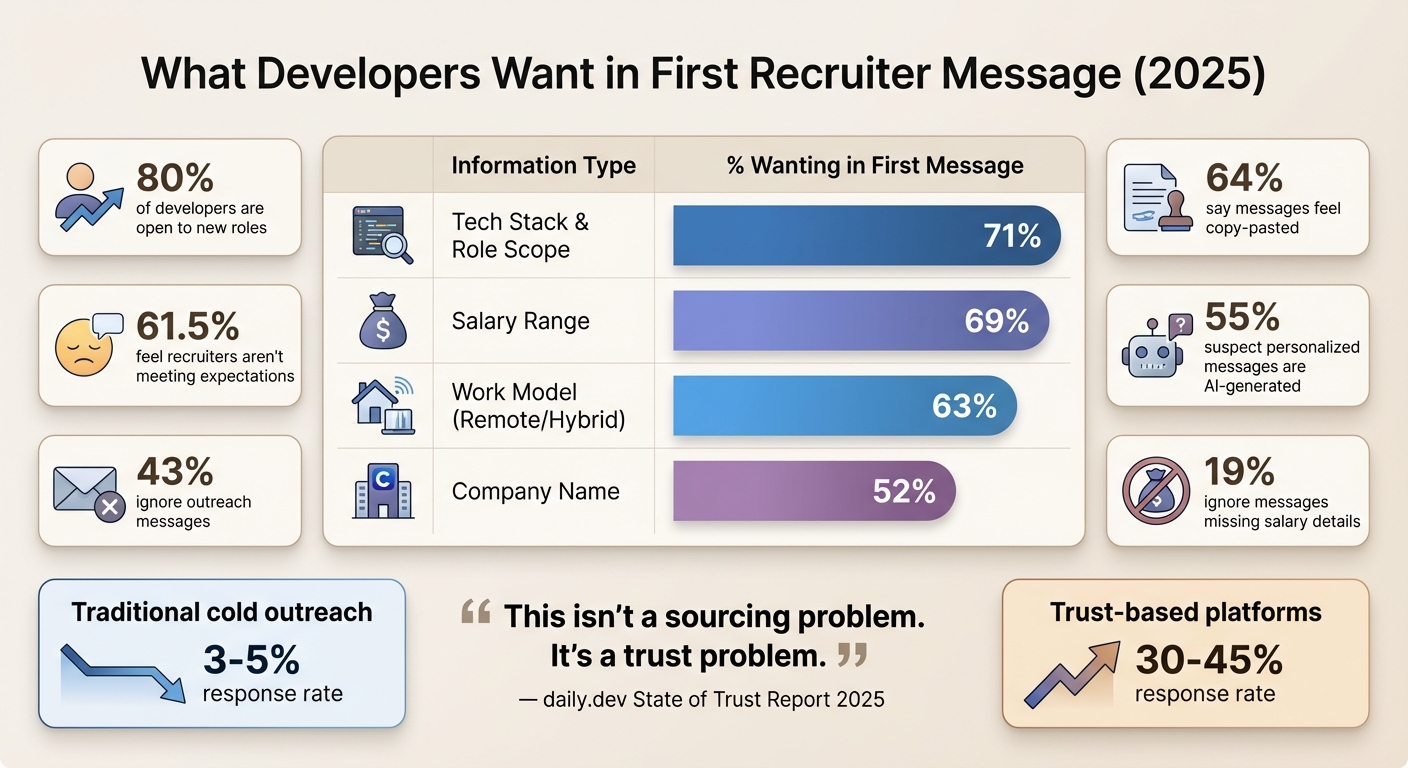 {What Senior Backend Engineers Want in Recruiter Outreach 2025}
Finding senior backend engineers in 2025 is less about locating talent and more about earning their trust. While about 80% of developers are open to new roles, only a small percentage are actively searching. Complicating matters, 61.5% of developers feel recruiters aren’t meeting their expectations. Recruiters are shifting from traditional cold outreach, which sees dismal response rates of 3–5%, to platforms that provide real-time insights into candidates’ interests and behaviors. As noted in the daily.dev State of Trust Report 2025:
"This isn't a sourcing problem. It's a trust problem." – daily.dev State of Trust Report 2025
Developer-First Recruitment Platforms
Modern recruitment tools focus on warm, mutual introductions rather than impersonal cold messages. For example, daily.dev Recruiter connects recruiters with developers already active in its ecosystem. Instead of relying on static profiles, recruiters gain insights from candidates’ real-time reading habits and coding activities.
This "TinDev" model - where both parties must opt in - reduces spam and achieves response rates of 30–45%, far surpassing traditional methods. The platform operates on a pay-for-results model, so recruiters only pay when they successfully connect with a qualified candidate - no placement fees or monthly subscriptions required.
What sets this apart is context. Unlike conventional platforms with profiles that only 14% of developers trust to reflect their actual skills, daily.dev uses behavioral data to match recruiters with developers who are actively exploring new opportunities. By combining this insight with active participation in developer communities, recruiters can build a more effective sourcing strategy.
Developer Communities and Open Source
Senior backend engineers often gather in specialized communities to share knowledge, solve problems, and contribute to open-source projects. Platforms like GitHub are invaluable for spotting talent - not just for their technical skills but also for their collaboration style and problem-solving abilities.
Joining spaces like Discord, Slack, and niche forums requires a long-term approach. Build credibility by consistently participating: answer questions, share insights, and contribute meaningfully over time. When you eventually reach out, you’ll be recognized as a contributor rather than just another recruiter looking to fill a role.
Focus on developers working with languages and technologies like Rust, Go, Python, and cloud-native tools. Reviewing their commit history, pull requests, and discussions can reveal how they think and work, offering insights you won’t find on a resume. Once you’ve identified potential candidates, personalized outreach becomes the next critical step.
Writing Personalized Outreach Messages
Generic outreach doesn’t work. Forty percent of developers ignore spam-like messages, and 64% say recruiter messages feel copy-pasted. Worse, 55% suspect that even "personalized" messages are AI-generated. To stand out, you need to show genuine effort and transparency from the start.
Include "The Big Three" in your first message: tech stack, salary range, and work model (remote or hybrid). These are the details developers care about most. Specifically:
| Information | % Wanting in First Message |
|---|---|
| Tech Stack & Role Scope | 71% |
| Salary Range | 69% |
| Work Model (Remote/Hybrid) | 63% |
| Company Name | 52% |
Failing to include salary details alone causes 19% of developers to ignore messages. Be specific when describing technical requirements. Instead of vaguely asking for "Python experience", mention "Python 3.11 with FastAPI or Celery".
Skip corporate jargon. Developers want to know the real challenges they’ll tackle, not buzzwords about "cutting-edge innovation." For example, mention a concrete problem, like optimizing a service for millions of concurrent API calls. Keep your ask low-pressure - offer to share a short document they can review at their convenience instead of immediately requesting a call. This approach respects their time and increases the likelihood of a response.
How to Screen and Evaluate Senior Backend Engineers
Screening senior backend engineers goes beyond skimming resumes. With 76% of developers integrating tools like ChatGPT into their workflows , traditional coding tests may no longer be enough to separate true expertise from AI-augmented solutions. Modern approaches combine AI-powered tracking tools with real-world scenarios that replicate actual job challenges. Building on earlier discussions about technical skills and sourcing strategies, this section dives into specific methods for effective screening.
Backend-Specific Coding Assessments
The best coding assessments emphasize practical problem-solving over memorization. Tools like HackerRank allow candidates to use Copilot while tracking how they interact with it. Similarly, Codility's "Code Playback" feature offers recruiters a step-by-step view of how candidates debug and refine their solutions, providing valuable insights into their thought processes.
Keep these assessments under 90 minutes and tailor them to backend-specific challenges like optimizing database queries, designing REST APIs, or troubleshooting distributed systems. Let candidates use their preferred tools, as well as resources like Google and Stack Overflow, to mirror real-world conditions. For example, in 2025, Atlassian’s campus recruiting team used HackerRank’s AI features to reduce plagiarism flags from 10% to just 4% across 35,000 applicants .
"Traditionally, a plagiarism check could flag as high as 10% of applications. However, with HackerRank's AI-enabled features, this was brought down to just 4%." – Srividya Sathyamurthy, Senior Manager, Atlassian
Another tool, Devskiller TalentScore, uses the "RealLifeTesting" methodology to simulate production-level challenges, ensuring a more accurate measure of candidates' abilities.
After coding assessments, move on to system design interviews to evaluate architectural reasoning and teamwork.
System Design and Problem-Solving Interviews
For senior-level engineers, system design interviews often reveal more about their capabilities than coding speed alone. Present candidates with real-world architectural problems, such as designing a notification system for millions of users or migrating a monolithic application to microservices. Pay attention to how they analyze trade-offs, address scalability, and explain their reasoning.
Using standardized rubrics with clear benchmarks - like identifying potential scalability bottlenecks or suggesting cost-efficient caching strategies - helps reduce subjective bias. Pair programming sessions can also provide a window into their thought processes and collaboration skills, both of which are crucial for mentoring and cross-team communication.
Once system design skills are assessed, dig deeper into their cloud and DevOps expertise through targeted simulations.
Verifying Cloud and DevOps Experience
Certifications might suggest familiarity, but they don’t always guarantee hands-on proficiency. To verify practical experience, review candidates' GitHub contributions and set your ATS to flag keywords such as Kubernetes, Docker, Terraform, and cloud services like EC2, S3, and RDS.
Introduce 20–30 minute sandbox simulations where candidates debug APIs or manage cloud infrastructure. Platforms like daily.dev Recruiter use AI to analyze their coding behavior and deliver high-quality matches.
Build a skill matrix to differentiate between "Must-Have" skills (e.g., AWS, Kubernetes, Go) and "Nice-to-Have" skills (e.g., GraphQL, Python). This ensures you don’t miss out on strong candidates who can quickly learn additional tools. Focus on their production-level experience by asking them to describe a deployed application they’ve worked on or detail how they’ve optimized cloud costs in a past role. This thorough approach ensures you’re selecting candidates ready to tackle complex backend challenges.
How to Close Senior Backend Engineer Candidates
After a thorough screening process, the closing phase is where you seal the deal by presenting offers that are quick, clear, and transparent. In tech, the average time-to-hire is 4.9 weeks (34 days), but 60% of companies reported longer hiring timelines in 2024 . Senior backend engineers often juggle multiple offers, so speed and clarity are crucial. Your mission? Build a process that’s smooth, developer-friendly, and fosters trust from the first conversation to the signed offer.
Writing Clear Job Descriptions for Developers
Senior engineers value clarity over fluff. 69% of developers expect salary information in the first recruiter message, while 19% will ignore your outreach entirely if salary details are missing . To stand out, include the "Big Three" in your job descriptions: tech stack, salary range, and work model (remote/hybrid/onsite) . Be specific - state "$160,000–$190,000 USD base salary plus equity" instead of vague terms. Similarly, list tools like "Go 1.21, Kubernetes 1.28, PostgreSQL 15, AWS (EC2, RDS, S3)" instead of saying "modern tech stack."
Beyond salary, senior engineers look for perks like professional development funds, mental health support, student loan repayment, and equity or ownership . Highlight these benefits to make your offer more appealing. Keep the interview process concise - 3–4 rounds maximum - to avoid exhausting candidates. Aim to wrap up hiring within 2–3 weeks to stay competitive . Many companies now run technical, leadership, and culture interviews in parallel to save time .
| Element | Developer Expectation | Impact on Acceptance |
|---|---|---|
| Salary | Clear USD range in job description | High; builds immediate trust |
| Work Location | Remote/Hybrid with core hours | Critical; 72% prefer remote |
| Interview Length | 3–4 rounds max | High; prevents burnout |
| Tech Stack | Specific versions and use cases | Medium; ensures alignment |
| Assessment | Real-world tasks (1–3 hours) | High; respects candidate time |
To further streamline hiring, leverage applicant tracking systems (ATS) that improve communication and efficiency.
Using ATS Tools That Improve Candidate Experience
A good ATS system can make the hiring process smoother for everyone. Choose platforms that support clear workflows and allow you to ask 2–3 targeted technical questions upfront (e.g., "How do you handle state management in large-scale applications?") . This saves time and shows respect for the candidate’s expertise.
Tools like daily.dev Recruiter take this a step further with a double opt-in model, where engineers only engage with roles they’re genuinely interested in. This eliminates cold outreach and ensures candidates are motivated from the start. As Nimrod Kramer, CEO & Co-Founder of daily.dev, puts it:
"Trust is the only hack. Engineers already come to daily.dev to grow. They already trust the platform... When your role shows up inside that flow, it doesn't feel like outreach. It feels like an opportunity" .
This approach shifts recruiting from intrusive outreach to a trust-based matchmaking process.
Once you’ve streamlined job descriptions and tracking, the next step is ensuring candidates are a good fit for remote work and collaboration.
Assessing Remote Work and Collaboration Abilities
With 72% of engineers open to fully remote opportunities , and 63% prioritizing work model details in initial outreach , it’s clear that remote options are a major draw. However, some "remote" roles in 2025 come with hidden in-office requirements that only surface during interviews . Confirm your company’s stance on remote work before extending offers to avoid mismatches and last-minute rejections.
During behavioral interviews, ask candidates about their remote collaboration skills: “How have you mentored junior engineers remotely?” or “How do you manage asynchronous communication across time zones?” These questions help gauge their ability to succeed in distributed teams. Companies hiring remotely can also attract top talent for 10–15% lower compensation compared to roles based in expensive tech hubs . Remote flexibility remains a key advantage in 2025 hiring strategies.
Summary: Recruiting Senior Backend Engineers in 2025
Hiring senior backend engineers in 2025 demands a shift from traditional methods to a more transparent, candidate-focused approach. Developers' trust in recruiters remains low , making cold outreach less effective. Instead, success hinges on connecting with engineers where they are - on platforms like daily.dev Recruiter - and being upfront about key details. Developers now expect to see salary ranges and tech stack specifics early in the process .
Recruiters are also moving toward a skills-first evaluation. This means focusing on practical abilities rather than just academic or professional credentials. Teams are adopting coding tests and concise system design interviews, keeping the entire process to 3–4 rounds and aiming to close candidates within 2–3 weeks. With 72% of engineers open to fully remote roles , clarity about the work model from the very first conversation is crucial.
Effective communication is another essential piece of the puzzle. Platforms like daily.dev Recruiter address trust issues by replacing generic cold outreach with warm, opt-in introductions. Nimrod Kramer, CEO & Co-Founder of daily.dev, highlights this shift:
"Developers aren't failing your process - your process is failing developers."
This strategy transforms recruiting into a precise matchmaking effort rather than a numbers game.
Here’s the reality: while 80% of developers are open to new opportunities, 43% ignore outreach messages . To stand out, recruiters need to build trust, offer context, and respect developers' time. Including the "Big Three" - tech stack, salary, and work model - in job descriptions and focusing on real skills during evaluations not only speeds up the hiring process but also attracts motivated engineers who are ready to thrive from day one. This approach mirrors the industry's broader move toward transparency and candidate-focused recruitment, aligning perfectly with daily.dev Recruiter's philosophy.
FAQs
How can I reach senior backend engineers who aren’t actively job hunting?
To reach senior backend engineers who aren’t actively searching for jobs, focus on personalized, proactive outreach. Start by leveraging developer-focused platforms like daily.dev Recruiter and participating in niche communities such as GitHub or Stack Overflow. The key is to build trust - share content that’s relevant to their interests and always respect their time.
Platforms like daily.dev Recruiter make this process easier by enabling warm, opt-in introductions. This approach helps you connect with developers who are genuinely open to opportunities, leading to better response rates and more meaningful engagement.
What’s the best way to test real backend skills when candidates use AI tools?
To assess backend skills when candidates utilize AI tools, focus on practical coding assessments that reflect real-world challenges. These evaluations should test problem-solving abilities, core backend expertise, and the ability to write maintainable code. Incorporating AI-powered tools with features like plagiarism detection and live coding sessions can help confirm the candidate's authentic skills, ensuring they showcase their own capabilities instead of over-relying on AI support.
How do I shorten time-to-hire without lowering the bar for senior roles?
To speed up the hiring process for senior backend engineers while ensuring high standards, it’s crucial to refine your approach and embrace updated methods. Start by designing a straightforward and efficient process to eliminate unnecessary delays. Keeping a well-maintained talent pool lets you quickly connect with qualified candidates when openings arise. Incorporating AI tools can further streamline tasks like candidate screening and interview scheduling. Additionally, being upfront about role expectations and career growth opportunities can help keep top-tier candidates engaged throughout the accelerated hiring timeline.
.png)