Recruiters today do much more than just match candidates with job openings. They’ve evolved into trusted advisors who help companies plan for long-term success while guiding candidates in their career journeys. This shift is driven by the rise of AI handling routine tasks and the demand for better hiring experiences in a challenging job market. Here’s how recruiters provide real value:
- Focus on Quality Over Quantity: Recruiters prioritize candidates who align with a company’s mission, improving retention and engagement.
- Building Long-Term Partnerships: They help companies hire for future goals, not just current needs, and support internal mobility.
- Bridging Gaps: Recruiters improve trust and communication between candidates and hiring managers by being transparent and using market data.
- Using Expertise: They leverage industry trends, salary benchmarks, and hidden job opportunities to guide smarter hiring decisions.
- Staying Involved Post-Hire: Recruiters follow up with new hires, supporting career growth and improving retention.
What Adds Value in Recruitment
::: @figure 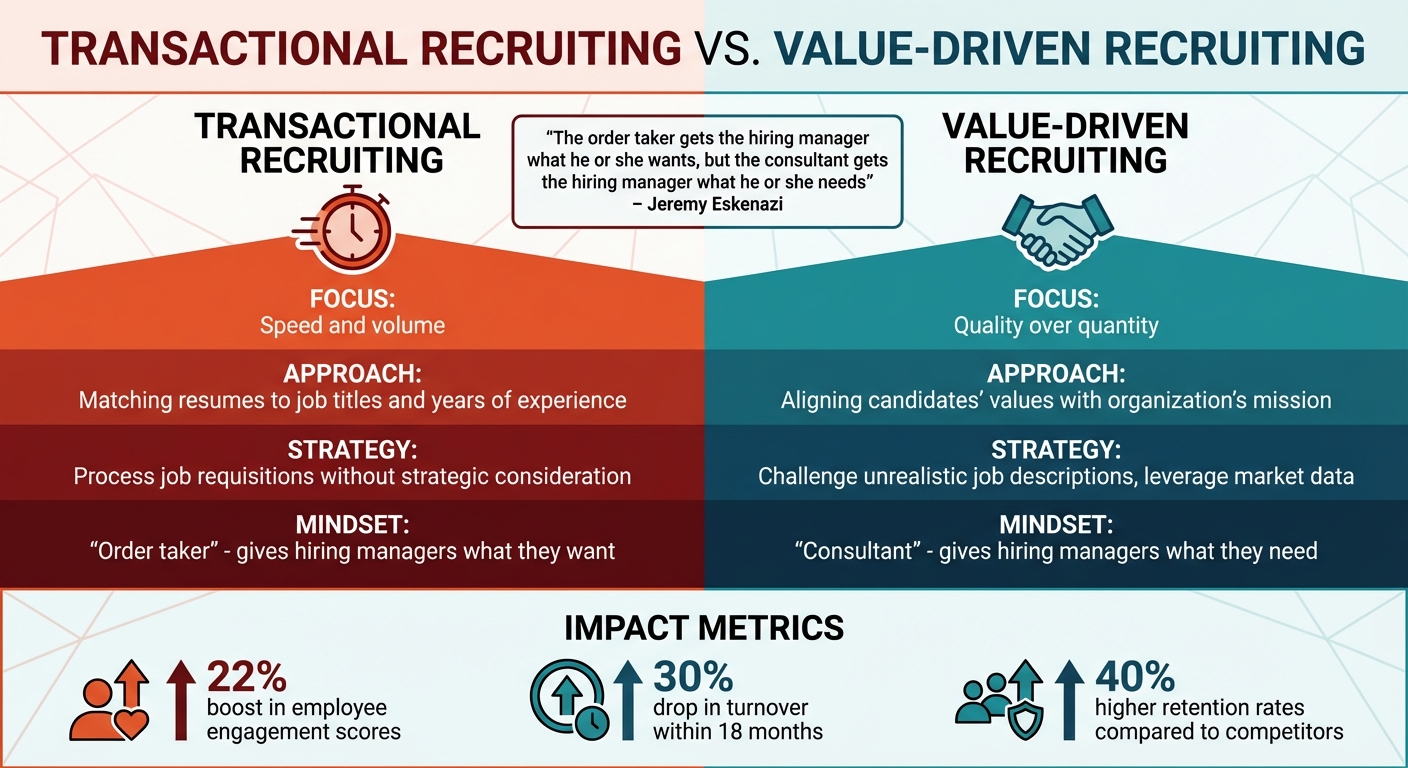 {Transactional vs Value-Driven Recruiting: Key Differences and Impact}
Recruitment strategies generally fall into two categories: transactional and value-driven. Transactional recruiting emphasizes speed and volume, focusing on quickly filling positions by matching resumes to job titles and years of experience. In this model, recruiters often process job requisitions without much strategic consideration .
On the other hand, value-driven recruiting prioritizes finding candidates whose values align with the organization's mission. This approach shifts the focus to quality over quantity, and the results speak for themselves: companies that adopt values-first hiring report a 22% boost in employee engagement scores and a 30% drop in turnover within 18 months . Moreover, organizations with a mission-driven focus enjoy 40% higher retention rates compared to their competitors .
The key difference lies in how recruiters view their role. As Jeremy Eskenazi puts it:
The order taker gets the hiring manager what he or she wants, but the consultant gets the hiring manager what he or she needs .
Value-driven recruiters challenge unrealistic job descriptions, leverage market data to guide hiring decisions, and aren’t afraid to say no to ideas that could undermine long-term success. This strategic mindset fosters stronger, more enduring partnerships between employers and candidates.
From Job Placements to Long-Term Partnerships
Value-driven recruitment isn’t just about filling roles - it’s about aligning talent with a company’s long-term goals. The traditional "fill-and-move-on" approach is outdated, as standard candidate sourcing has become increasingly commoditized . Instead, effective recruiters focus on building relationships that extend beyond the hiring process, ensuring the right talent supports the organization’s strategic vision.
This approach requires a deep understanding of where the company aims to be in three to five years and hiring individuals who can help achieve those goals. It also involves prioritizing internal mobility, enabling employees to develop new skills based on their interests rather than just immediate organizational needs. However, the challenges are real: only 22% of recruiting executives have clear visibility into their hiring needs for the current year, and 78% are working with stagnant or shrinking budgets . Recruiters who can navigate these constraints by aligning hiring strategies with long-term objectives become invaluable.
What Candidates and Employers Want Most
In the context of long-term partnerships, both candidates and employers are looking for more meaningful connections. Young professionals, in particular, value purpose and a sense of belonging over just a paycheck. For instance, 92% of Millennials and 89% of Gen Z professionals cite a sense of purpose as a key factor in job satisfaction . Many Gen Z candidates even evaluate a company’s authenticity and diversity by reviewing its social media presence .
Employers, on the other hand, want employees who will stay, contribute, and grow within their organization. They look for candidates with adaptability and a willingness to learn - qualities that AI cannot replicate . However, there’s often a disconnect: only 38% of HR leaders believe most employees can recite their company’s core values . This is where value-driven recruiters step in, embedding organizational values into job descriptions and using behavior-based interview questions to uncover genuine alignment rather than rehearsed responses.
The most successful recruiters treat both employers and candidates as long-term partners, emphasizing honest communication, timely feedback, and a personal touch. As Tera May explains:
Recruiting comes down to 'treating others the way you wish to be treated'; truly getting to know the heart of your candidates and your company to find the perfect fit .
Building Trust and Credibility
Trust doesn’t happen overnight - it’s built through honest communication and consistently following through on promises. In today’s job market, where many job seekers find the process increasingly challenging , transparency is more critical than ever. Employers face their own hurdles, too, with only about 31% of hiring managers feeling they communicate effectively with their recruiters . Bridging these gaps requires recruiters to step into the role of transparent and trusted advisors.
A major shift is happening in recruiting: moving from a transactional approach to a consultancy-based one. And the key to this transformation? Don’t just say “yes” to everything. Jeremy Eskenazi, Managing Principal at Riviera Advisors, puts it plainly:
If you just say 'yes, yes, yes' and don't push back on hiring managers' bad ideas, you will be seen as less strategic and less credible and pigeonholed into a transactional, administrative function .
Credibility grows when recruiters use market data to challenge unrealistic job descriptions or compensation expectations, even when those conversations feel uncomfortable.
The Impact of Transparent Communication
Clear and upfront communication is essential to avoid the dreaded "black hole" experience that frustrates both candidates and employers. For example, if a role is closed, shifted, or its requirements change, recruiters should notify candidates immediately rather than leaving them in the dark . Small actions, like including salary ranges in job postings and promptly removing outdated listings, show respect for candidates’ time and effort . And when hiring timelines stretch - say, nine weeks instead of four - setting realistic expectations from the beginning helps maintain trust.
Building trust with hiring managers also requires proactive communication. Sending a meeting agenda 24 hours before intake calls, complete with qualifications, salary ranges, and timelines, can set the tone for productive discussions. These meetings are a great chance to distinguish between “must-haves” and “nice-to-haves,” using market data to guide decisions . Additionally, identifying each manager’s preferred communication method - whether it’s Slack, email, or phone - and scheduling regular check-ins can help avoid misalignment . Interestingly, about 70% of hiring managers think recruiting programs should rely more on data .
Amy Spurling, CEO of Compt, highlights the importance of balancing technology with humanity:
Use automation for administrative tasks like scheduling and initial resume screening, but keep all candidate communication personal and authentic .
While AI can handle the logistics, trust is built through genuine, human connections.
Providing Constructive Feedback
Transparent communication isn’t complete without constructive feedback. Feedback isn’t just a polite gesture - it’s a critical tool for building long-term relationships. For instance, 94% of candidates want feedback after an interview, but most never receive it . Providing a few clear and constructive sentences to declined candidates not only strengthens relationships but also protects the employer’s brand . Specificity is key here: vague statements like “you need to communicate better” can come across as dismissive, while actionable suggestions - like recommending a professional development course - offer real value .
Effective feedback should focus on behaviors, not personal traits. Frame issues as isolated and improvable rather than as fundamental flaws . Using the SMART framework (Specific, Measurable, Achievable, Relevant, Time-bound) can make feedback more actionable . For example, instead of saying, “your technical skills need work,” try something like, “Practicing algorithm challenges on platforms like LeetCode for 30 minutes daily could improve your performance in technical interviews.”
When it comes to hiring managers, framing feedback around outcomes like speed and quality can make it more impactful. John Vlastelica, Founder of Recruiting Toolbox, explains:
If I'm not framing [the advice] so that the outcome sounds like it has a positive impact on speed and quality, they're probably not going to do it .
Creating a two-way feedback system, where recruiters also evaluate hiring managers on responsiveness and interview skills, can encourage accountability and foster continuous improvement.
Using Market Expertise to Deliver Insights
Recruiting has evolved into a strategic function - 87% of professionals agree on its growing importance . Brett Baumoel, VP of Global Talent Acquisition at Microsoft, captures this shift perfectly:
Recruiting professionals have never been able to make a bigger impact than right now... You used to be able to say, "These hires helped our company." Now you can say, "I changed the makeup of our company."
This transformation hinges on expertise. Recruiters who grasp industry trends, salary benchmarks, and workforce dynamics elevate themselves from resume senders to indispensable advisors. Let’s explore how staying informed and uncovering hidden opportunities can redefine recruitment.
Staying Informed About Industry Trends
A recruiter’s expertise begins with data. Key metrics - like median time-to-fill and cost-per-hire - combined with macroeconomic indicators, such as the unemployed-people-per-job-opening ratio, provide a strong foundation. For instance, with 56% of recruiting executives citing talent shortages as a major hurdle and 74% of hiring managers concerned about meeting pay expectations through 2026 , these figures can guide critical conversations. When hiring managers suggest below-market salaries, presenting these stats can help ground discussions in reality.
AI is also reshaping recruitment. Between 2024 and 2025, AI adoption in HR tasks jumped from 26% to 43% , freeing up about 20% of recruiters' weekly workload for strategic activities like building relationships . Salma Rashad, Global Executive Vice President of Talent Acquisition at Siemens, highlights AI’s potential:
AI-powered tools can analyze vast amounts of data to identify candidates with the highest likelihood of success, offering predictive insights that go beyond resumes and conventional interviews.
Another trend reshaping recruitment is the rise of skills-first hiring. With 75% of talent professionals prioritizing this approach through 2025 , recruiters who can identify closely related skills - known as skills adjacencies - help organizations adopt "buy, then build" strategies for upskilling . LinkedIn data shows a 16% rise in job postings that don’t require a degree , signaling a shift in how companies evaluate talent.
Salary negotiations are becoming more nuanced. Currently, 88% of professionals feel confident negotiating pay when receiving a job offer , and 66% would accept on-site work five days a week for higher pay . Recruiters who use localized salary tools incorporating factors like cost of living and labor demand can provide accurate, city-specific benchmarks, helping both sides reach fair agreements .
Accessing the Hidden Job Market
Did you know that 70% to 80% of job openings are never publicly advertised ? This hidden job market is a goldmine for recruiters who know how to leverage insights. By tracking signals like expansion plans, funding announcements, and leadership changes, recruiters can uncover opportunities before they hit the job boards .
The hidden market’s power is undeniable. Referred candidates are five times more effective than other sources and four times more likely to secure a job than those applying through websites . Additionally, referrals reduce time-to-hire from 39 days (via job boards) to just 29 days, saving companies around $7,500 per hire when accounting for recruitment costs and productivity gains . Plus, 46% of referred employees stay in their roles for over a year, compared to just 14% of hires from job boards lasting three years .
Internal hiring is also gaining traction, with internal marketplace usage rising from 25% in 2024 to 35% in 2025 . However, only 15% of recruiting executives report that their teams have the freedom to contact any employee about internal openings . This highlights a major opportunity for expert recruiters to facilitate internal mobility.
Labor market intelligence (LMI) further sets recruiters apart. By analyzing talent availability, competition, and hiring challenges, recruiters can guide clients on whether to "buy, borrow, or build" talent . Backing these recommendations with data ensures informed decision-making .
For senior roles, the hidden market is even more critical. Over 90% of executive positions are never publicly posted , making networking and private introductions essential. John Vlastelica, Founder and CEO of Recruiting Toolbox, explains:
The best recruiters... will become talent advisors who work with candidates who need the human touch to guide them on major career decisions. They will be providing more of an executive recruiter kind of experience.
To succeed in this evolving landscape, recruiters must shift from transactional tasks to advisory roles - building relationships, staying ahead of industry trends, and becoming trusted guides for both clients and candidates navigating complex career decisions.
Supporting Success After Job Placement
A recruiter's role doesn't stop once a candidate accepts an offer. In fact, some of the most impactful work happens after that point. Consider this: 94% of workers say they’d stay longer at a company if their employer invested in their career development . By staying involved post-placement, recruiters can help make this investment a reality, ensuring both the candidate and the employer thrive.
Follow-Up as a Trust-Building Method
Follow-ups can transform recruiters from simple deal-closers into trusted advisors. This approach shifts the relationship from being purely transactional - where the interaction ends with the placement - to one rooted in ongoing support and trust, often referred to as "communal norms" . Regular check-ins provide a safe space for new hires to discuss any challenges they face as they settle into their roles.
For example, employees who talk about their career goals with their managers every six months are 2.8 times more likely to feel engaged at work . As a recruiter, you can encourage these conversations by scheduling check-ins at key milestones, like a 30, 60, and 90 day plan. Use these opportunities to ask thoughtful questions about their role, any onboarding issues, and whether they feel supported. Having a complete onboarding checklist can help ensure no critical steps are missed during this phase. These early touchpoints can help identify and address potential problems before they grow, showing that you’re invested in their long-term success - not just in closing a placement. This foundation of trust sets the stage for sustained career growth, something we’ll explore further.
Helping with Career Growth and Retention
Once effective follow-ups are in place, recruiters can take it a step further by supporting career development. Growth isn’t just about climbing the ladder - it’s also about helping employees expand their skills. As LaShawn Davis, Founder of The HR Plug, explains:
Development is not just about a promotion or the next position. It's about stretching the abilities and talents employees have .
Recruiters can guide candidates and their managers by using the "Three E's" framework: Experience (hands-on tasks), Exposure (learning from others), and Education (formal training) .
Encourage new hires to maintain a "brag doc" to track their achievements, making performance reviews smoother and more productive . Suggest stretch projects that align with their interests and introduce them to internal mentors who can help accelerate their growth . Mentorship is especially impactful - employees in formal mentoring programs are 50% more likely to stay with their company, and 75% of those who receive promotions remain for at least three years . By actively supporting career development, recruiters not only boost individual success but also strengthen their relationships with clients.
Using Developer-Focused Platforms to Engage Top Talent
Why Developer-First Platforms Matter
Developers thrive in environments where they can learn, build, and engage with their peers. Traditional recruiting methods, like scraping profiles or sending cold outreach messages, often fail to connect with them effectively. Developer-first platforms change the game by meeting developers in the spaces they already value. Instead of interrupting their workflow, these platforms enable recruiters to interact with developers in trusted, professional communities. This shift - away from outdated profiles and toward real-time engagement - has transformed how companies access top talent.
Take daily.dev Recruiter as an example. This platform connects employers and developers directly within an active professional network. The process is built on a double opt-in system, where developers voluntarily review role details and choose to engage before any conversation begins. This ensures recruiters only interact with candidates who are genuinely interested, reducing spam and fostering trust. By creating a more respectful and transparent recruiting experience, these platforms encourage meaningful connections.
Creating High-Context, Warm Introductions
The double opt-in model redefines outreach by prioritizing relevance and respect. Generic messages often result in response rates of less than 10%, but personalized, high-context introductions can achieve response rates as high as 85–90%. Why? Because candidates have already shown interest in the role before the conversation even starts.
To craft these effective introductions, focus on clarity and relevance. Instead of overwhelming developers with lengthy job descriptions, provide concise role summaries that emphasize the purpose of the work. Highlight key aspects like technical challenges, team dynamics, and growth opportunities. Personalization is key - reference a developer’s specific contributions, whether through their GitHub projects, open-source and communities, or technical blogs. For senior-level candidates, emphasize aspects like autonomy and the quality of technical leadership. This thoughtful, tailored approach respects developers’ time and builds trust from the very beginning.
Conclusion
Recruiting isn’t just about filling positions - it’s about creating meaningful connections that deliver long-term value for both candidates and employers. By shifting from a transactional approach to building meaningful connections, recruiters can make a lasting impact. This involves offering mentorship, sharing market insights, providing constructive feedback, and supporting career development beyond the hiring process.
Here’s a compelling statistic: 94% of employees say they would stay longer at a company if it invested in their career development . When you position yourself as a champion of career growth rather than just a placement specialist, you become an invaluable resource. Additionally, employees with formal mentors are 75% more likely to feel their organization offers clear career development opportunities . These numbers highlight how your role as a guide can directly influence positive outcomes.
Jeremy Eskenazi, Managing Principal at Riviera Advisors, underscores this idea perfectly:
In order to rise to the role of trusted advisor, you have to switch from thinking that you serve the business to understanding that you are the business .
This perspective reinforces the importance of embracing a strategic mindset in today’s evolving hiring landscape.
Making this shift means focusing on collective value over short-term wins. It’s about advocating for skills-based hiring, challenging unrealistic job requirements, and leveraging your expertise to guide smarter hiring decisions. These efforts build trust and credibility over time.
Start small: this week, offer a candidate thoughtful career advice or share a relevant market trend with a hiring manager. These simple, intentional actions lay the groundwork for becoming the trusted advisor both employers and candidates turn to for guidance.
FAQs
How can recruiters help improve employee retention?
Recruiters can boost employee retention by prioritizing long-term relationships over simply filling open positions. When recruiters take on roles as mentors and career partners, they help employees visualize clear growth paths - an essential factor in retaining talent. Open conversations about career aspirations, access to skill development opportunities, and sharing valuable industry insights are key strategies to keep employees engaged and aligned with the company’s mission.
Taking a proactive stance, such as implementing stay interviews, gives recruiters insight into what drives employees and helps address concerns before they escalate into reasons for leaving. Companies that embrace this approach often experience noticeable reductions in turnover. Additionally, cultivating a workplace culture rooted in shared values and trust enhances employees' sense of belonging, making them less likely to seek opportunities elsewhere.
Platforms like daily.dev Recruiter highlight this relationship-driven approach by connecting employers with developers in an environment built on trust and career alignment. By focusing on mentorship and aligning roles with individual professional goals, recruiters can establish partnerships that inspire long-term motivation and commitment.
How does AI enhance modern recruitment strategies?
AI is reshaping recruitment by taking over repetitive tasks like resume screening, candidate outreach, and interview scheduling. This gives recruiters more time to focus on meaningful work - like mentoring candidates, offering career advice, and sharing insights about the industry. It also uses data to match candidates based on their skills, helping to improve the quality of hires and encouraging a shift toward skill-focused recruitment.
Beyond streamlining processes, AI brings valuable insights to the hiring journey. Predictive analytics help uncover new talent pools, while AI-powered tools provide objective feedback, enabling recruiters to make smarter decisions. Tools such as daily.dev Recruiter highlight this approach by connecting recruiters with pre-qualified, engaged developers. This not only reduces the need for cold outreach but also fosters more productive and meaningful conversations. As AI continues to evolve, it empowers recruiters to go beyond filling vacancies and focus on delivering real value.
Why is clear and open communication important in recruitment?
Clear and open communication is the cornerstone of trust in the hiring process. When recruiters share details like role expectations, timelines, and feedback upfront, candidates feel informed and valued. This simple act of transparency eliminates the frustration of being left wondering and creates a more positive experience, boosting confidence in the entire process.
It’s not just candidates who benefit - hiring managers do too. Keeping them in the loop about candidate pipelines, salary expectations, and interview schedules ensures everyone is on the same page. This alignment leads to quicker decisions and better hiring outcomes.
daily.dev Recruiter takes this commitment to transparency seriously. By giving candidates a complete understanding of roles and companies before any interaction, they establish trust and clarity right from the beginning.
.png)