In 2025, finding senior backend engineers isn’t about cold emails or outdated job boards. The best talent is active in developer-first communities, contributing to open-source projects, and engaging with technical content. Recruitment has shifted toward behavioral matching - identifying engineers based on their real-time interests and activities rather than static resumes.
Key takeaways:
- Top skills: Cloud platforms (AWS, Azure, GCP), AI integration, security (OAuth2, JWT, OWASP), event-driven systems (Kafka, RabbitMQ), and observability tools (Prometheus, Grafana).
- Soft skills: Problem-solving, leadership, and effective communication are as critical as technical expertise.
- Where to find them: Platforms like daily.dev connect recruiters to engaged developers through high-context, double opt-in introductions.
- Modern tools: daily.dev Recruiter uses real-time insights, ATS integration, and warm introductions to streamline hiring.
The focus is on trust-driven connections and matching opportunities to developers’ current skills, making traditional recruitment methods less effective.
::: @figure 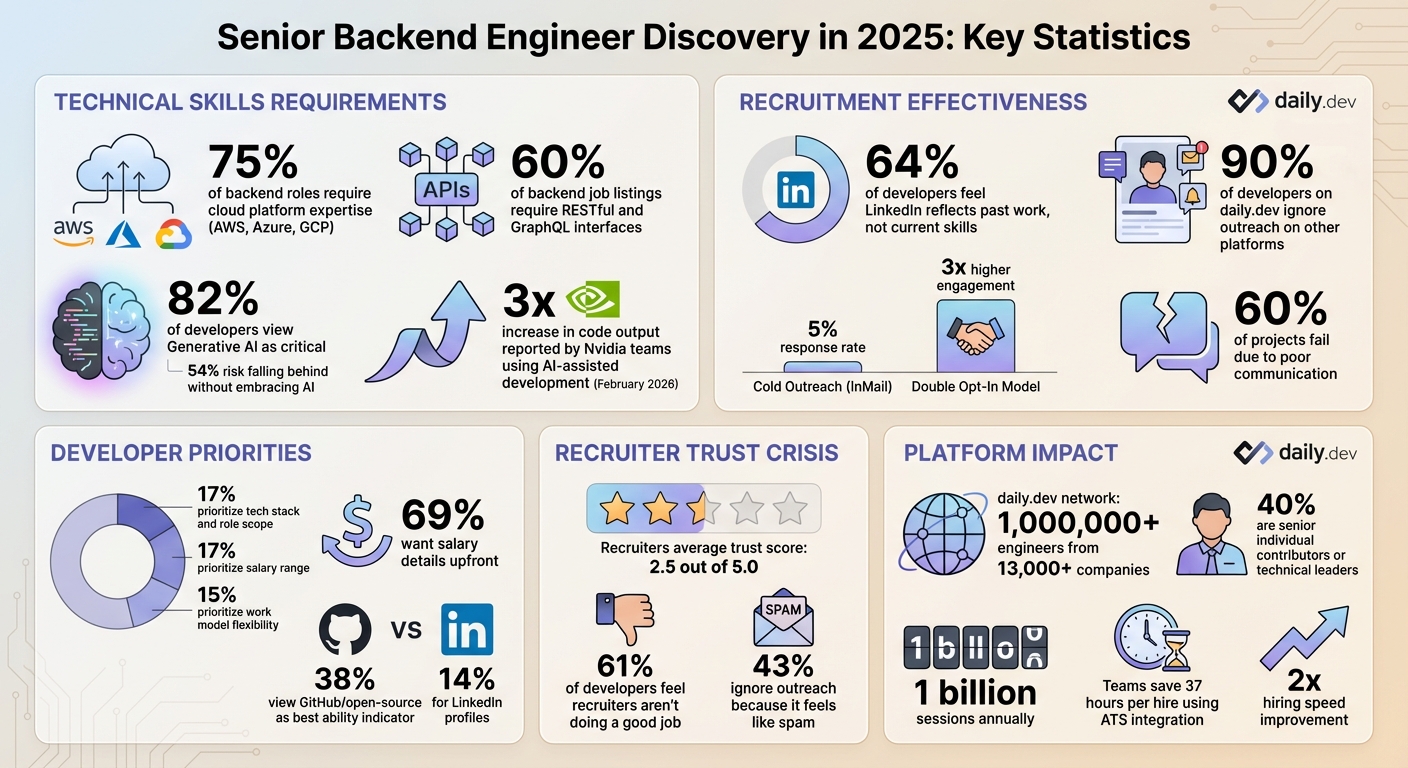 {Senior Backend Engineer Skills and Recruitment Statistics 2025}
Skills That Define Senior Backend Engineers in 2025
By 2025, 75% of backend roles will require expertise in cloud platforms like AWS, Azure, or GCP . But technical proficiency alone won’t cut it anymore. The best engineers combine sharp coding skills with strategic thinking, systems design, and the ability to collaborate effectively with AI. In fact, 82% of developers view Generative AI as critical, while 54% risk falling behind without embracing it . These evolving demands shape the diverse skill set senior backend engineers must bring to the table.
Technical Skills
Cloud-native development is now a baseline requirement. Engineers need hands-on experience with tools like serverless computing (e.g., AWS Lambda), IAM security protocols, and strategies for cloud cost optimization. The backend landscape has shifted far beyond traditional infrastructure.
AI and machine learning integration is no longer optional. Senior engineers are expected to embed AI models, manage complex data pipelines, and work with tools like Pinecone for vector databases in AI-driven applications . Nvidia’s engineering teams demonstrated this shift in February 2026, reporting a threefold increase in code output after incorporating AI-assisted development - all without increasing bug rates .
Security remains non-negotiable. Engineers must implement zero-trust principles, utilize OAuth2 and JWT for authentication, and follow OWASP security standards . Event-driven architectures, powered by tools like Kafka, RabbitMQ, or Redis Streams, are crucial for building real-time, scalable systems - a necessity as microservices dominate production environments . To round out their toolkit, engineers should be fluent in observability tools such as Prometheus, Jaeger, and Grafana. RESTful and GraphQL interfaces, appearing in over 60% of backend job listings, further highlight the need for versatile API development skills .
Architecture and Problem-Solving Skills
Technical expertise is just the starting point. Senior engineers are expected to design systems that anticipate 10× growth, handle regional scaling, and prevent failures before they happen .
For example, while a mid-level engineer might address a crash by adding error handling, a senior engineer digs deeper. They’d identify the root cause - like a misconfigured connection pool - and implement circuit breakers to ensure that such failures are architecturally impossible in the future . When assessing candidates, presenting a simple feature request and gradually increasing complexity can reveal their ability to think ahead. Strong candidates naturally consider edge cases, scalability, and how their technical decisions align with broader business objectives .
Collaboration and Leadership Skills
In a world where 60% of projects fail due to poor communication , emotional intelligence and teamwork are now as important as technical skills - especially in remote-first environments.
"Senior engineers often play a big role in how teams work, what gets built, and how fast you can respond to change." - Elena Bejan, People Culture and Development Director, Index.dev
The best engineers don’t just code; they simplify complex ideas for non-technical stakeholders, set realistic expectations, and build trust across teams. They know how to resolve conflicts, foster relationships with executives, and guide teams through adopting new technologies. Behavioral interviews and situational questions can uncover how candidates have demonstrated leadership, managed stakeholder dynamics, and driven innovation in their previous roles.
Hiring engineers?
Connect with developers where they actually hang out. No cold outreach, just real conversations.
Where Senior Backend Engineers Spend Time Online
If you’re looking to connect with senior backend engineers, you need to meet them where they actually spend their time - not where traditional platforms suggest they should be. 64% of developers feel LinkedIn reflects their past work rather than their current skills or interests . Platforms like LinkedIn rely on static profiles that quickly become outdated. Meanwhile, top engineers gravitate toward spaces focused on learning, problem-solving, and staying up-to-date with evolving technologies. This shift has paved the way for modern recruitment tools that prioritize these active, developer-first communities.
Developer-First Communities
A standout example is daily.dev, a platform that millions of engineers use as their browser homepage to follow tech trends . It’s more than just a news feed - it’s a hub where developers track real-time discussions, engage with architecture topics, and upvote relevant content. Importantly, this platform provides insights into what engineers are currently exploring, such as Rust, Go, or system design, rather than relying on outdated resume keywords.
daily.dev uses these real-time learning and coding behaviors to match engineers with opportunities, bypassing the limitations of traditional job boards . With 90% of developers on daily.dev ignoring outreach on other platforms , recruiters who tap into this community gain access to an engaged and selective talent pool. This approach naturally facilitates more meaningful, warm introductions between recruiters and candidates.
Why Warm Introductions Work Better
Cold outreach, like InMail, typically yields a 5% response rate, but double opt-in models can achieve three times higher engagement . The reason? Senior engineers value control over how and when they engage with opportunities - they’re not interested in being bombarded with generic messages.
This is where daily.dev Recruiter’s "TinDev" model comes into play. Both the recruiter and the developer must agree to connect before a conversation begins . Recruiters pitch roles privately, and only candidates who show explicit interest proceed to the next step. This eliminates ghosting and ensures every interaction is intentional. With 69% of developers wanting salary details upfront , warm introductions allow recruiters to lead with transparency, sharing key details like salary range, tech stack, and work model right from the start.
Building relationships in these developer-first spaces also shortens hiring timelines. Instead of scrambling to fill roles, recruiters who actively engage in these communities can maintain a pool of pre-qualified candidates, dramatically reducing time-to-hire when positions open . By fostering connections early, recruiters can stay ahead in the race for top talent.
Using daily.dev Recruiter to Find Senior Backend Engineers
daily.dev Recruiter takes a modern approach to sourcing talent, focusing on behavior-based outreach. Instead of relying on static profiles or generic messages, it connects you with backend engineers through real-time insights like reading habits, project involvement, and technical interests. This means you're reaching candidates who are actively engaged in topics relevant to your role right now . Here's how daily.dev Recruiter simplifies and enhances the hiring process for senior backend engineers.
Warm Introductions and Targeted Job Posts
The platform uses a feature called "TinDev" to ensure that contact is mutually agreed upon . Your job opportunity appears privately to developers as a "Verified Opportunity" within their feed, and they can choose to opt in if interested. To further refine the process, you can include up to three custom screening questions - such as, "How do you approach state management in large Astro applications?" - to assess technical fit before moving forward .
ATS Integration and Smarter Targeting
daily.dev Recruiter integrates seamlessly with popular applicant tracking systems (ATS) like Greenhouse, Lever, and Ashby . Once a senior backend engineer accepts your warm introduction, their profile is automatically added to your ATS, complete with real-time status updates. This eliminates manual data entry and prevents duplicate outreach. Teams using this feature report saving 37 hours per hire and doubling their hiring speed , thanks to matching candidates based on their current coding activities instead of outdated resume keywords.
A Global Network of Developers
Beyond personalized introductions, daily.dev Recruiter connects you to a worldwide community of over 1 million engineers from more than 13,000 companies . Impressively, 40% of this network consists of senior individual contributors or technical leaders . Developers on the platform log over 1 billion sessions annually, engaging with topics like distributed systems, AI architecture, and backend frameworks. The "Pre-Intent Sourcing" feature identifies potential candidates weeks before they officially update their profiles by analyzing their engagement trends . This gives you a valuable head start in reaching top-tier talent.
Nimrod Kramer, CEO and Co-Founder of daily.dev, explains the platform’s unique approach:
"Trust is the only hack. Engineers already come to daily.dev to grow. They already trust the platform... When your role shows up inside that flow, it doesn't feel like outreach. It feels like an opportunity."
With no placement fees or monthly commitments, you only pay for successful connections . It’s a cost-effective way to hire senior backend engineers while avoiding the inefficiencies of traditional recruitment methods.
Data-Driven Sourcing and Screening Methods
To make your hiring process more efficient, start by clearly defining your criteria. This helps you avoid spending time on candidates who don't meet your needs. Outline the specific technical skills required for the role - whether it's expertise in distributed systems architecture, microservices design, or database optimization - and match these to the appropriate seniority level.
Role Definition and Skill Mapping
When developers evaluate job opportunities, they focus on three key factors: tech stack and role scope (17%), salary range (17%), and work model flexibility (15%) . Make sure your job descriptions are crystal clear about these aspects. For example, if you're hiring a senior backend engineer to work remotely with Go and Kubernetes, spell that out explicitly.
When mapping out required skills, give weight to public technical contributions. A significant 38% of developers view GitHub and open-source work as the best indicators of ability, compared to only 14% who rely on LinkedIn profiles . Once your role criteria are set, the next step is to use advanced tools for technical assessment.
Technical Assessments and AI-Powered Screening
Identifying potential candidates is just the beginning. Validating their technical skills is crucial. While scanning resumes (2–5 minutes per resume) provides a quick overview, more detailed evaluations like coding tests (30–60 minutes) or take-home assignments (3–4 hours) offer better insights into a candidate's fit for the role.
AI-driven platforms like CodeSignal provide comprehensive skills assessments with scientifically validated grading, while tools like CoderPad enable real-time collaboration during live coding interviews . These platforms simulate real-world engineering workflows, which not only improves assessment accuracy but also gives candidates a chance to demonstrate their expertise in a practical context. However, technical skills alone aren't enough - you also need to evaluate how well candidates will fit within your team.
Behavioral and Team Fit Evaluation
A strong technical foundation doesn't guarantee success. Senior backend engineers, especially those working in distributed teams, must excel in collaboration and problem-solving. Video interviews, typically lasting 20–30 minutes, are an effective way to gauge communication style and alignment with your team's dynamics.
Use scenario-based questions to dig deeper. For instance, ask how they would handle architectural disagreements or mentor junior team members. Given that developers rate their trust in recruiters at an average of just 2.5 out of 5.0 , it's essential to approach these conversations with genuine interest rather than relying on scripted questions. Focus on how candidates approach complex problems and whether their working style complements your team’s culture. This balanced evaluation ensures you find not just a skilled engineer but one who thrives in your environment.
Conclusion
Hiring senior backend engineers in 2025 isn’t about flooding job boards or sending out more cold messages. It’s about connecting with developers through effective sourcing channels where they naturally spend their time, earning their trust, and matching opportunities to their current skills and interests - not outdated resumes.
The shift in how developers engage explains why traditional recruitment methods are struggling. Consider these stats: recruiters average a trust score of just 2.5 out of 5.0, 61% of developers feel recruiters aren’t doing a good job, 64% believe traditional platforms fail to reflect their actual potential, and 43% ignore outreach because it feels like spam .
daily.dev Recruiter offers a fresh approach by connecting you with over 1,000,000 engineers from 13,000+ companies who are already using the platform to learn and grow . Every connection is warm and double opt-in, meaning you’ll only interact with developers who are genuinely interested. The platform uses real-time insights - like what developers are reading or coding, whether it’s Rust, Go, or GenAI - to match talent, rather than relying on outdated profiles . Plus, it integrates seamlessly with your ATS, skips placement fees, and works on a pay-for-results basis with no monthly commitments .
FAQs
What is behavioral matching in hiring?
Behavioral matching in hiring is all about examining a candidate's past actions, motivations, and attitudes to get a sense of how they'll perform in the future and whether they'll mesh well with a specific role or team. It zeroes in on how individuals have navigated real-life challenges, highlighting traits like problem-solving, collaboration, and flexibility.
By 2025, AI-powered tools are taking this approach to the next level. These tools analyze candidates' responses, activities, and behavioral cues, turning hiring into a more data-informed and predictive process.
How do double opt-in introductions reduce ghosting?
Double opt-in introductions help cut down on ghosting by requiring developers to actively confirm their interest before proceeding. This two-way agreement builds trust and a sense of commitment, making it less likely for candidates to drop out after the first interaction.
How can I evaluate senior backend skills without long take-homes?
Assessing senior backend skills doesn't have to involve time-consuming take-home assignments. Instead, you can use approaches like technical conversations, portfolio reviews, and targeted assessments to evaluate candidates effectively.
Engage candidates in discussions about real-world scenarios to understand their problem-solving abilities and how they approach system architecture. You can also review their GitHub repositories, open-source contributions, or even their Stack Overflow profiles to get a sense of their coding quality and expertise.
For a more hands-on approach, short and focused assessments that mimic actual job challenges can offer valuable insights into their skills - while also respecting their time. This balance ensures a thorough evaluation without overburdening the candidate.
.png)