

Passive developers - around 70% of the workforce - aren’t actively job hunting but are open to the right opportunities. Social media platforms like LinkedIn, GitHub, and Twitter have become essential tools for recruiters to connect with these developers where they spend their time. With 94% of recruiters using social media for sourcing, the key is to approach passive candidates thoughtfully. Engaging with developers in spaces they trust, referencing their work, and showcasing your company’s culture and technical expertise can make a significant difference in attracting top talent.
Key Takeaways:
- Passive Candidates: 70% of developers aren’t job hunting but are open to offers.
- Recruitment Success: Outbound-sourced candidates are hired 5x more often than inbound applicants.
- Why Social Media Works: Platforms like GitHub and Twitter allow recruiters to connect with developers in their daily routines.
- Trust Matters: Passive candidates are selective and value alignment with company goals and values.
- Employer Branding: Sharing authentic team stories and technical insights builds credibility.
Social media isn’t just about job postings; it’s about building meaningful relationships with developers through personalized outreach and active participation in their communities.
::: @figure 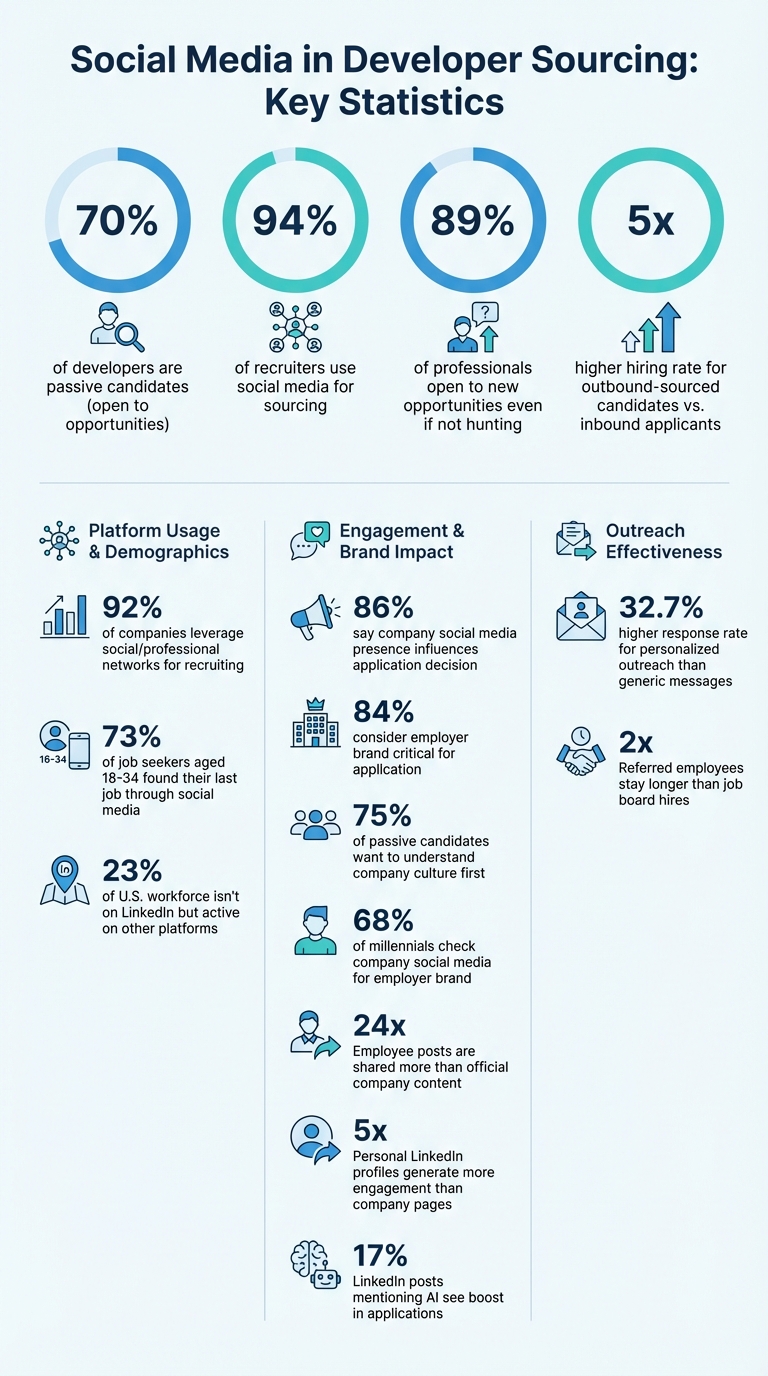 {Social Media Developer Sourcing Statistics and Key Metrics}
What Is Passive Developer Sourcing on Social Media
Passive developer sourcing is all about proactively finding and connecting with talented developers who aren’t actively looking for a new job - but might be open to the right opportunity . Instead of waiting for applications to roll in, you take the initiative to seek out skilled professionals on platforms like social media, open-source communities, or during technical discussions.
Unlike reactive approaches that target active job seekers , passive sourcing focuses on developers who may not have updated their resumes or started a job search. These individuals often represent the "hidden gems" of the workforce, making them highly valuable when approached thoughtfully .
Why Passive Developers Matter for Hiring
Here’s a compelling fact: 89% of professionals are open to new opportunities, even if they’re not actively job hunting . That’s a massive talent pool you could be missing if you only focus on active candidates.
Reaching out to passive developers also has another advantage - less competition. Active candidates are often juggling multiple offers, but passive candidates are usually focused on excelling in their current roles. These are often the top performers, the "A-listers" who can bring real value to your team . Additionally, 75% of passive candidates want to understand a company’s culture and values before considering a move . With a well-crafted employer brand and personalized outreach, you can attract candidates who are looking for the right opportunity, not just any job.
How Social Media Fits Into Developers' Daily Routines
To connect with passive developers, you need to meet them where they already spend their time. Developers are constantly learning, networking, and keeping up with trends on platforms like GitHub, Twitter, and daily.dev. They explore GitHub repositories for solutions, join technical discussions on Twitter using hashtags like #rustlang or #reactjs, and consume content tailored specifically for developers .
This makes social media a natural fit for recruiters. Instead of relying on cold calls or impersonal emails, you can engage developers in their comfort zones. Commenting on GitHub projects or participating in online communities helps you build trust through shared interests - a strategy that resonates strongly with passive candidates.
And here’s the kicker: 94% of recruiters now use social media to source candidates . The advanced targeting tools on these platforms allow you to zero in on developers with specific skills, track their open-source contributions, and observe their involvement in niche technical discussions. This precision ensures that your outreach is focused and effective, reaching the right people at the right time.
Next, we’ll dive into how to choose the best platforms to connect with these developers.
Selecting the Right Social Media Platforms for Developer Sourcing
Social and professional networks have become indispensable for recruiting, with 92% of companies now leveraging these platforms to find talent . However, simply having a presence on social media isn’t enough. The real challenge lies in identifying where your ideal candidates spend their time and how they interact with content.
To succeed, you need to align your recruitment goals with the strengths of each platform. For instance, if you’re assessing technical skills through code, GitHub is a great option. It allows you to review repository contributions, commit history, and coding style. For professional networking and verifying work history, LinkedIn continues to be a go-to platform. But for reaching developers in their everyday environment - where they’re already engaging with content - daily.dev Recruiter offers a unique, developer-focused experience that integrates seamlessly into their routine. Let’s dive into how specific platforms can help you connect with top developer talent.
Platform-Specific Insights for Developer Engagement
GitHub is perfect for code-focused hiring. Instead of relying on resumes, you can evaluate actual coding activity by reviewing repository contributions and commit history. This hands-on approach helps you identify passive talent that might otherwise go unnoticed. For example, you can use search strings like language:javascript location:Minneapolis followers:>4 to find local developers with proven community involvement .
daily.dev Recruiter takes a different approach, embedding recruitment into developers' daily content consumption. Its double opt-in model ensures that every interaction begins with genuine interest, creating a more meaningful connection.
Stack Overflow is another excellent platform for spotting skilled problem-solvers. Developers’ reputation scores and contributions to Q&A discussions highlight their technical expertise and community involvement, giving you a clearer picture of their abilities.
"Social media offers an additional medium by which to interact with candidates who may not be available or active on more traditional sourcing methods."
– Daniel Young, Senior Partner, WittKieffer
X (formerly Twitter) and Reddit are invaluable for engaging developers in real-time discussions about tech. On X, you can use Boolean operators and hashtags like #ReactJS to find relevant conversations, while niche subreddits like r/webdev and r/CSShelp on Reddit offer access to highly targeted communities. These platforms require authentic, community-driven engagement rather than generic outreach.
For showcasing your company’s culture and attracting younger developers, Instagram and TikTok are gaining popularity. Short-form video content can highlight your engineering team’s personality and workplace vibe, appealing particularly to Gen Z. In fact, 73% of job seekers aged 18–34 found their last job through a social media platform .
Once you’ve chosen the right platforms, the next step is to measure their effectiveness and refine your strategy.
Analyzing Platform Metrics and Engagement
Tracking performance metrics is crucial to understanding where your target audience is most active. Focus on metrics like post traffic and application conversions to identify which platforms yield the best results. This data not only shows where developers are engaged but also highlights the effectiveness of your outreach efforts.
Demographics play a big role too. For example, LinkedIn tends to attract more experienced professionals (ages 50–64), while Instagram appeals to younger audiences (ages 18–49). Adjust your recruitment strategy accordingly to reach the right group.
It’s also worth noting that about 23% of the U.S. workforce isn’t on LinkedIn but maintains an active presence on other social platforms . Expanding your recruitment efforts across multiple channels can help you tap into a broader talent pool.
Lastly, make sure your content is optimized for mobile. Most professionals access social platforms on their phones, so job links should lead to mobile-friendly application pages . A poor mobile experience can derail an otherwise effective sourcing strategy.
Building Your Employer Brand on Social Media
Your employer brand should feel genuine and resonate with the developers you want to attract. Social media is your stage to tell a story - not just post job openings. It’s about creating a connection that makes passive candidates stop scrolling and take notice.
One way to do this is by sharing real, unfiltered team stories through employee-generated content. Developers can spot insincerity a mile away, and they value authentic insights over overly polished corporate messaging. They want to see the people behind the code, the workspace they might step into, and the values that drive your team. With nine out of 10 brands using social media to recruit , standing out means being real, not just present.
Sharing Company Culture and Values
To build a strong employer brand, focus on showcasing your people. As Tony Prudente, Senior Specialist in Employer Branding at Brother, explains:
"Always do your best to highlight and showcase your employees – people respond to people more than they do brands" .
This means ditching the stock photos and corporate jargon. Instead, let your employees take the spotlight by sharing their genuine experiences. Whether it’s a snapshot from a team hackathon, a quick video about solving a technical challenge, or a heartfelt post about why they love working with your team, this type of content resonates deeply. In fact, employee-generated posts are shared 24 times more often than content from official company channels .
Encourage your team to use a corporate hashtag when sharing work-related posts. This creates an easily searchable collection of authentic content for potential candidates to explore . You can also try employee takeovers on platforms like Instagram or TikTok, where a developer runs your account for a day to give followers an unfiltered look at life at your company .
Platforms like Instagram and TikTok are perfect for showcasing your company’s culture, while LinkedIn works well for professional updates . Considering that 68% of millennials check a company’s social media to assess its employer brand , make sure what they find reflects your actual values and environment.
And while culture is key, don’t forget to highlight your technical expertise, which we’ll dive into next.
Establishing Your Company as a Thought Leader
Your employer brand isn’t just about culture - it’s also about demonstrating technical expertise. Developers want to work with teams that are pushing boundaries and leading in their fields. Sharing technical blog posts, industry insights, webinars, and coding challenges helps position your company as a hub for learning and innovation .
The stats back this up: LinkedIn posts mentioning AI see a 17% boost in applications , showing that developers are drawn to companies engaging with advanced technologies. But thought leadership isn’t just about trendy buzzwords - it’s about offering real value. Share tutorials, highlight technical challenges your team has tackled, and host live Q&A sessions where senior developers interact with the community.
Jillian O'Malior, VP of Brand & Creative Development at Recruitics, emphasizes:
"Social media is a great place to get your employer brand voice out there, engage directly with your audience of candidates and employees, and drive awareness" .
Engagement is a two-way street. Reply to comments, participate in technical discussions, and acknowledge contributions from the community. This shows that your company isn’t just broadcasting - it’s listening and actively participating.
Also, don’t underestimate the power of your employees’ personal networks. Posts shared from personal LinkedIn profiles generate five times more engagement than those from company pages . Help your team share content by providing monthly content packs with pre-written captions, images, and links . This makes it easy for them to amplify your brand while staying authentic.
Hiring engineers?
Connect with developers where they actually hang out. No cold outreach, just real conversations.
Connecting with Passive Developers Through Targeted Outreach
Once your employer brand is established, the next step is reaching out to the developers you want to connect with. Passive developers, who aren’t actively looking for jobs, tend to ignore generic messages. To catch their attention, your outreach needs to feel personal, relevant, and genuinely valuable.
The key to standing out? Context. Developers can instantly tell if you’ve put in the effort to learn about them or if you’re just sending out a generic message. Each interaction should focus on building a real connection, not just ticking off a task.
Writing Personalized, Context-Rich Outreach Messages
Subject lines like "Exciting Opportunity at [Company]" don’t work. Instead, reference something specific about the developer - perhaps a GitHub project they’ve worked on, a recent article they wrote, or a technical problem they solved. This shows you’re reaching out to them specifically, not just anyone with "developer" in their job title.
When reaching out, tools like LinkedIn’s Private Mode can help you avoid appearing intrusive . Instagram also allows you to message up to 10 people outside your network at a time, offering more flexibility for initial outreach .
Here’s a quick comparison of what works versus what doesn’t:
| Outreach Element | Traditional Approach (Avoid) | Personalized Approach (Recommended) |
|---|---|---|
| Subject Line | "Exciting Opportunity at [Company]" | "Question about your [Specific Project] on GitHub" |
| Opening | "I came across your profile and was impressed..." | "I really enjoyed your recent article on [Topic]..." |
| Value Prop | "We are a fast-growing startup with great perks." | "We're currently solving [Specific Problem] using [Tech Stack]." |
| Call to Action | "Send me your resume and availability for a call." | "Would you be open to a quick chat about how you tackled [Technical Challenge]?" |
Avoid overused buzzwords like "rockstar" or "ninja." Instead, focus on being technical and transparent. Mention the tech stack, the challenges your team is addressing, and even salary ranges upfront. This kind of clarity builds trust right away.
Once you’ve nailed down personalized messaging, use platforms that naturally encourage mutual interest to strengthen these connections.
Using Warm Introductions on daily.dev
Cold outreach often feels impersonal and can erode trust. Developers are frequently bombarded with messages from recruiters who haven’t taken the time to understand their work or goals. That’s where warm, double opt-in introductions come in.
With daily.dev Recruiter, every interaction begins with mutual interest. Developers discover your open roles while they’re already engaged - whether reading tech news, learning, or exploring content. If they’re interested, they opt in, meaning you only connect with candidates who genuinely want to hear from you. No spammy emails. No awkward follow-ups. Just meaningful conversations with developers who are open to the right opportunities.
This shifts recruiting from a noisy, impersonal process to one built on trust. Instead of chasing passive candidates, you meet them where they are, with your credibility already established.
Participating in Developer Communities and Discussions
Engaging with developer communities is another way to strengthen your employer brand. Building relationships is a long-term effort, and the best connections often happen long before you ever mention a job opening. Focus on joining specialized communities - whether for React, DevOps, or other technical areas - rather than broad, generic forums.
Follow the 80/20 rule: dedicate 80% of your time to providing value (like sharing insights, answering questions, or posting educational content) and only 20% to promoting your company or roles. Developers trust peers over recruiters, and employees who come through recommendations tend to stay twice as long as those hired through job boards .
Engage with developers by commenting on their posts, reviewing their GitHub projects, or showing interest in their portfolios. Use tools like Twitter “Topics” or subreddit discussions to identify professionals tackling relevant challenges. When you finally reach out, reference something specific they’ve worked on - this proves you’ve done your research.
Here’s how to make the most of different platforms:
| Platform | Best Community Engagement Strategy |
|---|---|
| Join niche groups, comment on posts, and use mutual connections for referrals. | |
| Participate in chats, follow hashtags like #pycon or #devops, and explore technical "Topics." | |
| Join developer-specific groups and follow speakers from technical events or hackathons. | |
| daily.dev | Engage with trending tech news and use double opt-in introductions for genuine connections. |
| Monitor subreddits for technical discussions and identify knowledgeable contributors. | |
| GitHub | Explore individual or team projects to understand problem-solving approaches before reaching out. |
Measuring and Improving Social Media Sourcing Results
When evaluating your social media recruiting efforts, it’s crucial to prioritize impact metrics over vanity metrics like likes, followers, or impressions. These surface-level numbers might look good, but they don’t necessarily translate into hiring success or meaningful engagement .
Start by focusing on engagement quality. Metrics like saves and shares carry more weight than likes because they reflect genuine interest. For instance, if a developer saves your post, it indicates they plan to revisit it, while a share suggests they’re recommending it to their network. Pair these insights with applicant conversion rates by using UTM parameters on every shared link. This way, you can pinpoint which platforms and content types are driving the most applications .
To go deeper, assess the quality of candidates by tracking how they progress through your recruitment funnel. Measure the percentage of applicants who advance beyond screening and compare their interview and retention rates to candidates from other sources. As Gary Zukowski, Senior VP at CareerArc, explains:
"Your recruiting efforts on social media should attract high quality, culturally aligned candidates who contribute more, stay longer and who are promotable" .
Key Metrics to Track in Developer Recruitment
When it comes to developer recruitment, the metrics that truly matter can be grouped into four categories:
- Engagement metrics: Comments, shares, saves, and clicks help gauge whether your content resonates with your audience.
- Conversion metrics: Track key stages like sourced-to-screen, screen-to-interview, and offer-to-accept to identify where candidates drop off in the funnel.
- Brand health metrics: Evaluate your credibility by monitoring share of voice, sentiment, and brand mentions within developer communities.
- Efficiency metrics: Time to hire and recruiting cost ratio (RCR) provide insights into the ROI of your efforts .
For developer hiring, it’s better to use Recruiting Cost Ratio (RCR) instead of Cost Per Hire. RCR divides your total recruiting costs by the first-year compensation of hires, offering a more accurate benchmark. This approach accounts for the higher effort and costs required to hire senior developers compared to junior roles, which Cost Per Hire often overlooks .
Additionally, track pipeline speed, measuring the time it takes for a candidate to move from initial contact on social media to an accepted offer. Compare results across platforms like LinkedIn, GitHub, and Twitter to determine where your efforts yield the best results .
Refining Your Strategy Based on Data and Feedback
Once you’ve gathered data, use it to refine your recruiting strategy. Experiment with different approaches, such as A/B testing outreach methods. For example, compare LinkedIn voice messages to text-based messages and monitor response-to-screen ratios. Personalized outreach tends to perform better, with a 32.7% higher response rate than generic messages. Test various messaging styles to discover what resonates most with your target audience .
Social listening tools can also provide valuable insights. These tools let you monitor mentions of your brand and gauge sentiment in real time. By tracking how often your company is mentioned in developer conversations compared to competitors (your "share of voice"), you can assess whether your employer brand is gaining traction or needs adjustment .
Don’t overlook the power of post-recruitment surveys. Ask candidates sourced through social media to rate their experience and identify which touchpoints influenced their decision to apply. Instead of using a simple "source-of-hire" checkbox, ask them to rank all factors - such as your tech blog, a GitHub project, or a Twitter conversation. This approach gives you a clearer picture of how your social media presence impacts hiring decisions .
Finally, compare your metrics to industry benchmarks. With 86% of job seekers saying a company’s social media presence influences their decision to apply, it’s clear that a strong social sourcing strategy is non-negotiable . Track your metrics monthly and adjust your approach based on the data .
Conclusion
Social media has completely reshaped how recruiters connect with passive developers. A striking 94% of recruiters now rely on social platforms to source candidates, according to industry data . This shift highlights a key reality: passive developers are innovating and engaging online, making it essential for recruiters to move away from cold, impersonal outreach and adopt smarter, relationship-focused strategies.
The key lies in blending precision targeting with authentic relationship-building. Engage with developers where they are - through targeted searches, active participation in online communities, and sharing relevant technical content. As Daniel Young, Senior Partner at WittKieffer, aptly explains:
"Utilizing social media for me personally ensures that my clients are getting a comprehensive look at the marketplace and that we are meeting candidates where they want to be met."
The numbers back this up. Employees hired through referrals or social recommendations tend to stay twice as long as those sourced from job boards. Additionally, 84% of job seekers consider an employer's brand a critical factor when deciding where to apply . These stats emphasize the value of cultivating a credible and trustworthy employer brand. Your social media presence isn't just about finding talent - it’s about building the kind of trust and reputation that draws the right people to you.
Platforms like daily.dev Recruiter take this approach to the next level. By eliminating cold outreach, they connect you with passive, pre-qualified developers through warm, double opt-in introductions. This creates genuine, trust-based connections that make a lasting impact.
FAQs
How can recruiters use social media to connect with passive developers?
Recruiters can use social media to connect with passive developers by engaging on platforms where developers naturally spend their time, such as GitHub, Stack Overflow, Reddit, Twitter, and the daily.dev community. Start by identifying developers whose expertise matches your needs. Tools like GitHub filters or developer-profile tags on daily.dev can make this process easier.
Once you’ve pinpointed potential candidates, interact with their content in a meaningful way - like their posts, leave thoughtful comments, or share their work. This shows genuine interest and helps establish a connection. When reaching out, craft personalized messages that reference their recent projects, blog posts, or contributions. Avoid generic outreach, as it can come off as insincere. A tailored message demonstrates effort and builds trust, increasing the likelihood of a positive response.
For an even more effective approach, consider using daily.dev Recruiter. This tool facilitates warm, double-opt-in introductions, ensuring developers are already open to communication before you reach out. By viewing social media as a way to build relationships rather than just a recruitment tool, you can create genuine connections, improve response rates, and attract developers who are truly interested in exploring new opportunities.
What social media platforms are best for finding developers, and why?
The best social media platforms for finding developers are those where they actively participate, share their work, and solve challenges. GitHub stands out as a prime option because developers use it to showcase their code, contribute to open-source projects, and demonstrate their technical abilities. Similarly, Stack Overflow offers a window into a developer's expertise through their Q&A activity and reputation scores.
daily.dev Recruiter provides a unique approach by connecting recruiters with pre-qualified developers through a developer-focused network. This platform is filled with developers who are already engaged in reading, learning, and interacting, making connections feel more natural and purposeful.
Other platforms like LinkedIn allow recruiters to dive into detailed career histories and perform targeted searches. Meanwhile, Twitter and Reddit are great for real-time interactions and joining niche developer communities. Even Facebook and Instagram can be useful for finding regional or specialized developer groups. By focusing on these platforms, recruiters can build meaningful connections and engage with developers where they are most active.
How can companies use social media to attract top developer talent?
To catch the attention of top developer talent on social media, start by crafting a clear and honest Employer Value Proposition (EVP). This should highlight what makes your company an exciting and rewarding place to work. Instead of relying solely on job postings, share authentic content such as team projects, behind-the-scenes glimpses, and employee stories. These real-life moments can help showcase your company’s culture and values in a way that feels relatable and engaging.
It’s also essential to tailor your strategy for each platform. Use LinkedIn to share career insights and thought leadership pieces. On Instagram and TikTok, focus on fun, behind-the-scenes videos that highlight your workplace vibe. For communities like Reddit or Discord, consider hosting interactive sessions such as AMAs (Ask Me Anything), where developers can connect with your team directly. Additionally, encouraging employees to share their personal experiences can humanize your brand and extend your reach through their trusted networks.
For a more focused approach, platforms like daily.dev Recruiter offer a way to connect with pre-qualified developers in a context-driven and respectful manner. This not only ensures developers feel valued but also helps turn awareness into meaningful conversations, speeding up the hiring process.
.png)


