AI engineers are in high demand, with job postings up 78% year-over-year, while the talent pool has only grown by 24%. To stand out in a competitive market, recruiters need to avoid generic outreach and demonstrate technical understanding. Missteps, like confusing AI roles or failing to personalize messages, can damage credibility. Here's how you can effectively attract top AI talent:
- Understand the Roles: Differentiate between AI Engineers, AI Researchers, MLOps Engineers, and Prompt Engineers.
- Target the Right Platforms: Use GitHub, Kaggle, Hugging Face, Stack Overflow, and academic conferences to find skilled candidates.
- Craft Personalized Outreach: Reference specific projects, research, or achievements, and be transparent about compensation and job details.
- Engage Technically: Prepare for conversations by reviewing portfolios and asking practical, production-related questions.
- Leverage Tools: Platforms like daily.dev Recruiter can connect you with passive candidates through warm, double opt-in introductions.
::: @figure 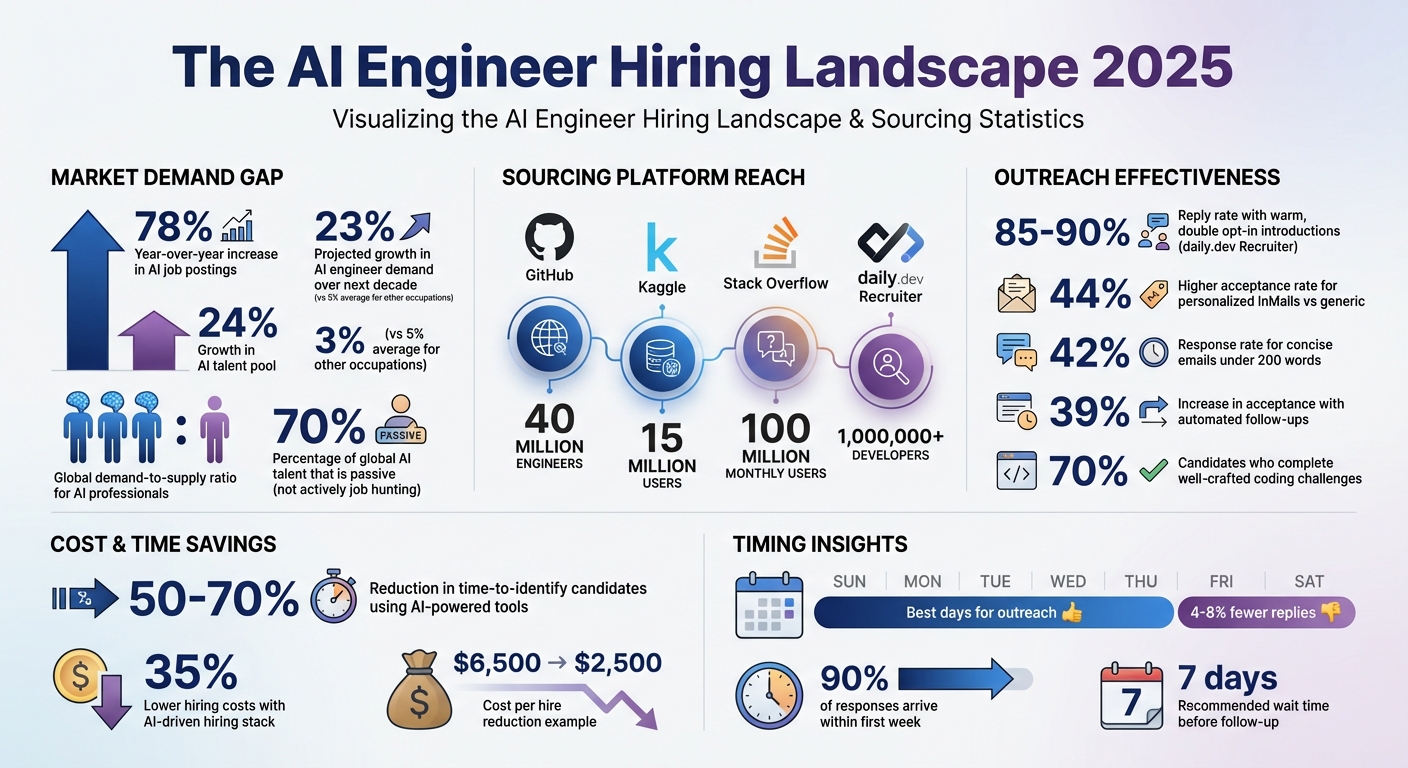 {AI Engineer Hiring Market Statistics and Key Sourcing Metrics 2025}
Understanding AI Engineer Skills and Profiles
AI engineers play a critical role in building, deploying, and scaling machine learning models using tools like TensorFlow and PyTorch. Unlike developers, who focus on application logic, AI engineers are responsible for delivering production-ready code and managing large datasets. This contrasts with AI researchers, who prioritize developing novel architectures and publishing academic work . Recognizing these distinctions and understanding the technical skills involved ensures your developer hiring process is well-informed.
Technical Skills to Look For
Python is the backbone of AI development, forming the foundation for most industry frameworks . Expertise in TensorFlow and PyTorch is also vital for building and deploying models . For roles focused on natural language processing, familiarity with libraries such as NLTK, spaCy, or Hugging Face Transformers is essential . Meanwhile, computer vision roles often require experience with OpenCV .
Top AI engineers bring strong data preprocessing capabilities to the table, including cleaning, normalization, and feature extraction. They also need a solid understanding of statistical methods such as probability distributions and regression . Additionally, proficiency with cloud platforms like AWS SageMaker, Microsoft Azure, or Google Cloud is becoming increasingly important . Notably, the U.S. Bureau of Labor Statistics predicts a 23% growth in demand for AI engineers over the next decade - far outpacing the 5% average growth across other occupations .
Here are some core technical areas to prioritize when evaluating candidates:
| Skill Category | Essential Tools & Concepts |
|---|---|
| Programming | Python, R, Java, C++ |
| ML Frameworks | TensorFlow, PyTorch, scikit-learn, Keras |
| Data Handling | Pandas, SQL, NoSQL, AWS S3 |
| NLP Tools | NLTK, spaCy, Hugging Face Transformers |
| Cloud/DevOps | AWS SageMaker, Azure, Google Cloud, Docker |
With these technical benchmarks in mind, the next step is assessing candidates' real-world contributions and track records.
How to Identify Top AI Talent
Technical skills alone don’t paint the full picture. A candidate’s public portfolio can reveal their expertise and problem-solving abilities. Start by reviewing their GitHub profile. Look for repositories showcasing original work on complex projects rather than simple clones or exercises from bootcamps . Repositories with a modest number of followers or stars for unique contributions can be a strong signal of expertise.
Kaggle rankings are another useful indicator. For example, Allstate once hosted a Kaggle competition that drew over 3,000 participants, enabling the company to identify candidates with hands-on machine learning experience . High-ranking Kaggle participants or Grandmasters often demonstrate exceptional skills.
For research-intensive roles, academic contributions are key. Platforms like Google Scholar and ResearchGate can help you evaluate candidates' publications in top conferences such as NeurIPS, ICML, ICLR, or CVPR . High citation counts in niche areas signal thought leadership. Additionally, a strong reputation on Stack Overflow in machine learning-related tags can indicate active community engagement and expertise .
Where to Find AI Engineers
Finding top AI engineers often means looking beyond traditional job boards. According to research, 70% of the global talent pool consists of passive candidates . These professionals aren’t actively browsing job listings - they’re busy building models, solving advanced problems, and engaging in technical communities.
Best Sourcing Channels for AI Engineers
To connect with skilled AI engineers, focus on platforms where they showcase their expertise:
GitHub: With 40 million engineers contributing, GitHub is a goldmine for evaluating technical skills. Look for developers with high-quality commits, well-documented repositories, and active collaboration.
Kaggle: This platform, with its 15 million users, highlights hands-on expertise through competition rankings and dataset contributions.
Hugging Face: For natural language processing (NLP) specialists, Hugging Face has become the hub for transformer models and cutting-edge NLP work.
Stack Overflow: With 100 million monthly users, it’s a great place to assess problem-solving abilities through reputation scores and detailed answers.
Academic Conferences: Events like NeurIPS, ICML, ICLR, and CVPR allow direct access to PhD students and leading researchers in AI.
daily.dev Recruiter: This global network of over 1,000,000 developers connects you with active, engaged engineers who are constantly improving their skills. It’s a practical way to make meaningful connections with top talent.
Using daily.dev Recruiter for Warm Introductions
Since most AI engineers are passive candidates, reaching out through targeted platforms can significantly improve engagement. Cold outreach often falls flat because generic messages get ignored. Platforms like daily.dev Recruiter offer a better alternative: warm, double opt-in introductions. This method allows developers to review opportunities before committing, resulting in reply rates of 85–90%, compared to the single-digit response rates typical of cold emails.
With daily.dev Recruiter, you can create job briefs that highlight technical challenges, specific tech stacks, and growth opportunities. The platform also allows you to pre-screen candidates based on custom criteria, ensuring you connect only with those who meet your needs.
Here’s a real-world example: In August 2025, a SaaS company in Berlin hired 10 full-stack engineers in just 14 days. By combining GitHub API sourcing with automated pre-screening, they reduced their average cost per hire from $6,500 to under $2,500 . While this case involved multiple tools, daily.dev Recruiter simplifies the process into one streamlined platform, saving both time and effort.
The platform integrates seamlessly with your existing applicant tracking system (ATS), so candidate data flows automatically. Its transparent pricing eliminates the uncertainty often tied to traditional recruiting tools. Most importantly, developers have control over how and when they engage, ensuring they never feel overwhelmed by unsolicited offers.
How to Write Personalized Outreach Messages
AI engineers are quick to dismiss generic, impersonal recruiting messages. The difference between a message that gets ignored and one that sparks interest lies in personalization and technical credibility. Personalized InMails, for instance, show a 44% higher candidate acceptance rate compared to generic ones . But personalization isn’t just about inserting a first name - it’s about demonstrating that you’ve done your homework and understand what makes this particular engineer stand out.
Personalizing Your Messages
Tailor your message by referencing specific achievements, like a standout GitHub project, a Kaggle competition win, or a notable paper presented at NeurIPS. For example, instead of a vague compliment like, "I saw your impressive GitHub profile", say something more specific: "I came across your work on the transformer-based sentiment analysis model in your 'nlp-experiments' repo. The approach you used was fascinating and caught my attention."
Be clear about why you’re reaching out and highlight the unique challenges and opportunities of the role. AI engineers can easily spot mass emails sent to anyone with "machine learning" on their profile. Instead, offer concrete examples: "You’d be building real-time fraud detection models capable of processing 50 million transactions daily" or "You’d have access to a cluster of 128 A100 GPUs and petabyte-scale datasets."
Transparency is key. Include details about the technical environment and provide a clear compensation range. In a market where the demand for AI experts far exceeds supply - global demand outpaces talent availability by a ratio of 3:1, and AI job postings have risen 78% year-over-year while the talent pool grew only 24% - top candidates won’t engage without full transparency. Use a low-pressure call to action, like: "Would you be open to a 15-minute call to compare notes?" or "Can I share more details about the team and tech stack?"
Common Outreach Mistakes to Avoid
Even with personalization, certain missteps can derail your outreach efforts. Messages that show a lack of research immediately lose credibility. Avoid long, dense paragraphs - most candidates check messages on their phones, and walls of text are likely to be ignored . Don’t ask for a resume upfront; this feels transactional and high-pressure. Instead, focus on starting a conversation.
Failing to address compensation expectations is another common mistake. For senior roles, be upfront with a clear and competitive salary range. Also, relying solely on LinkedIn InMail can be a missed opportunity, as many AI engineers rarely check it . Instead, try verified emails or platforms like daily.dev Recruiter for better results.
| Outreach Element | Common Mistake | Recommended Approach |
|---|---|---|
| Subject Line | Generic (e.g., "Job Opportunity") | Personalized (e.g., "Loved your NeurIPS paper on transformers") |
| Call to Action | "Send me your resume" | "Would you be open to a quick intro chat?" |
| Compensation | "Competitive salary" | Specific range (e.g., "$300,000+ base salary with clear equity details") |
| Tech Stack | General list of tools | Specific usage (e.g., "PyTorch 2.0 for real-time inference") |
| Length | Long, dense job description | Brief (four sentences or less) |
Timing also plays a role. Messages sent between Sunday and Thursday receive better responses, while those sent on Friday or Saturday see 4–8% fewer replies . If you don’t hear back, wait at least seven days before following up - 90% of responses arrive within the first week . Automated follow-ups can also help, boosting acceptance rates by 39% , but make sure each follow-up adds new value.
With your outreach message polished, you’ll be better prepared to engage in technical conversations that solidify your credibility.
Hiring engineers?
Connect with developers where they actually hang out. No cold outreach, just real conversations.
How to Handle Technical Conversations
Once you've initiated tailored outreach, the next step is to establish technical credibility during your conversations. After receiving a candidate's response, focus on discussing practical experience rather than diving into textbook theories. You don't need to be an expert with a PhD in machine learning - what matters is emphasizing real-world application and preparing effectively.
Preparing for Initial Conversations
Start by reviewing the candidate's portfolio, such as their GitHub projects, Kaggle results, or publications. This helps steer the discussion toward practical applications rather than abstract knowledge - an approach that resonates more with AI professionals. As Shreyans Bhansali, Co-Founder of Maven, explains:
One may expect Google engineering to largely consist of implementing PhD level algorithms, and while that's sometimes true, much of a search or AI engineer's job involves looking at examples, spotting patterns, hand labeling data, and other non-scalable, in-the-weeds analysis .
Focus your questions on real-world production challenges. For instance, you could ask, "How would you diagnose and fix a model that performs well on training data but poorly on new data?" . Dive deeper by asking about their experience with deployment pipelines, managing model versions, or troubleshooting corrupted datasets. These kinds of questions show that you understand the full lifecycle of AI systems.
Additionally, consider using AI-powered resume parsing tools to identify transferable skills and rank candidates objectively . Ask about their preferences for tools like Python or PyTorch and explore the trade-offs they’ve encountered. This approach helps you frame targeted questions that highlight their expertise in production-level scenarios.
Using Skills Assessments
When evaluating candidates directly isn’t enough, assessing technical skills without coding tests or using structured assessments can provide an objective way to validate technical skills. Platforms like CodeSignal offer IDE-based evaluations specifically designed for machine learning and AI roles . These tools ensure you can verify candidates' abilities before involving senior engineers, streamlining the process while maintaining credibility.
You might also explore interview-as-a-service providers like Karat. These services use trained "Interview Engineers" and standardized scoring rubrics to conduct evaluations, even when you lack deep technical expertise yourself . Research shows that 70% of candidates successfully complete coding challenges when they’re well-crafted and relevant .
To ensure fairness, create structured scoring rubrics that focus on observable behaviors rather than subjective impressions. For example, award points when a candidate identifies the correct solution approach, explains their reasoning, and specifies the data inputs needed . As Peggy Klaus highlights:
75 percent of long-term job success depends on people skills, while only 25 percent on technical knowledge .
Finally, balance technical assessments with questions that evaluate how well candidates can explain complex ideas to non-technical team members. This ensures you’re not only hiring for technical expertise but also for communication skills that are crucial in collaborative environments.
Building a Global AI Talent Pipeline
The demand for AI professionals is soaring, with a global demand-to-supply ratio of about 3:1 and AI job postings increasing by 78% year-over-year . Yet, the talent pool isn’t growing quickly enough to keep up. Adding to the challenge, 70% of the global talent pool is passive talent - these individuals aren’t actively job hunting but are open to the right opportunity . To build a steady pipeline of AI talent, you need to move beyond traditional job boards. Instead, focus on proactive sourcing in technical communities like GitHub, Kaggle, and Stack Overflow, where AI engineers are most active. Additionally, broaden your search to include regions often overlooked, and use tools to keep your pipeline continuously active.
To strengthen these strategies, shift your focus to regions like Eastern Europe, Latin America, and Africa. Rather than prioritizing local prestige, assess candidates based on their technical contributions. This approach not only diversifies your talent pool but also lowers hiring costs and reduces time-to-hire, as seen in successful global sourcing efforts. Keep your pipeline warm by engaging "silver medalists" - qualified candidates who weren’t hired initially. Automated campaigns that send updates every 30 days can maintain their interest and keep them in the loop .
Remote Hiring Approaches
When it comes to remote hiring, speed and personalization are key. AI-powered sourcing tools can cut your time-to-identify candidates by 50–70%, helping you secure talent before larger companies even finish their internal processes . For example, a 100-person remote-first SaaS company replaced external recruiters with an AI-driven hiring stack, slashing time-to-fill by more than half and lowering hiring costs by 35% .
To stand out from big tech, offer what they often can’t: autonomy and cutting-edge resources. Many AI engineers value access to high-end GPUs, TPUs, or cloud credits more than higher salaries . Highlight opportunities to lead innovative projects, publish research, or contribute to open-source initiatives - freedoms that are often limited in larger organizations. When reaching out, personalize your communication by referencing specific GitHub commits or research papers. Keep emails concise - under 200 words - to boost response rates, which can reach as high as 42% .
Integrating ATS and Tracking Tools
Once your remote-friendly pipeline is in place, integrate it seamlessly with Applicant Tracking Systems (ATS) like Greenhouse or Lever to streamline your workflow. Connecting AI sourcing tools directly to your ATS allows you to maintain a unified view of your talent pool and avoid redundant outreach . Modern ATS platforms leverage Natural Language Processing to interpret intent and synonyms, ensuring roles like "UI Engineer" aren’t missed when searching for "Frontend Developer" .
Advanced tools can also assign "engagement probability scores" by analyzing behavioral signals such as recent GitHub activity or LinkedIn updates, helping you prioritize outreach to passive candidates . A Fortune 500 retail company used ATS integration to implement anonymized screening, removing identifying details during initial reviews. This approach led to a 41% increase in hiring underrepresented minorities within six months . Additionally, automated segmentation can reactivate candidates when their profiles align with new openings, turning your ATS into a proactive talent hub.
Conclusion
The strategies outlined above provide a clear path to effectively source and engage top AI talent. Successfully attracting AI engineers without compromising your credibility boils down to four key principles: understand the roles you’re hiring for, go where AI professionals are active, personalize your outreach, and communicate in a way that resonates with them. With AI job postings rising by about 78% year-over-year, while the pool of AI-skilled professionals has only grown by roughly 24%, relying on generic outreach methods is a recipe for missed opportunities.
To build on these principles, platforms like daily.dev Recruiter offer a smarter approach. Instead of sending cold emails that often go unread, you can tap into warm, double opt-in introductions with over 1 million pre-qualified developers. Real-time skill tracking ensures you’re connecting with professionals based on their most recent contributions, not outdated profiles. Plus, custom screening questions allow you to identify essential technical skills before starting a conversation.
Personalization is the cornerstone of success. Citing specific, tangible contributions shows you’ve done your homework and genuinely value the candidate’s expertise. As Nimrod Kramer, CEO of daily.dev, emphasizes:
Trust is the only edge that lasts.
In an environment where AI PhD graduates can command offers exceeding $500,000, tailoring your approach isn’t just beneficial - it’s absolutely necessary.
FAQs
What’s the difference between AI Engineers and AI Researchers, and how can I hire the right one?
AI Engineers and AI Researchers play distinct roles, and knowing their differences is crucial when bringing the right talent on board. AI Engineers are all about building and implementing AI systems. They work with machine learning models, integrate AI into products, and focus on solving real-world business challenges. Their expertise typically includes programming languages like Python, software engineering, and deploying AI technologies effectively.
In contrast, AI Researchers are more focused on advancing the theoretical side of AI. They develop new algorithms, explore experimental research, and aim to drive innovation in the field. Their work often lays the foundation for the tools and techniques engineers apply.
When hiring, it’s essential to tailor your evaluation process to the specific role. For AI Engineers, prioritize candidates with strong coding skills, experience in system architecture, and a proven track record of deploying models. For AI Researchers, emphasize academic achievements, research publications, and deep knowledge of algorithm development. Adjust your interviews accordingly - engineers might face coding challenges, while researchers could tackle problem-solving exercises. This focused approach helps ensure you find the right fit for your organization’s goals.
What are the best platforms to find passive AI engineering talent?
When it comes to reaching passive AI engineers, LinkedIn stands out as an excellent platform. Its advanced search capabilities and personalized messaging make it easier for recruiters to connect with professionals who might not be actively job hunting but are still open to exploring new roles.
For more technical insights, platforms like GitHub and Stack Overflow are invaluable. These sites provide a window into developers' coding projects, activity, and community participation, helping you identify highly skilled AI talent. Pairing these platforms with AI-driven sourcing tools can broaden your search and make it easier to pinpoint specialized candidates.
How can I make my outreach to AI engineers more engaging and effective?
To craft compelling outreach for AI engineers, it’s essential to start by understanding their unique skills and interests. Your message should clearly show how the role matches their expertise and aligns with their career aspirations. Skip the cookie-cutter templates and instead opt for clear, focused communication that reflects genuine effort and research.
Personalization is the secret ingredient here. Reference specific projects, publications, or technologies they’ve been involved with, and explain why their experience makes them an ideal candidate for the role. Maintain a tone that’s professional but approachable, aiming to build an authentic connection. By showing that you’ve taken the time to understand their background, you’ll stand out and boost your chances of receiving a positive reply.
.png)