Hiring frontend engineers in 2026 is tough. There are three job openings for every qualified candidate, and most engineers aren’t actively looking for new roles. Traditional job boards and cold outreach aren’t cutting it anymore. To stand out, you need to focus on:
Behavioral signals: Look for GitHub updates, portfolio changes, or increased engagement in developer communities.
Career growth indicators: Certifications, new skills, or activity in cutting-edge tech like React Server Components or WebAssembly.
Tailored outreach: Personalize messages based on their recent work or interests. Engineers expect clarity on salary, tech stack, and work models upfront.
Tools like daily.dev Recruiter can help by using real-time data to connect with passive candidates where they already engage. With response rates of 85–90%, it’s far more effective than traditional methods. The key is to act fast, track metrics like response rates and time-to-hire, and focus on building long-term relationships with potential hires.
How to Spot Frontend Engineers Ready for a New Role
Finding frontend engineers open to new opportunities often requires going beyond traditional job postings. The top candidates are usually employed and not actively searching, but their online activities can reveal when they’re ready for a change. By paying attention to these subtle signals, recruiters can identify engineers who might be gearing up for their next career move.
Activity Patterns in Online Communities
Engineers preparing for a transition often leave clues in their online behavior. For instance, updating their GitHub README, refining their portfolio, or showcasing new projects are strong signs they’re positioning themselves for discovery. Another key indicator is increased contributions to open-source projects or heightened engagement in technical communities - these actions suggest they’re looking to raise their profile.
There’s also a noticeable shift from passive to active participation. An engineer who typically reads technical articles but starts commenting, sharing insights, or joining discussions is likely expanding their professional connections. These changes often align with broader online activity tied to career exploration.
Job-Related Behavior in Developer Networks
A spike in research on technical topics can signal that an engineer is preparing for a move. For example, someone diving into resources about React performance optimization, exploring new frameworks, or reading up on salary negotiation and company culture is likely transitioning from passive interest to active job consideration.
Interacting with hiring managers or engaging with company-related content on developer platforms is another clear indicator. Whether they’re commenting on job posts, downloading technical resources like guides or checklists, or asking questions about work environments and tech stacks, these actions signal openness to new opportunities. Timing is key - focus on candidates who’ve shown activity within the last month, as older signals tend to lose relevance quickly.
Career Growth Indicators: Certifications and New Skills
Engineers acquiring new skills are often preparing to advance their careers. For example, learning technologies like WebAssembly, Next.js server-side rendering, or React Server Components demonstrates they’re positioning themselves for roles that require cutting-edge expertise.
Certifications and completed courses are intentional signals. When engineers finish training in areas like performance optimization, accessibility, or modern JavaScript frameworks, it’s often with the goal of leveraging those qualifications in future roles. Additionally, external factors like leadership changes, upcoming equity vesting cliffs, or company strategy shifts can quickly turn content employees into passive job seekers.
Using daily.dev Recruiter to Reach Passive Frontend Talent
Once you've identified those subtle signs that a developer might be open to new opportunities, the next step is reaching them in a way that feels personal and effective. Here's the challenge: most top frontend developers simply ignore generic outreach. In fact, 90% of developers don’t respond to traditional recruiter messages on other platforms . That’s where daily.dev Recruiter steps in, offering a way to connect with developers on a platform they already use and trust. This creates a smoother, more effective hiring process.
What Sets daily.dev Apart for Frontend Hiring
Unlike traditional recruiting methods, daily.dev Recruiter moves beyond outdated resumes and cold outreach. Instead, it connects you with 42% of its active network focused on Web and React technologies , tapping into developers actively engaged in learning and professional development. The platform uses real-time behavioral signals, showing what developers are currently exploring, rather than relying on static keywords or profiles.
The key difference here is trust. Nimrod Kramer, CEO and Co-Founder of daily.dev, puts it this way:
Trust is the only hack. Engineers come to daily.dev to grow and trust the platform, resulting in 6–10x higher response rates .
This trust translates into real results: teams see response rates of 85–90% compared to less than 20% for LinkedIn InMails .
Here’s how it works: daily.dev uses a double opt-in system. You pitch a private role, and developers who are interested can choose to start a conversation. This keeps the process respectful and aligned with the developer’s workflow. Plus, 80% of developers on daily.dev are open to new opportunities , but they prefer engaging on their own terms - not through spammy, unsolicited messages.
Filtering Candidates by Skills and Preferences
daily.dev Recruiter doesn’t just stop at trust - it helps you find the right candidates with advanced filtering options. You can narrow your search by specific technologies like React, Vue, Next.js, TypeScript, Tailwind, and even tools for accessibility . Career stage filters are also available, letting you target junior (0–3 years), mid-level (3–7 years), or senior (7+ years) engineers. The platform’s network is made up of 25% junior, 45% mid-level, and 30% senior talent .
Need to focus on location? That’s covered too. Whether you’re hiring for remote U.S. roles or specific regions, you can filter by geography. The global network includes 40% from EMEA, 35% from North America, 15% from APAC, and 10% from Latin America .
Another standout feature is behavioral matching. Instead of just searching for a "React developer", you can find engineers actively exploring topics like advanced state management or performance optimization. For example, if you’re hiring for a role focused on Core Web Vitals, you can target developers diving into resources on LCP optimization or CLS improvements. To ensure alignment, you can even include up to three custom screening questions during the opt-in process .
Presenting Jobs That Respect Developer Time
Frontend developers are tired of vague job descriptions and irrelevant messages. daily.dev Recruiter solves this by presenting roles with clear details upfront, including the tech stack, salary, and work model . These roles appear as "Verified Opportunities" in the developer’s daily feed, blending seamlessly with the content they already consume.
For instance, a frontend engineer might see a role that mentions "SSR/SSG with Nuxt, remote US, growth path" alongside metrics like "CLS under 0.1" . This lets them quickly evaluate whether the role is a good fit - no need for a back-and-forth or an immediate call. This approach works because 40% of developers trust opportunities from familiar communities . By presenting roles where developers are already learning and engaging, daily.dev ensures that only relevant opportunities reach them, cutting out the noise of traditional recruiting channels.
Using Data to Target the Right Frontend Engineers
Finding the right frontend engineer means using data to focus on candidates who align with your specific needs. The best hiring teams don't rely on intuition or generic job boards. Instead, they analyze factors like technology stacks, engagement patterns, and behavioral signals to pinpoint engineers whose current expertise matches their requirements. This data-driven strategy builds on earlier methods, ensuring recruiters connect with engineers who are actively engaged in relevant technical spaces.
Identifying Engineers by Technology Stack
Targeting by tech stack requires more than just matching keywords. For instance, seeing "React" on a profile doesn’t necessarily mean a candidate is ready for a Next.js role. On the other hand, a "Vite Expert" who creates custom plugins or configures SSR showcases in-depth knowledge, setting them apart from someone who just uses basic CLI commands. This distinction is crucial when identifying senior-level talent.
Modern recruiting tools leverage semantic AI to find connections between related technologies. For example, a React expert is often well-suited for roles involving Next.js, Remix, or TanStack Query, even if those tools aren’t explicitly mentioned. Similarly, familiarity with modern build tools like Vite, Vitest, and Turborepo suggests readiness for high-performance roles, while expertise in Webpack might indicate experience with legacy migration projects. In early 2025, Netflix’s talent team utilized targeted GitHub searches to hire 15 senior engineers in just two months. This approach reduced their time-to-hire by 33% and increased offer acceptance rates by 27% .
When hiring for senior roles, prioritize candidates with experience managing significant migrations - like moving from Webpack to Vite - or handling monorepo tooling such as Nx or Turborepo. GitLab, for example, improved its developer experience for over 1,000 engineers by migrating its large frontend from Webpack to Vite. The move reduced build times and enhanced HMR performance, showcasing the level of expertise needed for such transitions .
Using Engagement Data to Improve Outreach
Technical skills are essential, but real-time engagement can reveal a candidate’s current interests and openness to new opportunities. Unlike static resumes, which can quickly become outdated, real-time activity - such as reading habits, group participation, or job brief interactions - provides a clearer picture of a candidate’s current focus.
Direct opt-ins are the most reliable signal of interest. However, medium-reliability indicators like active participation in specialized groups or recent platform activity can also help recruiters prioritize outreach efforts.
For example, in December 2025, B/E Aerospace used insights into competitor talent movement to attract skilled aerospace engineers, leading to faster hires and higher offer acceptance rates .
Engagement data also helps refine messaging. Candidates who respond to job briefs highlighting technical challenges rather than generic corporate language are more likely to engage with personalized outreach. In July 2024, Cogent Biosciences revamped its recruitment strategy using Lever ATS and its "Visual Insights" analytics tool. By analyzing recruiting data through real-time dashboards, they not only met their hiring goals more quickly but also improved both time-to-hire and offer acceptance rates .
Hiring engineers?
Connect with developers where they actually hang out. No cold outreach, just real conversations.
Writing Outreach Messages That Frontend Engineers Respond To
Frontend engineers are swamped with recruiting emails that all sound the same. If you want to stand out, you need to make your message relevant to their work and show how it connects to a real challenge your team is solving.
How to Personalize Your Outreach
Here’s a simple four-step approach to crafting personalized outreach:
Do Your Homework: Look into the engineer’s recent work. This could be a GitHub commit, a blog post, or even a Stack Overflow answer. Use this as your opener - keep it short (one sentence) and make it clear you’ve taken the time to understand their expertise.
Introduce Yourself Briefly: In about 20 words, explain who you are and what makes your opportunity stand out.
Connect Their Skills to a Challenge: Tie their experience to a specific problem your team is working on. For example, if you notice their company’s careers page loads in 3.2 seconds, mention how your team is tackling similar performance bottlenecks.
End with a Low-Pressure Ask: Instead of vague questions like “Are you open to opportunities?”, offer something concrete like, “Can I send you a one-page audit of your app’s re-render issues?”
This approach ensures your message is relevant, respectful, and stands out from the noise. Below are examples of how to apply these strategies in outreach emails.
Sample Outreach Templates for Frontend Roles
Initial Contact for Senior React Engineer:
Subject: Your Next.js scaling approach on [specific blog/post]
Hi [Name],
I came across your post about optimizing Next.js for high-traffic apps, especially your take on incremental static regeneration. At [Company], we’re facing similar challenges with a large-scale React app.
I’m [Your Name], and I lead frontend hiring for a team rebuilding our checkout flow. We’re focusing on improving performance and need someone who understands the complexities of SSR at scale.
Would you have time for a quick call to discuss this further?
Follow-Up After No Response (7 days later):
Subject: Re: Your Next.js scaling approach
Hi [Name],
I know you’re busy, so I wanted to follow up. Here’s a quick overview of our frontend architecture and the challenges we’re tackling: [link to technical doc].
If you know someone in your network who might be interested, I’d appreciate any referrals.
Outreach for Mid-Level Frontend Engineer:
Subject: Vite migration experience
Hi [Name],
I noticed your contributions to [specific open-source project] involving Vite. We’re currently migrating from Webpack and tackling challenges like HMR optimization.
Would you be open to a 20-minute conversation to discuss our migration strategy?
Staying Connected with Engineers Not Ready to Move
Starting the conversation is just the first step. Building long-term relationships with engineers who aren’t immediately looking for a change can pay off later. Here are some ways to stay on their radar:
Share technical content that aligns with their interests, like articles about tools they use or invites to your team’s webinars. This positions you as a resource, not just another recruiter.
Set up quarterly check-ins with high-potential candidates. A simple message like, “Congrats on [Company’s] new feature launch! How’s the new role treating you?” keeps the connection alive without being overbearing.
Consider creating a technical newsletter for your talent pool. Share your team’s blog posts, open-source projects, or updates on engineering challenges you’re solving. This kind of consistent, valuable content helps build trust and keeps your company top of mind for future opportunities.
Tracking Your Frontend Recruitment Results
::: @figure 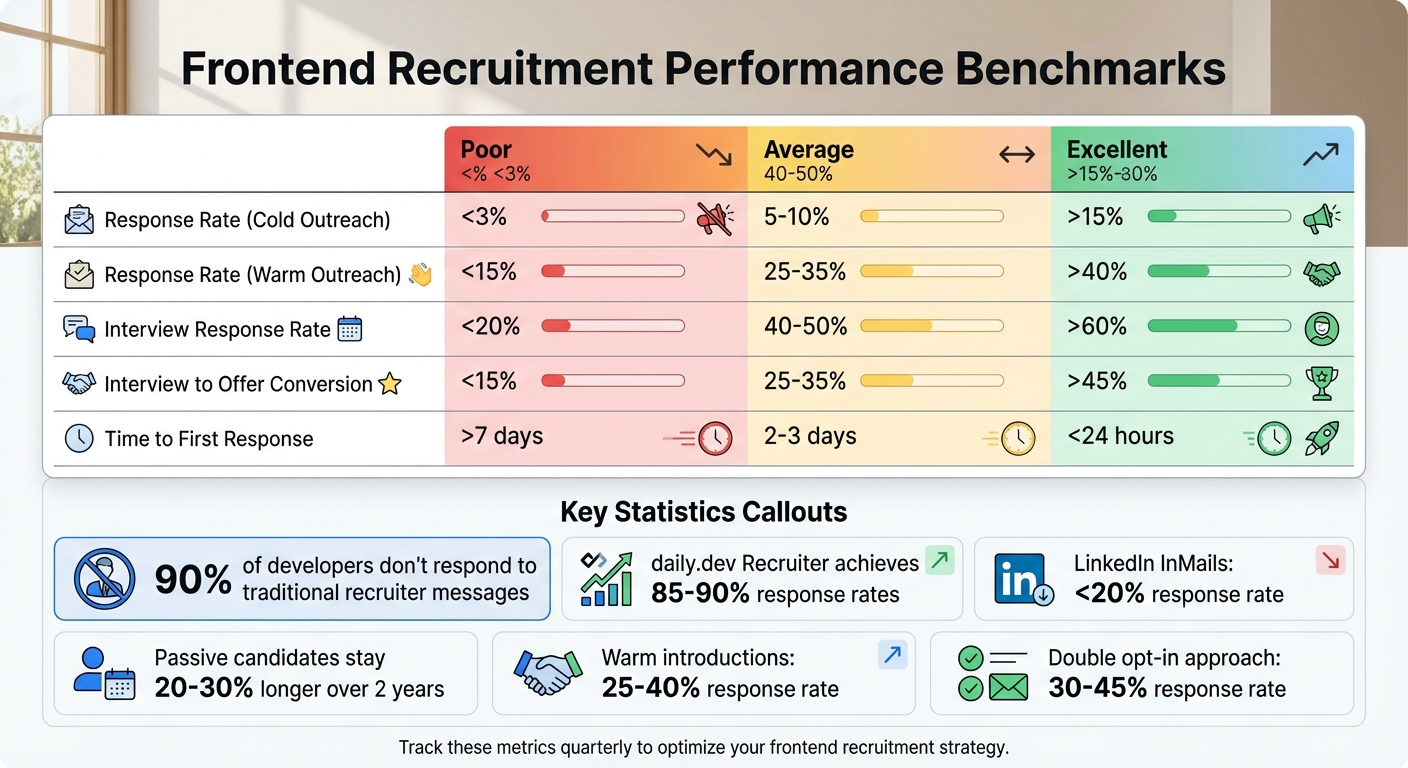 {Frontend Engineer Recruitment Metrics: Cold vs Warm Outreach Performance Benchmarks}
Once your outreach strategy is in place, the next step is figuring out what’s working and what isn’t. Tracking the right metrics can help you pinpoint issues in your hiring process and show you where to focus your time and money. By taking a data-driven approach, you can fine-tune your targeting and messaging to improve results.
Measuring Conversion From First Contact to Hire
Think of your hiring process as a funnel with distinct stages: initial contact, response, phone screen, technical assessment, interview, offer, and hire. Tracking how candidates move through these stages can reveal where things break down. For example, if you contact 100 engineers and make 2 hires, that’s a 2% conversion rate. But if 20 candidates respond (20% conversion) and only 8 complete the technical assessment (40% conversion), you’ve identified a bottleneck. Best practices suggest the entire frontend recruitment process should take two to four weeks, so tracking the speed of each stage is equally important .
Monitoring Response and Engagement Rates
Once you’ve mapped out your funnel, evaluate how effective your outreach is. Response rates are a key indicator of whether your targeting and messaging are hitting the mark. A cold outreach response rate under 3% suggests weak targeting or overly generic messaging. A rate between 5-10% is typical, while anything above 15% is excellent . On the other hand, warm introductions - like referrals - usually see response rates between 25-40%. Using a double opt-in approach can push that number even higher, to 30-45% .
Pay attention to which outreach methods work best. For instance, if personalized messages referencing specific GitHub projects get an 18% response rate, while generic templates only get 8%, you know where to focus your efforts.
Calculating Time-to-Hire and Cost-per-Hire
Efficiency and cost are just as important as engagement. Start by measuring time-to-hire, which is the number of days from first contact to offer acceptance. Then calculate cost-per-hire by dividing your total recruitment expenses - like software subscriptions, job postings, recruiter salaries, and assessment fees - by the number of successful hires .
For example, if your quarterly recruitment budget is $50,000 and you hire 5 frontend engineers, your cost-per-hire is $10,000. But don’t just focus on cutting costs. A $15,000 cost-per-hire that brings in high-performing engineers with strong retention is a better investment than an $8,000 cost-per-hire with poor retention . Passive candidates, in particular, tend to stay 20-30% longer over two years compared to active job seekers, which can significantly lower your long-term hiring costs .
| Metric | Poor | Average | Excellent |
|---|---|---|---|
| Response rate (cold) | <3% | 5-10% | >15% |
| Response rate (warm) | <15% | 25-35% | >40% |
| Interview response | <20% | 40-50% | >60% |
| Interview to offer | <15% | 25-35% | >45% |
| Time to first response | >7 days | 2-3 days | <24 hours |
Compare your metrics to these benchmarks every quarter. If your response-to-interview rate is under 40%, it’s worth investigating whether your screening process is too strict or if interview scheduling delays are causing drop-offs. Use these insights to refine your strategy and focus on the channels that deliver the best results.
Conclusion
Finding frontend engineers who are ready to make a move means knowing where to search, identifying the right signals, and tailoring your outreach efforts. With over 100,000 frontend job openings annually across various industries, the competition is fierce . The most successful teams avoid generic job boards and mass emails, instead focusing on niche communities where developers are actively participating and growing their skills.
To stay ahead, start with a well-crafted outreach strategy. Create a concise one-pager that highlights your tech stack - whether it’s React, TypeScript, Next.js, or another framework - alongside measurable performance goals, like achieving an LCP under 2.5 seconds. Tools like daily.dev Recruiter can help you connect with a network of highly engaged developers. This approach builds trust and cuts through the noise of cold outreach, ensuring you reach candidates who are genuinely interested in roles that align with their expertise.
Teams that incorporate short, focused technical exercises and transparent offers often reduce their hiring timelines to just 2–4 weeks while boosting retention rates . Keep an eye on key metrics like response rates, time-to-hire, and cost-per-hire each quarter. If your hiring process stretches beyond four weeks, it’s time to identify and address bottlenecks in your interviews. These efficient practices reflect a data-informed approach to finding and securing top talent.
It’s also crucial to maintain ongoing engagement. The best frontend developers are constantly learning, experimenting with new tools, and honing their skills . Meet them where they are, value their time, and clearly communicate why your opportunity is worth their attention. By focusing on personalized messaging, quality interactions, and continuous refinements, you’ll not only fill roles faster but also build a team of high-performing engineers who stay for the long haul.
FAQs
What are the best signals a frontend engineer is ready to move?
Developers often signal their interest in new opportunities through specific behaviors. These include updating their professional profiles, diving into technical content, joining specialized developer communities, and highlighting recent projects or contributions on platforms like GitHub. Such actions typically reflect a strong intent and active pursuit of growth or career changes.
How can I reach passive frontend candidates without spamming them?
To engage passive frontend candidates effectively, prioritize personalized communication and trust-building. Craft messages that align with their specific skills, interests, and career aspirations - mentioning their projects or professional contributions can go a long way. Be upfront about key details like salary, the tech stack, and role expectations to establish credibility right away. Connect with them on platforms they frequent, share meaningful insights, and leverage opt-in tools to create genuine connections. Avoid impersonal, spam-like outreach by focusing on offering value before making any direct requests.
Which hiring metrics should I track to improve frontend recruiting?
To make frontend recruiting more efficient, focus on tracking critical metrics. Start with time-to-hire, which measures how quickly candidates move through the hiring process. Then, evaluate candidate quality by looking at technical assessment pass rates, and keep an eye on the offer acceptance rate to ensure your offers align with developer expectations.
Don’t forget to monitor cost per hire to manage expenses effectively. Also, pay attention to candidate engagement signals - like updated profiles or activity in developer communities - to spot motivated candidates early. By combining these insights, you can streamline your hiring process and fine-tune your overall recruitment strategy.
.png)