Passive developers, who make up 70%-75% of the talent pool, are not actively seeking jobs but are open to the right opportunity. These candidates are highly experienced, often stay longer in roles, and account for over 60% of engineering hires in top companies. However, they’re hard to reach due to inbox fatigue - receiving over 50 generic recruiting messages monthly - and their selective nature.
To connect with them effectively:
- Personalize outreach: Reference specific projects or contributions they’ve made.
- Use warm introductions: Engage through mutual connections or their content.
- Leverage niche platforms: Explore GitHub, Stack Overflow, or developer communities.
- Build relationships: Offer value through webinars, newsletters, or Slack groups.
- Avoid spam: Be clear, concise, and respectful of their time.
Focus on trust and relevance to stand out and build long-term connections.
What Are Passive Developers?
::: @figure 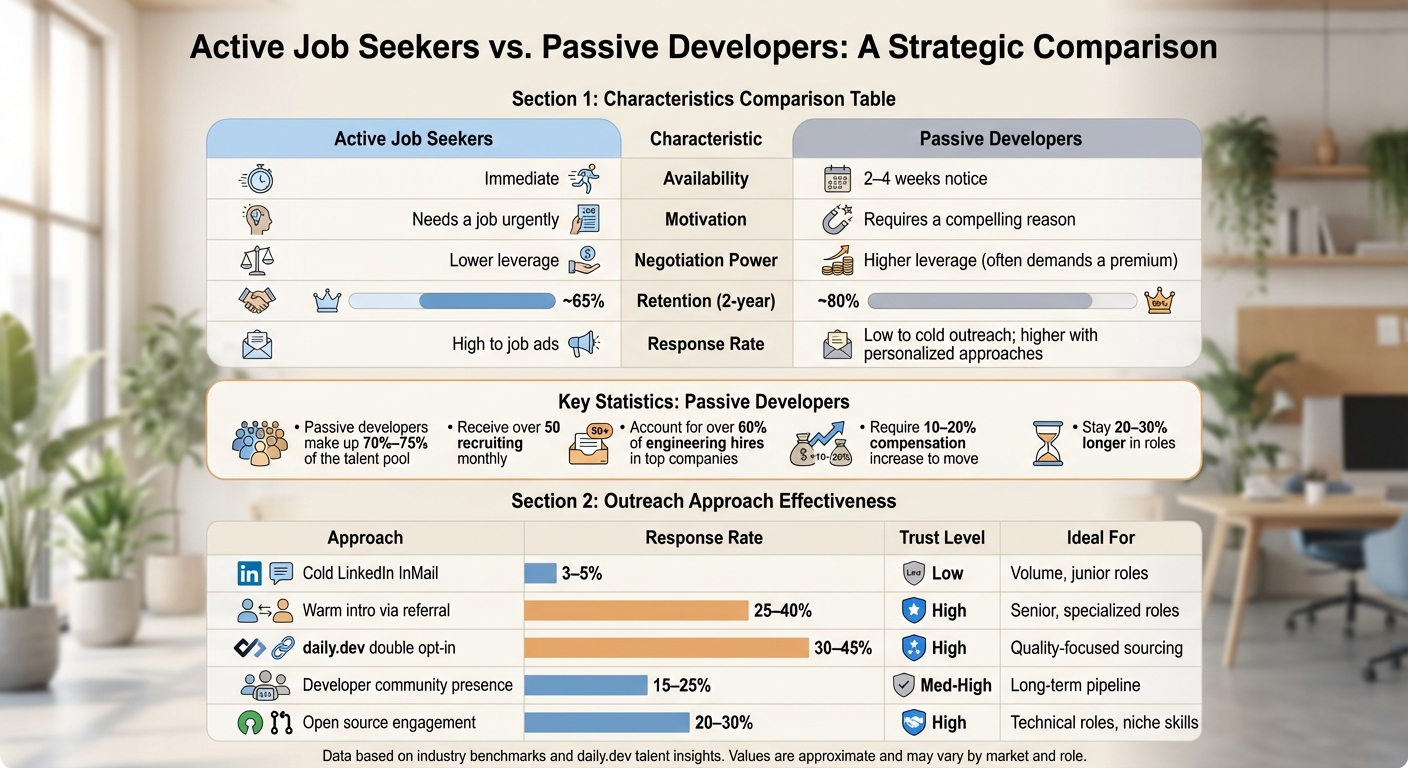 {Active Job Seekers vs Passive Developers: Key Differences and Response Rates}
Defining Passive Developers
Passive developers are professionals who aren’t actively searching for new jobs but are open to exploring the right opportunity if it comes along. Unlike active job seekers who frequent job boards and apply to openings, passive developers are generally content in their current roles. However, they might consider a new position if it offers a meaningful improvement - whether that’s in terms of challenges, technology, or compensation.
These developers exist on a spectrum of passivity. Some are "Open but Not Looking", meaning they’re happy where they are but curious about potential opportunities. Others are "Passively Open", indicating they might be swayed by an exceptional offer. Then there are those who are "Not Open" at all, often because they’ve recently been promoted or achieved a major career milestone. Understanding where someone falls on this spectrum is key to effectively engaging them.
The main difference between passive developers and active job seekers lies in their motivation and leverage. Active candidates are often in urgent need of a new role and may have less room to negotiate. Passive developers, on the other hand, are more selective and often require a 10–20% increase in compensation to justify the risk of leaving a stable position. They also typically need a 2–4 week notice period before transitioning to a new role. These factors make passive developers harder to approach, as explained below.
Why Passive Developers Are Hard to Reach
Passive developers don’t spend time on traditional job boards. Instead, they’re more likely to be found on platforms like GitHub, Stack Overflow, technical Twitter feeds, Dev.to, and HackerNews. These are spaces where they contribute to discussions, share insights, and engage with the developer community. By focusing only on active candidates, you could miss out on as much as 70% of the talent pool.
Another hurdle is inbox fatigue. Passive developers often receive over 50 recruiting messages each month. This deluge of generic, templated emails leads many to ignore outreach entirely. Past experiences with impersonal recruiting tactics have made them highly selective about who they respond to. To connect with these developers, it’s essential to use personalized, thoughtful approaches that respect their time and preferences.
| Characteristic | Active Job Seekers | Passive Developers |
|---|---|---|
| Availability | Immediate | 2–4 weeks notice |
| Motivation | Needs a job urgently | Requires a compelling reason |
| Negotiation Power | Lower leverage | Higher leverage (often demands a premium) |
| Retention (2-year) | ~65% | ~80% |
| Response Rate | High to job ads | Low to cold outreach; higher with personalized approaches |
(Data from )
Where to Find Passive Developers
Passive developers tend to steer clear of traditional job boards. Instead, they immerse themselves in coding, learning, and collaborating in online spaces. One of the best places to find them is GitHub, where you can explore their real-world code contributions, commit frequency, and collaboration patterns - essentially, a living resume. To narrow your search, you can use Boolean searches on Google. For example, try something like: site:github.com ("python" OR "django") AND "boston". This approach lets you filter candidates by location and preferred tech stack.
Another effective strategy is to explore professional networks and forums where developers actively share knowledge and solve problems. Platforms like Stack Overflow are particularly valuable for identifying skilled problem solvers in areas like React or Kubernetes. Similarly, daily.dev allows you to connect with developers who engage with technical content on a regular basis.
For a broader approach, niche forums and professional communities can complement your efforts. On LinkedIn, advanced Boolean searches such as "software engineer" AND Python NOT "looking for job" can help you pinpoint developers who are already employed. Other spaces like Reddit (e.g., subreddits such as r/programming or r/MachineLearning), Discord, and Slack communities offer opportunities to engage with developers discussing frameworks or troubleshooting technical challenges. Thoughtful participation in these communities can significantly improve your response rates.
Open-source projects are another goldmine for finding passionate and skilled developers. By examining GitHub contributor graphs, you can identify key contributors to projects. To build relationships, consider engaging with their work - fork a project, submit a meaningful pull request, or provide insightful feedback. This approach helps you transition from simply observing to establishing genuine connections.
For example, software company Mooncascade successfully attracted around 250 candidates in just a few days by running targeted ads in developer groups on Facebook and LinkedIn. Notably, 39% of recruiters now leverage Facebook for passive sourcing, citing its speed and cost-effectiveness .
Lastly, developer events and conferences - whether virtual or in-person - offer great opportunities to meet passive talent. Websites like dev.events or Meetup.com list local gatherings where you can sponsor a session, host a roundtable discussion on emerging trends, or simply network in a natural way. When following up, reference shared interests or discussions from the event rather than immediately pitching a role. This ensures your outreach feels personal and genuine, rather than transactional or spammy.
How to Engage Passive Developers Without Spamming
finding passive developer candidates requires a thoughtful approach. Generic, mass-sent messages don’t work. Instead, you need to focus on personalized, meaningful communication that builds trust and sparks interest.
Personalize Your Outreach
When contacting a developer, show that you’ve done your homework. Reference specific projects, code contributions, or technical achievements they’ve shared on platforms like GitHub or Stack Overflow . Avoid cookie-cutter templates. Instead, point out particular repositories they’ve worked on, programming languages they specialize in, or even technical discussions they’ve participated in. Highlighting recent contributions or unique coding techniques proves you’ve taken the time to understand their work, which makes your outreach feel intentional rather than transactional .
Make it clear why the opportunity you’re presenting aligns with their skills and career goals. For instance, if a developer has been actively contributing to open-source machine learning projects, explain how your role connects to that passion. This approach makes the conversation feel relevant and valuable to them .
Once you’ve built initial trust through personalized outreach, fostering deeper relationships through talent communities can keep the connection alive.
Build Talent Communities
Passive developers are more likely to engage when they feel part of a community rather than being treated as prospects. Offer newsletters, webinars, or virtual events that provide value without pressuring them into immediate recruitment . For example:
- Host exclusive webinars focused on technical skill-building.
- Organize virtual roundtables where experts discuss industry trends.
- Arrange Q&A sessions with executives to answer burning questions about the field .
These initiatives position your company as an industry leader while keeping you on developers’ radars for future opportunities.
You can also create Slack or Discord groups tailored to professionals in your niche or publish blog content that appeals to developers researching similar topics . The key is to offer genuine value first, so when developers are ready to make a move, they naturally think of your company.
Beyond community-building efforts, leveraging warm introductions can make your outreach even more effective.
Use Warm Introductions Instead of Cold Emails
Cold emails often feel impersonal and get lost in the noise. Warm introductions, on the other hand, significantly boost response rates . Start by engaging with a developer’s content - comment on their posts, share their articles, or participate in discussions they’re involved in. This builds familiarity and trust before you reach out directly .
Employee referrals are another powerful tool. Offer meaningful incentives for employees who refer candidates for hard-to-fill positions - like extra PTO, bonuses, or event tickets . When employees introduce a developer, they can provide valuable context about the company’s culture and the role’s technical requirements, making the outreach more effective.
Platforms like daily.dev Recruiter take this a step further by using double opt-in introductions, ensuring both parties are interested before any contact is made. This turns recruiting into a respectful, trust-based process rather than intrusive outreach.
Here’s how different approaches compare:
| Approach | Response Rate | Trust Level | Ideal For |
|---|---|---|---|
| Cold LinkedIn InMail | 3–5% | Low | Volume, junior roles |
| Warm intro via referral | 25–40% | High | Senior, specialized roles |
| daily.dev double opt-in | 30–45% | High | Quality-focused sourcing |
| Developer community presence | 15–25% | Medium-High | Long-term pipeline |
| Open source engagement | 20–30% | High | Technical roles, niche skills |
How to Maintain Relationships With Passive Developers
Finding passive developers is just the beginning. The real test lies in nurturing those connections over time. Without consistent effort, even the most promising relationships can fizzle out. The goal is to strike a balance between staying visible and offering genuine value, ensuring that developers think of you when they're ready to explore new opportunities. By building on personalized outreach, and leveraging warm introductions, you can keep your brand at the forefront of their minds.
Use CRM Tools for Regular Check-Ins
CRM tools can be game-changers for staying connected with passive developers. These systems help you track interactions, schedule follow-ups, and maintain a detailed history of communication. They also let you record developers' technical interests and automate reminders for periodic check-ins, typically every 3–6 months. Engagement tracking features, such as monitoring profile updates, can boost response rates by 20–30% .
Additionally, CRM tools allow you to segment candidates by their expertise - like Frontend, Backend, or DevOps - and even by niche interests such as "Rust enthusiasts" or "open-source maintainers." This segmentation makes it easier to send tailored updates that feel relevant, avoiding the pitfalls of generic, mass emails .
Share Helpful Content to Stay Top of Mind
Passive developers are more likely to engage with helpful insights than direct job offers . Sharing industry news, technical articles, research papers, or engineering blog posts can add real value to your interactions. A great example is Atlassian, which built a thriving talent community by sending out regular newsletters that members opted into. This approach resulted in 47.5% annual growth, reaching 13,000 active members with a 62% average open rate and nearly 300 hires .
Tracking engagement metrics like email opens, clicks, and replies can help refine your approach. You might also try A/B testing different types of content to see what resonates most. Developers are far more likely to respond to meaningful, well-curated content - often two to three times more than they would to generic updates .
Conclusion
Effectively connecting with passive developers revolves around three key principles: trust, personalization, and respect. Since passive developers aren’t actively seeking jobs, generic messages or pushy tactics will only alienate them. Instead, focus on forging genuine connections. Leverage warm introductions, participate in developer communities, and engage on platforms they already frequent. When you reach out, make it meaningful - highlight specific projects, provide clear salary ranges like $140,000–$170,000, and steer clear of vague phrases like "exciting opportunities."
Warm introductions can achieve response rates between 30% and 45% , and passive hires often stay 20%–30% longer because they make deliberate career decisions . Opt for low-pressure approaches rather than immediate demands. For instance, instead of requesting a "quick call", offer a concise role description they can review at their convenience . This shows respect for their time and builds trust from the outset.
Beyond personalized outreach, long-term relationship management is essential. Use CRM tools to track interactions and organize contacts by their expertise. Share valuable resources like technical articles or industry insights instead of bombarding them with job offers. This way, you stay relevant without being intrusive.
FAQs
What should I say in a first message to a passive developer?
To write a strong first message to a passive developer, focus on making it personalized, clear, and upfront. Highlight specific aspects of their work, skills, or projects that caught your attention. Mention technologies or experiences relevant to the role and include essential details like the salary range and whether the position is remote. Skip the generic templates - showing genuine interest in their expertise can help establish trust and increase the likelihood of a reply.
How do I find passive developers on GitHub or Stack Overflow quickly?
To identify passive developers efficiently on GitHub or Stack Overflow, start by examining their contributions, repositories, and overall activity. Leverage advanced search techniques, such as Boolean operators and filters, to narrow your focus to relevant projects and individuals. Assess their coding abilities by analyzing repository content and reviewing their contribution history. Additionally, consider using sourcing tools that integrate with these platforms to streamline and automate your search, ensuring quicker and more precise results.
How often should I follow up without annoying passive candidates?
To connect effectively with passive candidates, it's essential to space out your follow-ups carefully. Focus on creating personalized and meaningful interactions rather than bombarding them with excessive contact. Start by building trust - offer something valuable to them before asking for anything in return. Striking the right balance between persistence and respect ensures your communication comes across as sincere, not pushy. Always maintain professionalism and avoid overwhelming candidates with too many messages.
.png)