Hiring developers from open source communities offers a unique advantage: their public contributions showcase their technical skills, collaboration abilities, and passion for coding. By analyzing their code, commit history, and interactions, you can assess their real-world expertise without traditional coding tests more effectively than through resumes. Open source contributors are often passive candidates who are deeply engaged in projects they care about, making them a valuable talent pool.
Here’s a quick overview:
Where to Look: Platforms like GitHub, GitLab, npm, and PyPI are prime spots for finding talent. Specialized forums and language-specific communities (e.g., Rust, Go) also provide access to niche expertise.
How to Evaluate: Focus on the quality of contributions (e.g., accepted pull requests, meaningful code reviews) rather than quantity. Look for signs of collaboration and leadership, such as maintainer roles or active participation in discussions.
Engaging Candidates: Personalize outreach by referencing their contributions. Avoid spamming project spaces, respect their commitments, and clearly communicate job details.
Legal Considerations: Ensure candidates have proper permissions for their contributions and understand any relevant intellectual property agreements.
Recruiting from open source communities requires respect, transparency, and a long-term approach. By supporting these communities and aligning roles with contributors' interests, you can build trust and attract skilled developers who are already making an impact.
Where to Find Developers in Open Source Communities
The best developers often work on and maintain projects across various platforms, far beyond traditional job boards. Knowing how to recruit developers through open source and communities can help you discover both up-and-coming talent and experienced maintainers who drive entire ecosystems forward.
GitHub, GitLab, and Other Code Hosting Platforms
GitHub dominates as the largest code hosting platform, while GitLab appeals to developers who value self-hosted options and integrated CI/CD workflows.
Package registries like npm (JavaScript), PyPI (Python), and Maven Central (Java) showcase developers managing libraries and SDKs that are widely used. When exploring these platforms, focus on maintainers who consistently offer clear documentation and frequent updates - these are signs of professionalism and a commitment to the long haul.
For more niche or technical environments, platforms like Gerrit and Phabricator host major projects like Android and LLVM. These spaces attract developers with strong technical expertise and a focus on rigorous code reviews. On the other hand, platforms like CodePen, JSFiddle, and Glitch are hotspots for frontend developers showcasing interactive UI demos and polished designs. If your search leans toward contributors who value open-source principles, Savannah - home to GNU projects - is a great place to find developers committed to free software ideals.
If you're looking for specialized skills, language-specific communities can uncover talent with highly focused expertise.
Language-Specific Communities and Forums
While global platforms provide access to a broad pool of developers, language-specific forums offer deeper insights into niche expertise. For instance, Rust and Go communities are popular among engineers eager to build their reputations by contributing to in-demand language repositories.
Public directories like Disboard.org (for Discord servers) and slofile.com (for Slack workspaces) can help you find these tight-knit communities. Each programming language has its own culture - Rust developers often emphasize memory safety and systems-level programming, while Go developers typically focus on cloud infrastructure and scalability. By understanding these nuances, you can identify candidates whose skills and interests align perfectly with your technical needs. These smaller, focused communities often yield developers who excel both technically and in their commitment to the open-source ethos.
Hiring engineers?
Connect with developers where they actually hang out. No cold outreach, just real conversations.
How to Evaluate Open Source Contributions
::: @figure 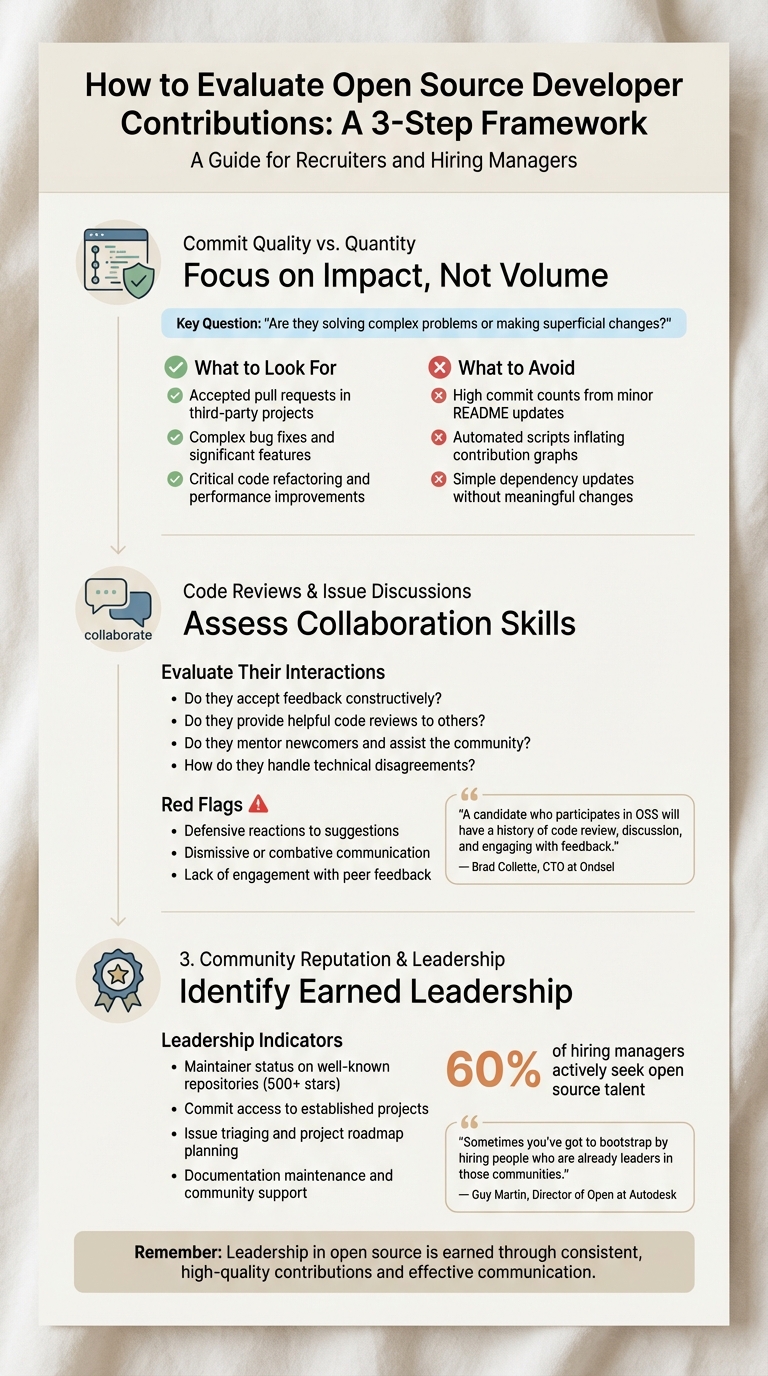 {How to Evaluate Open Source Developer Contributions: A 3-Step Framework}
Not all open source contributions carry the same weight when assessing a developer's skills. A contributor with 500 commits might initially stand out, but if those commits consist of minor README updates or formatting tweaks, they don't necessarily reflect technical expertise. To truly understand a developer's abilities, it's essential to dig deeper into the nature of their contributions. Here's how to evaluate them effectively.
Commit Quality vs. Quantity
A high number of commits can be misleading. GitHub's contribution graph, for example, can be inflated with automated scripts or small documentation edits that don't showcase meaningful work. Instead of focusing on the sheer volume of activity, pay attention to accepted pull requests in third-party projects. These demonstrate peer validation of technical skills and adherence to project standards.
What matters most is the complexity of the issues a developer addresses. For example, a pull request that resolves a challenging bug or adds a significant feature provides far more insight into their skills than dozens of minor changes. Look closely at their diffs - are they refactoring critical code, improving performance, or just updating dependencies? The depth and impact of their work are far more telling than the frequency of their contributions. This approach helps you gauge both their technical ability and their capacity for tackling complex challenges.
Participation in Code Reviews and Issue Discussions
A developer's interactions with others can reveal collaboration skills that traditional interviews often overlook. Reviewing pull request comments can provide valuable insight into their coachability - do they accept feedback constructively, or do they react defensively? As Brad Collette, CTO at Ondsel, explains:
"A candidate who participates in OSS will have a history of code review, discussion, and engaging with feedback. Do they take suggestions on board, do they offer feedback and coaching to others?"
Also, consider their involvement in reviewing others' contributions. Developers who frequently review code and assist newcomers demonstrate mentorship potential and a collaborative mindset. In issue discussions, observe how they articulate technical decisions and handle disagreements. A patient and constructive tone signals strong communication skills, while dismissive or combative behavior can be a red flag, regardless of their technical expertise. These behaviors not only highlight their teamwork but also their reputation within the open source community.
Community Reputation and Maintainer Roles
In the open source world, leadership is often earned through consistent, high-quality contributions. Maintainer status or commit access to well-known repositories (typically those with 500+ stars) is a strong indicator of peer recognition. These roles reflect a developer's ability to deliver reliable code, communicate effectively, and contribute meaningfully over time. As Guy Martin, Director of Open at Autodesk, points out:
"Domain expertise and leadership in open source can sometimes take quite a long time at established companies... sometimes initially you've got to bootstrap by hiring people who are already leaders in those communities."
Leadership isn't limited to coding. Developers who triage issues, plan project roadmaps, or maintain documentation often possess organizational and project management skills that are invaluable in senior roles. With 60% of hiring managers actively seeking open source talent, recognizing these leadership signals can help you identify candidates who combine technical expertise with the ability to guide and inspire teams.
How to Engage Developers Ethically
Open source communities are built on trust, collaboration, and mutual respect. When recruiters fail to honor these principles, they risk tarnishing their personal reputation and their company's image within the developer ecosystem. The key to successful outreach lies in understanding this: developers contribute to open source because they care deeply about the work - not because they’re waiting for job offers.
Before reaching out, it’s important to recognize that open source contributors often balance commitments to both their community and their employer. Asking them to compromise their standing within the community - by prioritizing your company’s needs over the health of a project or abruptly abandoning their maintainer duties - is not only unethical but also counterproductive. Respecting this balance builds trust and lays the groundwork for meaningful recruitment efforts. This respect serves as the foundation for the practical tips outlined below.
Do's and Don'ts of Outreach
To align with the values of open source communities, consider the following practices:
Personalize your outreach: Reference specific contributions, such as a pull request or commit, to show you’ve done your homework. Generic messages suggest a lack of effort and are likely to be ignored. Highlight how their work aligns with the role you’re offering to demonstrate genuine interest.
Avoid spamming repository spaces: Never post recruiting messages in repository issues or pull requests. These areas are meant for technical collaboration, not job postings. Instead, use appropriate channels like LinkedIn, email addresses listed on GitHub profiles, or forums with dedicated career sections.
Be upfront about details: Clearly outline salary, tech stack, and other relevant information from the start. This shows respect for their time and reduces unnecessary back-and-forth.
Respect their decision: If a developer declines or doesn’t respond, move on gracefully. Pressuring them will only damage your reputation and future opportunities for engagement.
Adapting to Community-Specific Etiquette
Different programming communities have their own norms and expectations, which shape how developers prefer to be approached. Tailoring your outreach to these nuances can make a big difference.
For example, Rust developers tend to value inclusivity and thoughtful communication, while Go developers often appreciate concise and direct messaging. Python and JavaScript communities, on the other hand, expect recruiters to have a deeper understanding of their ecosystems.
Within Python communities, many developers specialize in frameworks like Django or Flask. Acknowledging this expertise - rather than treating them as general Python developers - shows respect for their skills. Similarly, JavaScript communities are diverse, spanning technologies like React, Vue, and Node.js, each with its own subculture. Recognizing these distinctions positions you as someone who genuinely understands their world, rather than an outsider looking to exploit it.
Converting Open Source Contributors into Candidates
Learning how to recruit developers through open source projects takes careful planning, well-timed outreach, and a genuine commitment to the community. Overlooking their ongoing project responsibilities can make your efforts fall flat.
Timing Your Approach
Reaching out at the wrong time can derail even the best recruitment plans. The ideal moment to connect with a contributor is right after they've hit a major milestone - like completing a project release or merging a key feature. Developers who are exploring new tools or technologies are often more open to opportunities. On the flip side, avoid reaching out during periods of intense activity, like critical bug fixes or active development cycles, when their attention is fully on the project.
Once the timing feels right, focus on aligning the role with their demonstrated interests and skills.
Matching Roles with Their Open Source Interests
The best candidates are those who see a clear link between the job you're offering and the work they're already passionate about. Dive into their GitHub activity to understand their interests and align your job description with their contributions. This approach not only engages them but also shows that you're invested in their ongoing involvement in the open source community.
A great example of this is Samsung's open source team, led by Ibrahim Haddad and Guy Martin. They implemented a "50% rule", requiring developers to dedicate half of their working hours to upstream contributions. This ensured the company stayed actively engaged in the open source ecosystem and supported developers' passions.
"If you're not paying people well, they're not going to want to come to your company... but they also care about working on cool tech; they care about learning and growing." - Camille Fournier, Managing Director, Two Sigma
This kind of role alignment sets the stage for meaningful community investment.
Offering Sponsorship or Support
Sponsorship is a powerful way to build trust within the open source community. By sponsoring a project or paying developers to contribute upstream, your company demonstrates that it values open source beyond just finding talent. This approach fosters lasting relationships that extend beyond individual hires.
As Nithya Ruff, Senior Director of Open Source Practice at Comcast, explained:
"When companies establish open source practices they send a big message saying that we're serious about open source and that we want to invest in it"
Offering developers guaranteed time to work on upstream contributions - like Samsung's 50% rule - makes your company more appealing to top-tier talent who want to balance community work with a steady paycheck. Sponsoring projects and supporting contributors shows that your company is committed to the ecosystem, not just its own interests, making you a destination of choice for maintainers and key contributors.
Legal and IP Considerations for Open Source Hiring
When hiring from open source communities, it's crucial to navigate intellectual property (IP) rights and legal agreements effectively. Contributor License Agreements (CLAs) are central to this process. These agreements allow developers to specify how their contributions can be used, ensuring the project has the legal right to distribute the code and clarifying IP ownership . Alternatively, some projects opt for a Developer Certificate of Origin (DCO), a simpler document where developers confirm they have the rights to contribute the code they submit . Without these agreements, the original author retains ownership, which can restrict the project's legal use of the code .
For example, in February 2024, Orange S.A. faced a penalty of over €900,000 for violating the GNU General Public License (GPL) in the Entr'ouvert v. Orange case . Similarly, Mozilla had to spend five years (2001–2006) relicensing Firefox and Thunderbird due to the need for agreements from every contributor with copyright claims on the code . Such cases highlight the importance of understanding contributor agreements when assessing candidates.
Understanding Contributor Agreements
When evaluating candidates, pay attention to whether they’ve signed CLAs for major projects. This often indicates they understand IP transfer and have likely obtained necessary approvals from their employers . The type of agreement they’ve worked under also matters. CLAs typically include explicit IP transfers and patent grants, which can be complex and may require employer involvement. On the other hand, DCOs are simpler, often requiring just a sign-off in the commit message, making them a preferred choice for many developers due to lower administrative demands .
"Determining license compatibility and compliance and who holds copyright can get complicated and confusing very quickly." - Open Source Guides
Understanding these agreements also helps you avoid "toxic" code - contributions tied to restrictive licenses that could hinder commercialization or lead to future legal disputes .
Employer Policies on Open Source Contributions
Employment contracts often grant employers ownership of IP created by their employees, especially if the work relates to the company’s business or uses its resources . As a result, candidates may have needed employer approval for their open source contributions. When reviewing a candidate’s background, ask whether their previous employers had policies limiting open source participation . If a seasoned developer uses open source software but has no contributions, it’s possible their employer prohibited such activity .
"The worst possible thing you can do is take code where your employer is the copyright holder and doesn't want it contributed. The technical term for the result is 'an almighty legal mess'." - gnasher729, Software Engineer
To avoid complications, confirm that candidates have written permission or a "waiver of rights" from their employer to contribute to open source projects . Regional laws also play a role. For instance, California generally protects work done on personal time and equipment if unrelated to the employer’s business. In contrast, other jurisdictions may favor the employer . Notably, New York State passed law S5640 in July 2024, retroactively safeguarding employees who develop software on their own time without using employer resources . Understanding these legal nuances ensures a candidate’s contributions are legally authorized, reducing the risk of IP conflicts and fostering trust with open source communities.
Building Long-Term Relationships with Open Source Communities
Recruiting in the open source world isn’t about quick hires or treating communities as talent reservoirs. Instead, it’s about building genuine, lasting relationships. By moving away from transactional hiring and focusing on collaboration, companies can create a steady flow of candidates who already trust and understand their values. This approach builds on the ethical tech recruitment strategies mentioned earlier.
Participating in Community Engagement
One of the best ways to show your commitment to the open source ecosystem is by actively supporting the projects your company depends on. Dedicate paid developer hours to contribute upstream. This sends a clear message: your organization values the community and its work.
"A lot of how you recruit should center on thinking consciously about how you change the perception of the open source community on what your company is about." – Guy Martin, Director of Open, Autodesk
Take it a step further by engaging experienced maintainers to mentor your internal teams. This helps align your company’s values with those of the community. Sponsoring events, providing resources, and even open-sourcing internal tools can also establish credibility. These efforts make future recruitment conversations smoother and more natural.
Creating a Talent Pipeline Through Trust
Trust is the foundation of any successful recruitment strategy in open source. When a company invests time in fostering trust within the community, it not only improves candidate quality but also ensures a steady flow of talent.
Long-term involvement builds a unique kind of loyalty - developers who contribute to your organization while staying active in their project communities . Supporting this dual role strengthens both the individual and the ecosystem.
However, be cautious about over-hiring from a single project. Taking all the key contributors at once can harm the community and damage your reputation . A more balanced approach is to create mentorship programs where senior developers guide junior contributors. This creates a natural pathway from community member to employee . Including open source contribution opportunities in job descriptions can also attract developers eager to grow their public profiles . When developers see that your commitment to their communities is genuine, recruitment conversations feel more like discussions among colleagues rather than cold pitches.
Conclusion
Contributing to open source projects showcases collaboration and problem-solving in a transparent way. Unlike traditional interviews, this method offers a clearer picture of someone's technical expertise and teamwork dynamics.
It's important to focus on quality over quantity. Don't just glance at GitHub activity graphs or the number of "green squares." Instead, pay attention to meaningful contributions like accepted pull requests, insightful code reviews, and constructive participation in issue discussions. These elements highlight not only technical skills but also collaboration and leadership potential. A focus on meaningful contributions sets the stage for respectful and ethical approaches to recruitment.
Approach outreach with care. Make it personal by referencing specific contributions, acknowledge developers' time and commitments, and never resort to spamming project issues or pull requests. Research shows that personalized outreach significantly increases response rates .
Hiring from open source communities isn't about rushing to fill roles. It's about building trust through consistent involvement, supporting the projects your company relies on, and enabling new hires to continue contributing to those projects. Genuine, long-term engagement turns recruitment into a collaborative effort. With 60% of hiring managers actively seeking open source talent , those who succeed will be the ones who treat these communities as partners rather than just a pool of candidates.
FAQs
What should I look for in a developer’s GitHub profile besides commit counts?
When evaluating developers, it's important to look beyond just the number of commits they’ve made. Instead, pay attention to the quality of their contributions, their participation in issue discussions, their involvement in code reviews, any roles they’ve taken as maintainers, and their overall standing within the community. These factors offer a much clearer picture of their skills, how they collaborate, and their influence in the open-source world.
How can I contact open source contributors without violating community norms?
To reach out to open source contributors in a respectful way, focus on being genuine and considerate. Start by showing real interest in their work - highlight specific contributions to prove you've taken the time to review what they've done. Avoid spamming issues or pull requests with generic messages. Instead, explain clearly why you're reaching out and how your request or opportunity connects with their expertise and interests.
Another great way to build trust is by participating in community discussions constructively. Engage in conversations, offer value, and familiarize yourself with the community's norms. When you do reach out directly, be mindful of their time and always adhere to the community's etiquette.
What legal or IP risks should I review before hiring an open source maintainer?
Before bringing an open-source maintainer on board, it's crucial to evaluate licensing compliance, attribution obligations, and intellectual property rights. This can help you steer clear of legal issues like licensing violations or infringement. Take time to understand contributor agreements and check any employer policies tied to their open-source contributions. Doing this upfront reduces the risk of conflicts and makes the hiring process smoother.
.png)