Tired of sifting through irrelevant resumes on job boards? Here's how you can find skilled developers by engaging directly with their work and communities:
- Engage in developer communities: Platforms like GitHub, Stack Overflow, and Reddit allow you to observe real coding skills and technical discussions.
- Leverage open-source contributions: Review GitHub profiles to evaluate code quality, collaboration, and problem-solving abilities.
- Use tools like daily.dev Recruiter: This platform connects you with pre-qualified developers through a double opt-in system, ensuring genuine interest and eliminating spammy outreach.
- Tap into referrals: Employees’ networks can significantly speed up hiring while improving retention rates.
- Attend events and hackathons: Meet developers in action, observing their technical and teamwork skills in real-time.
These methods prioritize meaningful connections and real-world skills over keyword-heavy resumes. By meeting developers in their spaces, you can build trust and attract top talent without relying on job boards.
::: @figure 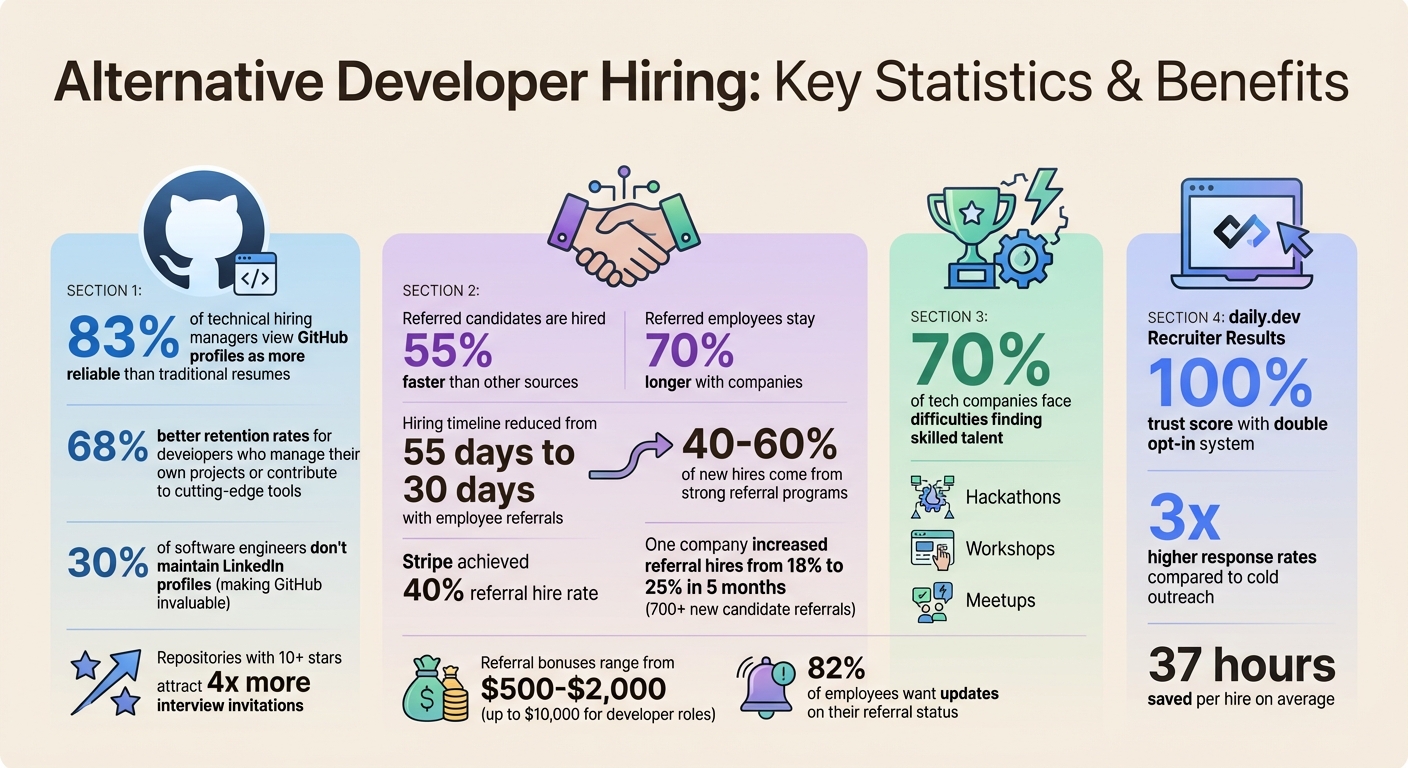 {Developer Hiring Statistics: Referrals, Open-Source & Event Recruitment ROI}
Connect with Developer Communities
Developer communities offer a unique window into how engineers solve problems - insights you won’t always find on a resume. Engaging in these spaces allows you to evaluate skills firsthand and build trust by interacting where developers naturally gather.
Join Online Forums and Discussion Platforms
Start by identifying the platforms where your target developers spend their time. Popular choices include Stack Overflow, Reddit subreddits like r/programming, Hashnode, and Dev.to. These platforms are buzzing with technical discussions, project showcases, and troubleshooting threads.
When joining, create a transparent recruiter profile and take the time to observe how the community operates. Pay attention to trending topics, influential contributors, and the tone of conversations. By aligning with the platform’s norms, you’ll maintain credibility and avoid coming across as intrusive.
Add Value to Technical Discussions
Dive into discussions by offering meaningful contributions. For instance, help troubleshoot a tricky error, share configuration tips, or guide someone to useful documentation. If the issue is beyond your expertise, connect them with team specialists who can help.
Recurring problems you notice? Turn them into concise guides or resources for the community. Share insights about your team’s tech stack - like using Python 3.11, following test-driven development, or implementing CI/CD pipelines. Highlight interesting projects, share useful links, or celebrate community milestones. The key is to engage authentically, without pushing a recruitment agenda. This approach helps you build trust through meaningful communication and positions you as a valuable part of the community, not just someone looking to hire.
Find Talent Through Open-Source Projects
Exploring open-source contributions offers a direct and unfiltered way to evaluate a developer's skills beyond what a traditional resume can show. Open-source work showcases how developers actually write code, solve problems, and collaborate with others. Unlike the self-reported skills on a CV, public repositories provide a lasting record of their technical abilities. You can examine key aspects like code structure, how they handle edge cases, testing practices, and their responses to feedback. In fact, 83% of technical hiring managers follow modern technical hiring best practices and view GitHub profiles as more reliable than traditional resumes .
Open-source platforms also highlight essential soft skills. For instance, pull request discussions and issue trackers reveal how developers communicate bug fixes, accept feedback, and mentor others. These interactions mirror real-world collaboration, offering a preview of how they might fit into your team before you even schedule an interview.
Developers who manage their own projects or contribute to cutting-edge tools often demonstrate passion and self-motivation, traits linked to higher engagement and 68% better retention rates after hiring . Plus, with 30% of software engineers not maintaining LinkedIn profiles, GitHub becomes an invaluable resource for discovering talent that traditional methods might overlook.
Review GitHub Activity and Contributions
Start by reviewing a developer's pinned repositories and README files. These give insight into the quality of their projects and how well they document their work. Clear, well-organized documentation often signals strong communication skills and systematic thinking - important for working with both technical and non-technical teams.
To find top developers in your tech stack, check the "Insights" tab and then "Contributors" on popular libraries like React, Django, or TensorFlow. GitHub's advanced search lets you refine your search with filters like language:python location:"San Francisco" followers:50..500, helping you zero in on active, mid-to-senior-level developers in specific areas .
Pay close attention to accepted commits in third-party projects, as merged pull requests demonstrate peer-reviewed skills. Also, look at peer reviews - developers who frequently review others' code often show strong collaboration and leadership potential .
Focus on original repositories rather than forks to evaluate unique work. A consistent history of commits is more meaningful than occasional bursts of activity, as it signals reliability. However, be cautious of "green square" inflation from automated scripts or superficial contributions.
Once you've assessed contribution quality, shift your focus to finding candidates who are solving challenges similar to yours.
Target Developers Working on Related Technologies
To find developers already tackling problems like yours, use targeted search techniques. For example, a Google X-ray search like site:github.com "python developer" "machine learning" location:Austin can uncover profiles that GitHub's native search might miss . Look for repositories with 10+ stars, as highly-starred projects often indicate community-valued work and attract four times more interview invitations .
Tools like Git-Talents can help match developers based on specific languages, frameworks, and libraries . If you're hiring for a Python 3.11 role with CI/CD pipeline experience, search for repositories using those technologies and focus on the most active contributors.
Follower counts can hint at a developer's community standing. For example:
- 11–30 followers: Strong engagement
- 31–75 followers: Excellent reputation
- 75+ followers: Influencer status
But don't rely solely on metrics. As Brad Collette, CTO at Ondsel, warns:
"If you're a hiring manager and you're judging an applicant's skills and experience by how many green squares they have... this is the most superficial way to look at it" .
Ultimately, the quality of contributions matters far more than vanity metrics.
Use daily.dev Recruiter to Access Pre-Qualified Developers
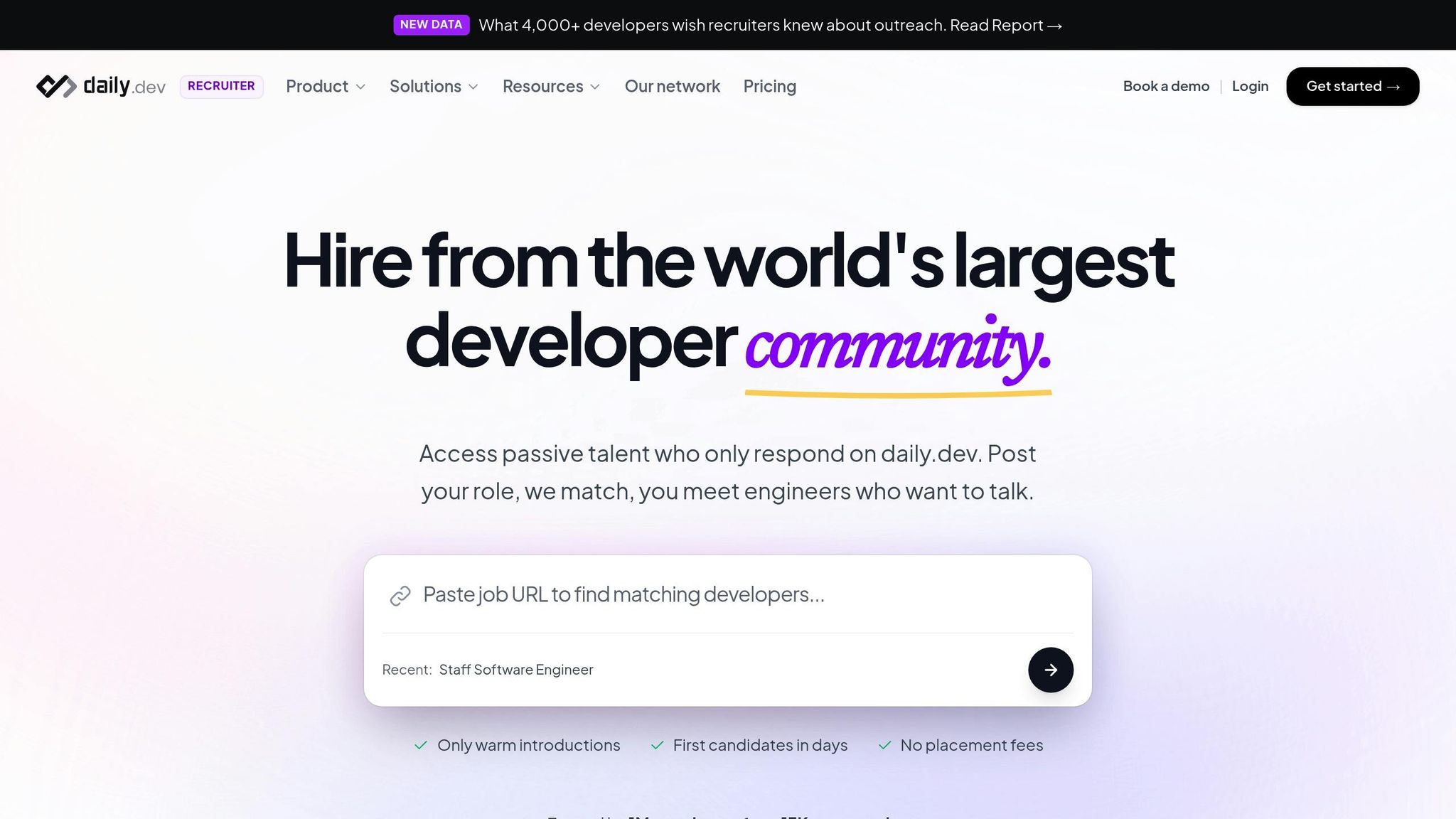
GitHub might showcase code quality, but it doesn't solve the trust issues that come with unsolicited outreach. daily.dev Recruiter takes a different approach with its double opt-in system called "TinDev." This process ensures that both you and the developer agree to connect before any interaction happens. The result? A 100% trust score for every introduction, eliminating ghosting and fostering genuine connections.
The platform leverages real-time behavioral data to match developers with opportunities that align with their current interests. It also verifies crucial details like timezone, location, tech stack, and seniority, ensuring that every introduction is meaningful and relevant. These checks help build trust between recruiters and developers from the outset.
Get Warm Introductions Instead of Cold Outreach
Cold outreach often disrupts developers with unsolicited messages, leading to low engagement. daily.dev Recruiter flips the script by privately pitching roles to developers based on their skills and preferences. This lets developers review opportunities on their own terms and opt in only if they're genuinely interested. The result? Reply rates that are three times higher than traditional cold outreach methods.
"When your role shows up inside that flow, it doesn't feel like outreach. It feels like an opportunity. That's why it just works."
To streamline your workflow, the platform syncs accepted pitches directly with ATS tools, so you can focus on meaningful conversations instead of administrative tasks. This system ensures that you're reaching developers where they're already active and engaged.
Reach Developers on Their Professional Platform
Job boards tend to attract only those actively seeking work, leaving out a vast pool of passive talent. daily.dev, on the other hand, engages developers daily, embedding opportunities directly into their content feeds. This approach naturally draws in passive candidates without disrupting their routines. The platform's behavioral matching engine even identifies potential candidates weeks before they update their public profiles.
"The bottleneck isn't message volume. It's access. daily.dev gives you a new channel to reach passive talent where they actually live."
Hiring engineers?
Connect with developers where they actually hang out. No cold outreach, just real conversations.
Build and Activate Your Referral Network
Your current developers likely already have talented individuals in their professional circles. Here's why tapping into these networks is so effective: referred candidates are hired 55% faster than those from other sources and tend to stay with companies 70% longer . Plus, leveraging employee referrals can cut the hiring timeline from 55 days to just 30 days . Companies with strong referral programs often see 40% to 60% of their new hires coming from these efforts .
The key is to make referrals easy. Take a page from Stripe’s playbook: they reached a 40% referral hire rate by hosting "Spin Up Sessions" during onboarding. These sessions allowed departments to explain their work and highlight open roles. Stripe also identified "strong referrals" and gave them special attention, like inviting the referring employee to post-interview debriefs to provide additional insights .
Create an Employee Referral Program
Start by simplifying the process. Use tools like two-click referral systems integrated with Slack or your ATS, so employees can make referrals without disrupting their workflow . Encourage new hires to submit referrals within their first month and structure referral bonuses into two payouts - one immediately and another after 90 days .
Referral bonuses typically range from $500 to $2,000, but some tech companies offer as much as $10,000 for successful developer referrals . Cash isn’t the only incentive, though. Offer rewards that resonate with tech professionals, like tickets to React Summit or PyCon, premium noise-canceling headphones, or even opportunities for professional growth .
Keep employees in the loop. A staggering 82% of employees want updates on whether their referral was hired . Automated status updates can prevent frustration and ensure transparency. As Kara Yarnot, President of Meritage Talent Solutions, emphasizes:
"The single worst mistake a company can make with its referral program is to not contact referred candidates when an employee expects them to."
For inspiration, consider a Bay Area company that ran a 5-month referral contest. They used an internal leaderboard and experiential rewards, generating over 700 new candidate referrals and increasing hires from referrals from 18% to 25% .
These streamlined systems not only boost referrals but also build on the trust and connections already present within your team.
Network with Industry Contacts
While community engagement focuses on active talent, your extended network can unlock even more opportunities. Former employees, ex-colleagues, and conference connections are excellent referral sources because of the trust already established.
Host casual recruitment events where your engineers can introduce their peers to hiring managers . These informal meetups remove the pressure of traditional interviews while giving candidates a glimpse of your company culture. Alumni networks are another goldmine - employees who left on good terms might know talented peers in their new organizations who could be a perfect match.
The goal is to build authentic relationships so referrals happen naturally and effortlessly.
Meet Developers at Events and Hackathons
Events provide a unique chance to see developers tackle challenges in real-time. Hackathons, in particular, serve as a "real-world test" where you can observe how developers approach tricky problems, adapt when things go wrong, and work together under tight deadlines . These moments reveal a lot - like who naturally steps into leadership roles, who keeps the energy up during late-night coding sessions, and who can bridge communication gaps between technical and non-technical team members .
With 70% of tech companies facing difficulties in finding skilled talent , these in-person opportunities are crucial for building a strong hiring pipeline.
Attend Developer Meetups and Conferences
Face-to-face interactions at meetups and conferences allow you to pick up on subtle cues about technical expertise and teamwork. Focus on events that match your hiring goals. For instance, if you're scouting React developers, check out React Summit or React Conf. Looking for AI or machine learning experts? PyCon, NeurIPS, and CVPR are excellent options. For DevOps and infrastructure talent, events like KubeCon and AWS re:Invent are ideal .
Don’t just attend as a sponsor. Send your engineers to participate as mentors or speakers. This not only helps evaluate technical and soft skills but also fosters genuine connections . Local meetups and user groups are just as important, especially for finding talent in niche languages or frameworks where the community tends to be smaller and closer-knit.
Organize Hackathons or Coding Competitions
Hosting your own hackathons offers an even deeper look into a candidate's abilities. Tailor the event to your goals - whether you're targeting specific skills or assessing general technical talent . Create challenges that mirror the kinds of problems your team tackles daily. This helps you see how participants handle real-world scenarios .
Focus on more than just the final product. Pay attention to how candidates approach problem-solving, structure their code under pressure, and communicate with their team . Sometimes, the most impressive developers aren’t part of the winning team. Look for those who built a solid backend or wrote clean, maintainable code even if the overall project didn’t succeed . Having your engineers mentor teams during the event can also provide valuable insights into technical skills and team dynamics .
To attract a diverse pool of talent, consider offering virtual or hybrid formats. This approach can help include individuals who face geographic or physical barriers, as well as those who are neurodivergent . Incentives like conference tickets, learning subscriptions, or internships can draw in highly motivated participants . After the event, follow up with all participants - not just the winners. Provide constructive feedback and invite them to future company tech talks to keep them engaged in your talent network .
Conclusion
Finding top developers doesn't have to rely on traditional job boards. The strategies outlined here focus on authentic connections rather than impersonal outreach.
By engaging with developers in spaces they already value, these methods transform cold outreach into meaningful conversations. This approach shifts the focus from purely transactional recruiting to building real engagement - a crucial edge when competing for top talent.
Taking these principles further, daily.dev Recruiter offers a platform designed to connect with active and passive developers through warm, double opt-in introductions. This means both parties - recruiter and developer - express interest before any conversation begins, cutting out spam and unnecessary chasing . Instead, you’re engaging with developers who are genuinely open to opportunities.
The platform also leverages real-time insights into developer activities, using behavioral signals that go far beyond outdated resume keywords . The results speak for themselves: teams using this approach report 3x higher response rates and save an average of 37 hours per hire . As Nimrod Kramer, CEO & Co-Founder of daily.dev, explains:
"We built a place where engineers can turn off the noise. To enter this space, you don't need a hack. You need trust" .
This method perfectly reflects the importance of building trust and fostering genuine relationships with developers.
FAQs
What are the best ways to assess a developer's skills without using job boards?
You can gauge a developer's skills by diving into their open-source contributions and activity on platforms like GitHub or GitLab. By reviewing their public repositories, commit history, and pull requests, you get a strong sense of their coding expertise, problem-solving approach, and how they work with others in practical situations.
Another great option is to explore developer communities like Stack Overflow or Reddit. Observing their participation - through answers, discussions, and shared knowledge - can reveal their technical depth, communication style, and how they tackle challenges. These methods provide a clear and practical way to evaluate developers beyond the limitations of traditional job boards.
What makes hiring developers through open-source contributions a smart choice?
Hiring developers through open-source contributions offers a distinct way to evaluate talent that goes far beyond what a traditional resume can show. With open-source projects, you get a clear and practical view of a developer's technical expertise, problem-solving approach, and ability to work within a team. Since their contributions are publicly available, you can directly assess their coding quality, attention to detail, and communication style.
This method also opens the door to discovering hidden talent - developers who might not be actively looking for a job but are already proving their skills through impactful projects. By analyzing their work, you can see how they handle challenges, write efficient code, and interact with others in the community. In the end, hiring through open-source contributions creates a solid foundation of trust and ensures you're connecting with skilled and driven developers.
What is the double opt-in system on daily.dev Recruiter, and how does it work?
The double opt-in system on daily.dev Recruiter is all about creating meaningful, consent-driven interactions between recruiters and developers. Here's how it works:
First, a developer needs to show interest or give initial consent to be contacted. Then, they follow up with a second confirmation step - like verifying their interest through email or another secure method.
This two-step process acts as a safeguard against unwanted messages. It ensures that developers are genuinely interested in connecting with recruiters, which builds trust, cuts down on spam, and makes the hiring process smoother for everyone. For more information, check out daily.dev Recruiter’s official resources or reach out to their support team.
.png)