Hiring 10 engineers in 90 days is challenging but achievable with the right system. The key is balancing speed with quality while protecting your team from burnout. Here's how:
- Set Weekly Goals: Break the hiring process into smaller milestones. For 10 hires, aim for 77 prospects and 5–6 interviews weekly.
- Build a Strong Pipeline: Source 400–500 leads upfront and monitor recruitment funnel conversion rates to keep the process moving efficiently.
- Leverage Multiple Channels: Use platforms like referrals, blogs, and open-source projects to attract qualified candidates.
- Automate Tasks: Use the best hiring tools for technical roles for resume screening, scheduling, and follow-ups to save time and focus on top candidates.
- Limit Interview Load: Cap interviews at 2–3 per engineer weekly to maintain productivity and avoid burnout.
- Standardize Processes: Use structured scorecards and clear rubrics for consistent evaluations.
- Speed Up Offers: Extend verbal offers immediately after final interviews and follow up with written offers within 24–48 hours.
This approach ensures you hire quickly without compromising quality or overburdening your team.
::: @figure 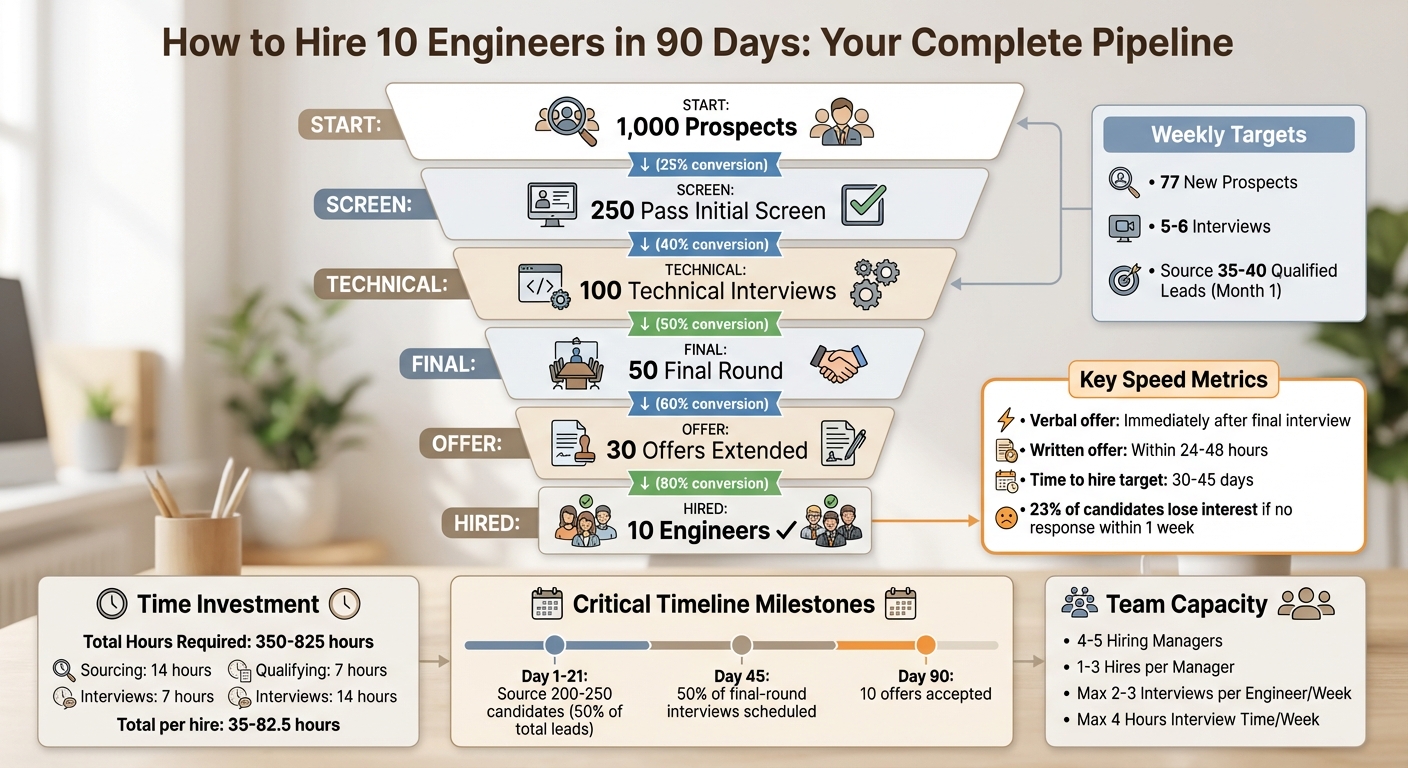 {Hiring 10 Engineers in 90 Days: Pipeline Metrics and Weekly Targets}
1. Build Your Quarterly Hiring Sprint Framework
Think of hiring 10 engineers in 90 days as a sprint. The trick is to break this big goal into smaller, weekly milestones. By setting clear weekly targets for each stage of the hiring process, you can avoid overwhelming your team and keep progress on track.
Focusing on a quarterly timeline instead of a year-long plan makes a huge difference. It helps you stay motivated and adapt quickly if something isn’t working. Gabriel Isaac, an engineer and tech educator, explains it best:
"A year is too long to stay on fire. But 12 weeks? I can sprint through that."
This sprint approach also connects directly to strategies for automation and tracking candidates, which we’ll explore later.
1.1 Calculate Weekly Hiring Targets
Start by breaking down the numbers. To hire one engineer, you’ll typically need to start with 100 prospects, narrow that down to 10 interested candidates, and conduct 7 interviews . For 10 hires, this means targeting 1,000 prospects, 100 engaged candidates, and 70 interviews over the quarter. On a weekly basis, that’s about 77 prospects and 5–6 interviews.
Now, let’s talk time. Each hire requires 35–82.5 hours of work, divided into 14 hours for sourcing, 7 hours for qualifying, and 14 hours for interviews . For 10 hires, this translates to 350–825 hours spread across the quarter. To manage this workload, involve 4–5 hiring managers. Each manager should realistically handle only 1–3 hires per quarter to avoid overloading your team .
1.2 Map Your Candidate Pipeline
A strong pipeline is built on clear conversion ratios. To get 10 hires, you’ll need to source 400–500 leads, accounting for drop-offs at each stage. Here’s a typical funnel breakdown: 25% of sourced leads pass the initial screen, 40% of those move to technical interviews, 50% make it to the final round, 60% receive offers, and 80% accept .
Focus heavily on sourcing in the first month. Aim to identify and contact 200–250 candidates (half of your total leads) within the first three weeks . This ensures your pipeline is full for interviews in months two and three. During the first half of the quarter, set weekly sourcing goals of 35–40 qualified leads. Once you’ve built a strong pool, shift your energy toward interviews and closing offers.
Keep a close eye on your pass-through rates (PTR) every week. If fewer than 20% of candidates are advancing from the initial screen to technical interviews, hit pause and reassess your job description or sourcing strategy . By Day 45, you should have at least 50% of your final-round interviews scheduled, so you’re not scrambling at the end . And remember, 23% of candidates lose interest if they don’t hear back within a week , so keep things moving to avoid losing top talent.
Next, we’ll dive into developer sourcing channels to help you hit these targets.
2. Run Multiple Sourcing Channels at Once
Once your quarterly sprint framework is in place, it's time to broaden your reach by leveraging multiple sourcing channels. A diverse approach ensures a steady flow of candidates, complementing the sprint structure you’ve already established.
2.1 Use Different Sourcing Channels
Start by focusing on platforms where developers naturally spend their time. For instance, daily.dev Recruiter can connect you with qualified developers through warm introductions, increasing engagement with potential candidates.
Combine this with a structured referral program. Your current team members are often well-connected within the industry. A straightforward and organized referral process can bring in candidates who are not only skilled but also align well with your team’s values and work environment .
Another effective way to attract talent is by showcasing the technical challenges your team is tackling. Share insights through blog posts, open-source projects, or social media updates. This helps build a pipeline of candidates who are genuinely interested in your work. In fact, companies with a strong employer brand are known to deliver software 2.4x faster, as they attract engineers who are enthusiastic about contributing to meaningful projects .
2.2 Set Weekly Sourcing Benchmarks
Keep a close eye on your weekly sourcing metrics to identify and resolve issues early. To align with your hiring goals, calculate how many qualified profiles you need at the top of your funnel during the initial stages of your hiring cycle. Spread these targets evenly across all sourcing channels.
Pay attention to conversion rates, such as how many profiles from each channel move to the screening stage. If one channel consistently delivers better results, consider reallocating resources to maximize its potential. As Kealan Shults from LinkedIn points out:
"If you don't reverse-engineer your hiring goals using real interview-to-hire conversion ratios and interviewer capacity, your growth plan is a guess - not a strategy" .
Use data from your pipeline to fine-tune your sourcing strategy.
Wherever possible, automate repetitive tasks at the top of your funnel. AI-powered tools can help with initial candidate screening and profile matching, allowing your team to focus on meaningful conversations with the most qualified candidates . This approach not only saves time but also ensures your resources are spent where they matter most - on interviews and closing offers. By relying on data and automation, you set the stage for a more efficient and effective hiring process.
3. Automate Screening and Candidate Tracking
When you're tasked with hiring 10 engineers in just 90 days, manual screening can grind the process to a halt. The stats are clear: 92% of US hiring managers now rely on AI for resume screening or pre-screening interviews . Automated tools can filter out 40-50% of applications that fail to meet basic requirements - all without human input .
By automating repetitive tasks, your team can focus on meaningful conversations with top candidates. Modern ATS (Applicant Tracking System) platforms can cut hiring times by 22% , and AI-driven analytics can speed up resume reviews by as much as 75% . This efficiency gives your engineering team more time to work on building products instead of sifting through resumes.
3.1 Set Up ATS Workflows
To streamline the process, configure your ATS to sort applications into three categories: "Reject" for unqualified or fake submissions, "Review" for candidates who need further evaluation, and "Priority" for standout prospects . This triage approach ensures recruiters focus on the most promising candidates first.
Use AI-powered resume parsing to extract key details like qualifications, skills, and experience from various file formats. Automate tasks like sending confirmations, status updates, and follow-up nudges to keep candidates engaged throughout the process . For interview scheduling, integrate tools that allow candidates to book slots directly based on your team's availability. This can eliminate the back-and-forth communication that typically eats up 38% of a recruiter’s time .
Make sure your ATS integrates seamlessly with third-party screening tools to avoid manual data entry . You can also deploy AI chatbots to handle routine inquiries and provide instant updates to candidates 24/7 .
3.2 Add Pre-Screening Assessments
After your ATS filters applications, introduce developer assessment tools like automated coding tests or design challenges to verify technical skills before involving senior engineers in interviews . This step ensures only qualified candidates move forward, saving your team valuable time.
Standardize scorecards with clear yes/no criteria for initial assessments, allowing coordinators to evaluate candidates in as little as 15 minutes . For roles in emerging fields like AI/ML engineering - where demand is growing 300% faster than for traditional software positions - focus on hands-on portfolios and competency-based assessments rather than just traditional degrees.
Set up your ATS to automatically reject candidates who lack essential qualifications, such as specific programming languages or work authorization, and notify them promptly. This keeps your pipeline clean and ensures candidates stay informed . Companies using advanced hiring technologies have maintained excellent candidate experience scores, averaging 4.8/5, even during high-volume hiring periods .
4. Protect Your Team from Interview Overload
Trying to hire 10 engineers in just 90 days can stretch your team too thin. If engineers spend more than 4 hours a week on interviews, their productivity on core tasks often takes a hit . During resource shortages, some teams push their engineers to handle 6–8 interviews weekly, but that pace is hard to sustain unless their usual workload is adjusted . In extreme cases, technical leads have reported conducting as many as 60 interviews in a single month - a surefire recipe for burnout.
The constant decision-making required in interviews also drains mental energy. Adem Bilican, Co-founder and CTO at Relai, explains it well:
"Hiring is ultimately about judgment. But judgment requires: focus, energy, and clarity. Every repetitive task that steals attention makes judgment worse" .
On top of that, administrative tasks like scheduling and drafting interview invitations add to the mental load. Below are some steps you can take to protect your team’s focus while keeping your hiring goals on track.
4.1 Cap Interviews Per Engineer Per Week
Limit engineers to 2–3 interviews per week to ensure they can still focus on their primary responsibilities. This roughly equals 4 hours of interview time - the threshold where work on regular projects often starts to suffer . For roles that demand deeper technical assessments, you might want to set an even lower limit.
Consider time-blocking interviews on specific days or within set hours to help engineers stay focused on their daily work . If an engineer’s project work starts to lag, redistribute the interview load immediately. As José Aponte puts it:
"IT IS normal for a software engineer to take interviews. It is NOT normal to have too many interviews per week" .
4.2 Rotate Interview Panel Members
To maintain hiring momentum without overburdening your team, rotate interview panel members. Assign specific engineers to evaluate particular "signals" rather than having everyone assess every aspect of a candidate . For instance, one panel member could focus on technical and soft skills, and another on cultural fit. This prevents the monotony of repeatedly asking the same questions .
Monitor how many hours each team member spends interviewing each week to identify when someone needs a break . Organizing interviews by role and scheduling them on specific days - like backend roles on Tuesdays and frontend roles on Thursdays - can also help panel members compare candidates more effectively while reducing the mental strain of context-switching . Amazon, for example, requires employees to complete a full-day training course on interviewing before they’re allowed to participate in the process, ensuring a clear understanding of decision-making and common pitfalls .
4.3 Use Structured Scorecards for Feedback
Standardized scorecards are a game-changer. They can reduce post-interview debates by 40% and make it 30% more likely that your company identifies top-quality hires . Focus on 3–6 key competencies per role, with clear definitions for each score. For example, a "3" might mean "explains concepts clearly when prompted", while a "5" could indicate "proactively simplifies complex ideas without prompting" .
Encourage interviewers to submit scorecards within 24 hours of the interview to capture fresh, independent impressions before group discussions begin . Adding mandatory evidence fields - where interviewers must provide specific examples from the interview - can make the evaluation process even stronger. As Vicky Liu from Juicebox notes:
"An interview score card is the compass that aligns everyone. It provides a shared, objective framework to ensure every candidate is measured against the same critical standards, turning gut feelings into defensible data" .
5. Maintain Quality Standards While Hiring Fast
When you're aiming to hire 10 engineers in just 90 days, it’s easy to feel tempted to cut corners. But relying on unstructured or instinct-driven hiring methods won’t work at this pace . Instead, maintaining clear quality standards becomes your safety net during such an intense hiring sprint.
The key isn’t to slow down your hiring process but to set clear benchmarks before you even begin. Once established, these benchmarks should guide every decision, no matter how urgent the need feels. By combining these standards with earlier strategies like automation and candidate tracking, you can ensure that only the best candidates move forward. As Luis Gonçalves from Scaleup Methodology explains:
"The most successful scaling companies view recruitment technology as an enhancement to human judgment, not a replacement for it" .
Companies that embrace structured and modern hiring techniques report 27% lower turnover rates and 62% higher productivity among new hires .
5.1 Define Your Non-Negotiable Criteria
Start by documenting your technical and cultural non-negotiables in one centralized reference. This document acts as a safeguard when the pressure to lower standards creeps in. It should align with your weekly hiring goals and interview frameworks. Prioritize core engineering principles over superficial skills like syntax knowledge - candidates with strong fundamentals can adapt to new frameworks more easily than those who only know specific tools .
Your non-negotiables should also include hard filters, such as:
- Minimum years of experience with key technologies (e.g., "5 years of PHP").
- Availability to start within your required timeline.
- Salary expectations that fit your budget.
Automating these filters through your ATS can weed out 40–50% of unqualified applicants upfront .
Beyond technical skills, evaluate problem-solving abilities and communication. Katerina Trajchevska, CEO of Adeva, highlights this:
"Evaluating a person's communication skills is imperative and identifying what type of environment an engineer will thrive in" .
Pair programming exercises are an excellent way to test both technical expertise and collaboration. When weighting criteria, consider a structure like 60% technical skills, 25% problem-solving, and 15% communication and cultural fit .
5.2 Create Clear Pass/Fail Rubrics
Structured rubrics are essential for keeping evaluations objective and efficient, especially during high-volume hiring. They prevent endless debates and ensure consistency. Define your scoring criteria before interviews begin. For example:
- Strong Hire: Average score between 3.5 and 4.0.
- Hire: Average score between 3.0 and 3.4.
- No Hire: Below 3.0 .
Use a 1–5 scale with clear behavioral indicators. For instance, a "3" might reflect basic competency with occasional guidance, while a "5" indicates mastery and independence . Research shows that structured interviews can improve the accuracy of hiring decisions by up to 40% compared to unstructured methods . Additionally, Google saved about 40 minutes per interview by eliminating post-interview confusion with structured formats . Jen Dewar from JobScore adds:
"Structured interviews help ensure that candidates are judged solely on their skills, qualifications, and fit for the role, rather than on personal biases or subjective impressions" .
To avoid scoring fatigue, limit your rubric to 5–7 core competencies and use specific behavioral descriptions (e.g., "effectively explains technical concepts" instead of "good communicator") . Before starting your hiring sprint, conduct calibration sessions with your interview panel. Review sample answers together to align on what each score level represents. This step prevents inconsistencies where one interviewer’s "4" might be another’s "2", which can derail the evaluation process .
| Recommendation Level | Score Range | Action |
|---|---|---|
| Strong Hire | 3.5–4.0 | Immediate offer |
| Hire | 3.0–3.4 | Proceed if no "Strong Hire" available |
| No Hire | Below 3.0 | Reject |
6. Speed Up Your Offer-to-Close Process
You've built a solid pipeline, automated your screening process, and protected your team from burnout. Now, the focus shifts to closing candidates quickly to hit your 10-hire goal. This phase ensures you secure top talent without losing the momentum you've built. Using a developer hiring timeline planner can help you stay on track during this critical window. Keep in mind that 28% of job seekers ghost employers, with 20% doing so because they receive competing offers . For highly skilled technical talent, aim to have offers accepted within 30 to 45 days - anything beyond 60 days significantly increases the risk of losing the candidate .
The key isn't just about moving faster; it's about removing any roadblocks between "we want to hire you" and "I accept." This requires early alignment with internal teams, automating approvals, and treating every offer as a competitive scenario.
6.1 Communicate Offers Quickly and Clearly
Speed is everything when it comes to offers. As soon as your team decides to proceed, extend a verbal offer immediately - ideally before the candidate leaves the interview or ends the video call. Carla Firpo from Crosschq explains:
"A hiring manager who presents their offers after the final interview before the candidate leaves the office shows decisiveness" .
Follow up with a written offer within hours. To make this happen, ensure early coordination between hiring managers, recruiters, and HR. Use your ATS to streamline offer approvals by automating workflows based on pre-set criteria like role, department, or salary band. This way, only non-standard offers require additional review . For standard roles, pre-approved salary ranges can speed up the process.
Set specific days for final interviews and decision-making so candidates hear back within 48 hours. Require all interviewers to submit their scorecards within 24 hours to keep things moving. Digital reference checks can also save time - up to 95% faster than manual checks - so integrate them into your workflow early .
| Metric | Definition | Target for Tech Roles |
|---|---|---|
| Time to Offer | Days between final interview and formal offer | < 24-48 Hours |
| Time to Hire | Days from application to offer acceptance | 30-45 Days |
Once you've nailed the timing, focus on personalizing your outreach to strengthen the candidate's commitment.
6.2 Personalize Your Candidate Outreach
Every interaction matters. Tailor your approach by understanding what drives each candidate. Are they a "problem-solver" drawn to technical challenges, or "mission-oriented" and motivated by impact ? During the offer call, highlight specific achievements from their interviews to show your team values their contributions. Connect them with mentors they mentioned during the process (e.g., "You'll be working directly with Sarah on our machine learning infrastructure") .
Adil Ajmal, CTO of LendingHome, explains this method:
"The secret to closing isn't offering the most equity or saying just the right thing during an offer call. It's really closely listening to and noticing what's motivating each candidate during the entire process, and then explaining precisely how your company will serve those needs" .
Have everyone from the interview panel reach out within 24 hours of the offer to share a personal, positive memory of the candidate. Instead of generic swag, consider sending a personalized gift that reflects a hobby or interest they mentioned during interviews . Between the offer and their start date, keep the connection alive by sending relevant articles, inviting them to casual team events, or sharing updates that align with their interests.
Once you've secured their enthusiasm, it's time to streamline negotiations for a quick close.
6.3 Prepare for Salary Negotiations
Clear and efficient negotiations are critical for maintaining the hiring pace. Start with your best offer and stand by it. Lowballing candidates not only wastes time but can also harm your credibility, especially in a fast-paced hiring sprint.
Since many candidates may not fully understand equity packages, take the time to explain them. For example, if your company achieves a 5X valuation increase, show how a $100,000 equity package (vested over four years) could translate into actual wealth . Schedule these discussions at the end of the day, allowing ample time to address every question.
If a competitor's offer is higher, consider using a one-time signing bonus to close the gap without disrupting your internal salary structure . When competing with larger firms, emphasize opportunities for rapid growth, meaningful work, and a strong team. With 83% of software developers reporting burnout, work-life balance can also be a persuasive point . Ask candidates directly, "How do you evaluate an opportunity?" to tailor your pitch to their priorities.
Expect that 20-30% of offers might be declined during high-volume hiring. Keep a warm backup pipeline ready . Avoid "exploding offers" with arbitrary deadlines; instead, set realistic expiration dates based on open conversations about the time the candidate needs to decide.
Conclusion
Bringing on 10 engineers in a single quarter demands a smarter approach, blending structured processes, automation, and protecting your team’s capacity.
Run parallel hiring pipelines and lean on automation for repetitive tasks like screening, scheduling, and tracking. This frees your team to focus on what really matters: assessing technical skills and fostering strong relationships with candidates. To prevent burnout - an issue reported by 65% of tech workers - limit the number of interviews per engineer and rotate interview panels to share the load .
Keep quality high, even when hiring fast. Structured scorecards and clear rubrics ensure consistency during interviews. Speed up the process by giving verbal offers as soon as possible and following up with written offers within 24–48 hours.
Shift your mindset from celebrating individual achievements to nurturing "multiplier engineers" - those who enhance the entire team through mentorship, collaboration, and strong documentation. As Shahzad Ali wisely states:
"The most valuable engineer isn't the one who writes 10 times the code. It's the one who makes 10 other engineers better" .
FAQs
How do I adjust the weekly targets if our conversion rates are worse than expected?
If you notice conversion rates slipping, it's time to tweak your weekly targets to align with pipeline efficiency. Lowering targets temporarily can help avoid burnout and maintain high standards while concentrating on sourcing and screening efforts. To balance things out, work on increasing candidate volume or improving sourcing quality. Keep a close eye on your metrics and adjust targets based on real data to stay adaptable and scale effectively.
What’s the simplest interview loop that still keeps quality high at this speed?
A well-organized interview process that prioritizes both speed and quality typically involves 2-3 rounds. These include a technical screening or coding challenge, a cultural fit interview, and a final review with a senior engineer or manager. This setup minimizes exhaustion for candidates while conserving the time and energy of interviewers.
To ensure fairness and consistency, structured scorecards are used for evaluations. Additionally, capping the number of interviews conducted each week helps teams stay focused and operate efficiently.
How do I keep engineers from burning out while still hitting hiring goals?
To help your engineering team meet hiring goals without hitting burnout, it’s important to protect their time and energy. Start by capping the number of interviews they handle each week. Use structured scorecards to make evaluations quicker and more consistent. Automating repetitive tasks - like scheduling and initial screenings - can save even more time.
Make sure workloads are balanced to prevent anyone from feeling overwhelmed. Keep an eye out for signs of burnout, encourage team members to take breaks when needed, and maintain regular feedback sessions. This approach supports both their productivity and overall well-being.
.png)