Hiring frontend developers with a strong design sense is about finding professionals who can merge technical skills with a keen eye for user experience. These developers not only implement designs but also refine them, ensuring interfaces are functional, visually appealing, and accessible. Here’s what you need to know:
- Why It Matters: A poorly designed interface can drive users away, while a well-executed one improves retention, satisfaction, and conversions.
- Key Skills to Look For: Proficiency in HTML5, CSS3, JavaScript frameworks (like React or Vue), responsive design, accessibility standards (WCAG 2.1), and design principles like typography and color theory.
- Where to Find Talent: Platforms like Behance, Dribbble, and Frontend Mentor showcase portfolios; tools like daily.dev Recruiter connect you with experienced candidates.
- How to Evaluate Candidates: Review portfolios for live demos, test their ability to translate designs into code, and assess their problem-solving through hands-on tasks.
- Crafting Job Descriptions: Be specific about technical and design expectations, request detailed portfolios, and use clear titles like "Design-Oriented Frontend Developer."
What Is Design Sense in Frontend Development?
Understanding design sense is key when evaluating frontend developers who can balance functionality and aesthetics. This skill allows developers to turn static designs into user-friendly, consistent, and responsive interfaces. It’s not just about making a website visually appealing - it’s about creating interfaces that work seamlessly across devices while maintaining a cohesive look. Developers with a strong design sense go beyond simply implementing designs from tools like Figma; they know how to spot and fix elements that feel off once a design goes live.
These developers fine-tune designs in real-world scenarios - adjusting spacing, visual flow, and accessibility to deliver the best possible user experience. As Steve Jobs famously said:
"Design is not just what it looks like and feels like. Design is how it works."
On the technical side, this requires expertise in semantic HTML5, modular CSS3, and JavaScript, as well as a solid grasp of responsive design, accessibility standards (like WCAG 2.1), and core design principles such as typography and color theory. Developers with a sharp eye for design also ensure readability by following guidelines like maintaining a contrast ratio of at least 4.5:1 for normal text . Below, we’ll explore the skills that highlight strong design sense and how they impact project outcomes.
Skills That Show Design Sense
A developer’s design sense shines through a mix of technical and visual skills. On the technical front, they should be proficient in:
- HTML5 for semantic structure
- CSS3 for styling, often using tools like Tailwind CSS or Sass
- JavaScript frameworks such as React or Vue
- Design tools like Figma, Sketch, or Adobe XD for translating wireframes into code
React, for example, is a cornerstone of modern frontend development, used by roughly 80% of developers today .
Beyond coding, these developers excel in responsive design, using advanced techniques like Container Queries for component-specific adjustments. They also prioritize accessibility, ensuring proper keyboard navigation, screen reader support, and adequate color contrast.
Mastery of typography, color theory, and layout principles further demonstrates their design expertise. Thoughtful CSS practices can also improve performance - such as cutting bundle sizes by 30% to 50% through optimization .
How Design Sense Affects Project Outcomes
For recruiters, understanding how design sense influences project results is crucial. Developers with this skill create interfaces that are intuitive and visually consistent, leading to better user retention and satisfaction. Their ability to balance design intent with technical constraints helps them identify and resolve potential issues early, saving time and avoiding costly redesigns .
By focusing on clean, maintainable code and a component-driven approach, these developers make it easier to scale projects. Establishing consistent design tokens for elements like colors, spacing, and typography ensures brand consistency across the product. These practices streamline workflows, reduce technical debt, and ultimately boost conversion rates and customer satisfaction .
As more U.S. users rely on mobile devices to access the internet, developers who adopt mobile-first, responsive strategies are increasingly valuable . Reflecting this demand, hiring for specialized frontend roles grew by 25% between 2019 and 2020, with senior developers earning salaries ranging from $125,000 to $165,000 .
Hiring engineers?
Connect with developers where they actually hang out. No cold outreach, just real conversations.
How to Find Frontend Developers with Design Skills
If you're looking to hire frontend developers with a strong design sense, the key is to focus on places where these professionals naturally showcase their skills. Many of these developers aren't actively job hunting but are open to the right opportunity. You'll often find them in developer and design communities, which makes conventional recruiting methods less effective.
Platforms like Behance, Dribbble, and Frontend Mentor are great starting points. These sites highlight a candidate's UI/UX expertise and their ability to tackle responsive design challenges. Similarly, developer communities such as Stack Overflow and other specialized forums provide insight into how candidates solve problems and collaborate with peers. By focusing on these platforms, you can identify candidates with real-world design expertise and a strong understanding of frontend development.
Using daily.dev Recruiter to Connect with Design-Focused Developers
To streamline your search for design-savvy developers, tools like daily.dev Recruiter can make a big difference. This platform connects you with developers who are already engaged with design-heavy topics like "Frontend Architects", "Advanced State Management", and modern CSS techniques.
One standout feature of daily.dev Recruiter is its double opt-in introduction process. This ensures that both you and the developer express mutual interest before any conversation begins, making every introduction warm and relevant. This approach is particularly effective, as 90% of engineers on daily.dev typically ignore traditional outreach methods. Nimrod Kramer, CEO & Co-Founder of daily.dev, explains:
"Engineers come to daily.dev to learn and stay sharp. They trust the platform enough to share career goals... When your role appears inside that routine, it doesn't feel like spam".
The platform provides access to a high-quality talent pool, with 85–90% of users already employed and 40% holding senior roles or leadership positions. It also integrates with ATS tools like Greenhouse, Lever, and Ashby, making the transition from initial contact to formal hiring seamless. At $350 per role per month, with no placement fees or long-term contracts, daily.dev offers a predictable and efficient way to reach top-tier developers who value design quality.
Finding Talent in Developer Communities
As mentioned earlier, a strong design sense often reveals itself through portfolio work and active community participation. Communities like Frontend Mentor are particularly useful for identifying talent. This platform allows developers to work on professional-grade UI projects, showcasing their ability to turn designs into functional, beautiful interfaces.
For more experienced professionals, networks like Match.dev provide access to pre-vetted frontend developers skilled in frameworks such as React, Vue, and Svelte. These networks are highly selective, accepting only 1% to 3% of applicants to ensure you’re connecting with top talent. While developers on Match.dev typically charge $50 to $80 per hour, you're investing in individuals who have proven their ability to balance technical expertise with design skills.
To further evaluate candidates, consider asking them to critique or test your current website during the hiring process. This hands-on exercise can reveal their design instincts and how well they align with your brand's aesthetic. By focusing on these strategies, you'll be better equipped to find developers who excel in both frontend development and design.
How to Evaluate Design Skills During Hiring
::: @figure 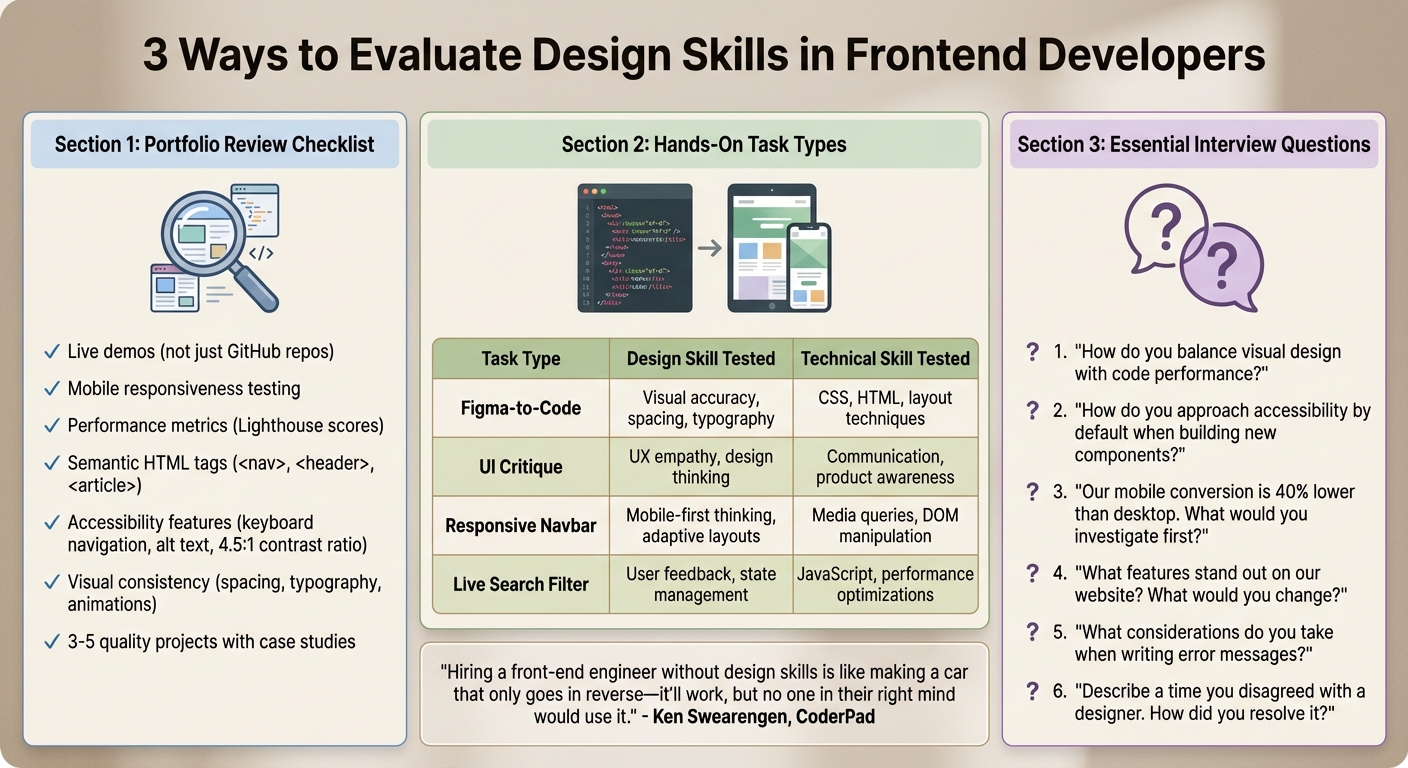 {Frontend Developer Skills Assessment: Portfolio Review, Hands-On Tasks, and Interview Questions}
Once you've identified promising candidates, the next step is to dig deeper into their design abilities. The goal is to find someone who can blend visual appeal with solid technical execution. This involves reviewing their portfolios, assigning hands-on tasks, and asking thoughtful interview questions. Below are detailed strategies - ranging from portfolio reviews to practical assignments - that can help you assess a candidate's true design potential.
How to Review Portfolios for Design Quality
Start by checking if candidates provide live demos of their projects. If a portfolio links only to a GitHub repository without a deployed demo, it could indicate a lack of attention to detail. Test their projects on your phone to ensure they work seamlessly on mobile. If buttons are unresponsive or text is difficult to read, it’s a sign they may have skipped mobile testing.
Use tools like Chrome DevTools Lighthouse for a quick performance check. Look for optimized images, small bundle sizes, and fast load times. Beyond speed, see if they’ve implemented features like loading states, skeleton screens, or lazy loading to enhance the user experience.
Inspect the HTML for semantic tags like <nav>, <header>, and <article>. Avoid portfolios that rely heavily on generic <div> tags. Also, check for accessibility basics: keyboard navigation, alt text for images, proper heading hierarchy, and adequate color contrast.
Pay attention to visual consistency across their projects - uniform spacing, aligned elements, typography that feels intentional, and animations that add value without being distracting. A great portfolio often includes a narrative explaining the reasoning behind design choices, the trade-offs made, and how constraints were handled. Ideally, a portfolio should showcase 3–5 projects that demonstrate complexity, visual finesse, and problem-solving skills. While a strong portfolio sets the stage, practical tasks can confirm a candidate’s design expertise.
Hands-On Tasks to Test Design Abilities
Static evaluations only go so far. Assigning hands-on tasks allows you to see how candidates apply design thinking in real-time. For example, a Figma-to-code exercise can test their ability to translate a design into pixel-perfect, responsive code.
Another effective approach is to present a poorly designed interface and ask candidates to improve it. This could include refining spacing, improving hierarchy, or addressing accessibility issues. You might also ask them to critique your own website - what stands out, what could be better, and how they would approach changes.
To test their component-based thinking, assign a responsive navbar task where they create a navigation bar that collapses into a hamburger menu on mobile devices. This helps you evaluate their use of media queries, accessibility tags, and DOM efficiency. A live search filter task can further reveal their ability to handle dynamic interactions and performance optimization.
| Task Type | Design Skill Tested | Technical Skill Tested |
|---|---|---|
| Figma-to-Code | Visual accuracy, spacing, typography | CSS, HTML, layout techniques |
| UI Critique | UX empathy, design thinking | Communication, product awareness |
| Responsive Navbar | Mobile-first thinking, adaptive layouts | Media queries, DOM manipulation |
| Live Search | User feedback, state management | JavaScript, performance optimizations |
Interview Questions to Understand Design Thinking
Great interview questions can uncover how candidates approach the balance between aesthetics and technical constraints. For instance, asking, "How do you balance visual design with code performance?" can highlight their ability to weigh trade-offs like heavy animations versus load times. Similarly, "How do you approach accessibility by default when building new components?" can reveal whether inclusivity is part of their design process from the beginning.
Scenario-based questions are another way to explore their UX instincts. For example, "Our mobile conversion is 40% lower than desktop. What would you investigate first?" encourages candidates to think about user outcomes and not just the technical side. Asking them to walk through a real project and explain their design decisions often provides deeper insights than standard technical questions.
You can also ask candidates to critique your website with a question like, "What features stand out to you? What would you change?" This helps you gauge their ability to spot UX issues and propose actionable improvements. Additionally, questions like, "What considerations do you take when writing error messages?" can shed light on their focus on reducing user frustration.
Collaboration is key in design work, so ask, "Describe a time you disagreed with a designer about an implementation. How did you resolve it?" This can reveal how they handle conflicts and communicate technical limitations to non-technical team members.
Ken Swearengen from CoderPad sums it up perfectly: "Hiring a front-end engineer without design skills is like making a car that only goes in reverse - it'll work, but no one in their right mind would use it."
Writing Job Descriptions That Attract Design-Oriented Frontend Developers
Your job description serves as the first handshake between your company and potential candidates. If it’s vague or generic - think phrases like "good design sense required" - you risk missing out on the right talent. Instead, focus on specifics: skills, tools, and the mindset you’re looking for. Make it clear that design excellence is central to the role, not just an afterthought.
Be precise about the role. Is it a "Frontend Developer" with a focus on visual and interactive elements? Or a "Frontend Engineer" emphasizing architecture and performance? Use terms like "pixel-perfect implementation", "visual consistency", and "user-centered design" to convey the expectations clearly. Opt for clear, searchable titles like "Design-Oriented Frontend Developer" to help candidates self-select. Then, dive into the exact technical and design skills needed for the job.
Skills and Tools to List in Job Posts
Go beyond the basics like HTML5 and JavaScript. Highlight CSS3 expertise, including Flexbox, CSS Grid, CSS Variables, and Container Queries. Mention familiarity with design tools like Figma, Sketch, and Adobe XD - this signals that the developer will work closely with design files. Include CSS preprocessors (e.g., Sass/SCSS) and utility frameworks (e.g., Tailwind CSS, Material UI). Also, emphasize knowledge of typography, color theory, contrast, spacing, and grid systems, as these are essential for maintaining visual harmony.
To attract candidates who care about user experience, include standards like WCAG 2.1 for accessibility and performance metrics like Core Web Vitals. Developers with strong CSS skills can significantly enhance performance by cutting bundle sizes by 30% to 50% and improving rendering speeds. Lastly, with 96% of tech employers now offering remote roles, consider highlighting flexibility to make your position more appealing.
Requesting Portfolios in Job Descriptions
Portfolios are key to verifying both technical skills and design sensibilities. Ask candidates to submit portfolios that showcase responsive design, mobile-first approaches, and pixel-perfect mockup implementations. Request three to five projects that demonstrate a mix of complexity and variety. For example, one project might feature advanced state management, another could highlight UI animations, and a third might solve a unique problem creatively.
Specify that you want live demos hosted on platforms like Vercel, Netlify, or GitHub Pages instead of just code repositories. This ensures you can evaluate functionality and user experience firsthand. Also, encourage candidates to include detailed case studies explaining their design decisions, trade-offs, and constraints. Ask for links to creative platforms like Behance or Dribbble alongside technical profiles. Make it clear that your evaluation will focus on functionality, accessibility, performance, and visual polish - showing that you value developers who take pride in their craft.
Conclusion
A well-thought-out design approach in frontend development is the key to creating both technically sound and user-friendly products. Hiring developers with a strong design focus ensures you build interfaces that users love. With 80% to 90% of a website's performance tied to the frontend , even the most robust backend can't compensate for a poorly executed interface.
Design-oriented frontend developers are the bridge between creative vision and functional technology. They understand that pixel-perfect execution enhances brand identity, semantic HTML improves accessibility, and a stunning interface is meaningless if it loads too slowly. These developers go beyond simply implementing designs - they refine them, addressing UX challenges early and writing maintainable code.
The payoff for businesses is clear. Companies that prioritize modern UI updates report UX score increases of up to 70% , making a strong case for hiring design-savvy developers. For e-commerce platforms, skilled frontend developers can drive conversion rate improvements of 45% . By hiring developers who balance aesthetics with functionality, businesses benefit from higher user retention, quicker sales processes, and less technical debt.
To attract the right talent, start by crafting job descriptions that emphasize design expectations. Look for portfolios showcasing polished, responsive UIs, and evaluate candidates with practical tasks that reveal their design thinking. With global hourly rates falling between $40 and $120 , investing in developers who merge technical expertise with design insight is a smart move - they transform static concepts into dynamic, engaging user experiences.
This is what separates a product that merely works from one that truly excels.
FAQs
What does “design sense” mean for a frontend developer?
"Design sense" for a frontend developer refers to the ability to grasp and implement design principles effectively, resulting in user interfaces that are both visually appealing and easy to navigate. It involves skills like interpreting design mockups, fine-tuning layouts, and creating interfaces that feel intuitive and balanced. A strong design sense not only improves the visual flow but also elevates the overall user experience.
How can I quickly spot design skills in a portfolio?
To spot design skills in a portfolio, focus on projects that demonstrate clear UI/UX principles like seamless navigation, engaging visuals, and a strong emphasis on user needs. Look for live, interactive demos that show how these concepts are applied in real-world scenarios. Examine the use of semantic HTML and attention to visual details - these often reflect a refined design approach. Portfolios with functional and user-friendly interfaces are a strong indicator of a solid grasp of design basics.
What short take-home task best tests design-focused frontend skills?
Creating a simple UI layout, such as a two-tab interface for "Users" and "Roles", is an effective take-home task for assessing design-focused frontend skills. It allows you to see how well a candidate can craft clean, functional components. Another strong option is asking them to build a signup form. By including features like error handling and animations, you can evaluate both their technical expertise and their eye for aesthetics. These types of tasks provide insight into how candidates apply UI/UX principles in practical scenarios.
.png)