

Hiring mobile developers in 2026 is harder than ever. With 88% of mobile usage happening in apps and the app market growing at 23% annually, demand for skilled developers outstrips supply. The U.S. alone faces a 1.4 million developer gap, and hiring a senior developer takes an average of 74 days. Here's what you need to know to navigate this competitive landscape:
- Native vs. Cross-Platform: Native developers (Swift for iOS, Kotlin for Android) deliver top performance but require separate teams. Cross-platform tools like Flutter and React Native power 46% of new enterprise apps, cutting development time by up to 45%.
- Specialized Skills: Developers now focus on specific frameworks, and roles like Kotlin Multiplatform (KMP) specialists are on the rise. KMP adoption has grown 120% year-over-year, offering shared logic while keeping native UI.
- Costs: U.S. senior mobile developers earn $200,000–$270,000 for iOS, $190,000–$255,000 for Android, and $130,000–$175,000 for cross-platform roles. Equity, remote work, and learning budgets are key perks.
- Where to Find Talent: Developers frequent GitHub, Reddit, and Stack Overflow, not LinkedIn. Platforms like daily.dev offer direct access to engaged, skilled developers.
To hire effectively, define your needs (native vs. cross-platform), assess practical skills (like shipping live apps), and offer competitive packages. Use developer-focused platforms to connect with top talent faster.
Mobile Developer Market Overview
By 2026, the mobile development field has become highly specialized, with developers categorized based on their expertise in specific frameworks. As one expert puts it, “mobile developer” without specifying a framework is as vague as calling someone a “programmer” without mentioning a language . Whether you're hiring a Swift expert, a Kotlin specialist, or a cross-platform engineer, each role demands a unique set of skills. This framework-driven specialization has reshaped hiring practices and team structures.
The hiring timeline reflects this specialization: iOS roles typically take 8–16 weeks to fill, Android positions 6–14 weeks, and cross-platform roles 5–12 weeks . For example, a Flutter developer won’t be able to maintain a Swift codebase, and a React Native developer likely won't fit into a Kotlin-based Android project. Choosing a framework is, therefore, a decision that impacts hiring costs, team dynamics, and time-to-market.
Another shift in 2026 is the way apps are built to support "AI Retrieval" and "Zero Click" environments. These apps are designed to provide information directly to AI-driven search agents, often without requiring users to open the app itself .
Business models are also evolving. Sixty-eight percent of CTOs now favor dedicated team models over project-based outsourcing . The gig economy approach, while flexible, has a 24% "ghosting" rate, often leading to fragmented codebases. This makes long-term team consistency crucial for companies developing AI-integrated, 6G-ready applications. As a result, precise role definitions are more important than ever.
iOS vs Android Developers: What Sets Them Apart
iOS and Android developers work in ecosystems that are as different as night and day. Over 95% of new Android projects now use Kotlin , while Swift dominates iOS development. iOS developers operate within Apple's tightly controlled environment, relying heavily on Swift and SwiftUI. They also need to navigate stringent deployment requirements - Apple rejects about 40% of first-time App Store submissions . Familiarity with App Store guidelines, TestFlight, and privacy frameworks is essential for success.
Android developers, on the other hand, grapple with OS fragmentation. Using Kotlin and Jetpack Compose, they must account for countless device configurations, screen sizes, and Android versions. By 2026, declarative UI expertise has become a must - developers with only XML or UIKit experience are considered outdated . Additionally, modern Kotlin developers stand out with their understanding of structured concurrency, particularly through coroutines .
The salary gap between these roles reflects their unique challenges. In U.S. tech hubs, senior iOS developers earn $200,000–$270,000 annually, while Android specialists make $190,000–$255,000 . The slightly higher pay for iOS roles is due to a smaller talent pool and the stricter demands of Apple's ecosystem.
Meanwhile, cross-platform development offers its own set of opportunities and challenges.
Cross-Platform Development: React Native, Flutter, and KMP
Cross-platform frameworks have transitioned from being a cost-saving option to a strategic choice. Flutter and React Native now power nearly half of new enterprise apps, reducing development time by 30–45% .
Flutter is particularly valued for its speed and ability to create pixel-perfect UIs, making it the top choice for 46% of developers in 2026 . React Native, on the other hand, benefits from the extensive React and JavaScript ecosystem, though its reliance on a JavaScript bridge can complicate the development of custom native modules.
Kotlin Multiplatform (KMP) reached stability in 2024 and has since grown rapidly, with a 120% year-over-year increase in enterprise adoption . Unlike other cross-platform tools, KMP focuses on sharing business logic - like API calls and data models - while keeping UI development native. Companies like Netflix, Cash App, and Philips have embraced KMP to streamline backend code while maintaining native experiences on both iOS and Android .
"The pendulum that swung hard toward cross-platform solutions is now finding a balance. Companies are adopting hybrid strategies where performance-critical features are implemented natively while shared business logic leverages cross-platform frameworks." - Priya Sharma, CTO, AppFusion Solutions
This hybrid approach is reshaping how companies hire. Kotlin’s role has expanded beyond Android development to include backend services, with its usage growing 40% year-over-year . A Kotlin developer in 2026 might handle Android UIs, share business logic via KMP, and even build backend systems - all using the same language. This versatility comes at a cost, with KMP specialists earning 10–20% more than standard native developers .
For businesses, selecting the right framework is a critical decision that should be made before crafting job descriptions. While cross-platform developers in the U.S. earn $130,000–$175,000 annually , their skills don’t overlap with those of native specialists. Ultimately, the framework you choose will shape your hiring process, team structure, and ability to deliver cutting-edge products efficiently.
Hiring engineers?
Connect with developers where they actually hang out. No cold outreach, just real conversations.
Skills Assessment: What to Look for Beyond Years of Experience
When hiring mobile developers, focus on those who have shipped live apps rather than solely relying on resumes with impressive credentials but no real-world projects . This doesn’t mean dismissing formal qualifications - it’s about recognizing that success in mobile development relies on practical skills beyond just time spent in the field. The best developers bring a mix of technical expertise and sound judgment, and your evaluation process should reflect that. These skills are especially important for crafting advanced, AI-powered mobile apps that will meet the demands of 2026.
Technical Skills Beyond Swift and Kotlin
Mastery of platform fundamentals is what separates experienced developers from those who’ve only completed basic tutorials. Candidates should have a solid grasp of the app lifecycle, including how apps behave in background, suspended, or killed states. They should also understand memory management differences, such as iOS's ARC versus Android's Garbage Collection . Developers lacking knowledge of offline-first architecture will likely struggle in situations where connectivity is unreliable. Look for experience with local data storage solutions like Core Data, SQLite, or Realm, as well as synchronization strategies .
API integration is another area where strong candidates stand out. Beyond simple HTTP requests, they should be adept at working with RESTful APIs, handling JSON, implementing authentication methods like OAuth and JWT, and ensuring security through techniques like certificate pinning . Additionally, they should demonstrate performance awareness, using tools to identify battery drain, memory leaks, or frame rate issues without needing explicit guidance .
Experience with App Store operations is also crucial. With Apple rejecting nearly 40% of first-time app submissions , developers need to understand certificate management, versioning, staged rollouts, and adhering to store guidelines. A practical way to evaluate this is through a three-to-five-hour take-home project. Have candidates build a small app that integrates a real API and local data storage. This will showcase their ability to architect solutions, handle errors, and ensure smooth UI performance - skills they’ll use daily.
Once you’ve confirmed their technical abilities, it’s time to assess how they communicate and solve problems in real-world scenarios.
Communication and Problem-Solving Abilities
While technical skills are essential for getting hired, collaboration is what ensures long-term success . Mobile developers often act as the bridge between designers, product managers, and backend teams. Developers who dive into coding without understanding the broader user context risk creating friction instead of adding value.
Assess problem-solving with realistic scenarios rather than abstract puzzles. For example, present a crash on an iPhone 12 running iOS 15.3 and ask candidates to walk through their debugging process . Strong candidates will first investigate user behavior and analytics before suggesting changes to the code. They understand that technical decisions impact business metrics like user retention and conversion rates, not just the quality of the code.
Be mindful of potential red flags, such as "The Platform Purist", who dismisses other operating systems, or "The Framework Fanatic", who insists one tool is a solution for everything . These attitudes can limit a team’s ability to adapt to new technologies like SwiftUI or Kotlin Multiplatform. On the other hand, look for pragmatic thinking, such as:
"We could build this natively for performance, but a cross-platform solution makes more sense for our timeline" .
This kind of reasoning shows flexibility and an understanding of trade-offs.
To evaluate collaboration skills, consider a mobile code review exercise. Pair candidates with your team for 45 minutes to review real code. Pay attention to whether they offer constructive feedback, ask thoughtful questions, and engage respectfully . For remote teams, prioritize developers who excel at clear documentation and asynchronous communication, especially since nearly half of mobile developers feel they lack the right tools for their work .
Where Mobile Developers Actually Hang Out (Not LinkedIn)
LinkedIn isn’t the go-to spot for mobile developers. Instead, they gravitate toward spaces where they can learn, solve problems, and showcase their skills - not just polish their resumes. If you want to connect with developers who aren’t actively job hunting but might be open to the right opportunity, you need to be present where they already spend their time. This approach is key to finding top-tier mobile talent efficiently.
Developer Communities: GitHub, Stack Overflow, and Reddit
GitHub is a favorite among mobile developers for sharing solutions, hosting libraries, and showcasing personal projects. Developers’ activity here can reveal their coding style, how often they contribute, and their experience with open-source collaboration. Pay attention to those who maintain well-documented repositories - they’re often the ones who take pride in their work.
Reddit offers a space for open discussions and real-world insights. Popular subreddits for mobile developers include:
- r/androiddev: 271,000 members
- r/iOSProgramming: 144,000 members
- r/FlutterDev: 180,000 members
- r/reactnative: 90,000 members
These communities are where developers discuss updates like iOS 17 SwiftUI changes before they hit mainstream channels. Look out for threads like "Show-off Saturday", where developers showcase their latest projects .
"The visibility gained from thoughtful contributions can be more valuable than traditional networking events, as it demonstrates actual technical competency rather than just communication skills."
- PainOnSocial
Stack Overflow remains a key resource for formal Q&A, though many developers prefer Reddit for broader discussions around architecture and alternative approaches. When sourcing talent here, focus on top contributors who regularly post detailed answers or tutorials. These individuals often showcase a deeper technical understanding than those found through traditional recruiting methods .
These platforms naturally lead to more specialized spaces, offering even more personalized ways to connect with developers.
Developer-First Platforms Like daily.dev
Beyond the usual developer communities, platforms like daily.dev provide a more focused way to engage with mobile talent. These platforms attract developers who are already tuned in to industry trends. For example, daily.dev is growing rapidly as a hub where mobile engineers explore personalized news feeds and discussions, especially around Flutter and React Native . Developers on this platform engage with technical content an impressive 200 times per month, making it a goldmine for identifying strong candidates .
Unlike traditional recruiting channels, platforms like daily.dev use a double opt-in model. This means developers actively choose to be contacted, ensuring mutual interest and higher engagement. It’s a refreshing change from cold outreach, creating a more respectful and effective connection.
"When you reach someone in a place they actually care about and use daily.dev Recruiter, you're not competing with a wall of noise. That's been the biggest shift for recruiters using daily.dev Recruiter. Trusted space changes everything."
- Dafna Ran, daily.dev
To stand out, tailor your outreach based on a developer’s community activity - like their GitHub contributions or blog posts. Thoughtful, personalized messages that acknowledge their expertise go a long way. Developers are increasingly frustrated by generic, automated messages, so transparency and respect are non-negotiable if you want to attract the best talent.
Salary Benchmarks and Offer Strategies
::: @figure 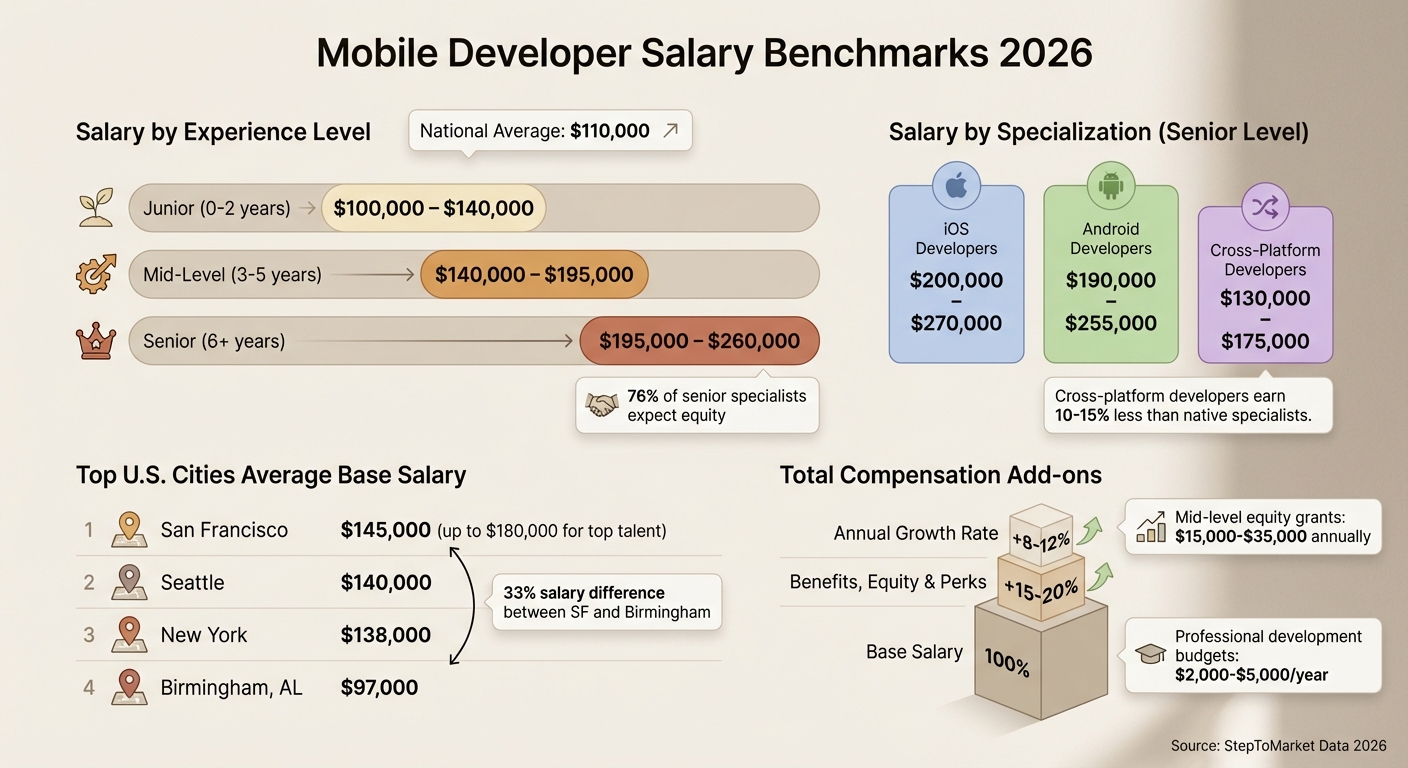 {Mobile Developer Salary Ranges by Experience Level and Role Type 2026}
Finding the right talent is just the beginning - offering competitive compensation is what seals the deal. In today’s tight market, mobile developers are well aware of their value, and companies need to align their offers with market expectations to attract and retain top talent.
Salary Ranges by Role and Location
Mobile developer salaries in the U.S. vary based on experience, specialization, and location. While the national average is $110,000, this figure only scratches the surface . Native iOS developers often earn slightly more than Android developers, whereas cross-platform experts (like those specializing in React Native or Flutter) typically earn 10–15% less than their native counterparts .
| Experience Level | Annual Salary Range |
|---|---|
| Junior (0–2 years) | $100,000 – $140,000 |
| Mid-Level (3–5 years) | $140,000 – $195,000 |
| Senior (6+ years) | $195,000 – $260,000 |
Source: StepTo Market Data 2026
Location plays a huge role in compensation. San Francisco leads with an average base salary of $145,000, reaching as high as $180,000 for top-tier talent . Seattle and New York follow closely, offering $140,000 and $138,000 on average, respectively . On the other hand, cities like Birmingham, Alabama, average $97,000 - a 33% difference compared to San Francisco .
"Offer at least $120,000 per year to attract experienced engineers in San Francisco, Austin, New York, or Seattle." - MoldStud
Total compensation is more than just the base salary. Packages often increase by 15–20% when factoring in benefits, equity, and perks like learning budgets . Additionally, in competitive markets, salaries grow 8–12% annually due to ongoing skill shortages .
But compensation isn’t just about money. Benefits and perks are becoming just as important in shaping a candidate’s decision.
Beyond Base Salary: Equity, Remote Work, and Learning Budgets
As the mobile tech landscape changes, compensation packages need to reflect more than just a paycheck. Today’s developers expect a mix of financial rewards, flexibility, and growth opportunities.
Equity is a major draw, especially for senior-level developers. In fact, 76% of senior specialists in tech hubs expect equity as part of their package . For mid-level engineers, annual equity grants typically range from $15,000 to $35,000 . Most companies follow a four-year vesting schedule with a one-year cliff, meaning 25% of the equity vests after the first year, with the rest vesting monthly . Early-stage startups often allocate up to 10% of their equity pool to the first 10 employees, while senior iOS developers in such startups might receive 0.25–0.5% equity . To retain talent, companies often offer annual equity refresh grants worth 25–50% of the original grant .
"The complete package - including benefits and perks - significantly influences a developer's decision." - Carl Bailey, Mobile Developer
Remote work is another key factor. While remote mobile developer roles at U.S. startups average $76,106, this is about 17.5% lower than the average remote startup salary . However, 54% of remote engineers prioritize flexible benefits, such as home office stipends, over higher base pay . Many companies now offer monthly wellness stipends of $100–$200 for gym memberships, mental health resources, or home office upgrades .
Investing in professional development is another way to stand out. Budgets of $2,000–$5,000 per year for conferences, courses, or technical books are becoming common . Companies that allocate $1,000–$2,000 annually per engineer for certifications and events have reported retention rates improving by up to 24% . Additionally, providing high-end equipment - like a top-tier MacBook Pro and high-resolution monitors - is now seen as a standard requirement for mobile development roles .
Interview Framework for Mobile Roles
Hiring for mobile development roles works best when it respects developers' time while thoroughly evaluating their technical expertise and ability to fit within a team. A well-structured process should emphasize practical, real-world scenarios over academic exercises or platform-specific trivia.
"The reason your mobile hiring process fails isn't because you're not asking the right Swift questions. It's because you're solving the wrong problem entirely." - Full Scale CTO
A streamlined framework includes a 30-minute debugging session, a 45-minute collaborative code review using real project code, and a behavioral interview . This approach helped a FinTech company reduce its hiring timeline from 16 weeks to just 6, saving $120,000 in recruitment costs while achieving a 94% retention rate across 150+ hires .
Technical Assessments That Respect Developers' Time
Replace lengthy take-home projects with concise, focused challenges that reflect actual work scenarios. One effective method is a 30-minute debugging exercise. For example, provide a real crash log from a specific device or a user report about battery drain, and ask the candidate to explain their investigative process . This approach highlights their problem-solving skills and technical intuition without requiring hours of unpaid effort.
For iOS roles, prioritize topics like Automatic Reference Counting (ARC), the trade-offs between SwiftUI and UIKit, and performance profiling using Xcode Instruments . On the Android side, focus on Garbage Collection, background processing with WorkManager, and profiling tools like Android Profiler . When evaluating cross-platform developers, assess their understanding of state management in React Native or widget composition in Flutter. Also, test their ability to decide when native development is more appropriate than cross-platform solutions .
The collaborative code review is another essential step. Spend 45 minutes having candidates review real code from your app. This reveals their ability to provide constructive feedback, communicate effectively, and demonstrate technical depth . For instance, an e-commerce startup used this technique to grow their team from 2 to 8 developers. The result? 95% code sharing between platforms and a jump in their app store rating from 3.2 to 4.7 stars within six months .
As AI-powered features become more common in mobile apps, assess candidates' familiarity with tools like CoreML for iOS, TensorFlow Lite for Android, or third-party AI APIs . Additionally, check their experience with managing 2- to 4-week sprints using tools like Jira, as agile workflows are now standard .
After the technical evaluations, shift focus to how candidates interact with teams and approach collaboration.
Behavioral Interview Questions for Mobile Developers
Behavioral interviews provide insight into how developers work with others, respond to feedback, and make decisions within business constraints. Start with questions about ownership, such as: "Walk me through the last mobile app you worked on. What were you directly responsible for?" This separates those who contributed to core features from those who handled minor tasks .
Collaboration is critical in mobile development, as apps require seamless integration between backend logic and frontend design. Ask: "How do you collaborate with designers and backend engineers during development?" to gauge their communication skills . Another key question: "Our users are abandoning the checkout flow on mobile. Walk me through how you'd investigate and solve this." This tests their user empathy and problem-solving approach .
To evaluate architectural thinking, ask candidates to justify their preference for native versus cross-platform frameworks. This reveals their ability to balance technical goals with practical constraints like budget and timelines .
"Technical skills get you hired. Collaboration keeps you employed." - Full Scale
Coachability is another critical factor. Ask candidates to share examples of feedback that shaped their coding or communication habits . The best candidates can articulate how they’ve adapted their approach, especially when it comes to performance trade-offs or architecture decisions . Considering that 77% of employees value workplace culture over salary, the behavioral phase is as important as the technical one .
How daily.dev Recruiter Surfaces Mobile Engineers
Most mobile developers aren’t actively looking for new jobs. Instead, they’re busy diving into technical content, staying up-to-date on the latest frameworks, and solving the challenges of their current roles. That’s where daily.dev Recruiter steps in - connecting employers with developers in spaces designed for learning and professional growth, not job hunting.
The platform identifies mobile talent by analyzing developers’ preferences and reading habits. For instance, consistent engagement with topics like SwiftUI, Kotlin Multiplatform, or Flutter highlights both expertise and interest in specific technologies. This approach goes beyond outdated profiles or keyword-heavy resumes, focusing instead on real, current skills.
Why daily.dev Recruiter Outperforms Traditional Hiring Methods
Traditional recruitment often struggles to connect with mobile developers. Why? Because it relies heavily on cold outreach - reaching out to candidates who aren’t actively searching or interested. daily.dev Recruiter flips the script by enabling warm, double opt-in introductions. This means employers and developers connect only after both express interest in having a conversation.
| Metric | Traditional Recruiting (Job Boards & Cold Outreach) | daily.dev Recruiter |
|---|---|---|
| Response Rate | Low due to unsolicited outreach | High, thanks to opt-in engagement |
| Candidate Quality | Mixed; requires heavy screening | Pre-vetted based on skills and behavior signals |
| Access to Passive Talent | Limited, as many developers avoid job boards | Direct access to engaged, informed developers |
| Time-to-Hire | Longer timelines | Shortened by warm introductions |
| Developer Experience | Impersonal and often spam-like | Respectful and context-driven, valuing developers’ time |
The key difference? Intent and context. Employers craft detailed job briefs that developers review before deciding to engage. If the job aligns with their goals and interests, developers opt in. This ensures every conversation begins with mutual interest and clear expectations. It’s a smarter, more respectful way to connect.
Warm Introductions vs Cold Outreach
Cold recruiting emails often miss the mark. They’re impersonal, irrelevant, and fail to build trust. Mobile developers, in particular, are inundated with generic pitches from recruiters who don’t understand their work. daily.dev Recruiter fixes this problem with its double opt-in model, delivering opportunities tailored to developers’ goals.
This approach respects developers’ expertise by providing them with meaningful details upfront - like the tech stack, team structure, and specific challenges they’d tackle. When developers choose to engage, it’s because the opportunity genuinely fits their career aspirations. It’s not just recruiting - it’s a conversation that starts on the right foot.
Key Takeaways
Here’s a quick recap to help you sharpen your mobile development hiring process:
Define your needs early. Decide whether you're looking for native expertise (Swift/Kotlin) or cross-platform skills (Flutter, React Native, Kotlin Multiplatform). Developers usually specialize in specific frameworks, so a broad "mobile developer" job title won’t attract the right candidates . This clarity helps craft better job listings and assess candidates effectively.
Prioritize practical experience. Focus on candidates who’ve launched and maintained live apps in the App Store or Google Play Store. These developers bring hands-on knowledge of challenges like OS fragmentation, memory management, and offline functionality - skills that go beyond just years of experience.
Leverage developer communities. Look for talent in platform-specific spaces like r/iOSProgramming, GitHub, and Stack Overflow, or developer-focused platforms like daily.dev. You can also research apps you admire and track down their contributors to find developers with proven track records .
Offer competitive compensation. A strong package - including salary, equity, and benefits - is crucial. Hiring from regions like Latin America or Eastern Europe can result in 40–60% cost savings while retaining high technical standards .
Act fast. Delays in hiring can cost you top talent . Use practical assessments, such as debugging crash logs or completing small take-home projects (3–5 hours), to evaluate real-world skills rather than relying on theoretical tests.
Streamline connections. Platforms like daily.dev Recruiter can simplify the process, offering warm, double opt-in introductions to developers who are already interested in meaningful opportunities.
These strategies can help you attract and hire the right mobile development talent efficiently and effectively.
FAQs
Should I hire native or cross-platform mobile developers?
Choosing between native and cross-platform developers boils down to your app's specific requirements.
Native developers use tools like Swift for iOS and Kotlin for Android. This approach ensures top-notch performance and seamless access to all device features, making it a great choice for apps with intricate functionality or demanding performance needs.
On the other hand, cross-platform developers work with frameworks like Flutter or React Native to build apps for multiple platforms using shared code. This can save both time and money, but it might come with compromises in performance or limited access to certain native features.
When deciding, think about your app's complexity and what you envision for its future.
What’s the fastest way to test real mobile dev skills?
The quickest way to assess mobile developers is by using technical tests that simulate real-world tasks. These evaluations target specific technologies like React Native, Swift, or Kotlin, offering a focused approach to skill measurement. In just 10-15 minutes, these practical coding challenges can reveal a candidate's true capabilities, going beyond what a resume might show. This ensures you identify developers with the technical skills needed for mobile development roles.
Where can I find strong iOS and Android developers?
To find skilled iOS and Android developers, prioritize candidates with hands-on production experience, such as successfully launching and maintaining apps on the App Store or Google Play. Begin by determining whether your project requires native developers (proficient in Swift for iOS or Kotlin for Android) or cross-platform developers. Then, use focused assessments to gauge both technical and problem-solving abilities. This approach ensures you identify professionals with practical expertise that goes beyond platform-specific coding.
.png)


