By 2026, hiring QA Engineers and SDETs is more critical than ever as software development accelerates and AI-driven tools introduce new challenges. QA roles have expanded, requiring expertise in automation, AI tools, and risk management. Here's what you need to know:
- QA Engineers focus on user experience, manual testing, and spotting usability issues.
- Test Automation Engineers handle automated scripts and CI/CD pipelines.
- SDETs combine coding and testing, building infrastructure and scalable frameworks.
Key skills include coding (Java, Python, JavaScript), API testing, CI/CD integration, and AI tool management. QA professionals are now embedded in development teams, emphasizing "shift-left testing" to catch issues early. Salaries range from $85,000 for entry-level roles to $175,000+ for senior SDETs, with added demand for expertise in cloud, security, and AI testing.
To find top talent:
- Look in niche communities like Ministry of Testing and The Test Tribe.
- Attend automation-focused conferences.
- Use platforms like daily.dev Recruiter for targeted outreach.
The hiring focus has shifted beyond technical skills to include strategic thinking, communication, and the ability to work within AI-driven workflows. QA roles are no longer just about finding bugs - they're about driving quality across the entire software lifecycle.
QA Engineer vs SDET vs Test Automation Engineer: What's the Difference?
::: @figure 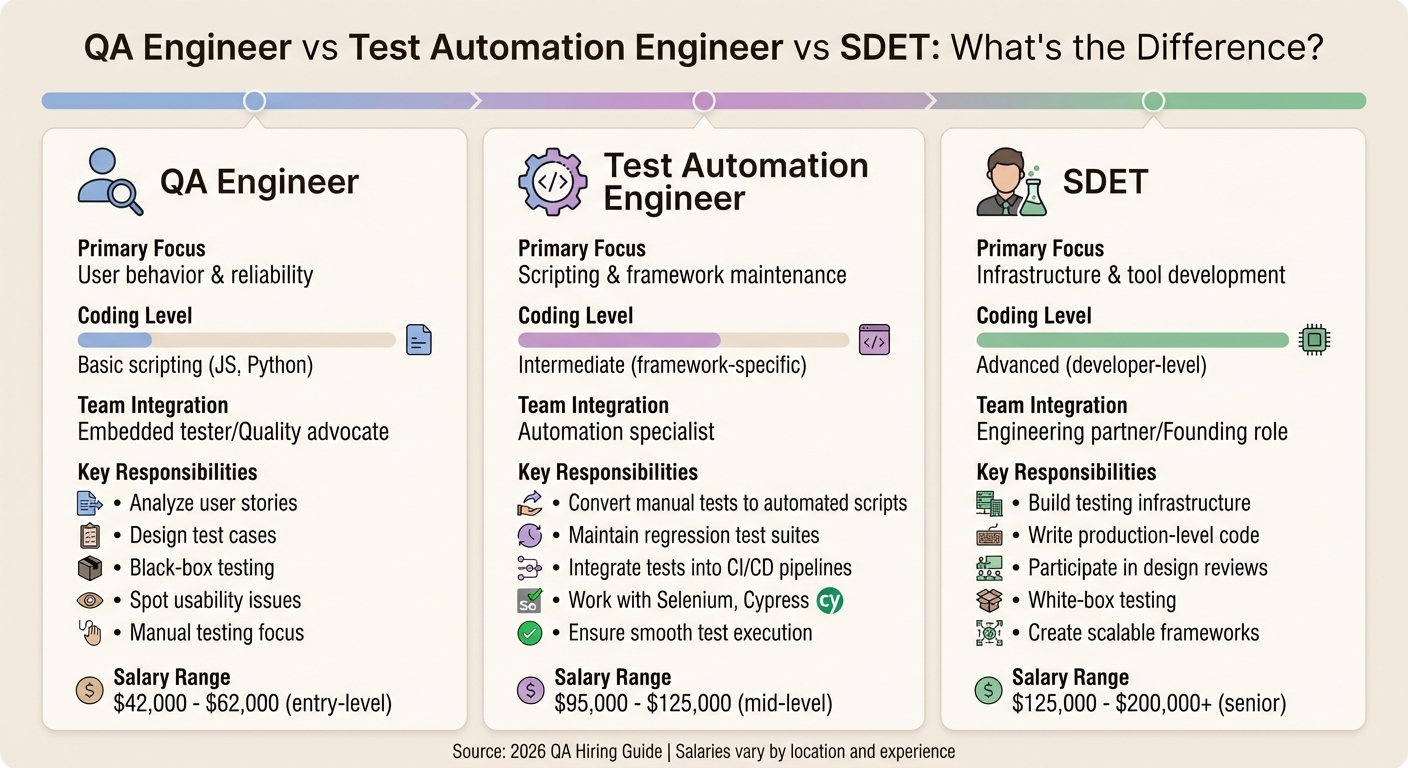 {QA Engineer vs Test Automation Engineer vs SDET: Roles, Skills & Salaries Comparison 2026}
QA roles often overlap, but knowing the distinctions can help you find the right fit for your team. A QA engineer prioritizes the end-user experience, designing test strategies and spotting usability issues through manual testing before moving to automation. A test automation engineer bridges the gap by creating and managing automated test scripts with tools like Selenium or Cypress, while also handling automation frameworks and CI/CD pipelines. An SDET (Software Development Engineer in Test) works at the developer level, building testing infrastructure and writing production-level code to address complex scenarios. Understanding these roles ensures your team gets the right expertise for its automation needs.
What Each Role Does
QA engineers act as the voice of the user. They analyze user stories, design test cases, and conduct black-box testing to confirm the software meets customer expectations. They often catch subtle issues - like a button that technically works but feels sluggish or a workflow that confuses users - problems that automated tests might overlook.
Test automation engineers focus on converting manual test cases into automated scripts. They maintain regression test suites, integrate them into CI/CD pipelines, and ensure tests run smoothly, prioritizing script execution and upkeep.
SDETs combine development and testing expertise. They participate in design reviews, perform white-box testing, and create scalable frameworks. As Maruti Techlabs puts it, "SDETs have emerged as crucial assets for enterprises. Their software development expertise, clubbed with testing acumen, bridges the gap between QA teams and developers" . Some startups even recognize SDETs as "Founding Engineers" for establishing strong quality foundations early on.
Technical Skills Required
Each role demands a different level of coding expertise.
- QA engineers need basic scripting knowledge, including HTML, CSS, and JavaScript, to understand the software they test and create simple automation tools.
- Test automation engineers require intermediate coding skills, proficiency with frameworks like Selenium or Cypress, and the ability to debug and update scripts as UI elements change.
- SDETs need advanced programming skills on par with developers. They write in languages like Java, Python, or JavaScript, understand systems architecture, and work with tools like Jenkins, Docker, and Git. They also create self-healing scripts that adapt to UI changes, reducing maintenance. API testing using tools like Postman or Rest Assured is crucial across all roles .
How They Work with Engineering Teams
QA engineers are embedded within product teams and act as quality advocates. They collaborate with developers to identify bugs, validate features, and ensure the product meets end-user expectations. They often work in agile sprints, testing features as they are developed.
Test automation engineers focus on the testing pipeline. They work alongside DevOps to integrate automated tests into CI/CD workflows, ensuring every code commit triggers the right test suites. A significant part of their role involves updating scripts to reflect changes in the codebase, like modified CSS classes or restructured components.
SDETs function as engineering partners. They review pull requests, participate in architecture discussions, and help shape the testing strategy from the planning stage. Their developer-level involvement helps prevent bugs early in the process. This expertise explains why senior SDET salaries average around $125,000, compared to entry-level QA roles, which typically fall between $42,000 and $62,000 .
Here’s a quick comparison of these roles:
| Role | Primary Focus | Coding Level | Team Integration |
|---|---|---|---|
| QA Engineer | User behavior & reliability | Basic scripting (JS, Python) | Embedded tester/Quality advocate |
| Test Automation Engineer | Scripting & framework maintenance | Intermediate (framework-specific) | Automation specialist |
| SDET | Infrastructure & tool development | Advanced (developer-level) | Engineering partner/Founding role |
Grasping these dynamics helps align team roles with your quality and automation goals for the future.
Hiring engineers?
Connect with developers where they actually hang out. No cold outreach, just real conversations.
Required Skills and Tools for QA Engineers and SDETs in 2026
By 2026, the global software testing market is projected to reach $54.4 billion, with employment for testing specialists expected to grow by 25% by 2032 . This growth underscores the increasing demand for QA professionals who can pinpoint and address issues early in the development process, especially in an era dominated by automation and AI.
Modern QA engineers and SDETs need a mix of automation skills, cloud-based testing expertise, and AI proficiency. While frameworks like Selenium, Cypress, and Playwright remain crucial, the expectations have expanded. QA professionals must now be adept at using Docker and Kubernetes to create on-demand test environments, integrating security tools like OWASP ZAP into CI/CD pipelines, and leveraging AI-driven systems for self-healing scripts that adapt to changes in UI elements . As Refonte Learning aptly puts it:
Quality assurance automation is no longer optional - it's a strategic necessity .
In addition to technical expertise, data analysis and communication skills are increasingly important. QA engineers need Python and SQL to analyze test results and monitor data drift in AI models. They must also communicate effectively with developers, product managers, and stakeholders to advocate for quality as a core engineering principle. The ability to quickly adopt new AI tools and testing frameworks - referred to as "learning-agility" by recruiters - has become a key trait for top-tier talent .
Test Automation Frameworks: Selenium, Cypress, and Playwright
Selenium remains a popular choice for cross-browser testing, particularly for legacy systems and complex enterprise applications. Its flexibility allows tests to be written in multiple languages such as Java, Python, JavaScript, and C#, making it versatile for diverse tech stacks. However, it does require more setup and maintenance compared to newer tools.
Cypress has gained popularity for its ease of use with modern web applications. Its developer-friendly features, such as built-in wait mechanisms and real-time browser reloading, reduce flaky tests and improve productivity. However, it primarily supports JavaScript and has limited cross-browser functionality compared to Selenium.
Playwright, developed by Microsoft, has become a favorite for teams focusing on speed and reliability. It supports multiple browsers (Chromium, Firefox, WebKit) out of the box and handles modern web complexities like iframes and shadow DOM seamlessly. Playwright also excels in parallel execution, reducing test run times significantly. Its robust API testing capabilities and ability to manage complex interactions, such as file uploads and geolocation, make it a strong contender for many teams.
The choice of framework often depends on the application’s architecture and team expertise. SDETs typically work across all three, selecting the most suitable tool for each scenario. Once the right frameworks are in place, integrating them into a CI/CD environment becomes the next priority.
CI/CD Integration and Performance Testing
QA professionals are now embedding testing deeply into CI/CD pipelines to ensure seamless deployments. Automated quality gates halt deployments if critical tests fail, while tools like Jenkins, GitHub Actions, and GitLab enable tests to run immediately after code commits. Organizations with advanced automated pipelines report a 200% increase in deployment frequency while reducing production issues .
Modern pipelines use test tags like @smoke, @api, and @critical to determine which tests run at various stages. For instance, smoke tests run on every pull request, while full regression suites are reserved for pre-staging deployments. AI-driven test prioritization further optimizes execution time by selecting only the most relevant tests based on code changes. A Lead QA from a Tel Aviv SaaS company shared:
Adopting CI/CD-friendly testing with CloudQA empowered our team to deploy confidently every day, reducing defects and accelerating delivery .
Performance testing has also shifted earlier in the development process. Tools like JMeter and Gatling are now integrated into CI pipelines to identify bottlenecks before they escalate. QA engineers use Docker-based setups, such as Selenium Grid or Playwright, to run multiple test suites across different browsers and devices simultaneously, maintaining coverage without sacrificing speed.
API Testing and Debugging Skills
As microservices architecture becomes the norm, API testing has taken center stage. Tools like Postman, REST Assured, Swagger, and Karate DSL enable QA engineers to test at the service layer, catching integration issues before they affect the user interface . Automated API tests now serve as critical checkpoints in CI/CD pipelines, ensuring broken endpoints don't make it to production.
Strong debugging skills are essential for tracing issues in distributed systems. QA engineers need to interpret API responses, analyze logs, and use observability tools to identify and correlate failures across multiple services. Automated observability platforms are particularly useful for speeding up this process compared to manual inspection .
Security testing has also become a core responsibility. Tools like OWASP ZAP and Burp Suite are integrated into CI/CD pipelines to identify vulnerabilities during automated regression runs. QA engineers now act as security gatekeepers in DevSecOps workflows, ensuring software is both functional and secure .
Shift-Left Testing: Why QA Now Works Inside Development Teams
Shift-left testing shifts the focus of quality assurance (QA) from the end of the development cycle to the very beginning. Instead of waiting until a product is nearly complete, QA professionals now participate in early stages like requirements analysis, design discussions, and sprint planning. This approach aims to catch potential issues early, prioritizing prevention rather than detection .
In this model, QA engineers are embedded within development teams rather than working in separate departments. They join daily standups, review designs, and collaborate with developers to write tests. This integration creates a multiplying effect - a single QA engineer can guide 4–6 developers in testing practices, significantly increasing the team’s overall quality capacity compared to relying solely on manual validation . As the Total Shift Left team aptly puts it:
Velocity without quality is technical debt .
This embedded approach naturally favors individuals who excel in collaborative and team-oriented settings.
Why Shift-Left Testing Works
Early QA involvement has tangible benefits, including faster feedback loops and improved code quality. Reviewing requirements and designs early helps uncover edge cases and gaps that might otherwise manifest as bugs much later in the process. Automated tests integrated into CI/CD pipelines provide instant feedback on every code commit, reducing the need for costly fixes down the line .
The results speak for themselves. For instance, in 2025–2026, a B2B SaaS company with 120 engineers shifted from a centralized QA team of 12 manual testers to an embedded quality engineering model. They reassigned 10 engineers to individual squads and trained them on Playwright. Over the course of eight months, they slashed manual regression testing time from three weeks to just 45 minutes and reduced their defect escape rate from 28% to 6% .
This approach also eliminates bottlenecks. Traditional QA teams often cause delays due to handoffs, slowing down deployments. In contrast, embedded QA teams operate seamlessly within DevOps workflows, enabling multiple daily deployments by automating regression testing. However, adoption is still a work in progress - only 31% of organizations report that their QA teams have fully adapted to the DevOps model, even though 72% are actively working toward it .
Finding QA Engineers Who Work Well in Teams
With QA now playing a critical role in early development, hiring managers need to prioritize candidates who excel at collaboration and risk assessment. The shift-left approach not only enhances code quality but also demands strong teamwork and communication skills.
Hiring for these roles requires a different mindset than for traditional QA positions. Look for candidates with "risk reasoning" - the ability to identify what doesn’t need to be tested and allocate resources wisely . Senior QA professionals in shift-left environments often act as Quality Coaches or Test Architects, focusing on improving team workflows rather than simply executing test cases .
During interviews, behavioral questions can help assess a candidate's ability to influence team decisions. For example, ask about times they challenged a go-live decision or addressed unclear requirements. These scenarios reveal their capacity to advocate for quality practices. As Joshua Bihun, a Fractional QA Leader, explains:
Seniority isn't about facility with any one single tool in the toolset - it's about scope of thinking and impact .
Instead of abstract coding challenges, consider a pair-programming exercise where candidates write tests for a realistic scenario. Pay attention to how they decide what to test and how they discuss trade-offs. Strong communication skills are essential - embedded QA engineers must explain technical risks to both developers and product managers early in the process . Candidates from collaborative communities like The Test Tribe often bring the adaptability and cross-functional skills needed for these roles .
Where to Find QA Engineers and SDETs in 2026
The demand for specialized QA roles is on the rise as AI-driven development continues to introduce complex edge-case bugs. This shift has reshaped how top QA professionals engage with the job market. Instead of relying on generic job boards, they gravitate toward niche communities where they can learn, share insights, and build their reputations. For recruiters, this means adapting their strategies to tap into these specialized spaces where top-tier QA talent thrives.
Testing Communities and Automation Conferences
Ministry of Testing (MoT) remains a standout resource for connecting with experienced QA professionals. Their Pro Slack channel, included with a $1,499/year membership, offers a unique advantage: recruiters can observe candidates tackling real-world technical challenges in a collaborative environment before reaching out . This approach allows you to identify critical thinkers who prioritize quality over simply following scripts.
For those seeking agile learners, The Test Tribe operates primarily on Discord and is known for fostering candidates who quickly adapt to new tools and methodologies . Similarly, Women Who Test provides a global network of female QA leaders through its Slack channels and local chapters, offering access to a diverse talent pool .
If you're hiring for expertise in specific automation frameworks, focus on the communities where these professionals are most active. For example:
- Playwright Community (Discord/GitHub)
- Cypress Community (Matrix/Discord, with over 11,000 members)
- Selenium Ecosystem
These hubs are where engineers deeply immersed in these tools collaborate and share knowledge . Another valuable resource is the TechWell Hub, which connects professionals across Agile, DevOps, and testing disciplines for peer learning and collaboration .
For startup roles, particularly "Founding QA" positions, platforms like Wellfound (formerly AngelList) and the Hacker News "Who Is Hiring" threads are excellent options. These channels are frequented by elite engineers who often bypass traditional recruiting processes to connect directly with founders .
In-person events also provide unparalleled access to top talent. Consider attending:
- Innovate QA 2026 (June 4-5 in Bellevue, WA): Focused on AI-powered testing and engineering, this event attracts QA engineers and SDETs from major tech companies like Microsoft and Amazon. Individual passes start at $499 for one day, or $799 for two days, with group discounts available .
- Automation Guild '26 (February 9-13, 2026, with monthly training through November): This event draws over 2,600 software professionals focused on end-to-end automation. Passes range from $227 to $327 .
These conferences not only allow you to network with top professionals but also provide insights into the latest trends in QA and automation.
Using daily.dev Recruiter to Find Quality-Focused Engineers
While active communities help you engage with visible talent, tools like daily.dev Recruiter allow you to connect with high-performing QA engineers who aren't actively job hunting but remain deeply invested in their craft.
The platform identifies these professionals by analyzing their participation in developer discussions and their engagement with technology trends. Instead of relying on outdated LinkedIn profiles or generic outreach, daily.dev Recruiter offers pre-qualified, double opt-in introductions to engineers who are already involved in quality-focused conversations.
This approach is particularly effective because top QA engineers are often already employed at companies that prioritize quality. They’re unlikely to respond to generic messages, but daily.dev Recruiter connects you with them in a way that feels relevant and respectful. For instance, you might find candidates reading about the latest Playwright updates, exploring AI-assisted testing, or discussing shift-left testing strategies.
What sets this platform apart is its precision. You can filter candidates based on specific criteria like experience with certain test frameworks, API testing skills, or knowledge of performance testing tools. This aligns with the "Guild" hiring model of 2026, where reputation and active community engagement play a critical role in identifying high-value candidates .
How to Assess QA Candidates Beyond Coding Tests
When hiring QA engineers, it's important to look beyond their ability to write code. A great candidate combines technical expertise, strategic thinking, and strong communication skills. Here's how to evaluate these qualities effectively.
Testing Automation and Debugging Abilities
Start by pairing the candidate with an engineer to work on real-world testing tasks. For example, ask them to write or fix tests for an actual feature. During the process, pay attention to how they handle edge cases and whether they can differentiate flaky tests from real bugs.
Focus on practical skills that directly impact your team's efficiency. For instance, can they verify API error handling using tools like Postman or Rest Assured? Can they trace a "slow page" complaint back to a specific database query or network issue? These tasks reveal their ability to solve problems that matter in day-to-day operations .
In today's QA landscape, evaluating how candidates interact with AI-generated tests is also critical. Ask them to review an AI-created test suite, identifying gaps in coverage or flawed assumptions. This skill is increasingly important as QA teams spend 30% to 50% of their time maintaining existing tests rather than creating new ones . A candidate who can oversee AI tools and improve test quality demonstrates a deeper level of technical expertise and business awareness.
Test Design and Understanding Business Requirements
A strong QA candidate knows that their role isn't just about running tests - it’s also about making strategic decisions. One key question to ask is: "How do you decide what NOT to test?" Their answer can reveal how well they prioritize high-risk areas and allocate their efforts wisely .
Another valuable scenario is to ask how they would handle a situation where a product manager suggests skipping testing to meet a deadline. Look for candidates who can clearly communicate risks, focusing on customer impact and business outcomes rather than just technical details .
You should also dig into their ability to clarify unclear requirements. Ask for examples of times they identified gaps in acceptance criteria early in the process. Did they wait until development was finished to raise concerns, or did they proactively address issues before code was written? QA engineers who catch incomplete requirements early save significant time and resources .
Communication and Teamwork Skills
Clear communication is a cornerstone of effective QA work. Review their bug reports to see if they are actionable, constructive, and easy to understand. Strong communication can often mean the difference between resolving issues smoothly and creating unnecessary friction .
Behavioral questions can also help you gauge their teamwork abilities. For example, ask them to describe a time they disagreed with a developer about whether something was a bug. How did they resolve the disagreement? The best candidates focus on customer impact and avoid assigning blame, keeping the conversation productive .
"Seniority isn't about facility with any one single tool in the toolset - it's about scope of thinking and impact." - Joshua Bihun, Fractional QA Leader
Be on the lookout for red flags. Candidates who see their role as merely "catching mistakes" or who have never pushed back on a shipping decision may not fully understand the broader responsibilities of QA. The best QA engineers act as quality advocates, working collaboratively to improve the product without slowing the team down . By assessing these multidimensional skills, you can ensure the candidate aligns with your team's commitment to quality-first engineering.
QA Salaries and How to Compete for Top Talent
2026 Salary Ranges for QA Engineers and SDETs
In 2026, the average annual salary for a QA Engineer in the U.S. is around $125,361 . However, salaries vary significantly depending on the role and level of experience.
SDETs (Software Development Engineers in Test) often earn more than traditional QA engineers due to their coding expertise. Their median base salary is approximately $112,000 . Interestingly, the pay gap between QA roles and software engineering roles continues to shrink. For instance, mid-to-senior QA Automation Engineers now often earn salaries similar to backend software engineers . In high-cost areas like San Francisco, senior SDETs can see base salaries reaching up to $190,000 .
Here's a breakdown of SDET salaries by experience level:
| Experience Level | SDET Salary Range | Median Salary |
|---|---|---|
| Entry-Level (0–2 years) | $75,000 – $95,000 | $85,000 |
| Mid-Level (3–5 years) | $95,000 – $125,000 | $110,000 |
| Senior (6–10 years) | $125,000 – $160,000 | $140,000 |
| Staff / Principal (10+ years) | $155,000 – $200,000+ | $175,000 |
Beyond base salaries, total compensation packages often include annual bonuses (typically around 10%) and equity grants (0.1%–0.2% for founding roles) . When factoring in benefits, taxes, and tools, the true cost of a QA hire in the U.S. ranges from $102,000 to $196,000 annually . Specialized roles, such as AI/ML Test Engineers, rank among the highest earners, with senior positions offering salaries between $160,000 and $200,000 .
Closing the Pay Gap Between QA and Development Roles
Bridging the salary gap between QA and software development requires a strategic approach. The industry is gradually moving away from "Manual QA" roles and focusing more on advanced positions like SDETs or Quality Operations Engineers. These roles demand skills such as full-stack development, proficiency with tools like Playwright and Docker, and expertise in CI/CD pipelines - skills that command higher salaries comparable to traditional developers .
"QA engineering positions have grown by 17% in the last two years - outpacing traditional developer roles (9% growth) - largely because AI-generated code is producing significantly more edge-case bugs." - Hien D. Nguyen, Author of 'The SDET Playbook'
Offering skill-based salary enhancements is another way to attract top talent. For example, expertise in Cloud/DevOps (e.g., AWS, Kubernetes) or Security Testing can add an extra $10,000–$20,000 to base pay . Startups, in particular, can stand out by offering equity (0.1%–0.2%) and "Founding QA" titles, positioning QA professionals as integral to the product's success rather than as ancillary support staff . This approach aligns with a broader trend of embedding QA roles as essential partners in engineering teams.
Benefits Beyond Salary That Attract QA Talent
Compensation is important, but non-monetary benefits can make or break your ability to attract top QA talent. Remote work flexibility remains a key factor, with 12% of QA roles in 2026 being fully remote . Many companies have adopted a "Single National Rate" for remote roles, avoiding pay cuts for employees in lower-cost regions .
Upskilling opportunities are another major draw. Currently, 58% of enterprises are investing in training their QA teams in areas like AI tools, cloud infrastructure, and security . Covering the cost of professional memberships - such as the Ministry of Testing Pro Slack (around $1,499 annually) - shows a commitment to professional development . Additionally, providing access to modern testing tools like Playwright and Cypress, and allowing engineers to design autonomous pipelines, demonstrates that their expertise is valued .
Positioning QA as a core function rather than a final checkpoint is also critical. Engineers are drawn to roles where they can act as "automation architects", involved in the development process from the start, rather than being relegated to a reactive role . This shift, combined with competitive pay and growth opportunities, can help you secure and retain the best talent in the field.
How AI is Changing QA and SDET Roles
AI Tools Changing How Testing Works
By 2026, AI has significantly reshaped the way testing is conducted. Industry experts describe this progression as a shift from manual scripting to AI-assisted tools, and now to autonomous testing. In this latest phase, AI agents make decisions in real time during test execution. This builds on earlier trends in automation and signals a deeper integration of AI into QA roles.
One of the standout advancements is self-healing capabilities. Tools like Testim, Mabl, and Applitools can automatically update test locators when UI elements change. This feature alone saves teams more than 20 hours per week, a common time sink for those using open-source frameworks . AI-assisted test generation has also proven to be a game-changer, reducing the time needed to create initial test cases by 60% to 70% . Predictive test selection tools, such as Launchable, cut testing cycle times by 50% to 75% . Today, 81% of software development teams incorporate AI tools into their workflows, whether for planning, management, or execution .
Visual AI validation tools like Applitools Eyes take testing a step further by identifying UI regressions - such as layout shifts or color contrast issues - that traditional functional tests might overlook . Generative AI platforms like BlinqIO and ACCELQ enable testers to generate executable test code using natural language prompts . Tal Barmeir, founder of BlinqIO, highlights this advancement:
You can have an army of virtual testers underneath you that work during the night .
Quash, another industry expert, underscores the evolving role of AI in testing:
AI in QA has crossed from the execution layer into the decision layer - it's no longer just running tests faster, it's deciding which tests to run, when, and why .
This evolution is also reshaping the daily responsibilities of QA engineers. Instead of just running tests, they now focus on reviewing AI-generated outputs, fine-tuning models to reduce false positives, and setting strategic testing priorities. While 89% of organizations are experimenting with or deploying generative AI in their quality engineering processes, only 15% have fully embraced these tools at an enterprise level .
Hiring QA Engineers Who Can Work with AI Tools
As AI continues to transform testing workflows, hiring managers are looking for QA candidates who can effectively leverage these intelligent tools. The focus has shifted to finding engineers who understand that AI is a tool to enhance their role, not replace it. The best candidates treat AI-generated tests as drafts requiring thorough human review. This is especially important given that 96% of developers don’t fully trust AI-generated code to be functionally correct, and only 48% consistently verify it before committing changes .
Adaptability is a key trait for QA engineers in 2026. Candidates who stay engaged in communities like Ministry of Testing or The Test Tribe demonstrate a commitment to keeping up with evolving tools and techniques . One effective interview approach is asking candidates to review and debug AI-generated test cases that include intentional errors or "hallucinations." This can reveal their ability to critically evaluate and improve AI outputs.
Top QA engineers also emphasize the importance of data. They treat datasets as critical test artifacts, focusing on data validation, synthetic data generation, and monitoring for data drift. They define what "healthy behavior" looks like in production environments and use observability tools to catch silent failures. Recognizing that achieving 100% test coverage is unrealistic in AI-driven systems, they prioritize testing areas that have the most significant business impact and user risk.
Upskilling is another major trend. Currently, 58% of enterprises are investing in training their QA teams on AI tools, cloud testing, and security testing . Offering professional development opportunities, such as funding memberships or providing access to advanced AI-powered platforms, can help attract and retain top talent. Interestingly, senior QA professionals who focus on leadership and strategy earn a 10.6% income premium, while those limited to technical tasks face a 13.8% income penalty .
Conclusion
Recruiting QA engineers and SDETs in 2026 requires a fresh perspective compared to traditional developer hiring. The market now splits into generalist QA roles and specialized SDET positions, often sourced from quality-focused communities . Recognizing the differences between QA engineers, SDETs, and test automation engineers is crucial to avoiding single points of failure and building a team equipped to address modern testing challenges.
The rise of AI coding assistants has reshaped the testing landscape. While these tools enhance development speed, they also introduce more edge-case bugs that traditional unit tests often overlook. This shift has driven a 17% increase in QA engineering roles over the past two years, outpacing the 9% growth seen in traditional developer positions .
To attract top talent, focus on candidates experienced in AI-assisted testing, shift-left strategies, and seamless team collaboration. Streamline interviews to two or three steps to secure strong candidates quickly . Beyond technical skills, evaluate their ability to design effective tests, understand business needs, and communicate clearly.
In competitive QA markets, recruitment tools are indispensable. Platforms like daily.dev Recruiter connect you with quality-focused engineers actively engaged in professional development, using warm, double opt-in introductions to ensure meaningful connections.
FAQs
When should I hire a QA Engineer vs a Test Automation Engineer vs an SDET?
Choosing the right role - QA Engineer, Test Automation Engineer, or SDET - in 2026 depends entirely on what your team needs at the time.
- QA Engineers focus on both manual and automated testing, with an emphasis on improving processes and ensuring quality across the board.
- SDETs come equipped with strong coding skills, often building testing frameworks and integrating them into CI/CD pipelines.
- Test Automation Engineers, on the other hand, concentrate on automating test cases to make workflows more efficient.
For early-stage projects, SDETs can be a great fit due to their ability to create robust testing infrastructures. Meanwhile, manual QA might be more practical for specific tasks or for projects in later phases.
What should a QA/SDET interview include beyond a coding test?
When conducting a QA or SDET interview, it’s important to look beyond just coding skills. The evaluation should cover areas like test design, test execution, and the ability to work effectively with development teams. Focus on assessing knowledge of test automation frameworks (such as Selenium or Cypress), experience with CI/CD pipelines, and familiarity with performance testing and API testing.
Equally important are soft skills like communication, teamwork, and analytical thinking. Scenario-based questions can help gauge problem-solving abilities, giving a more complete picture of the candidate's capabilities. This approach ensures a balanced evaluation of both technical expertise and interpersonal skills.
How do I build a shift-left QA model without slowing delivery?
To implement a shift-left QA model without compromising delivery speed, it's all about embedding quality into the development process right from the start. Here’s how you can make it happen:
- Automate testing early: Use tools like Selenium or Cypress to set up automated tests that run continuously throughout the development process. This helps catch bugs before they snowball into bigger issues.
- Integrate testing with CI/CD pipelines: Embedding tests directly into your CI/CD workflows ensures that potential problems are identified as soon as possible, keeping the development cycle smooth and efficient.
- Utilize AI for test suite management: AI-powered tools can help maintain and update test suites, reducing manual effort and keeping your testing process adaptive to changes.
By adopting these strategies, you can prioritize quality without slowing down your delivery timelines.
.png)