Finding and hiring software engineers is harder than ever. With 77% of employers struggling to fill open roles and a 25% projected increase in demand over the next decade, businesses face intense competition for top talent. Companies like Meta and Google are hiring aggressively, leaving smaller firms to compete for a shrinking pool of skilled engineers.
Here’s how you can stand out and hire effectively:
Find candidates: Use developer networks like daily.dev, explore GitHub for real-world coding examples, and leverage employee referrals (4x more likely to result in hires).
Screen skills: Test technical abilities with developer assessment tools or take-home projects and assess motivation through initial calls.
Evaluate thoroughly: Combine technical interviews, behavioral questions (STAR method), and team involvement to assess both skills and fit.
Make fast offers: Act within 24-48 hours post-interview and tailor offers with salary, growth opportunities, and perks like remote work or learning stipends.
Hiring software engineers isn’t just about filling a role - it’s about building trust and creating a process that respects candidates’ time while showcasing your company as a great place to work.
::: @figure 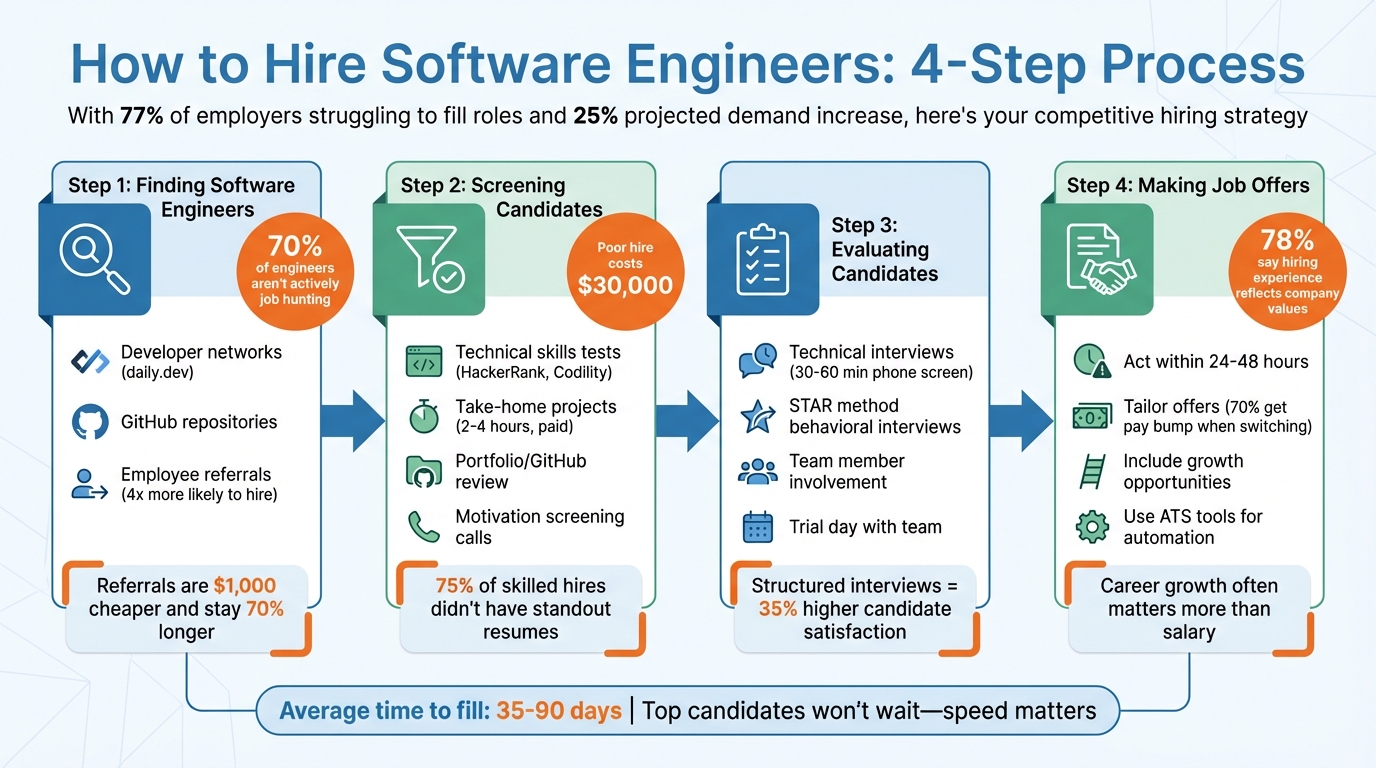 {4-Step Process to Hire Software Engineers: From Sourcing to Offer}
Step 1: Finding Software Engineers
Did you know that about 70% of software engineers aren’t actively looking for new jobs? That makes them passive candidates, and your challenge is to connect with them in ways that feel natural, not pushy. Let’s break down some of the best ways to find passive developer candidates.
Tap Into Developer Networks
While traditional job boards might cast a wide net, developer networks give you direct access to a more engaged pool of talent. Platforms like daily.dev Recruiter are designed to connect you with developers through warm, double opt-in introductions. Instead of struggling with cold outreach, you can match with candidates based on real-time insights into their interests and skills .
Here’s why this matters: 90% of engineers on daily.dev say they ignore outreach from other platforms, and 40% of its users are senior-level contributors or leaders . That’s a serious advantage when you’re searching for top-tier talent.
"We built a place where engineers can turn off the noise. To enter this space, you don't need a hack - you need trust."
- Nimrod Kramer, CEO & Co-Founder, daily.dev
To make things even easier, the platform integrates directly with your ATS, streamlining your candidate management process .
Explore GitHub and LinkedIn
If you’re not looking at GitHub, you’re missing out on a treasure trove of technical insights. This platform lets you see how developers work in real time. By reviewing public repositories, you can evaluate code quality, contributions, and overall technical expertise . Look for things like consistent commit history, well-documented code, and projects aligned with your tech stack. These details offer a level of proof that resumes just can’t match.
LinkedIn is another essential tool, especially for reaching senior or executive-level engineers. With over 200 million U.S. professionals on the platform , it’s a great place to start. Use specific technology keywords to narrow your search, but keep in mind that many top engineers don’t list every skill on their profiles . Combine LinkedIn outreach with GitHub research to get a more complete picture, and when you reach out, reference specific projects or contributions to boost your chances of a response.
Leverage Employee Referrals
Your current team might be your best resource for finding new talent. Employee-referred candidates are 4x more likely to be hired , and 85% of jobs are filled through networking rather than cold applications . Plus, referrals are more cost-effective - they’re about $1,000 cheaper to hire, stay 70% longer, and can be onboarded up to 13 days faster than other candidates .
To make the most of referrals, ask new hires for recommendations right after they join, when their enthusiasm is at its peak . Keep the program visible by sharing open roles regularly through Slack or company newsletters . And instead of offering cash bonuses, consider experiential rewards like trips or events, which often motivate employees more effectively .
The secret to a successful referral program? Build a strong engineering culture first. Employees are more likely to recommend high-quality peers when they’re passionate about their own work . A well-run referral program doesn’t just save money - it strengthens the trust and camaraderie that make your company a place where top engineers want to work.
Step 2: Screening Candidates
Once you've sourced a pool of candidates, the next challenge is figuring out who’s truly qualified. While software engineering roles average just 21 applicants - far fewer than the 250 for general positions - the stakes are much higher. A poor engineering hire can cost you around $30,000, and that's before factoring in their salary . This makes it essential to have a screening process that’s both efficient and precise.
Test Technical Skills
A resume might give you a glimpse of a candidate’s background, but it rarely reflects their actual technical abilities. In fact, 75% of hiring managers have brought on highly skilled individuals who didn’t have traditional or standout resumes . That’s why skills-based assessments are so crucial. The trick is to tailor the test to the role and its level of seniority.
For junior roles or high-volume hiring, automated coding platforms like HackerRank, Codility, or CodeSignal are excellent tools. They’re quick, scalable, and impartial . However, these tests aren’t perfect - they can mistakenly screen out talented candidates over small errors like typos or syntax issues and may feel impersonal . To fine-tune these assessments, have about 20 of your own engineers try them out to ensure the difficulty is appropriate and doesn’t unintentionally filter out top talent .
For senior or specialized positions, automated tests often fall short. Experienced engineers may find them irrelevant or even off-putting, leading them to drop out of the process . A better approach? Assess technical skills without coding tests by assigning take-home projects that reflect real-world tasks, such as debugging a complex codebase or developing a specific feature . These assignments should take no more than 2–4 hours to complete, and compensating candidates for their time can significantly increase participation rates . Once they submit their work, schedule a live session where they can present their solution and walk you through their thought process. This not only verifies the authenticity of their work but also gives you a chance to assess their communication skills .
"Hiring a bad engineer is worse than not hiring at all."
- Munir Usman, Founder and CEO, CodeInterview
Another valuable tool is reviewing portfolios and GitHub profiles. These offer an unfiltered look at a candidate’s actual coding abilities. Check for consistent commit histories, well-documented projects, and work that aligns with your tech stack . This kind of real-world evidence often paints a clearer picture than any timed test. While technical skill is critical, don’t overlook the importance of aligning candidates with your team’s culture.
Check Motivation and Company Fit
Technical expertise might get a candidate through the door, but their alignment with your company’s values and culture determines whether they’ll thrive. Even the most skilled engineer can be the wrong fit for your team. That’s where initial screening calls come in - they help you gauge communication skills and genuine enthusiasm .
Ask straightforward questions like: "Why do you want to work here?" and "What about this role excites you?" These responses can quickly distinguish candidates who are genuinely interested from those applying indiscriminately. Pay attention to whether they ask insightful questions about your team, culture, or tech stack - this curiosity often signals both engagement and potential.
Be upfront about your salary range, benefits, and company culture early in the process. This transparency allows candidates to self-select based on alignment, saving everyone time. To further assess their passion, ask them about applications they admire or their favorite programming languages. Also, notice how they explain technical concepts - if they can break things down for non-specialists, it’s a good sign they’ll work well with cross-functional teams.
"Interactions with interviewers are the top-mentioned factor in candidate feedback - more important than recruiter interactions, company benefits, or even type of work."
- The Holloway Guide to Technical Recruiting and Hiring
Step 3: Evaluating Candidates
Once you've screened the applicants, the next step is to evaluate them thoroughly to ensure they're not only capable of doing the job but also a good fit for your team. This phase builds on the screening process by diving deeper into both technical expertise and behavioral traits. A standardized approach to interviews can help align expectations and minimize unconscious bias in technical hiring .
Run Technical Interviews
Technical interviews are all about understanding how candidates approach and solve problems . Start with a 30–60 minute technical phone screen to test their grasp of core concepts. Then, move to a hands-on evaluation . For senior positions, whiteboard sessions can be especially useful for assessing high-level system design and software architecture, rather than just focusing on coding syntax .
Another effective method is to have candidates present their take-home projects. This not only evaluates their technical approach but also gives insight into their communication skills . Pay attention to how they explain their choices, ask clarifying questions, and demonstrate clean coding practices like documentation, clear logs, and test cases . Strong communication is just as important as technical ability, especially in cross-functional teams.
Use the STAR Method for Behavioral Interviews
While technical skills are essential, behavioral interviews help determine if a candidate will thrive in the long term. The STAR method (Situation, Task, Action, Result) provides a structured way to explore past experiences and predict future behavior . For example, you might ask, "Can you describe a time when your actions positively impacted your team?" or "How did you handle a project delay?" .
Structured interviews tend to be much more effective than unstructured ones in predicting job performance . Using a standardized grading rubric ensures that all interviewers are aligned on what constitutes a strong, average, or weak response . Focus on how candidates analyze problems, define solutions, and learn from their mistakes.
"Structured interviews are one of the best tools we have to identify the strongest job candidates (i.e., predictive validity). Not only that, they avoid the pitfalls of some of the other common methods."
- Dr. Melissa Harrell, hiring effectiveness expert at Google
Interestingly, candidates who experience a structured interview process report being 35% more satisfied with it compared to those who go through unstructured interviews .
Include Team Members in Interviews
Involving your engineering team in the interview process can provide a well-rounded perspective on a candidate's compatibility. Beyond technical and behavioral evaluations, your team can assess how well the candidate might fit into the group's dynamics.
"Hiring is a team sport. With this much hiring and interviewing, every engineer will need to participate - not just managers and leads."
- The Holloway Guide to Technical Recruiting and Hiring
Team members can evaluate technical depth, identify potential collaboration challenges, and gauge how well a candidate aligns with team values . To avoid overlap, assign specific topics to different interviewers - one might focus on technical craftsmanship, while another evaluates team dynamics . For top candidates, consider offering a trial day where they work with the team for a few hours.
"Invite the best candidate to work with your team for a few hours or a full day. This is the best way to see how they would fit in and gain input from their potential team."
- Munir Usman, Founder and CEO, CodeInterview
This approach not only builds trust but also gives candidates a firsthand look at what it’s like to work with your team .
| Interview Stage | Primary Goal | Format |
|---|---|---|
| Technical Phone Screen | Test core skills and basic programming concepts | 30–60 minute coding call |
| Take-Home Evaluation | Assess job-specific skills and tech stack expertise | 2–4 hour paid assignment |
| Onsite/Final Interview | Evaluate architecture, problem-solving, and fit | Live coding, whiteboard, and behavioral questions |
| Trial Day | Confirm team fit and real-world performance | Short probationary period or collaborative work session |
Hiring engineers?
Connect with developers where they actually hang out. No cold outreach, just real conversations.
Step 4: Making Job Offers
Once you've identified your top candidates, it's time to move quickly. The offer stage is critical, and many companies lose strong candidates here due to delays or impersonal processes.
Make Fast Decisions
Top engineers often juggle multiple job offers, so dragging your feet can cost you a great hire . While filling a software engineering role can take anywhere from 35 to 90 days, the best candidates won't wait around that long . Streamline your approval process and aim to extend offers within 24 to 48 hours after the final interview.
Keep candidates in the loop to avoid creating unnecessary anxiety. Even a short email like, "We're finalizing details and will have an update by Friday", can make a big difference. It's worth noting that 78% of candidates believe their hiring experience reflects how much a company values its people . Maintaining consistent communication aligns with the candidate-first approach discussed earlier.
Tailor Offers to Each Candidate
A one-size-fits-all offer rarely attracts top talent. While salary is important - over 70% of professionals get a pay bump when switching jobs - career growth often matters more . To stand out, include a clear path for advancement and show how the role aligns with the candidate's long-term goals.
If you can't compete on salary, focus on non-monetary benefits. Flexible work options, learning stipends, tuition reimbursement, or covering certification costs can make your offer more appealing . Developers place a high value on professional development, so providing access to online courses or conference budgets can be a game-changer. Don’t forget to highlight other perks like equity, bonuses, or unlimited vacation days .
"If you can't compete on the rising salaries, it's your chance to stand out with the other factors developers care about." - OfferZen
Be transparent about salary ranges and benefits as early as the initial phone screen. This helps candidates make informed decisions and avoids surprises later . A tailored offer not only strengthens your position but also sets the stage for a smooth hiring process.
Use ATS Tools to Manage Offers
When it's time to extend an offer, leverage automation tools to keep things organized. Managing multiple offers manually can quickly become chaotic. An Applicant Tracking System (ATS) simplifies this by filtering candidates based on skills, automating communication, and tracking their progress in the hiring pipeline . Advanced ATS platforms even integrate with HRIS systems, automatically triggering onboarding steps like ordering equipment and setting up payroll once a candidate accepts .
For better engagement, consider multi-channel outreach methods like SMS or texting, especially to reach candidates outside traditional work hours. This can significantly improve response rates . When extending an offer, set a clear decision deadline - typically five to seven business days - and always follow up verbal offers with formal written documentation. Remember, verbal acceptances aren't legally binding .
"When you're adding 50, 60, 100 employees at a time, you need automation to do that efficiently. When someone accepts an offer, now we've automated the entire process." - Dan Krzmarzick, Co-founder and CFO, Rippling
Conclusion
Summary of Hiring Steps
When hiring software engineers, adopt a structured approach that focuses on skills, moves quickly, and respects candidates' time. Start by sourcing talent through developer communities, GitHub profiles, and employee referrals. During the screening phase, lean on objective technical assessments like coding challenges and live debugging exercises rather than relying solely on credentials .
Combine technical problem-solving evaluations with behavioral interviews to get a well-rounded view of candidates' abilities and personalities. Involve team members in the interview process - not only to assess technical and interpersonal compatibility but also to help candidates feel welcomed and establish early rapport. Once you've found your ideal candidate, act quickly with a personalized offer that aligns with their career aspirations. If competing on salary isn't feasible, highlight what engineers value most: remote work options, equity, professional growth opportunities, or clear career progression.
optimizing the candidate experience is important, but building genuine connections with candidates is what makes a lasting impression.
Building Trust with Developers
Trust is a cornerstone of successful hiring. Being transparent about salary, work culture, and expectations fosters credibility. In fact, 49% of professionals appreciate clear, upfront answers to their questions . The hiring manager’s attitude plays a crucial role in shaping the candidate experience, so ensure your team is trained to create a respectful and comfortable environment at every stage .
Providing meaningful feedback - even when a candidate isn’t selected - can leave a positive impression. As Alex Tudor, Senior Front-end Developer at IAG Loyalty, shared:
"The feedback provided was both fair and helpful"
This kind of thoughtful interaction strengthens your reputation as an employer. Developers often share their experiences with peers, and a positive hiring process - even without an offer - can lead to referrals or future applications when the timing aligns.
FAQs
How can smaller companies attract top software engineering talent when competing with tech giants like Google and Meta?
Smaller companies have a real shot at attracting top-tier engineering talent by focusing on what developers value most: purpose, growth, and flexibility. Engineers are often drawn to roles where their work has a direct and visible impact. Highlight the unique challenges your company is tackling and the meaningful contributions engineers can make as part of a small, agile team.
Creating a flexible work environment can also make a big difference. Offering remote work options, opportunities for continuous learning, and access to cutting-edge technologies like AI or cloud platforms can be incredibly appealing. For many engineers, these kinds of perks - combined with a focus on skill development and work-life balance - can outweigh the allure of higher salaries.
Another way to stand out is by offering a compensation package that includes equity or profit-sharing, giving candidates a stake in the company’s success. Be upfront about career growth opportunities, too. Smaller teams often allow engineers to take on leadership roles and oversee projects from start to finish, which can lead to faster professional growth compared to larger corporations. By emphasizing these advantages, smaller companies can successfully compete for top talent without needing the massive budgets of tech giants.
What are the best ways to connect with passive software engineering candidates?
Building connections with passive software engineers takes patience and a well-thought-out strategy. Start by fostering a strong employer presence. Share regular updates like tech blog posts, behind-the-scenes videos highlighting your engineering culture, or newsletters showcasing exciting upcoming projects. These efforts keep your company on their radar, even when you're not actively hiring.
Meet developers where they already hang out - platforms like GitHub or Stack Overflow. When reaching out, make it personal. Reference their recent contributions or activity to show genuine interest. This approach not only grabs their attention but also improves the chances of a response.
Don’t stop there - blend online and in-person efforts to widen your reach. Leverage targeted social media campaigns, attend developer meetups or hackathons, and encourage your current engineers to share openings within their professional circles. These combined efforts build trust and familiarity, paving the way for meaningful connections when the right opportunity arises.
What strategies can companies use to attract top software engineers beyond offering high salaries?
To bring in top-tier software engineers, companies need to think beyond just salary. Start by offering flexible work arrangements - whether that's remote work, a hybrid setup, or adaptable hours. Pair that with a strong focus on work-life balance, something many engineers prioritize in their careers.
Another key draw? Opportunities for professional development. Highlight programs like mentorship initiatives, company-sponsored certifications, or chances to lead meaningful projects. These show that you’re invested in their growth, not just their output.
Of course, a competitive compensation package is still essential. Be transparent about pay and consider adding perks like equity or profit-sharing. These options not only sweeten the deal but also align the candidate’s success with the company’s goals.
Finally, don’t underestimate the power of a well-crafted job description. Clearly outline the role’s mission, the impact they’ll have, and the technical challenges they’ll tackle. Make it clear why this role stands out and why it’s worth their attention.
.png)