Recruiting spam wastes time, damages trust, and makes it harder to find qualified candidates. Moving away from mass outreach to a consent-based approach can help you improve results while respecting candidates’ preferences. Here's how you can achieve this:
- Focus on consent-based recruiting: Engage candidates who actively express interest, instead of sending unsolicited messages.
- Improve email practices: Use proper authentication protocols (SPF, DKIM, DMARC), include one-click unsubscribe options, and avoid misleading subject lines.
- Prioritize quality over quantity: Target candidates showing hiring signals (e.g., contributing to open-source projects) to achieve higher conversion rates.
- Personalize your outreach: Reference candidates' specific work, include clear salary ranges, and highlight relevant technologies.
- Be transparent: Share details about salary, tech stack, and work arrangements upfront to build trust.
- Leverage referrals and automation: Referrals deliver better results, and automation can streamline tasks to identify qualified candidates while maintaining a personal touch.
These strategies reduce spam complaints, protect your domain reputation, and improve your hiring efficiency. By focusing on meaningful connections, you can maintain a healthy pipeline without sacrificing quality.
What Defines Recruiting Spam?
Recruiting spam often falls short in technical standards, leading to penalties from email providers. Emails missing proper authentication protocols like SPF, DKIM, or DMARC, lacking a one-click unsubscribe option, or using misleading subject lines are flagged as spam. Providers like Google and Yahoo maintain strict thresholds - if your spam rate exceeds 0.10%, you're on their radar. Hit 0.30%, and your domain could face outright blocking.
But it’s not just about technical missteps. Recruiting spam also includes mass, impersonal outreach sent without the recipient's consent. Following tips for writing non-spammy recruiter emails can help you avoid these common pitfalls. This approach often backfires. For example, Gmail's AI filters, as of 2026, analyze engagement patterns. If candidates consistently ignore or delete your emails, Gmail learns to suppress future messages from your domain. In short, poor engagement and technical issues can cripple your recruiting efforts.
To avoid this, honor opt-outs immediately by including a clear, one-click unsubscribe link in every bulk email. Even better, adopt a consent-based recruiting model, where candidates express interest before you reach out. This shifts your approach from intrusive to inviting, improving both engagement and deliverability. Understanding these pitfalls is key to moving away from spam tactics and toward respectful, effective recruiting.
Why Focus on Quality Over Quantity in Recruiting?
Focusing on targeted recruiting strategies can lead to measurable improvements. For example, reaching out to developers who show active hiring signals - like contributing to open-source projects or engaging with tech-related content - can result in conversion rates of 8–12%, far surpassing the 2.3% achieved through traditional cold calling. This quality-driven approach not only increases efficiency but also delivers 50% more sales-ready leads at 33% lower costs, while also improving retention and shortening the time-to-hire.
But it’s not just about the numbers. Quality recruiting efforts also safeguard your employer brand. Each generic "Exciting Opportunity!" email risks eroding your credibility, highlighting the ongoing debate between cold emails vs. warm intros within the tech community. On the other hand, thoughtful and well-researched outreach strengthens your reputation, positioning your company as an employer of choice. This sets the stage for deeper personalization and transparent communication, ensuring a more meaningful connection with candidates.
How Does Personalization Impact Recruiting?
Personalized outreach transforms recruiting into a genuine dialogue. Instead of using a generic subject line like "Exciting Opportunity!", try referencing something specific, such as "Question about your [Project Name] on GitHub." Highlighting a particular pull request, a conference talk, or a technology they've worked on shows that you’ve taken the time to understand their work.
Details matter. Mentioning a salary range like "$140,000–$170,000" instead of vague terms like "competitive pay", or specifying technologies such as "React 18, Go, Kubernetes", makes your message stand out. These specifics demonstrate that you value their expertise and create a message that feels worth responding to.
How Does Transparency Build Trust?
Developers appreciate honesty and clarity. Being upfront about key details like salary ranges, tech stacks, and work arrangements - whether remote, hybrid, or on-site - instantly builds trust. On the flip side, vague phrases like "competitive compensation" or "cutting-edge technology" can breed skepticism.
Clear communication about your hiring process, timelines, and what candidates can expect at each stage shows respect for their time and reduces uncertainty. This straightforward approach fosters trust and encourages genuine engagement, creating a better experience for both parties.
How to Implement Consent-Based Recruiting
::: @figure 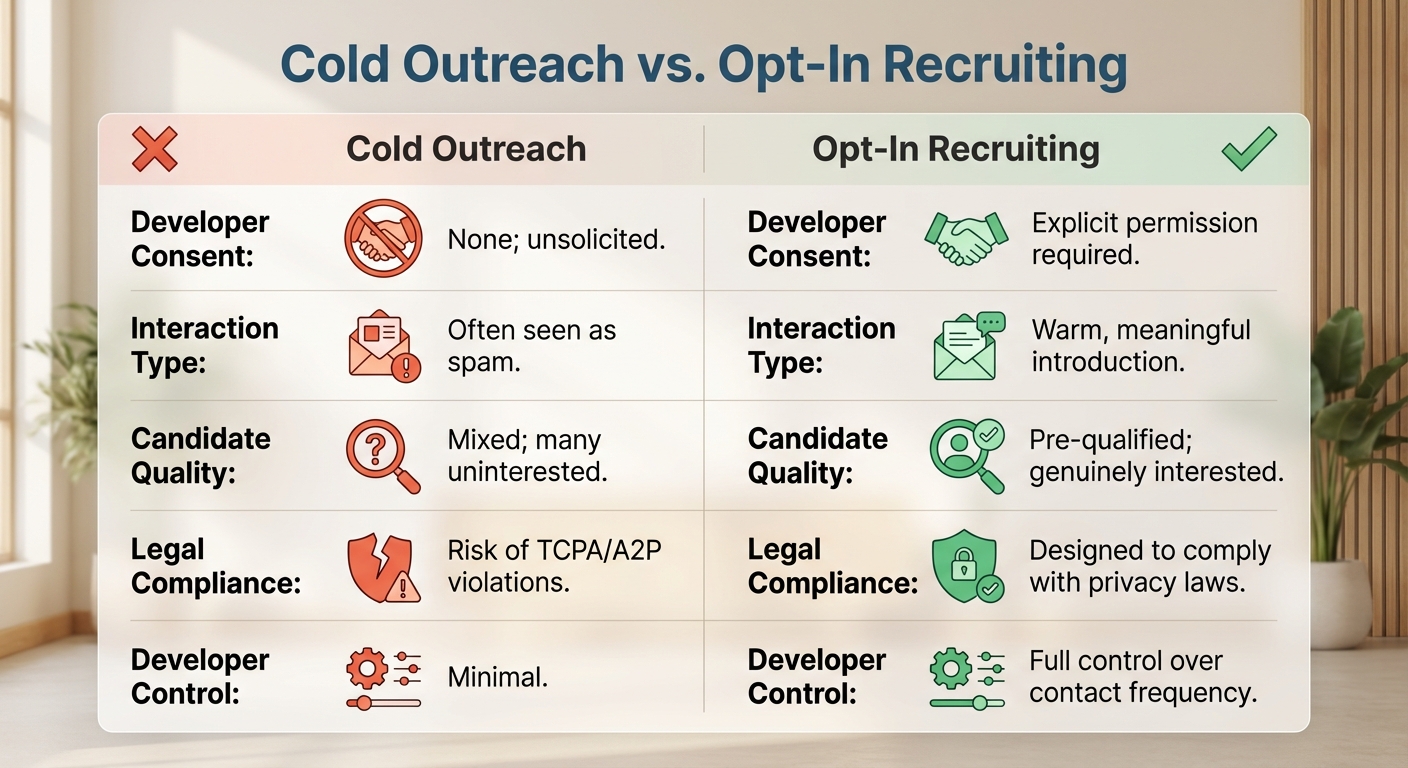 {Cold Outreach vs Opt-In Recruiting: Key Differences in Tech Hiring}
Consent-based recruiting takes the idea of targeted outreach and adds a layer of mutual agreement, ensuring interactions are meaningful and welcomed. With this approach, developers decide when and how they wish to be contacted, limiting outreach to those who’ve actively shown interest. This not only respects their time but also increases the likelihood of positive responses.
At the heart of this method is the concept of double opt-in introductions. Tools like daily.dev Recruiter use features such as the "TinDev" mechanic, where both recruiters and developers must agree to connect before any interaction takes place. This ensures that no one receives unsolicited messages, eliminating the discomfort often associated with social media and cold emails in tech hiring.
To make outreach even more effective, apply targeted filters before reaching out. Criteria like time zone, verified expertise in specific technologies, and seniority level help narrow down the pool to candidates who are a better match. This way, you’re engaging with developers who are not only qualified but also aligned with your needs, reducing wasted effort and improving the overall quality of your pipeline.
Here’s a quick look at how opt-in recruiting stacks up against traditional cold outreach:
| Aspect | Cold Outreach | Opt-In Recruiting |
|---|---|---|
| Developer Consent | None; unsolicited | Explicit permission required |
| Interaction Type | Often seen as spam | Warm, meaningful introduction |
| Candidate Quality | Mixed; many uninterested | Pre-qualified; genuinely interested |
| Legal Compliance | Risk of TCPA/A2P violations | Designed to comply with privacy laws |
| Developer Control | Minimal | Full control over contact frequency |
Modern recruiting platforms also leverage real-time behavior analysis. For example, daily.dev Recruiter examines developers’ reading habits and community participation to identify candidates who are not only skilled but also actively engaged in relevant technologies. This approach ensures you’re connecting with individuals who are both qualified and motivated, making your outreach more effective and efficient.
How to Maintain Pipeline Health Without Spam
Maintaining a healthy pipeline while respecting candidates requires a mix of thoughtful engagement, the right tools, and a focus on quality over quantity. Smart recruiters rely on personal connections and efficient automation to keep things running smoothly.
Using Employee Referrals
Employee referrals are a powerful resource, especially in the tech industry. While they made up only 7.5% of hires in 2025, they consistently deliver better results. Referred candidates are 18% more likely to be hired, 25% more productive, and twice as likely to stay beyond their first year. Impressively, 45% of referred employees stay with their company for over four years.
To make the most of this channel, simplify the referral process and offer appealing incentives. Your system should be mobile-friendly and integrated with your ATS, making it easy for employees to submit recommendations. Incentives don’t have to be one-size-fits-all - consider offering extra PTO, learning stipends, flexible work options, or even charitable donations. For particularly challenging roles or long-term referrals, tiered rewards can add extra motivation.
To keep quality high, provide employees with clear guidelines on what you’re looking for, including technical skills, experience, and alignment with company values. Some companies even organize "recruitment jams", where teams actively search their networks together for potential candidates. Keep employees engaged by sending automated updates on their referrals’ progress, which builds trust and encourages them to participate in the future. Automating parts of the screening process can also speed things up and make the experience smoother for everyone.
Automating Screening for Efficiency
Automation can be a game-changer for maintaining pipeline quality, especially when used strategically. It helps reduce workload and costs significantly. For example, automated candidate sourcing tools can cut engineer hours per hire from 60 to 14, reduce recruiter hours from 42 to 11, and lower the cost-per-hire from $14,076 to $3,349.
However, automation works best when balanced with a personal touch. The moment a candidate responds, all automated sequences should stop, shifting the interaction to a human-led conversation. Also, ensure your data is clean - separate first names and company names to avoid embarrassing errors like "Hi [Full Name]", which can make your outreach look spammy. By letting automation handle repetitive tasks, your team can focus on building genuine connections with interested candidates, making the process both efficient and respectful.
Conclusion
Cutting down on spam in tech recruiting doesn’t mean shrinking your talent pool - it means improving its quality. The strategies outlined here emphasize one key idea: quality always outshines quantity. By prioritizing personalized outreach, consent-driven engagement, and clear communication, you’re fostering trust with the developers you aim to hire. This shift from chasing volume to focusing on meaningful connections underpins every tactic discussed.
Simple changes - like tailoring your outreach or including upfront compensation details - can significantly enhance how candidates perceive your company. Plus, ethical tech recruitment practices protect your operations. If your spam complaint rate exceeds 0.3%, your domain could face penalties, potentially leading to blocked emails. That’s a risk no recruiter can afford to take.
FAQs
What spam rate is too high for recruiters?
A spam rate above 40-50% is generally seen as excessive for recruiters. When such a high percentage of outreach is flagged as spam, it can harm your reputation and significantly lower candidate engagement.
How can I build an opt-in tech recruiting pipeline?
To build a tech recruiting pipeline that candidates willingly join, start by securing clear, explicit consent before reaching out. Identify the specific developer profiles you're targeting and source candidates from active, relevant communities where they already engage. When reaching out, prioritize personalized and respectful communication tailored to each individual.
Keep your talent database well-organized and focus on fostering genuine relationships through consistent, two-way interactions. This method not only earns trust but also boosts response rates, steering clear of spammy practices while maintaining a pipeline filled with top-tier talent.
What can I automate without sounding spammy?
You can set up automation for personalized outreach, follow-ups (keeping it to a maximum of four emails), and tracking responses to ensure your communication doesn’t feel like spam. Stick to opt-in channels and consent-based methods so candidates are more likely to engage positively. By automating your talent database and tracking engagement, you can expand your efforts without sacrificing quality. Prioritize personalization and transparency to build trust and steer clear of messages that feel intrusive or overly generic.
.png)