43% of software engineers ignore recruiter messages, even though 80% are open to new opportunities. Why? Trust is the issue. Generic outreach, lack of salary details (which 69% of developers want upfront), and poor understanding of technical roles are major turn-offs.
To fix this, focus on transparency, personalization, and respect for their time:
- Include key details: Salary, tech stack, and work model in your first message.
- Personalize outreach: Reference their GitHub projects, blogs, or open-source work.
- Avoid buzzwords: Skip terms like "rockstar" or "game-changing."
- Time it right: Reach out mid-week, late afternoon, or during off-hours for better response rates.
- Follow-up thoughtfully: Limit to two follow-ups, adding new context each time.
Tools like daily.dev Recruiter can help by connecting you with developers via warm introductions, saving time and improving trust. The key is to build real connections, not rely on gimmicks.
::: @figure 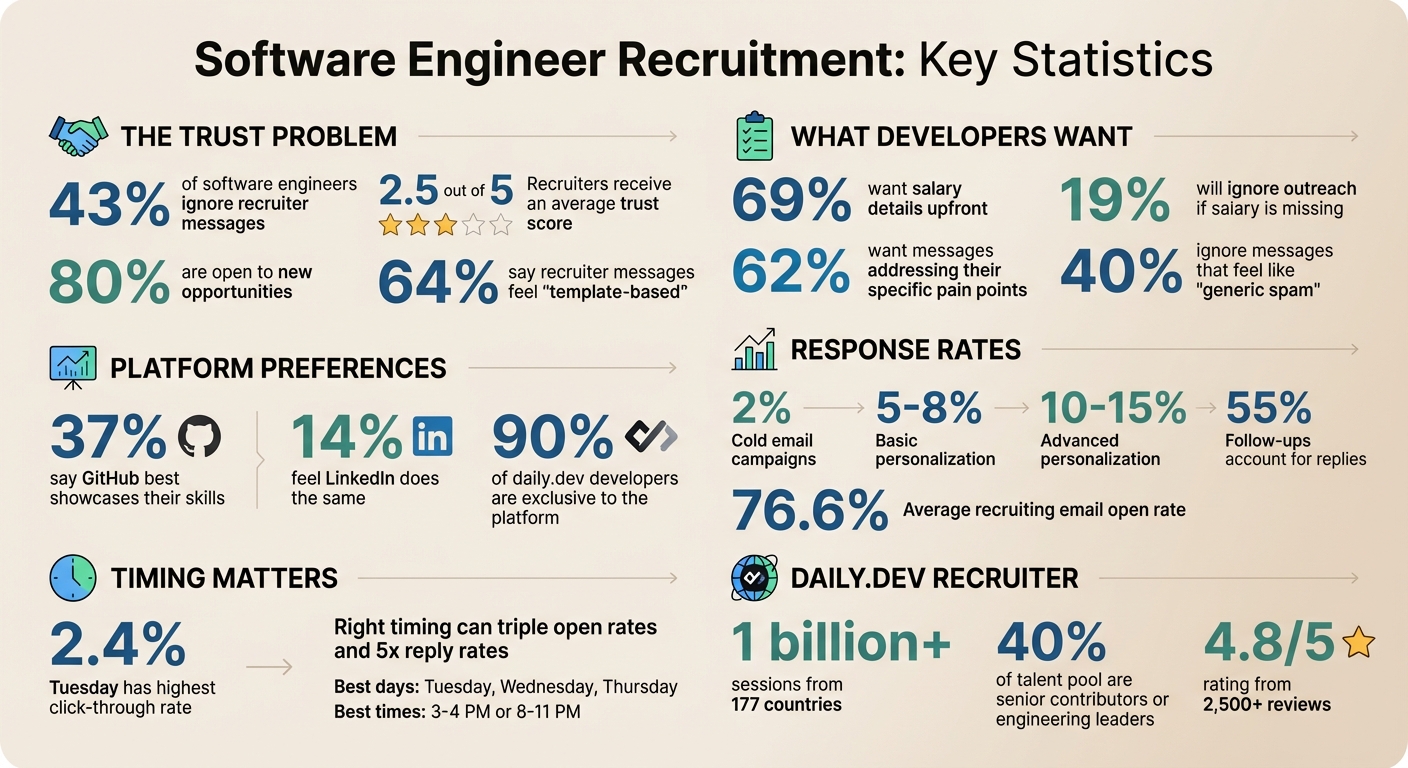 {Software Engineer Recruitment Statistics: Key Data on Developer Outreach and Response Rates}
Learn How Developers Prefer to Communicate
Developers lean toward concise, technical, and value-focused messages rather than lengthy corporate pitches. Tapping into this communication style is key to building stronger engagement.
The numbers back this up. Cold email campaigns typically see reply rates of just 2% . However, when advanced personalization is used, reply rates can climb to 10–15%, compared to 5–8% for basic personalization like just including a first name . This highlights the importance of speaking to developers in their language and connecting with them on the right platforms.
Find Where Developers Spend Their Time
Cold emails often fall flat, with 40% of developers saying they ignore messages that feel like “generic spam” . Instead of battling crowded inboxes, focus on the platforms where developers are already active and engaged.
For instance, 37% of developers say GitHub best showcases their skills, while only 14% feel LinkedIn does the same . Platforms like GitHub, Stack Overflow, and daily.dev are excellent places to connect with developers in a way that feels relevant to them.
Lead With Value in Every Message
Generic job descriptions don’t work - 62% of developers want messages that address their specific pain points . This means tailoring outreach to highlight how a role aligns with their technical expertise and career goals.
Skip vague pitches. Instead, reference specific details about their work, like a standout GitHub project, a technical blog they’ve written, or an open-source contribution. Personalization like this significantly improves response rates .
"We want to skip the business BS and just have an honest conversation." - Senior Backend Engineer
Keep your message short - under 80 words - and lead with the essentials: the tech stack, the challenge, and how the role can advance their career. When it comes to developers, brevity and relevance are the winning combination .
Write Personalized Outreach Messages
A whopping 64% of developers say recruiter messages feel "template-based" , and they give recruiters an average trust score of just 2.5 out of 5 . This highlights one thing loud and clear: personalization matters. Taking the time to research and craft tailored messages can make all the difference. Show candidates you’ve done your homework by referencing their work in a meaningful way.
Research Public Profiles for Context
Start by digging into a candidate's public profiles to discover conversation starters. For instance, check out their GitHub README or explore dynamic profiles updated via GitHub Actions. These details can help you craft messages that stand out.
Here’s a great example from 2025: Recruiter Alina researched developer Alexey’s GitHub and mentioned his "passenger transport simulator" project, which used a Spring/Hibernate/PostgreSQL stack. Alexey’s response?
"Hurray! You are the first person to view my code! Thank you for this!"
Alexey was so impressed that he immediately agreed to a meeting . This simple act of showing genuine interest in his work made all the difference.
Skip the Corporate Jargon
Developers can spot buzzwords a mile away, and terms like "rockstar", "ninja", or "game-changing" are an instant turn-off. These phrases scream "mass email" and lack the personal touch that developers value.
Michael Franco, Senior Director of Recruiting at Yext, puts it best:
"We're not trying to sell anything in our outreach. We're trying to start a genuine conversation."
Instead of vague buzzwords, focus on specifics. For example, don’t say "fast-paced environment." Instead, explain, "we prioritize weekly sprints and rapid deployments." And instead of calling someone a "rockstar developer", highlight their expertise, like "an engineer skilled in Kubernetes and microservices architecture."
Share Specific Details About the Role
Transparency goes a long way. Include key details like the salary range, the tech stack, and the challenges the team is tackling. Even your subject line can make an impact - try referencing a particular project instead of using a generic "Job Opportunity."
When it comes to your call-to-action, keep it low-pressure. Instead of asking for a 30-minute meeting right away, consider something more approachable, like a brief question or a link to schedule a quick 15-minute chat. This makes it easier for candidates to respond without feeling overwhelmed.
Use daily.dev Recruiter for Warm Introductions
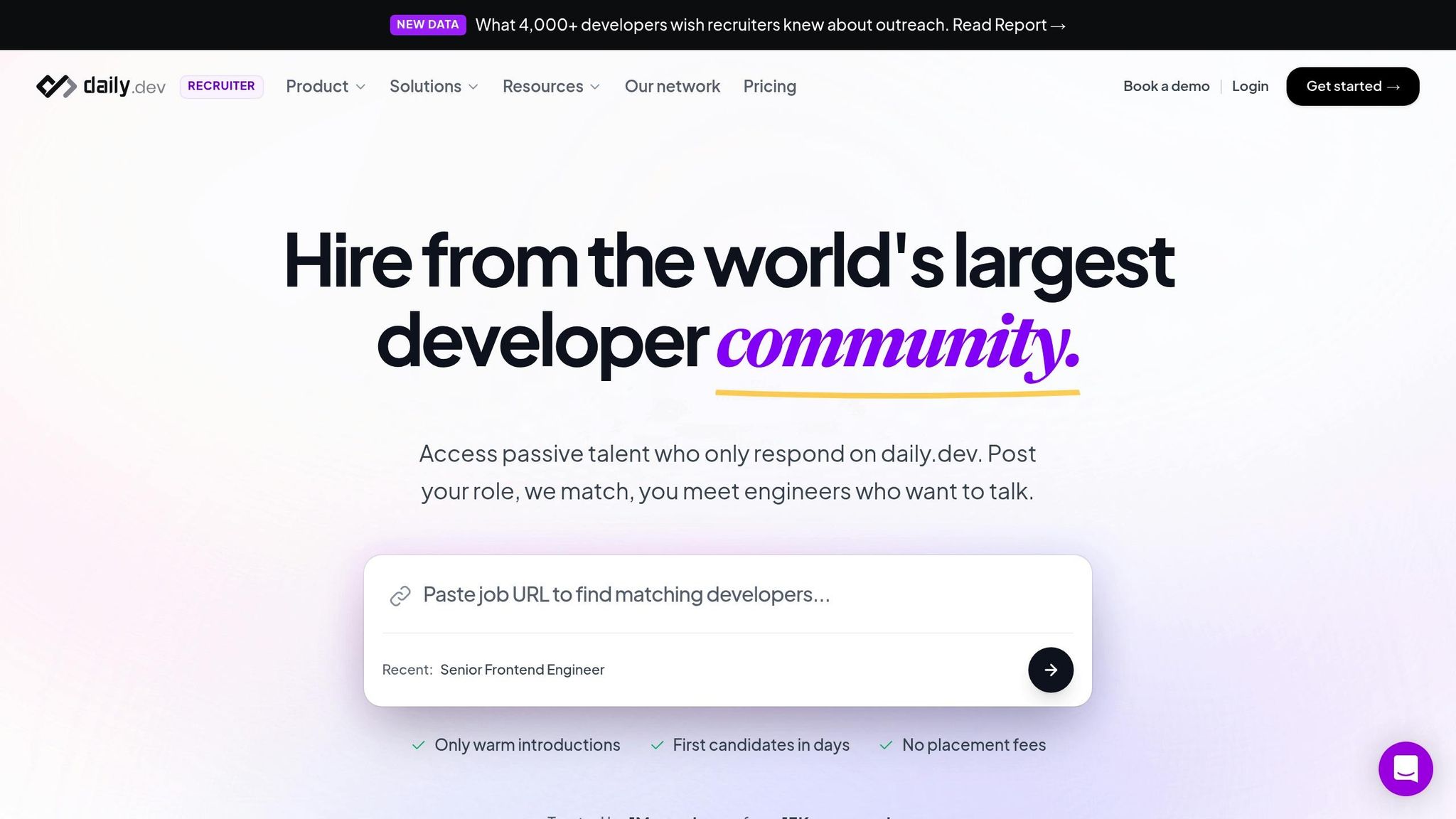
Reaching out to developers is far more effective when it comes through trusted networks rather than impersonal cold emails. With daily.dev Recruiter, you get warm, double opt-in introductions to developers who are already active on the platform - a platform that sees over 1 billion sessions from users across 177 countries . Forget the hassle of chasing leads or sending generic messages. By connecting with developers who already share mutual interests, you sidestep the usual skepticism of cold outreach. This approach doesn’t just boost response rates - it creates immediate trust.
Connect Through Developer Networks
Taking warm introductions a step further, daily.dev Recruiter taps into developer networks to seamlessly integrate your outreach into their daily routines. Developers on the platform are already engaging with career-focused content, and the system matches you with candidates based on real-time activity - what they’re reading, coding, and exploring - instead of outdated keyword searches . Your job postings appear directly in their daily feed, making the process feel natural. In fact, 90% of developers on daily.dev are exclusive to the platform .
To make the process even more precise, you can define up to three custom screening questions that developers must answer before an introduction is unlocked . For instance, you could ask, "What’s your approach to state management in large Astro applications?" This way, you’re not just connecting with developers - you’re connecting with the right ones who meet your technical needs.
Access Pre-Screened Developer Matches
When it comes to saving time and boosting credibility, targeting pre-screened developers is a game-changer. Traditional cold outreach can take around 30 minutes per prospect, but with daily.dev Recruiter, the platform does the heavy lifting. It identifies developers who align with your specific criteria, such as skills, experience, location, and interests. Impressively, 40% of the talent pool consists of senior contributors or engineering leaders .
The platform’s effectiveness is backed by a 4.8/5 rating from over 2,500 reviews and recognition as Product of the Year on Product Hunt . Trusted by engineers from companies like Google, Meta, Amazon, and Microsoft, daily.dev Recruiter has become the go-to professional network for sourcing top talent.
Time Your Outreach Correctly
Timing isn't just important - it can make or break your outreach. Even the most well-written message can miss the mark if it lands at the wrong time. A poorly timed email might get buried, while a decent one sent at the right moment could spark a meaningful conversation. In fact, getting the timing right can triple open rates and increase reply rates by five times .
When Developers Are Most Likely to Respond
If you're targeting software engineers, aim for Tuesday, Wednesday, or Thursday. These mid-week days are ideal because developers have settled into their routines but haven't started winding down for the weekend . Among these, Tuesday stands out with the highest click-through rate of 2.4% .
Avoid Monday mornings and Friday afternoons - these are peak times for developers to focus on their work, not their inboxes . For optimal results, consider reaching out during the late afternoon, around 3–4 PM, when many developers shift from deep work to catching up on messages. If you're sending B2B outreach, another effective window is between 8–11 PM .
"Tech professionals are often heads-down in coding or project work during morning hours, but review communications as they wrap up their workday." - Superhuman
For senior engineering leaders, like CTOs or VPs, timing is even more nuanced. These executives often work during "off-hours", such as 6–7 AM or 6–8 PM, before or after their teams are active . And don’t forget to adjust for the recipient's local timezone - a 9 AM email in your time zone might hit their inbox at an inconvenient hour . Pair these timing strategies with personalized messaging to ensure your outreach feels thoughtful and relevant.
Align With Industry Hiring Cycles
Timing your outreach also means understanding industry-specific hiring patterns. Different industries operate on unique schedules, and aligning with these rhythms can significantly improve your chances of success. For instance, in SaaS - a highly competitive space for talent - an aggressive follow-up schedule of 3, 5, and 8 days can help you stand out . On the other hand, Financial Services often involves longer evaluation periods, so a 3, 7, 7, and 10-day sequence is more effective . Consulting and Healthcare follow a similar cadence of 3, 7, and 7 days, with consulting showing the highest average reply rate of 7.88% .
It's also important to respect the internal workflows of engineering teams. Many companies have "No-Meeting" days, like "Throughput Thursday" or "No-Meeting Wednesday", to protect time for deep work . Instead of interrupting these focused periods, aim for Monday or Wednesday afternoons, when developers are more likely to be in "online work" mode . And remember, persistence is good, but overdoing it isn't - limit your follow-ups to 2–3 attempts to avoid annoying your prospects or triggering unsubscribes .
Hiring engineers?
Connect with developers where they actually hang out. No cold outreach, just real conversations.
Follow Up Without Being Pushy
Follow-ups account for 55% of replies in cold campaigns . But persistence doesn’t mean pestering - there’s a fine line between being diligent and being annoying. Limit yourself to two follow-ups, and make sure each one offers something new and valuable.
A well-thought-out four-stage email sequence can boost "interested" responses by nearly 68% compared to a single email . Angela Miller, Head of Talent at Moloco, puts it perfectly:
"The difference between a great sourcer and a sub‑par sourcer is in how much discipline someone has in following up... Less successful sourcers reach out once and never follow up" .
Here’s how to structure follow-ups that add value without overwhelming your audience.
Stop After Two Follow-Ups
To preserve the trust you’ve built with your personalized outreach, cap your follow-ups at two. If there’s no response after two concise attempts, close the loop with a polite message. Acknowledge that the timing might not be right and leave the door open for future conversations .
Keep follow-ups short - just a few sentences . The first follow-up can be a friendly nudge to bring your original email back into focus . If you still don’t hear back, use the second follow-up as your final chance to offer something meaningful before stepping back.
Add Fresh Context to Each Follow-Up
Every follow-up should bring something new to the table. Just like your initial email was tailored, your follow-ups should also reflect thoughtfulness and relevance. Avoid sending the same message with a tweaked subject line - it’s a missed opportunity to engage meaningfully.
Instead, give your recipient a reason to respond. Share a case study, link to a technical blog post from your team, or highlight an upcoming project they might find intriguing . For example, mentioning your team’s shift from React to Vue or your adoption of micro-frontends shows you understand their technical landscape.
In 2024, Jaime Onofre, Recruiting Manager at Zapier, conducted A/B tests on outreach sequences. He compared a brief, straightforward message with a longer one that detailed team challenges and potential impact.
"Although the longer message had fewer total opens, it resulted in a higher number of candidates replying with genuine interest" .
The lesson? Adding meaningful context to your follow-ups might not increase the volume of responses, but it can significantly improve their quality.
Track Results and Adjust Your Strategy
Keeping tabs on your outreach performance is crucial for understanding what’s working and what needs improvement. For instance, recruiting emails typically see an average open rate of 76.6% . If your results fall well below this, it’s a sign to revisit and refine your strategy.
Pay close attention to both open and reply rates. If your emails are being opened but not generating replies, it could mean your subject line is grabbing attention, but the body of the email isn’t delivering the information developers care about. Here’s a key detail: 69% of developers expect salary information in the initial message, and 19% will outright ignore outreach if it’s missing . If your emails aren’t getting traction, ensure they include essential details like compensation, the tech stack, and the work model upfront.
Monitor Open and Reply Rates
Your outreach metrics can reveal exactly where candidates are losing interest. Low open rates might indicate that your subject lines are too vague or feel overly promotional. On the other hand, if open rates are strong but replies are scarce, the content of your message may not align with what developers value most.
Angela Miller, Head of Talent at Moloco, highlights the importance of follow-ups in improving response rates:
"Response rates on that initial outreach might be 15%, but they might be 50% on the follow-up" .
If your initial reply rate hovers around 15% and you’re not sending follow-ups, you could be missing out on valuable opportunities to engage. Use these insights to refine your approach and systematically test what works best.
Test Different Message Formats
Once you’ve analyzed your metrics, tweak your messaging to better connect with developers. In late 2024, Jaime Onofre, Recruiting Manager at Zapier, ran an A/B test using Gem to compare two different email formats. One was short and concise (101–150 words), emphasizing team impact, while the other was longer and more detailed, focusing on technical challenges and team goals. While the shorter email generated more opens and replies overall, the longer one attracted more candidates who expressed genuine interest .
"I had fewer opens and replies on the long one, but more candidates replied with interest. So dive into your own metrics to figure out what works for you" .
Experimentation is key. For example, emails sent from a hiring manager or senior leader can boost reply rates by over 50% [13, 31]. Try concise subject lines (under seven words) and vary the length of your messages to see which approach yields not just more replies, but more meaningful conversations. The goal isn’t just quantity - it’s quality engagement with top technical talent.
Conclusion
Getting better reply rates comes down to trust, personalization, and showing respect. Developers can easily spot generic outreach, and it often turns them off. By taking the time to learn where developers hang out, what matters to them, and how they like to communicate, you can build real credibility. This forms the backbone of a smarter recruitment strategy.
The tips shared in this article - focusing on the "Big Three" details, researching public profiles, avoiding corporate buzzwords, timing your outreach well, and following up with care - are all about treating developers as real people, not just leads. Sure, it takes more effort than blasting out mass messages, but the payoff is worth it: better responses and stronger connections.
On top of these personalized approaches, using trusted tools can help amplify your efforts. For example, daily.dev Recruiter simplifies putting these principles into action. It connects you with developers through warm, double opt-in introductions, all within a platform where they’re already active. This means no awkward cold emails or spammy messages - just genuine, context-rich interactions that feel natural and respectful.
Every interaction you have leaves an impression. Developers talk, and when they feel valued and respected, they’re more likely to share positive experiences. This kind of word-of-mouth can boost your future recruiting efforts in ways you can’t measure. Start small: pick one or two of these strategies, track your progress, and adjust as you go. Improving reply rates isn’t a quick fix - it’s a continuous process. But when you focus on building real relationships instead of relying on gimmicks, you’re setting yourself up for long-term success.
FAQs
What’s the best way to personalize outreach to software engineers?
To connect effectively with software engineers, focus on being relevant and genuine. Start by referencing something specific about their recent projects, skills, or interests. This shows you’ve taken the time to understand their work and avoids the trap of sending generic or impersonal messages.
Make your outreach meaningful by emphasizing their technical expertise or career goals. For example, mention the technologies they’ve worked with or acknowledge a unique contribution they’ve made. This approach not only shows respect for their work but also helps build trust. Superficial gestures, like simply using their name, won’t cut it. Instead, reference something substantial from their experience. A thoughtful, well-researched message is far more likely to spark engagement and lead to a positive response.
When is the best time to reach out to software engineers for a higher response rate?
The best times to connect with software engineers are generally late morning (10:00 AM to 12:00 PM) and late afternoon (4:00 PM to 5:00 PM). Why? Late morning gives them a chance to get through their initial tasks and settle into their workflow, making them more open to communication. Late afternoon, on the other hand, is when meetings usually wrap up, leaving them with a bit more flexibility.
As for the best days, aim for Tuesday or Wednesday. Mondays are often spent catching up on tasks from the previous week, while Fridays see a dip in engagement as people shift their focus to weekend plans. Reaching out during these prime windows can make all the difference when trying to grab the attention of busy tech professionals.
Why is it important to be upfront about salary and tech stack in recruitment messages?
Being clear about salary and tech stack in recruitment messages is crucial. It demonstrates respect for the developer's time and what they care about most. Developers appreciate transparency, and sharing these details upfront can go a long way in building trust and credibility.
When you clearly outline the role's offerings and the tools they'll be working with, you attract candidates who are genuinely interested. This not only saves time for everyone involved but also makes your outreach feel more genuine, increasing the likelihood of a positive response.
.png)