

Your job description is often the first impression you make on a software engineer, and in today’s competitive tech job market, it needs to stand out. A generic post won’t work - developers want clarity, specifics, and a role that aligns with their skills and goals. Here’s what you need to know:
- Why It Matters: Software engineering roles are booming, with positions projected to grow by 25%. The average U.S. tech salary is $112,521, but in cities like New York and San Francisco, it’s much higher, making competition for talent fierce.
- What Works: Effective job descriptions are clear, structured, and specific. Include a detailed role summary, responsibilities, technical skills, compensation, and benefits. Avoid vague language or buzzwords like "ninja" or "rockstar."
- Focus on Developers: Speak directly to candidates, emphasizing real challenges they’ll solve, like “optimize API response times” or “reduce downtime.” Highlight tools and technologies they’ll use, from Java and Python to Docker and Kubernetes.
- Market-Specific Details: For U.S. roles, be transparent about salary ranges, benefits (healthcare, PTO, 401(k)), and work arrangements (remote, hybrid, or on-site). Salary transparency can increase applications by 70%.
- Customization: Tailor descriptions to specific roles—from recruiting senior software engineers to hiring backend, frontend, full-stack, DevOps, or mobile specialists. Each has unique responsibilities and skill sets, so avoid one-size-fits-all postings.
A well-crafted job description not only attracts better candidates but also sets the tone for a productive hiring process. Get specific, stay transparent, and focus on what engineers care about most.
What Makes a Software Engineer Job Description Work
A great job description is all about structure and clarity. Developers want to know exactly what they’ll be doing, not sift through vague or generic language. The most effective job postings include key details like the job title, location, a summary of the role, specific responsibilities, required skills, preferred qualifications, and perks like healthcare and 401(k) plans. When it comes to technical requirements, skip the buzzwords and name the actual tools - think Java, Python, Docker, or Kubernetes.
"Finding a qualified software engineer begins with the job description. The best job post is thorough and succinct and clearly conveys expectations for the role..." – LinkedIn
Speak to developers the way they’d speak to each other. Use a casual, technical tone and address the reader directly with “you” instead of phrases like “the ideal candidate.” Leave out terms like “ninja” or “rockstar,” which can sound unprofessional. Instead, focus on the real challenges of the role. For example, saying “optimize API response times to handle 10x traffic growth” is far more engaging than something vague like “solve complex problems.”
Standard Job Description Structure
A well-organized job description should include these essential elements:
- Job Title: Use straightforward terms like "Senior Backend Engineer."
- Location: Clearly state if the role is remote, hybrid, or on-site, and mention any US time zone requirements.
- Team Details: Explain the size and structure of the team.
- Role Summary: Provide a short, 2–3 sentence overview of the role’s purpose.
- Responsibilities: Outline the key tasks and day-to-day expectations.
- Required Skills: Highlight 3–4 must-have technical skills.
- Preferred Qualifications: List nice-to-have skills that won’t disqualify candidates.
- Compensation: Share the salary range in USD.
- Benefits: Include perks like healthcare, Paid Time Off, and 401(k) plans.
Including salary information can make a big difference - job postings with salary details get 75% more clicks and 30% more applications . This structure lays the groundwork for tailoring your job post to appeal specifically to developers.
Writing for Developers
Developers value specifics over fluff. Instead of saying “collaborate with cross-functional teams,” explain that candidates will “join daily standups and bi-weekly sprint planning using Agile methodology.” Talk about your code review process, deployment cycles, and testing standards. Highlight real-world challenges like reducing downtime or improving app performance.
For example, instead of a generic task, describe a specific goal: “reduce database query time by 40% for 2 million active users.” This kind of detail excites high-performing engineers and sets your role apart. Also, make a clear distinction between required skills and preferred qualifications. This helps candidates understand what’s essential and avoids discouraging them with an overly long list of “nice-to-haves.”
US Market Requirements
To stand out in the US job market, your posting needs to address some key specifics. Work arrangements are a big deal - only 20% of developers work entirely on-site . Be clear about whether the role is remote, hybrid, or on-site, and if hybrid, include details about on-site days. For remote roles, mention any time zone overlap requirements, like “4 hours overlap with EST.”
US-based developers also expect certain standard benefits, often referred to as the "Big Three": healthcare (medical, dental, vision), Paid Time Off, and 401(k) retirement plans. Compensation should align with market expectations. In May 2024, the median annual wage for software developers was $133,080, with the top 10% earning over $211,450 . In competitive markets like New York ($180,000) and San Francisco ($159,000), your salary range should reflect local norms . Including salary ranges isn’t just a nice touch - it’s proven to boost application volume by 70% and improve applicant quality by 66% .
Customizing Templates for Different Engineering Roles
::: @figure 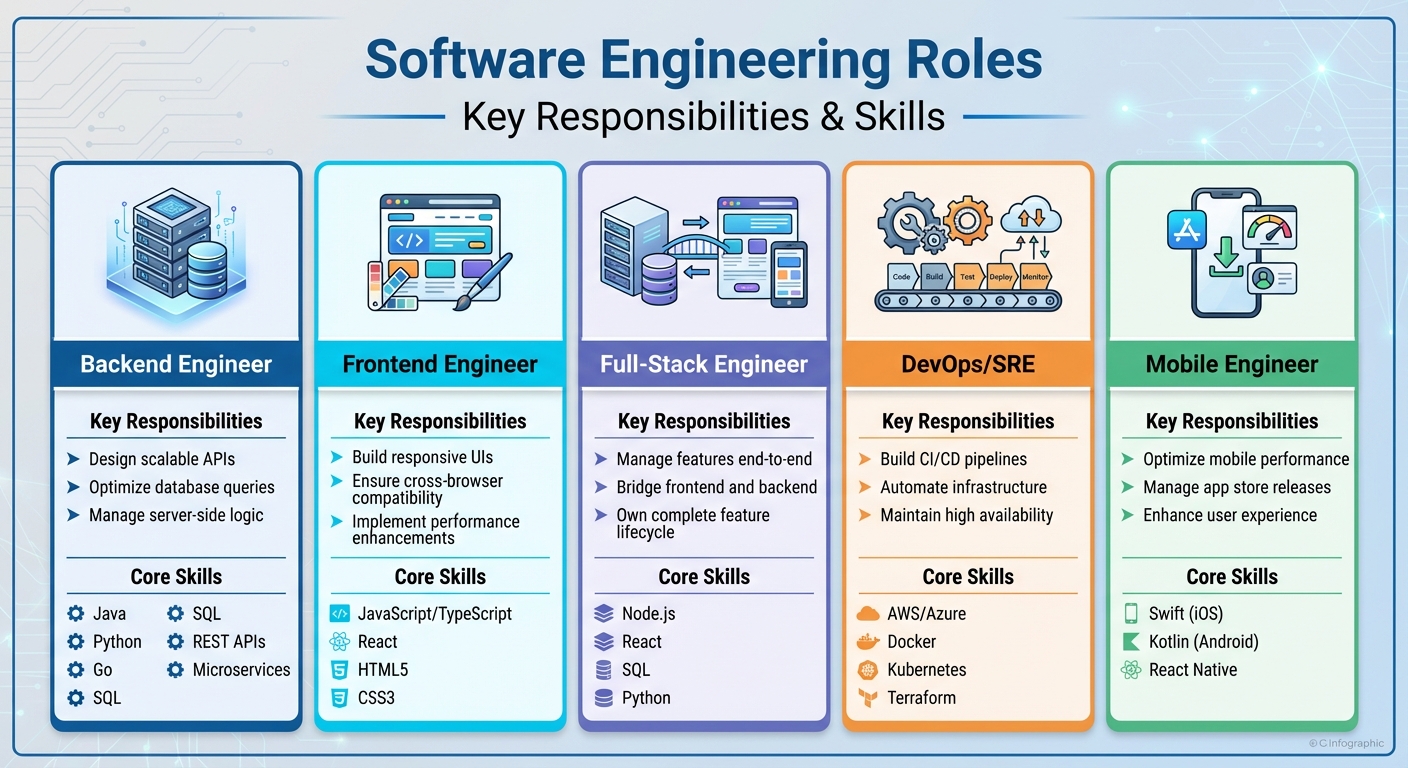 {Software Engineering Roles Comparison: Responsibilities and Required Skills}
When crafting templates for engineering roles, it's essential to tailor them to the specific demands of each position. While a backend engineer and a frontend engineer may both write code, their day-to-day tasks, technical expertise, and deliverables vary significantly. A well-customized template should clearly outline the unique responsibilities and expectations for each role.
Templates for Common Engineering Roles
Backend Engineers focus on building scalable APIs, optimizing database performance, and managing server-side logic. They often work with technologies like Java, Python, Go, SQL, and REST APIs. A strong template for this role should emphasize tasks such as designing and maintaining efficient RESTful APIs with quick response times.
Frontend Engineers are responsible for creating user interfaces and ensuring a seamless user experience. Their expertise lies in JavaScript/TypeScript, React, HTML5, and CSS3. Key responsibilities might include "developing responsive, accessible user interfaces that function across all major browsers" and "implementing performance enhancements to improve page load speeds." These engineers prioritize usability, design fidelity, and cross-browser compatibility.
Full-Stack Engineers operate across both the front-end and back-end, managing features from database design to user interface implementation. Their toolkit often includes Node.js, React, SQL, and Python. Highlight their ability to "take ownership of features from start to finish, including database schema design and front-end integration." This role is ideal for developers who enjoy working across the entire application stack.
DevOps and Site Reliability Engineers (SREs) ensure systems are reliable and deployments are efficient. They typically use tools like AWS/Azure, Docker, Kubernetes, and Terraform. Templates for these roles should focus on outcomes such as "building robust CI/CD pipelines for frequent, reliable deployments" and "maintaining high availability in production environments." These engineers are passionate about automation, infrastructure stability, and system monitoring.
Mobile Engineers specialize in developing apps for iOS or Android platforms. They often work with Swift for iOS, Kotlin for Android, or cross-platform frameworks like React Native. Responsibilities might include "enhancing app performance for a smooth user experience" and "managing app store releases and version updates."
How to Customize a Template
Begin by consulting your engineering team to identify the must-have skills for the role versus those that can be learned on the job.
"Envision how a software engineer would explain this role at a tech conference." – Christian Eilers
Next, pinpoint the technical challenges the role will tackle. Avoid vague descriptions and instead focus on specific goals, like "rewrite legacy code to improve performance." This approach attracts candidates who are motivated to solve concrete problems.
Keep the list of qualifications concise and focused on core skills. Overly long requirements can discourage potential candidates, especially self-taught developers or bootcamp graduates who might excel despite not meeting every criterion.
Finally, ensure the job description aligns with the role's seniority. For example, entry-level positions might emphasize "learning under mentorship", while senior roles should highlight responsibilities like "making architectural decisions" and "mentoring junior developers."
Role Comparison Table
| Role Type | Responsibilities | Skills |
|---|---|---|
| Backend Engineer | Design scalable APIs, optimize database queries | Java, Python, Go, SQL, REST, Microservices |
| Frontend Engineer | Build responsive UIs, ensure cross-browser compatibility | JavaScript/TypeScript, React, HTML5, CSS3 |
| Full-Stack Engineer | Manage features end-to-end, bridge frontend and backend | Node.js, React, SQL, Python |
| DevOps/SRE | Build CI/CD pipelines, automate infrastructure | AWS/Azure, Docker, Kubernetes, Terraform |
| Mobile Engineer | Optimize mobile performance, manage app store releases | Swift (iOS), Kotlin (Android), React Native |
Writing Job Descriptions for US and Global Developers
Crafting job descriptions that resonate with both US-based and international developers requires clear communication about work arrangements, legal requirements, and benefits. These details not only set expectations but also help attract the right candidates by addressing their specific needs.
Meeting US Developer Expectations
For US-based roles, it's crucial to specify the work arrangement using precise terms like:
- Remote – US Based
- Hybrid – San Francisco Office
- On-site – Austin, TX
Avoid generic labels like "Remote" without additional context. This ensures candidates immediately understand location requirements .
Clearly outline work authorization requirements. For instance: "Must be authorized to work in the United States without sponsorship" or "H-1B visa sponsorship available for qualified candidates" .
For remote roles, mention any time zone expectations. For example, if global candidates will support US-based teams, specify overlap requirements such as "4 hours during US Eastern Time business hours" . This level of detail helps set clear expectations and avoids misunderstandings.
Presenting Compensation and Benefits
Salary transparency isn't just a nice-to-have anymore - it's a must. Including pay ranges can increase applications by 70% and improve applicant quality by 66% . Additionally, many US states now legally require salary ranges in job postings.
For US-based roles, list compensation in USD and provide a range that reflects the current market. For example: "Base salary: $95,000 – $135,000 depending on experience." As of 2025, the average US tech salary is approximately $112,521, with entry-level full-stack engineers earning around $134,770 annually .
If equity is part of the package, be specific. Instead of vague terms like "Stock options available", say something like: "Significant equity package with a 4-year vesting schedule and performance-based refresh grants" .
For US-based roles, standard benefits often include 401(k) matching, health/dental/vision insurance, and flexible paid time off . For global remote positions, benefits may vary and could include home office stipends, professional development budgets exceeding $1,000 annually, or contributions to private health insurance . With only 20% of developers working fully on-site, offering remote-specific perks like home office setups is increasingly important .
Location and Benefits Comparison Table
| Feature | US On-Site/Hybrid | US Remote | Global Remote (Supporting US) |
|---|---|---|---|
| Location | Specific city/office address | "Remote – US Based" | "Remote – Worldwide" or specific regions (e.g., Latin America) |
| Time Zone | Local office hours | Flexible or specific US zone | Required overlap with US business hours (e.g., 4 hours/day) |
| Compensation | USD salary + local benefits | USD salary + state-specific considerations | USD or local currency via Employer of Record (EOR) |
| Key Benefits | 401(k), health/dental, commuter perks, PTO | 401(k), health/dental, home office stipend, PTO | Professional development budget, local compliance via EOR, home office stipend |
| Work Authorization | Must have US work authorization | Must have US work authorization | No US visa required; contractor or EOR status |
For global remote roles, it's helpful to mention if you’re using an Employer of Record (EOR) to manage international contracts, payroll, and compliance with local labor laws . For example, software developer salaries in Latin America typically range between $36,000 and $108,000 - 30% to 70% lower than US market rates - making nearshore hiring a cost-effective option for US companies seeking time zone alignment .
Up next, explore how daily.dev Recruiter uses developer network data to refine these templates.
Hiring engineers?
Connect with developers where they actually hang out. No cold outreach, just real conversations.
Using daily.dev Recruiter to Improve Job Descriptions
daily.dev Recruiter takes job description writing to the next level by grounding it in real-world developer data. Instead of relying on guesswork to determine what developers want, this platform taps into insights from a thriving network of over 1,000,000 developers . These developers actively consume and share technical content, providing a treasure trove of information to refine your approach.
Learning from Developer Network Data
The platform continuously tracks what developers are engaging with - whether it's trending programming languages, cutting-edge tools, or professional development topics. For instance, if you're crafting a job description for a React developer, you can highlight the most popular frameworks and technologies developers are currently exploring. Instead of vague requirements like "experience with modern JavaScript frameworks", you can specify trending tools that resonate with the community.
Additionally, insights from the personalized news feed can guide you in emphasizing the benefits developers care about most, like remote work options or opportunities for professional growth. By aligning your job descriptions with what developers are actively interested in, your postings feel relevant and timely, leading to better engagement and higher response rates.
Increasing Response Rates
Traditional job boards often force developers to wade through a sea of irrelevant postings. daily.dev Recruiter flips the script by integrating job opportunities directly into developers' workflows. Your postings appear where developers are already seeking career growth, ensuring they reach the right audience at the right time.
Instead of relying on cold outreach, the platform uses warm, double opt-in introductions. This means developers engaging with your listing have already shown interest, leading to more meaningful conversations. It's a respectful approach that values developers' time and significantly reduces the chances of your message being ignored.
Matching Templates to Developer Preferences
When you align each section of your job description with developer insights, the results can be transformative. Here's how tailoring your approach impacts engagement:
| Job Description Section | Developer Preferences | Impact on Response |
|---|---|---|
| Role Summary | Highlight opportunities for learning and a modern tech stack | Boosts the view-to-contact ratio when growth opportunities are emphasized |
| Responsibilities | Focus on technical challenges and meaningful contributions | Captures attention by showcasing problem-solving opportunities |
| Required Skills | Include trending tools and frameworks | Attracts better candidates when skills match active learning trends |
| Benefits | Emphasize professional development and remote flexibility | Drives higher reply rates when benefits align with developer priorities |
Conclusion
Crafting job descriptions that truly appeal to software engineers requires understanding what developers value most and communicating in a way that resonates with them. By tailoring your postings to specific engineering roles, emphasizing the right technical skills, and providing clear compensation details for the U.S. market, you can stand out and attract top talent instead of blending into the crowd.
When you customize templates for each role and focus on what developers care about - modern tech stacks, opportunities for growth, meaningful projects, and flexible benefits - you position your company as a place where they can excel. This thoughtful approach lays the foundation for a hiring process that aligns with developers' priorities. It also helps you identify qualified technical candidates more efficiently.
Platforms like daily.dev Recruiter make this process even more effective. With access to a network of over 1,000,000 active and engaged developers , the platform ensures your job descriptions reach developers where they already spend their time. Instead of relying on cold outreach, this method delivers your opportunities in a way that feels natural and relevant. When your postings reflect what developers are genuinely interested in, response rates go up, and the conversations that follow become more productive.
Start with these templates, adapt them to your specific needs, and let data-driven insights guide your adjustments over time. By combining clear, well-structured job descriptions with real insights from an active developer community, you can create a hiring process that respects developers' time, aligns with their goals, and helps you bring exceptional talent to your team.
FAQs
What are the best ways to create a software engineer job description that attracts top talent?
To create a standout software engineer job description, focus on being clear, relevant, and appealing. Start by clearly outlining the primary responsibilities and essential skills for the position. Emphasize how the role aligns with and supports your company’s goals. Use simple, professional job titles with relevant keywords to make the listing easy to find.
Be transparent by including salary ranges, along with benefits and perks, to catch the attention of potential candidates. Keep the tone engaging and reflective of your company’s culture, steering clear of unnecessary jargon or overly formal language. Make sure the description is concise, well-organized, and free from errors to maintain a professional impression. Lastly, use inclusive language to reach a diverse pool of candidates and demonstrate your commitment to equality.
What key elements should a job description include to attract top software engineering talent?
To draw in talented software engineers, craft a job description that leaves no room for guesswork. Start with a precise job title that clearly defines the role. Follow it up with a breakdown of the responsibilities and a list of the technical skills and technologies essential for the position. Make sure to showcase what makes your company stand out - whether it’s your work environment, career development paths, or any unique perks you offer. Including a clear salary range (e.g., $120,000–$150,000 per year) can significantly boost interest. Wrap up with a compelling call to action that motivates candidates to take the next step and apply.
Why is it important to include salary details in software engineer job descriptions?
Including salary details in job descriptions helps establish clear expectations for potential candidates, giving them a straightforward understanding of the compensation right from the start. This level of openness not only attracts applicants who fit within your budget but also minimizes time wasted on applications that don't align financially. Plus, it builds trust in your hiring process. Sharing salary information also reflects a commitment to fairness and professionalism - qualities that resonate strongly with top-tier software engineering talent.
.png)


