LinkedIn Recruiter is a powerful tool for sourcing talent, especially for large-scale hiring. However, its high costs - ranging from $8,999 to $15,000+ per seat annually - make it a significant investment. While it offers advanced search filters, ATS integration, and access to over 1 billion profiles, low response rates (18-25%) and oversaturated InMail outreach can limit its effectiveness for recruiting developers.
Key Takeaways:
Strengths: Extensive database, advanced search tools, ATS integration, and features like "Spotlights" to target active candidates.
Weaknesses: High pricing, low InMail response rates, and time-intensive profile filtering.
Alternatives: Platforms like daily.dev Recruiter provide developer-focused sourcing with real-time activity signals, flexible pricing, and better engagement.
Quick Comparison:
| Platform | Best For | Pricing | Key Features |
|---|---|---|---|
| LinkedIn Recruiter | Enterprise and high-volume hiring | $8,999–$15,000+ per seat annually | 40+ filters, ATS integration, Talent Insights |
| daily.dev Recruiter | Developer-focused hiring | Pay-per-role, no annual commitment | Real-time activity signals, double opt-in |
For enterprises with diverse hiring needs and budgets, LinkedIn Recruiter excels. For tech teams or startups hiring specialized developers, daily.dev Recruiter may be a better fit.
::: @figure 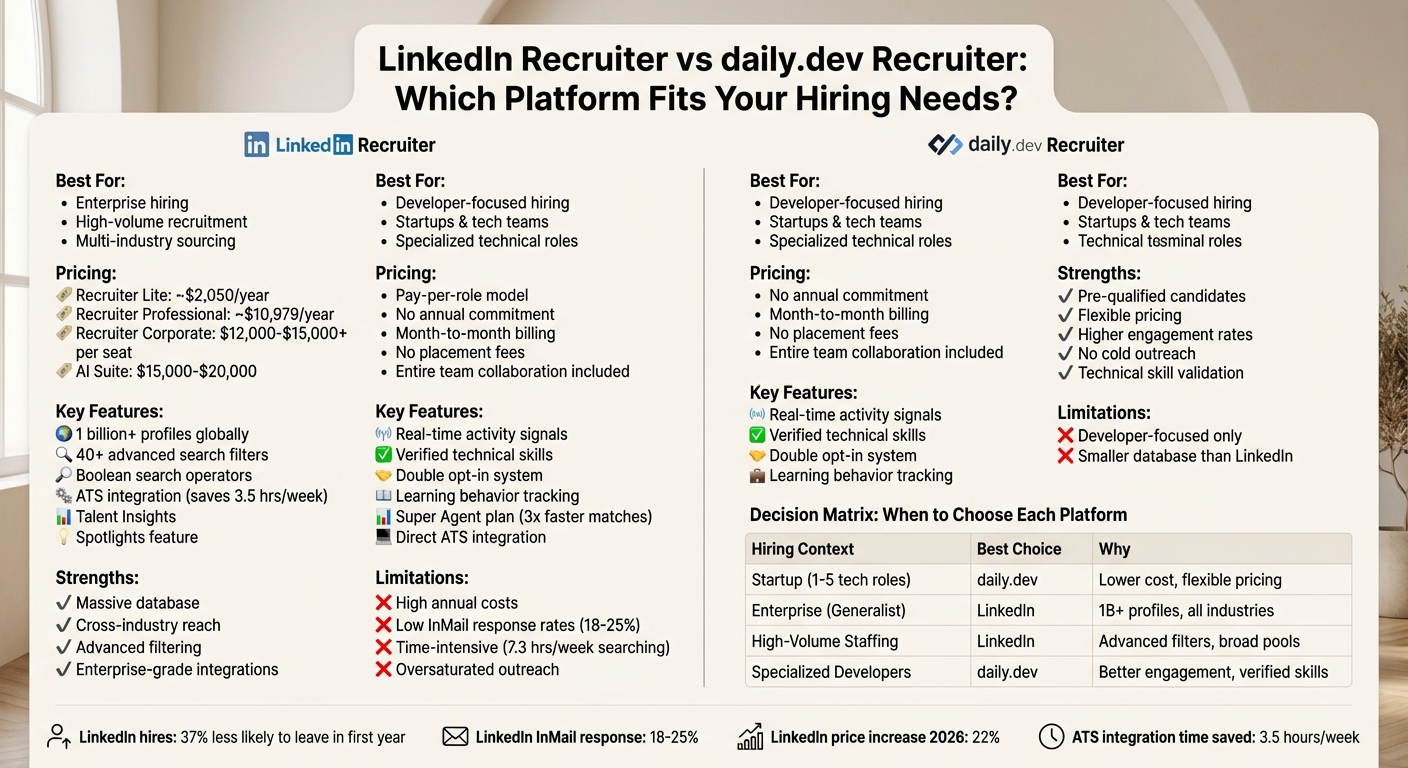 {LinkedIn Recruiter vs daily.dev Recruiter: Feature and Pricing Comparison}
1. LinkedIn Recruiter

Developer Sourcing Effectiveness
LinkedIn Recruiter offers over 40 filters to help you zero in on technical talent. These filters cover everything from skills and job titles to years of experience . By using Boolean search (e.g., "Developer NOT Freelance"), you can refine your results even further . Another powerful feature is Talent Insights, which provides data on where skills like Rust, Go, or AI/ML are most concentrated geographically .
The "Spotlights" feature is especially handy, allowing you to filter for candidates who are "Open to Work" or "Interested in your company." This can lead to higher response rates, even from niche experts . For example, candidates in "Recommended Matches" have a 35% higher likelihood of accepting InMails . If you're looking for individual contributors for senior technical roles, Boolean operators like NOT (Lead OR Manager) can help you avoid managerial profiles .
These advanced tools are essential for reaching passive developer candidates, a group that often requires more precise and strategic sourcing.
Pricing and Cost Efficiency
As of January 1, 2026, LinkedIn raised Recruiter fees by 22% . Here's a breakdown of the updated pricing:
Recruiter Lite: ~$2,050/year (30 InMails per month)
Recruiter Professional: ~$10,979/year (100 InMails per month)
Recruiter Corporate: $12,000–$15,000+ per seat (150 InMails per month)
AI Suite: $15,000–$20,000
LinkedIn justified the price increase by pointing to new AI features, though many of these were already available in 2025 . Before renewing your subscription, it’s a good idea to review your InMail response rates and seat usage. If you find low activity, consider negotiating for fewer seats or locking in a better rate . Keep in mind, LinkedIn requires at least a 13% response rate on 100+ messages within 14 days to meet policy standards .
While pricing is a key factor, LinkedIn Recruiter’s integration capabilities can also make a big difference in your recruitment process.
Integration with Recruitment Tools
LinkedIn Recruiter integrates seamlessly with popular Applicant Tracking Systems (ATS) like Greenhouse, Lever, and Workable through Recruiter System Connect (RSC) . This feature allows you to sync candidate data, view ATS history directly within LinkedIn, and access LinkedIn profiles straight from your ATS. On average, recruiters who use RSC save 3.5 hours per week and enjoy a 7% boost in InMail acceptance rates .
Other integrations include tools for video conferencing (Zoom, Teams, Google Meet) and email platforms (Gmail, Outlook). The CRM Connect feature simplifies candidate management by enabling one-click exports and offering a complete view of communication history . Most of these integrations come included with your LinkedIn Recruiter license, though your ATS or CRM provider might charge additional fees .
These integrations play a crucial role in making developer recruitment smoother by centralizing communication and streamlining workflows.
Hiring engineers?
Connect with developers where they actually hang out. No cold outreach, just real conversations.
2. daily.dev Recruiter
Developer Sourcing Effectiveness
daily.dev Recruiter uses real-time activity signals to pinpoint developer talent. By tracking what developers are actively reading and learning - like articles on Rust or discussions about microservices - the platform provides a clear picture of their skills. The Verified Signals feature ensures candidates' technical expertise aligns with your needs, based on their actual platform activity rather than outdated resume details . Plus, the double opt-in system ensures candidates express interest before any contact is made, making interactions smoother and more efficient.
Pricing and Cost Efficiency
daily.dev Recruiter offers a straightforward pricing model: you pay per open role, enabling your entire team to collaborate without incurring additional costs. There are no placement fees, no long-term commitments, and the month-to-month billing structure adapts to your hiring activity. Unlike traditional "take-or-pay" models, you only pay for roles you’re actively filling. For faster results, the Super Agent plan accelerates matches by three times and integrates directly with your ATS.
Candidate Engagement and Quality
daily.dev Recruiter taps into a thriving developer community to deliver pre-qualified candidates who are genuinely interested in new opportunities. The double opt-in system ensures that only developers who’ve confirmed their interest are introduced to you, avoiding cold outreach to passive developers and saving time on unresponsive profiles. Since candidates are sourced based on their learning and reading habits, conversations start with a mutual understanding of the technical needs - leading to more productive and meaningful interactions.
Pros and Cons
After diving into LinkedIn Recruiter's features, let's break down its main advantages and drawbacks when it comes to recruiting developers.
LinkedIn Recruiter provides access to a massive database of over 1 billion profiles worldwide. Its advanced search filters - more than 40 in total - and Boolean search capabilities make it easier to zero in on technical talent. The platform also integrates seamlessly with ATS systems and developer hiring platforms through Recruiter System Connect, saving time on administrative tasks. Features like "Spotlights" further enhance the process by highlighting candidates who are open to new opportunities.
On the flip side, the platform's pricing model can be a sticking point. Starting at around $8,999 per seat annually (as of 2026), costs can skyrocket quickly as your team grows. Another challenge is the oversaturation of InMail, leading to response rates that hover between 18% and 25%, as many developers tend to ignore generic outreach messages. Recruiters also spend an average of 7.3 hours per week searching for candidates, which can detract from other critical tasks.
"The real cost of recruiting platforms isn't the subscription price. It's the opportunity cost of your team spending time searching profiles instead of closing candidates." – HootRecruit
Key Strengths:
Access to over 1 billion profiles globally
Advanced search capabilities with 40+ filters and Boolean operators
Talent Insights offering data on skill concentrations by location
ATS integration reduces administrative workload, saving 3.5 hours per week on average
"Spotlights" feature identifies candidates actively open to opportunities
Key Limitations:
High annual costs ($8,999–$15,000+ per seat) with 15% yearly price increases
Low InMail response rates (18–25%) due to oversaturation
Time-intensive profile filtering and outreach
Seat-based pricing significantly increases costs for larger teams
70% of developers are passive candidates, requiring more nuanced engagement strategies
Conclusion
For companies with diverse hiring needs and generous budgets, LinkedIn Recruiter offers access to over 1 billion professionals, advanced filtering options, and smooth ATS integration. For recruiters handling high-volume hiring, its features can justify the steep price of $10,800+ per recruiter seat annually. Plus, LinkedIn hires are 37% less likely to leave within their first year compared to hires from other sources .
However, the cost can be a sticking point. For tech-focused teams or growing businesses, the annual contract and additional labor costs might cut into the overall return on investment (ROI). Before committing to renewal, it’s important to calculate the full investment, factoring in these added expenses, to get a clear picture of your ROI .
| Hiring Context | Best Choice | Why? |
|---|---|---|
| Startup (1-5 tech roles) | daily.dev Recruiter | Lower cost per role, flexible month-to-month pricing, no annual commitment |
| Enterprise (Generalist) | LinkedIn Recruiter | Access to over 1 billion profiles across various industries |
| High-Volume Staffing | LinkedIn Recruiter | Advanced filters and a massive database for building broad talent pools |
LinkedIn Recruiter makes sense for large-scale hiring across multiple job functions if your budget can cover the high per-seat cost. On the other hand, for specialized developer recruitment, daily.dev Recruiter often delivers better engagement with its double opt-in model and per-role pricing, without the added overhead. The best choice depends on your hiring scale, budget, and whether your focus is on generalist roles or niche technical talent.
FAQs
Which LinkedIn Recruiter plan should I choose for hiring developers?
When choosing a LinkedIn Recruiter plan, it’s all about matching your hiring needs and budget. Recruiter Lite, priced at approximately $170 per month, is ideal for smaller hiring efforts. It offers basic search filters and 30 InMails per month, making it a good fit for businesses with limited recruitment demands.
On the other hand, if you're managing a higher volume of hiring or need advanced tools, the full LinkedIn Recruiter plan might be worth considering. At over $900 per month, it provides features like team collaboration tools and a larger InMail allowance, making it better suited for large-scale recruitment.
For hiring developers specifically, Recruiter Lite is often sufficient for smaller, focused efforts. However, the full Recruiter plan is a stronger choice when tackling larger hiring projects.
How can I improve InMail response rates from engineers?
To improve InMail response rates from engineers, prioritize personalization and openness. Mention their specific projects or contributions to show you've done your homework. Be upfront about key details, like salary, the tech stack they'll work with, and whether the role is remote, hybrid, or in-office. Timing matters too - reaching out mid-week tends to yield better results. Additionally, leveraging trusted platforms where developers are already active and engaged can make a big difference. These steps help establish trust and relevance, making it more likely you'll get a reply.
How do I calculate ROI for LinkedIn Recruiter for dev hiring?
To figure out the ROI for LinkedIn Recruiter when hiring developers, start by adding up all your recruitment costs. This includes platform fees, the time spent by recruiters, and any other related expenses. Next, compare these costs to the value your new hires bring to the business - whether that's through increased productivity, cost reductions, or other measurable benefits.
Here’s the formula to use: ROI = (Business Value of Hires - Total Recruitment Costs) / Total Recruitment Costs. This will help you determine if the platform is worth the investment.
.png)