LinkedIn Recruiter comes with a hefty price tag in 2026, with costs starting at $2,040 annually for Lite plans and reaching upwards of $10,979 per seat for Corporate plans. While it offers access to over 1 billion profiles and advanced search tools, its value has come under scrutiny due to rising prices, low engagement rates, and limitations in sourcing specialized talent like developers.
Key Takeaways:
- High Costs: Corporate plans start at $10,979 annually per seat, with additional fees for AI add-ons and extra InMails.
- Low Response Rates: InMail response rates for tech roles have dropped to 4.77%, making outreach inefficient.
- Hidden Costs: Extra InMails cost $10 each, and annual contracts lock teams into high expenses.
- Challenges with Developers: Outdated profiles and generic outreach make it harder to connect with top tech talent.
Alternatives:
Platforms like daily.dev Recruiter offer a more targeted and cost-effective approach, focusing on real-time activity signals and flat pricing per open role. This eliminates cold outreach, achieves higher response rates (50%+), and reduces hiring costs significantly.
If you're hiring developers or working with a smaller budget, LinkedIn Recruiter may not be the best fit in 2026.
What Does LinkedIn Recruiter Cost in 2026?

LinkedIn Recruiter operates on a per-seat licensing model with three main tiers: Lite, Professional Services, and Corporate. Each tier offers different levels of access to features like InMail credits, search filters, and integration options. However, since the platform doesn’t provide floating licenses, every recruiter needs their own dedicated seat. This can make costs add up quickly as your team grows.
Pricing Tiers and Features
Recruiter Lite: Designed for solo recruiters or small teams, this tier costs about $170 per month, translating to $2,040–$2,670 annually. It includes 30 InMail credits per month, over 20 search filters, and the ability to contact 1st-, 2nd-, and 3rd-degree connections. However, it lacks ATS integration and team collaboration tools, which can be limiting for larger operations.
Recruiter Professional Services (RPS): Priced between $750 and $900 per month ($8,999–$10,800 annually), RPS offers 100 to 140 InMail credits, access to more than 40 advanced search filters, and ATS integrations with over 28 partners. It primarily allows access to 3rd-degree connections and includes a limited number of out-of-network profile unlocks.
Recruiter Corporate: This top-tier option costs between $825 and $1,080+ per month per seat, or $10,800–$12,960+ annually. A minimum of five seats is required, so entry costs start at approximately $49,500 annually. Each seat provides 150 InMail credits, access to over 1 billion profiles, more than 40 advanced filters, and features like shared projects and pipeline visibility. Additionally, the 2026 "Hiring Assistant" AI feature is available as an add-on for Corporate and enhanced RPS tiers.
"LinkedIn Recruiter Corporate now costs approximately $8,999 per year for a single-seat license... This represents a nearly 15% increase from previous years." – HootRecruit
These pricing distinctions highlight how costs can escalate, especially when factoring in hidden fees and add-ons.
Hidden Costs and Annual Price Increases
In addition to base pricing, there are several hidden expenses that can significantly increase the total cost. For example, additional InMails cost $10 each once the monthly quota is exceeded. For Lite users with only 30 InMails, this often results in frequent extra charges.
"The 30 InMail cap means you'll burn through your monthly allocation in just a few days if you're actively sourcing." – Augtal
As of January 1, 2026, Corporate seat costs rose to approximately $10,979 annually. While LinkedIn attributes this increase to new AI features, many of these tools were already available in older licenses. To access the most advanced capabilities, recruiters now need the "Recruiter AI Suite" add-on, which costs an additional $15,000–$20,000 per seat annually.
"You're paying 22% more for features that were already included, while the actually innovative AI tools cost another $5K-$10K per seat on top of the new pricing." – Judah 'News Boy' Jacobs, The Daily Hire
These additional costs can strain budgets, particularly for small to mid-sized teams. For example, a three-person team might spend around $27,000 annually before any hidden fees, while a 10-person team could see costs exceed $90,000. Since most Corporate plans require annual commitments, teams must pay for all seats even if hiring needs decrease or team members leave. For smaller teams hiring fewer than five roles a year, this could mean spending over $1,000 per hire - excluding the time and effort required for sourcing candidates. These rising costs have led many recruiters to reassess the platform's value for specific hiring needs, such as developers.
Is LinkedIn Recruiter Worth the Cost?
For enterprise teams managing high hiring volumes, LinkedIn Recruiter can be a practical tool. However, for smaller tech teams, the high price tag often overshadows its benefits.
Beyond the subscription cost, recruiters spend an average of 7.3 hours each week on candidate searches, equating to about $13,900 annually in lost time . To put this into perspective, a mid-sized company hiring 30 employees annually might spend roughly $74,765 (or $2,492 per hire) using LinkedIn Corporate. In contrast, modern AI sourcing tools, which reduce manual search time by 95%, bring that cost down to about $6,552 (or $218 per hire) .
"The real cost of recruiting platforms isn't the subscription price. It's the opportunity cost of your team spending time searching profiles instead of closing candidates." – HootRecruit
InMail response rates further complicate matters. While the average campaign response rate is 6.38%, it drops to just 4.77% for software and SaaS recruiting as of 2026 . This means recruiters need to send about 21 InMails to secure a single response.
Pros and Cons of LinkedIn Recruiter
| Advantages | Disadvantages |
|---|---|
| Access to over 1 billion profiles across industries | Annual price increases of around 15%, often with minimal improvements |
| 40+ advanced search filters for tailored targeting | InMail response rates as low as 4.77% for tech roles |
| Integration with ATS on corporate plans | High time investment for manual candidate searches |
| Well-established platform with global reach | Limited to single-channel communication (InMail only) |
| Shared pipelines and collaboration tools in Corporate plans | Annual contracts can lock teams in, even during hiring slowdowns |
While LinkedIn Recruiter is a strong option for high-volume recruiting that benefits from its vast database and brand recognition, it falls short when it comes to sourcing specialized tech talent or enabling flexible and efficient outreach strategies. These gaps often lead to deeper challenges, particularly in engaging passive candidates.
Problems with Passive Candidate Engagement
LinkedIn's limitations become even more apparent when dealing with passive candidates. Only 18% of talent is actively job hunting , leaving 82% as passive candidates who often ignore InMails. This is partly due to "InMail fatigue", as many receive generic messages weekly. These low engagement rates directly affect ROI, requiring recruiters to send more messages and spend more time for diminishing returns.
LinkedIn also prohibits automated follow-up sequences, forcing recruiters to manually follow up with candidates. This either adds to their workload or risks losing potential hires . Multi-channel outreach - combining email, LinkedIn, and SMS - can increase response rates by up to 60% , but LinkedIn's single-channel approach prevents recruiters from leveraging this advantage.
Another issue is the outdated nature of many profiles. Developers, for instance, may not regularly update their LinkedIn profiles, leading to discrepancies between listed skills and actual expertise. Additionally, LinkedIn evaluates recruiter performance using the "LinkedIn Recruiter Index" (LRI), which prioritizes activity metrics like profiles viewed and InMails sent over actual hiring success . This emphasis can encourage inefficient practices like mass messaging. If response rates fall too low, LinkedIn may even suspend bulk messaging privileges while continuing to charge full subscription fees .
Main Problems with LinkedIn Recruiter for Developer Hiring
LinkedIn Recruiter falls short when it comes to hiring developers, primarily because it depends on static profile information rather than real-time activity. A job title like "Senior Frontend Engineer" won’t reveal whether a candidate has recently worked with cutting-edge tools, such as React 18 in the last six months. On the other hand, platforms like GitHub or Stack Overflow often reflect a developer's most up-to-date skills and projects, as developers tend to update those far more frequently than their LinkedIn profiles. This outdated information makes it harder for recruiters to assess a candidate’s current technical abilities.
Adding to the challenge, LinkedIn's keyword-based search often misses qualified candidates. For example, a highly skilled Java developer who lists their role as "Software Engineer" might not show up in searches for "Java Developer." This forces recruiters to run multiple, time-consuming search variations to find the right talent.
"The greatest obstacle is connecting with candidates amid 2,000 other recruiters." – Ambra Benjamin, Facebook
Developers are also inundated with generic outreach, receiving between 10 and 30 recruiting messages every week . Unsurprisingly, response rates for InMail messages targeting software roles have dropped to just 4.77% . This means recruiters often need to send around 21 messages to get a single reply, which further highlights the inefficiency of the platform.
LinkedIn's reliance on a single-channel approach compounds these issues. Multi-channel outreach can increase response rates by up to 60% , but LinkedIn doesn’t support this strategy. Its filters also tend to prioritize profile completeness over actual technical skill, leaving about 20% of top tech talent effectively invisible to recruiters. These shortcomings not only make it harder to match developers with the right roles but also drive up both the time and cost of hiring.
A real-world example illustrates these limitations: In late 2025, Nick Poloni, President at Cascadia Search Group, transitioned from LinkedIn to an AI-powered sourcing platform that scans over 850 million profiles across multiple sources. This shift allowed him to find highly specialized candidates that LinkedIn’s search tools failed to uncover. As a result, he closed over $1 million in billings during just four months . This example underscores how LinkedIn's reliance on its internal database restricts access to the broader developer talent pool.
Hiring engineers?
Connect with developers where they actually hang out. No cold outreach, just real conversations.
How daily.dev Recruiter Addresses LinkedIn's Problems
daily.dev Recruiter flips the script on traditional developer hiring by eliminating the dreaded cold outreach. Instead of bombarding developers with mass messages, it uses a double opt-in system. This means both the recruiter and the developer must agree to connect before a conversation even starts. The result? Every interaction is built on mutual interest, not spam.
What makes it even more effective is its reliance on real-time activity signals. Instead of outdated LinkedIn profiles that might showcase skills from years ago, the platform focuses on what developers are currently reading, learning, or building. Job opportunities are delivered directly into developers' news feeds and browser extensions, seamlessly integrating with their professional routines. This approach ensures recruiters engage with developers who are actively honing their craft.
"We built a place where engineers can turn off the noise. To enter this space, you don't need a hack. You need trust." – Nimrod Kramer, CEO & Co-Founder, daily.dev
The pricing model is another standout feature. It’s based on open roles, not recruiter seats. This means entire hiring teams can collaborate without the need for extra licenses. Plus, there are no placement fees - just a flat monthly rate, regardless of how many hires you make . Unlike LinkedIn’s subscription model with unpredictable price hikes, this setup offers budget certainty. The predictable pricing also supports better collaboration and introduces features tailored for technical hiring.
Features That Improve Tech Hiring
daily.dev Recruiter connects you with over 1 million active developers across 100+ countries. Unlike LinkedIn Lite, which limits access to 3rd-degree connections, daily.dev allows you to reach senior engineers and technical leaders - even those who don’t maintain active LinkedIn profiles but are part of the daily.dev community.
The platform integrates effortlessly with major ATS systems like Greenhouse, Lever, Ashby, and Workable. Thanks to plug-and-play APIs, syncing candidate data and hiring pipelines happens in real time. Setup takes less than an hour, and automated workflows can cut manual data entry by up to 70% compared to traditional methods .
Job briefs on daily.dev are crafted with developers in mind. They focus on specific tech stacks (like React 18 or Node.js), salary ranges, and real technical challenges - steering clear of generic corporate jargon. Custom screening questions pre-qualify candidates, saving time for both recruiters and developers. The platform even tracks what developers are learning and their growth goals, making it easier to match them with roles aligned to their aspirations, such as transitioning into AI/ML work.
These features tackle LinkedIn's biggest flaws - outdated profiles, keyword-heavy searches, and one-dimensional outreach - by emphasizing real-time data and trust within the community. The result? A smoother, more effective hiring process.
Better ROI for Developer Recruitment
By removing cold outreach, daily.dev achieves response rates of 50% or higher and reduces the average time-to-hire for developer roles from LinkedIn’s 45 days to just 20-25 days .
For example, a San Francisco-based fintech company hired 8 backend engineers in Q1 2026 through warm introductions from Node.js communities. They reported a 55% response rate and saved $12,000 compared to using LinkedIn Corporate . Similarly, a remote-first gaming studio sourced 12 senior developers globally and saw a 30% faster onboarding process by integrating daily.dev with their ATS .
For a small recruiting team of three, daily.dev’s pricing - starting at $99-$199 per month with no annual contracts - can save around $20,000 per year compared to LinkedIn’s $32,400+ annual base cost . The ROI is undeniable, with 3-5x more hires per dollar spent. One VC-backed startup, for instance, secured 15 developer placements at $150/month, while LinkedIn’s $900/seat pricing yielded only four hires .
LinkedIn Recruiter Alternatives for Better Value
::: @figure 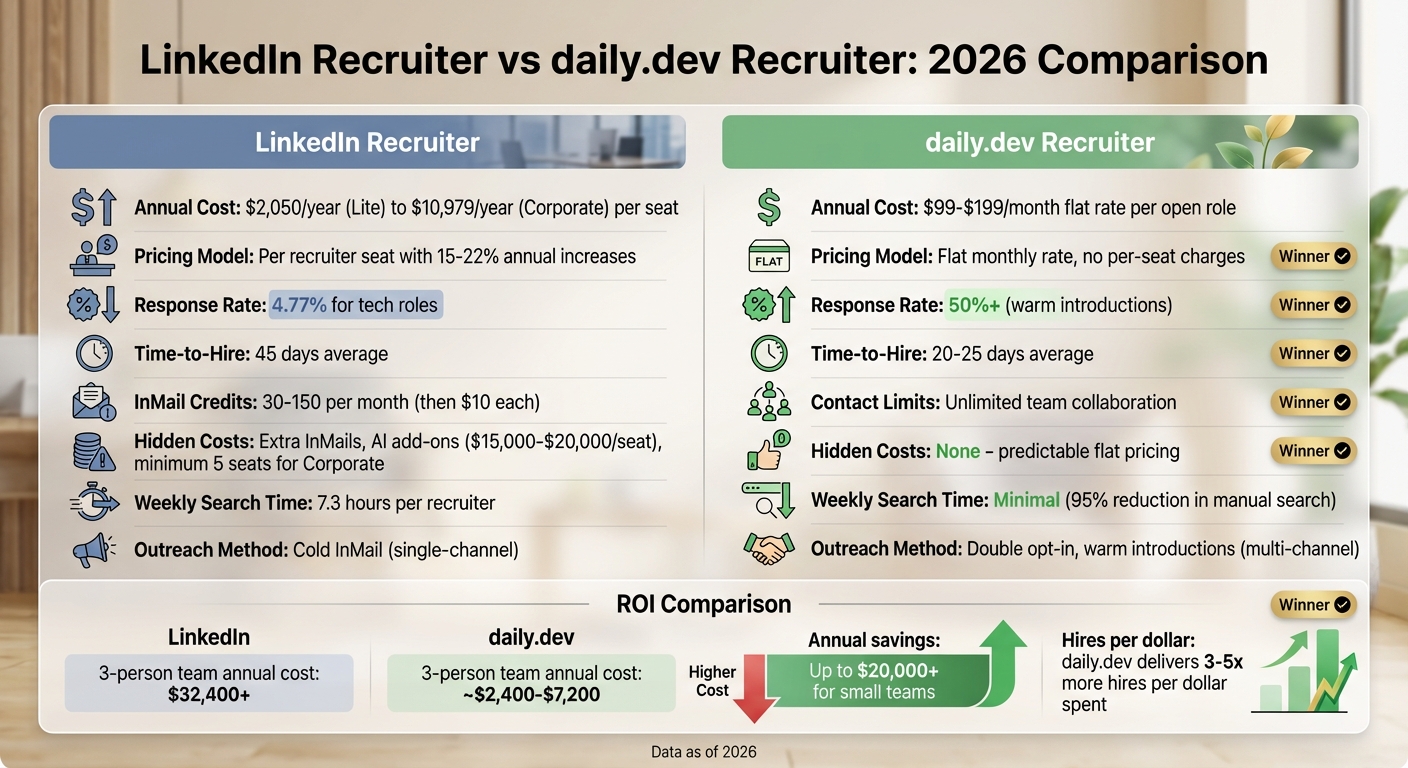 {LinkedIn Recruiter vs daily.dev Recruiter: Cost and Performance Comparison 2026}
When evaluating tech hiring platforms, two factors often stand out: pricing and cost predictability. Here's a side-by-side comparison to help you weigh your options:
| Feature | LinkedIn Recruiter | daily.dev Recruiter |
|---|---|---|
| Annual Cost (2026) | Recruiter Lite: ~$2,050/year per seat; Recruiter Standard: ~$10,979/year per seat | Flat monthly pricing per open role |
| Pricing Model | Per recruiter seat, with annual price increases (22% hike effective January 2026 ) | Flat monthly rate billed per open role |
This table highlights a key distinction: LinkedIn Recruiter charges per seat, with costs rising annually, while daily.dev Recruiter offers a flat, predictable rate tied to open roles.
For smaller teams, LinkedIn's escalating costs can create financial uncertainty, especially when benefits don't scale proportionally. On the other hand, daily.dev Recruiter simplifies budgeting by eliminating per-seat costs and unpredictable hikes. With one license, your entire team can collaborate seamlessly, focusing on meaningful connections rather than cold outreach.
For companies hiring multiple developers, daily.dev's pricing model and targeted approach can streamline recruitment efforts, ensuring better use of resources and a higher return on investment.
Conclusion: Is LinkedIn Recruiter Worth It in 2026?
Looking at the numbers and trends, it’s evident that tech hiring faces some tough challenges. LinkedIn Recruiter’s declining InMail response rates - just 4.77% for software roles - combined with annual price hikes of about 15%, make it a costly and unpredictable tool. Add to that the single-channel limitation and the fact that recruiters spend 7.3 hours weekly on manual searches, and it becomes clear that the return on investment is questionable. Paying around $10,000 per seat annually for minimal engagement feels like a losing strategy.
The average InMail response rate across industries sits at just 6.38%, and it’s even worse for developer roles. This puts outreach efforts on par with cold calling - time-consuming and largely ineffective. It’s clear the industry needs a better, more efficient solution.
Enter daily.dev Recruiter. It shakes up the recruitment game with a flat monthly rate per open role, eliminating the per-seat pricing model and its annual increases. Your team can work together under one license, removing budget headaches. But the real game-changer? Warm, double opt-in introductions to developers, with response rates soaring past 50%. By connecting with talent directly on daily.dev - where developers already spend their time - you replace the outdated cold outreach model with a trust-based approach.
For companies hiring multiple developers, the advantages are hard to ignore: predictable costs, better engagement, and a recruiting process that values developers' time and attention. The shift is overdue.
FAQs
What plan do I actually need?
When selecting a LinkedIn Recruiter plan, think about your hiring volume and budget.
- Recruiter Lite: Priced at about $170/month, this plan is ideal for small teams or companies with occasional hiring needs.
- Recruiter: At approximately $8,999/year per seat, this option is better suited for larger teams or businesses with frequent hiring demands.
Evaluate your hiring goals to determine which plan aligns with your requirements.
What are the hidden costs?
LinkedIn Recruiter comes with some hidden costs that might catch you off guard. For one, prices are set to climb significantly, with rates expected to jump by as much as 22% in 2026. On top of that, while LinkedIn offers AI-powered features, these tools don't always provide enough value to justify their expense. Another challenge? The high per-seat cost, which can feel especially inefficient for startups or smaller teams with limited budgets. For smaller organizations, these factors can quickly strain your hiring budget.
When does it pay off?
It’s worth the investment when the platform’s features - like its efficiency, access to an extensive professional network, and advanced search capabilities - align with your hiring needs. This is particularly beneficial for larger teams or companies that hire frequently, as it can simplify the recruitment process and help find higher-quality candidates.
.png)