LinkedIn has become a frustrating platform for developers due to spammy, impersonal recruiter messages and irrelevant outreach. Here’s the problem in a nutshell:
- 64% of developers feel recruiter messages are generic or AI-generated.
- 40% ignore outreach because it feels like spam.
- LinkedIn’s algorithm changes in 2025 reduced InMail response rates by 32%.
- Fake profiles and scams are rampant, with 86 million fake accounts detected in 2024.
Recruiters rely on high-volume, low-quality outreach, which damages trust and wastes time. Developers are now turning to platforms like GitHub and daily.dev, where recruitment is based on real-time activity, verified skills, and double opt-in introductions.
Key Takeaways:
- LinkedIn Recruiter is expensive ($10,000+ per seat annually) and inefficient.
- Platforms like daily.dev Recruiter offer better engagement with reply rates of 30–50%, compared to LinkedIn’s 10–25%.
- Alternatives focus on real developer activity, cutting through the noise of static profiles and spam.
If you’re tired of low response rates and wasted effort, it’s time to explore recruitment platforms built specifically for developers.
Why LinkedIn Became Spam Central for Developers
LinkedIn has turned into a spam hotspot for developers, largely due to the rise of success-only contracts. These contracts incentivize recruiters to send out mass, generic messages, hoping that even a single response will make their efforts worthwhile .
Automation tools and LinkedIn’s built-in templates have made it easy for recruiters to target anyone with a mention of "computer science" or basic programming skills in their profile . This approach has been further fueled by ongoing developer shortages in critical sectors like financial services, leading to a flood of impersonal outreach . Unfortunately, this automated strategy has also opened the door for more deceptive practices.
The situation worsened with the emergence of bots and scammers. LinkedIn reported detecting over 86 million fake profiles and 142 million spam or scam messages in early 2024 . These AI-powered bots often impersonate legitimate recruiters, using flattery and familiar phrases like "came across your profile" or "kindly" to lure users into phishing schemes . Joe Procopio, Founder of Teaching Startup, humorously summed up the trend:
"I mean, 'came across' is the chef's kiss of bot-speak. But you don't have to be a marketing specialist to see the patterns in 'experience,' 'discuss,' 'kindly,' and 'connection request.'"
A 2020 study revealed that about 35% of LinkedIn connection requests were immediately followed by aggressive recruitment messages . As a result, only 12% of developers now consider LinkedIn their go-to source for technical information . Even worse, 40% of developers outright ignore outreach because it "looks like spam" .
In late 2025, LinkedIn attempted to address the issue by updating its algorithm to filter out transactional language . While this change aimed to curb spammy practices, it also highlighted how deeply ingrained high-volume, automated outreach had become on the platform. These tactics have driven many developers to prefer more personalized recruitment approaches that build credibility. Up next, we’ll explore how these trends impact hiring through LinkedIn Recruiter. Many teams are now comparing LinkedIn Recruiter alternatives to find more effective ways to connect with talent.
Hiring engineers?
Connect with developers where they actually hang out. No cold outreach, just real conversations.
Problems with LinkedIn Recruiter for Developer Hiring

LinkedIn Recruiter faces challenges like outdated profiles, lack of real-time insights, and a pricing structure that doesn't always align with recruiting needs.
One of the biggest issues is that profiles on LinkedIn tend to remain static, especially for passive candidates who aren’t actively job hunting. This creates a disconnect between recruiters and developers. Recruiters often prioritize volume over precision, leading to mismatches and wasted time. Hiring manager Jason Cox sums it up well:
"The technology recruiting industry is entirely geared towards quantity over quality... Get these jobs filled and do it yesterday!"
This quantity-over-quality mindset frequently results in technical errors and generic outreach that developers disregard as spam.
Another major limitation is LinkedIn’s inability to track real-time developer activities, like ongoing education or contributions to open-source communities. Studies indicate that high-intent signals - like updating a portfolio - are up to 11 times more effective at predicting whether a candidate is open to conversations compared to keyword matching alone . Without these insights, recruiters often waste time contacting candidates who aren’t interested or available.
On top of these operational hurdles, the cost structure of LinkedIn Recruiter adds another layer of inefficiency. Pricing ranges from $1,680 to $12,960 per seat annually, but this includes a limited number of InMail credits (30–150 per month), which many recruiters exhaust by mid-month . Software engineer Adam Vesecký highlights the frustration this creates:
"Recruiter spam has become my biggest pain point with LinkedIn... top candidates are swamped, getting hundreds of messages daily, most of them being just recycled templates."
Recruiters also spend an average of 7.3 hours per week manually searching through profiles , often leading to outreach that developers dismiss as irrelevant or impersonal.
Here’s a quick comparison of LinkedIn Recruiter versus developer-first approaches:
| Metric | LinkedIn Recruiter | Developer-First Approaches |
|---|---|---|
| Data Type | Static profiles (often outdated) | Real-time activity & skill signals |
| Outreach Method | Cold InMails (low response rates) | Double opt-in, warm introductions |
| Pricing Model | Per recruiter seat ($1,680–$12,960/year) | Per open role (unlimited seats) |
| Search Time | ~7.3 hours/week manual searching | Minimal (pre-qualified matches) |
| Intent Signals | None (keyword matching only) | Behavioral triggers & engagement data |
These inefficiencies not only slow down the hiring process but also contribute to the growing perception of recruiter outreach as spam, making it harder to connect with developers effectively.
1. LinkedIn Spam Problems
Developers Are Drowning in Generic, Irrelevant Messages
Developers on LinkedIn face an avalanche of generic messages that fail to connect with their actual skills or needs. Recruiters often rely on buzzwords instead of focusing on real, up-to-date expertise, leading to outreach that feels off-target. This approach has damaged trust, with 40% of developers ignoring outreach simply because it comes across as spam.
But it’s not just the irrelevant messages causing issues. Fraudulent schemes and excessive ads are making LinkedIn a frustrating place for developers. Some scammers post fake job listings or lure users into "test projects" that secretly install malicious code, often targeting cryptocurrency wallets. The platform’s ease of creating professional-looking profiles and listings has made it a playground for these bad actors.
On top of that, developers are overwhelmed by ads. For every organic post in their feed, they encounter about 10 ads, making it harder to engage with genuine content. As Python for Engineers bluntly stated:
"LinkedIn has started showing these 'Suggested' posts by random weirdos on the internet. Most of them are garbage - they are from the sort of SEO spammy sites we see on Google".
This flood of irrelevant messages, scams, and ads not only frustrates developers but also undermines LinkedIn's effectiveness as a recruitment tool, leaving many to see the platform as more spam than substance. This shift is why many companies are now comparing developer-centric platforms vs traditional hiring tools to find better engagement.
What Developer-Focused Alternatives Exist?
Platforms Built Around Developer Communities and Code Activity
Recruiters are shifting away from LinkedIn's cluttered messaging environment to platforms where developers naturally spend their time. These alternatives prioritize actual code activity, community involvement, and technical portfolios over traditional resumes filled with keywords. It's about meeting developers where they are and valuing their real contributions.
Take GitHub, for instance. With a massive user base of 65 million showcasing their code repositories and tech stacks, it’s a goldmine for recruiters seeking verified skills . Then there’s AmazingHiring, a tool that aggregates data from over 50 platforms, giving recruiters a broader view of a candidate’s technical footprint . These platforms allow recruiters to evaluate talent based on real-world contributions rather than self-reported claims, cutting through the noise that plagues LinkedIn.
Some companies are already seeing results. Startups like Ramp and Perplexity have shifted over 80% of their hiring efforts away from LinkedIn, tapping into developer sourcing channels instead . By targeting developers active in open-source projects and technical communities, these businesses naturally avoid the spammy, impersonal outreach that’s so common on traditional platforms.
For recruiters, this approach is a game-changer. Instead of sending out cold, generic messages, you’re engaging with developers based on their actual work - whether it’s code commits, community contributions, or technical blogs. This not only boosts response rates but also fosters more meaningful connections.
3. Recruitment Efficiency
Time Wasted Fighting Spam and Fake Profiles
One of LinkedIn's biggest hurdles is the overwhelming presence of fake profiles and spam, which eats away at recruiter productivity. These fraudulent activities aren't just annoying - they're a serious obstacle to efficient hiring. Recruiters often find themselves bogged down, spending precious hours sorting through irrelevant or misleading information, which slows the entire hiring process and pushes them to explore more reliable, real-time alternatives.
Consider this: recruitment teams spend up to 30% of their time screening unqualified applicants . On top of that, they lose additional hours verifying whether profiles are even legitimate. This constant filtering of irrelevant data is further complicated by LinkedIn's static candidate information, which often fails to provide an up-to-date picture of a candidate's skills or activities.
LinkedIn's keyword-heavy profiles add another layer of inefficiency. Recruiters are forced into a manual verification cycle - checking GitHub contributions, conducting technical interviews, and cross-referencing claims - just to confirm a candidate's qualifications or identify qualified technical candidates more efficiently. This process not only wastes time but also drains energy, especially when recruiters have to deal with unresponsive candidates or profiles that don't match their expectations.
To make matters worse, only 22% of LinkedIn users in the United States log in daily . This low activity means messages often go unread, and response rates continue to drop, making the platform even less effective for time-sensitive hiring needs.
The real fix isn't to double down on LinkedIn's flawed system. Instead, recruiters should consider platforms to source software developers where activity is real-time, profiles are verified, and spam is a non-issue. These alternatives can save time and provide a more accurate view of potential candidates.
4. Candidate Engagement
Why Developers Ignore Most Recruiter Messages
Spam-like messages and a lack of trust are major reasons developers avoid recruiter outreach. In fact, 43% of developers mute recruiters because they find the messages irrelevant and overly generic . With 80% of developers being passive candidates who rarely update their profiles or respond to cold InMail , traditional approaches just don’t cut it anymore. Recruiters need to rethink their strategies and focus on methods that resonate with developers on a personal level.
Messages that feel generic - like those touting "exciting opportunities" or a "competitive salary" - are immediate turn-offs. Why? Because they fail to reflect any understanding of the developer's unique skills or interests. Developers want to see that you've taken the time to understand their work, not just skimmed their profile for keywords.
A better approach? Hyper-personalized outreach. Referencing a developer's specific repositories, commits, or technical contributions shows you've done your homework . This kind of effort proves you're genuinely interested in their work, not just casting a wide net. Even more effective is peer-to-peer outreach, where hiring managers or senior engineers reach out directly. Developers are far more likely to engage with technical peers who understand their world and speak their language .
| Feature | Traditional Outreach (LinkedIn) | Developer-Centric Outreach |
|---|---|---|
| Initial Contact | Cold Outreach | Warm Intro (Double Opt-In) |
| Trust Score | Low (5% for InMail) | High (Full Developer Opt-In) |
| Data Source | Static Resumes | Real-time Behavioral Signals |
Switching from cold outreach to warm, double opt-in introductions allows developers to engage on their own terms, ensuring conversations are more meaningful. This approach not only builds trust but also reflects a broader trend toward more effective, developer-centered hiring strategies.
5. Cost-Effective Solutions
How Much LinkedIn Recruiter Actually Costs (And What You're Really Paying For)
Let’s break down the true costs of using LinkedIn Recruiter. The Corporate plan runs between $8,500 and $10,000 per seat annually. For a team of five recruiters, that adds up to $42,500 to $50,000 per year. And that’s just the base cost. Need more InMails? Each additional credit costs about $10, so purchasing 100 extra InMails will set you back $1,000 - often resulting in only 18–25 replies.
But the expenses don’t stop there. Low reply rates (18–25%) mean you’re sinking money into outreach that largely goes unanswered, while competing in inboxes already drowning in spam. LinkedIn reported 142 million spam or scam messages detected in the first half of 2024 alone. On top of that, the tool-related cost per hire can climb to $2,125 to $2,500, and that doesn’t even include labor or job board fees.
Now, compare this to developer-focused platforms. These platforms turn the traditional model on its head. Instead of cold InMails that often go ignored, they focus on warm, double opt-in introductions - where developers have already shown interest. This approach delivers three times higher reply rates than cold outreach. In other words, you’re spending your budget on real conversations rather than unanswered messages.
What’s more, tools that leverage behavioral data from platforms like GitHub and Stack Overflow can drastically reduce screening time. With AI-powered sourcing, you can cut the process from months to just 30 minutes. Add to that native ATS integrations with systems like Greenhouse and Lever, and you eliminate tedious manual data entry, saving even more time and money.
Switch to daily.dev Recruiter: A Developer-Centric Solution
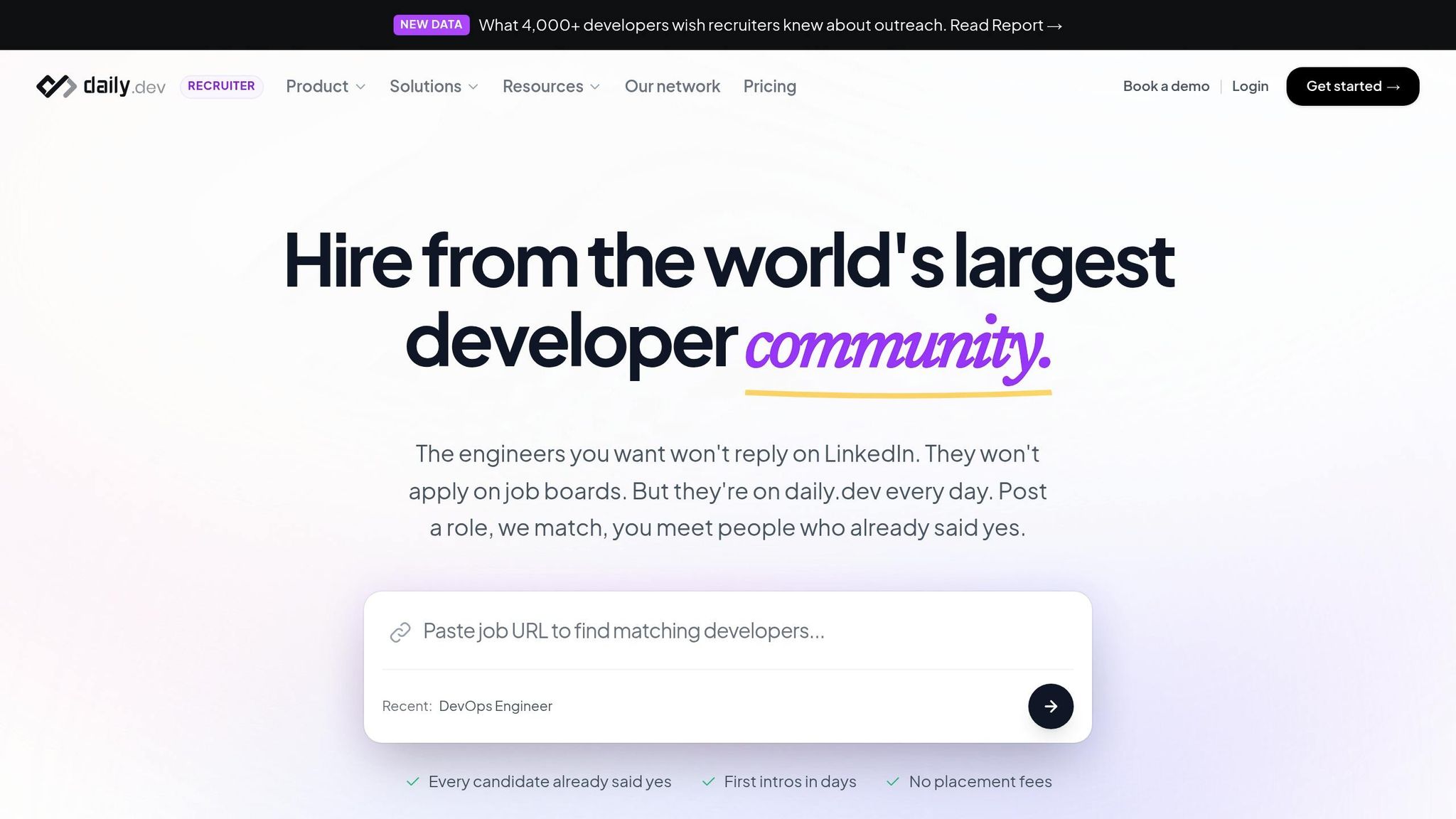
daily.dev Recruiter changes the game for connecting with developers. Forget cold InMails that often get ignored - instead, you’ll get warm, double opt-in introductions. This means both the developer and a mutual connection agree to the contact before any messages are exchanged. The result? Reply rates soar to 30–50%, compared to LinkedIn’s usual 10–20% range. This success is built on a vibrant community of tech professionals.
With over 1 million active users, daily.dev connects you to developers who are already using the platform daily to read, learn, and grow. When you post a job, it shows up directly in their feed alongside articles and resources they’re already engaging with. This seamless integration turns job postings into opportunities rather than interruptions, ensuring your roles reach the right audience. Using a developer hiring checklist can further streamline this outreach.
What sets daily.dev apart is its use of real-time interest tracking. For instance, if a developer is actively consuming content about React and your job requires React expertise, the platform automatically makes that connection. This precise targeting leads to stronger engagement and better alignment between candidates and roles.
Job postings on daily.dev are tailored specifically for developers. Each listing includes a concise TLDR summary, full salary details, the tech stack, team size, remote work policies, and a breakdown of the recruitment processes. The results speak for themselves: a tech staffing agency filled 15 senior developer roles in just 3 months with a 40% reply rate, compared to LinkedIn’s 6-month timeline and 12% reply rate. In another case, a startup hired a full-stack engineer after a single double opt-in introduction that showcased its React/Node.js stack, cutting through the usual hiring noise.
And the cost? Plans start at just $99 per month per seat, a fraction of LinkedIn Recruiter’s $10,800+ annual corporate seat price. But it’s not just about saving money - you’ll achieve faster placements, higher engagement, and genuine conversations with developers who are eager to connect. By combining affordability with meaningful engagement, daily.dev Recruiter offers a fresh approach to hiring in the tech world.
Benefits of Using daily.dev Recruiter Over LinkedIn Recruiter
::: @figure 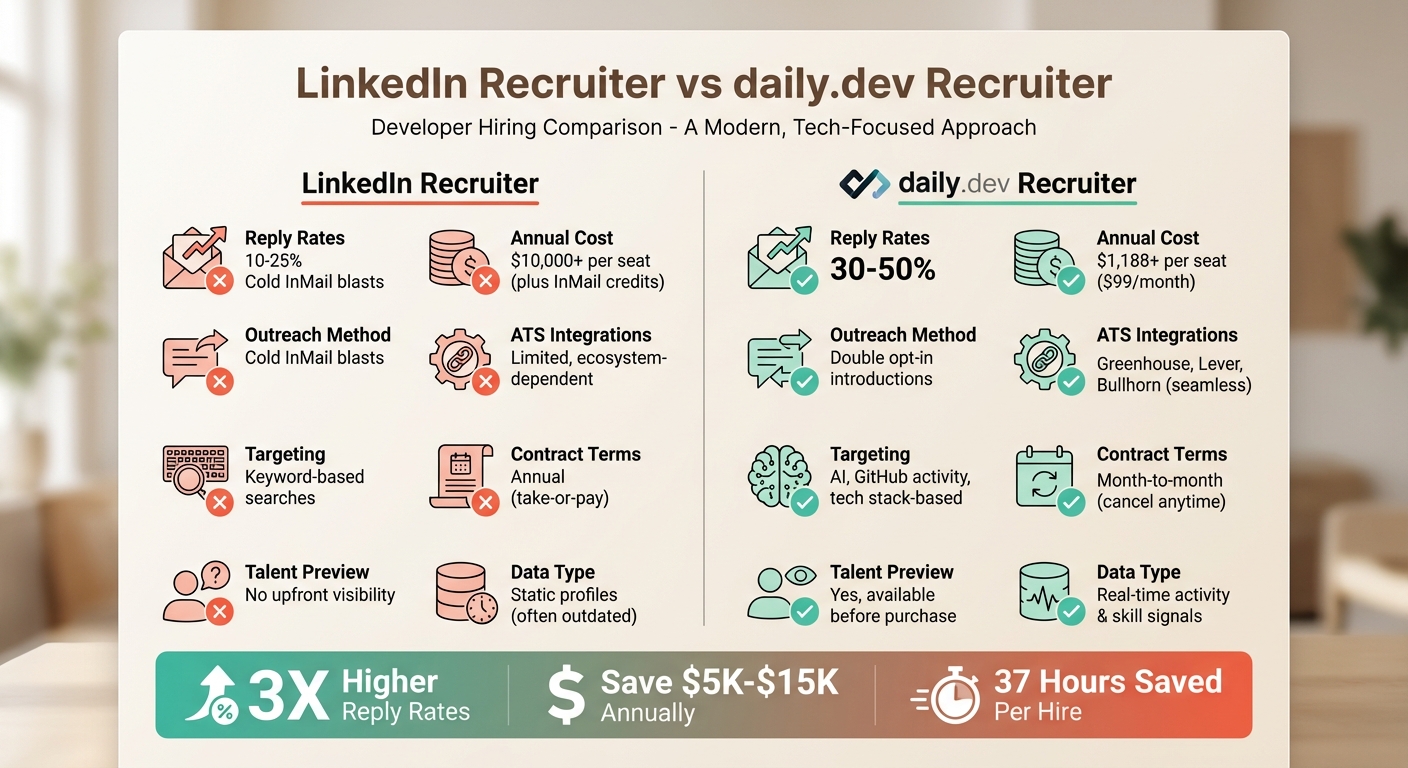 {LinkedIn Recruiter vs daily.dev Recruiter: Cost, Reply Rates & Features Comparison}
daily.dev Recruiter achieves 30–50% reply rates through warm, double opt-in introductions, compared to LinkedIn Recruiter's 10–25% reply rates via generic InMails . This success stems from engaging developers in spaces centered on tech content and learning, rather than bombarding them with unsolicited messages.
When it comes to cost, LinkedIn Recruiter charges over $10,000 per seat annually, plus extra fees for InMail credits, making expenses unpredictable. On the other hand, daily.dev offers a straightforward pricing model starting at $99 per month per seat , with no hidden fees. For teams sourcing 500 developers monthly, this could result in $5,000–$15,000 in annual savings . These financial perks are paired with daily.dev's extensive features.
daily.dev also shines in precision targeting. It integrates effortlessly with developer hiring platforms and ATS like Greenhouse, Lever, Workday, and Bullhorn, allowing for automatic candidate syncing and AI-powered profile enhancement from developer-specific sources . In contrast, LinkedIn primarily operates within its own ecosystem, often requiring additional setup to achieve similar functionality.
With daily.dev, AI-driven natural language prompts match developers based on GitHub activity, tech stack, and community involvement. This process generates curated profiles in seconds and pre-qualifies candidates by verifying timezone, location, tech stack, and seniority before introductions . LinkedIn's keyword-based searches, by comparison, frequently yield less relevant results .
Another standout feature is the ability to preview available talent for specific tech stacks before committing to a paid plan . This transparency eliminates the uncertainty tied to annual contracts and rigid take-or-pay agreements.
Cam Green, President of Cura Recruiting, highlighted the value of similar AI-driven tools, noting they improve candidate experiences by 100% while offering faster, more reliable support compared to traditional platforms .
| Feature | daily.dev Recruiter | LinkedIn Recruiter |
|---|---|---|
| Reply Rates | 30–50% (targeted dev communities) | 10–25% (spam-prone InMails) |
| Annual Cost | $1,188+ per seat | $10,000+ per seat plus credits |
| Outreach Method | Double opt-in introductions | Cold InMail blasts |
| ATS Integrations | Greenhouse, Lever, Bullhorn (seamless) | Limited, ecosystem-dependent |
| Targeting | AI, GitHub activity, tech stack–based | Keyword-based searches |
| Contract Terms | Month-to-month (cancel anytime) | Annual (take-or-pay) |
| Talent Preview | Yes, available before purchase | No upfront visibility |
Conclusion
LinkedIn Recruiter relies on cold InMails, static resumes, and keyword-based searches, often leading to response rates as low as 5% .
daily.dev Recruiter takes a completely different approach. Instead of cold outreach, it connects you with passive talent already engaged in learning and contributing within a trusted developer community. Using AI-driven behavioral matching, the platform analyzes real-time activity - what developers are reading, creating, and exploring - rather than relying on outdated keyword searches . This method uncovers talent that other platforms often overlook .
To make the process even smoother, the double opt-in system ensures that every introduction is mutual and welcomed, cutting out ghosting and spam. Job opportunities are seamlessly integrated into developers' daily content feeds, turning outreach into a professional opportunity rather than an interruption . This results in response rates three times higher than traditional channels and saves engineering managers an average of 37 hours per hire . That’s a game-changer for hiring teams looking to work smarter, not harder.
Struggling with low response rates and high recruiting costs? daily.dev Recruiter offers a better way. With plans starting at $99 per seat, month-to-month flexibility, ATS integration, and the ability to preview talent before committing, it’s designed to make hiring faster and more effective. This shift from cold outreach to trust-based connections reflects the future of developer recruitment - exactly how hiring should be.
FAQs
How can I spot recruiter spam on LinkedIn?
Recruiter spam on LinkedIn often comes with telltale signs. Watch out for profiles that seem freshly created or have very few connections. Unprofessional details, like messages riddled with poor grammar, are another red flag. Be especially wary if the recruiter insists on using unconventional contact methods, such as WhatsApp or Telegram. Generic or overly vague messages that don’t align with professional norms are also worth scrutinizing.
Why are LinkedIn Recruiter reply rates dropping for developers?
Recruiters are facing a growing challenge: developers are increasingly skeptical of their outreach efforts. Many developers perceive these messages as impersonal or even spammy, with a striking 64% believing the content is simply copy-pasted. What’s more, over half suspect that so-called personalized messages are actually written by AI, deepening the trust gap.
The problem doesn’t stop there. A significant 61.5% of developers feel that recruiters don’t truly understand the roles they’re hiring for, making the outreach feel irrelevant or uninformed. Even among developers who are open to new opportunities, 43% admit they actively ignore recruiter messages. This widespread lack of trust has made traditional LinkedIn outreach far less effective than it once was.
What makes double opt-in introductions work better for developer hiring?
Double opt-in introductions work well for hiring developers because they prioritize mutual interest and trust before any direct communication happens. This method often results in higher response rates, faster engagement, and a stronger alignment between candidates and job opportunities.
.png)