When reaching out to developers, your first message matters. A poorly crafted, generic message can be ignored instantly. Instead, focus on a minimum viable first message - short, specific, and respectful of their time. Here's how to nail it:
- Personalization: Reference their actual work, like a GitHub project or article, to show you’ve done your homework.
- Value Proposition: Highlight why the opportunity is relevant to their interests and career, not just your company’s needs. Be specific (e.g., salary range, tech stack).
- Simple Call-to-Action: End with a low-pressure ask, like a brief 15-minute chat, to keep the conversation easy and non-intimidating.
Avoid mistakes like vague messages, lack of technical understanding, or omitting key details like salary or job specifics. Tools like daily.dev Recruiter help by connecting you with developers based on their real-time interests, ensuring your outreach feels relevant and timely.
Key takeaway: Build trust by being clear, specific, and respectful of their time. Thoughtful communication leads to improving response rates and meaningful connections.
What Makes a Good First Message to a Developer
Crafting an effective first message comes down to three key elements: personalization, a clear value proposition, and a simple call-to-action. When these pieces come together, your outreach feels tailored and respectful of the developer's time, while clearly highlighting why the opportunity is worth their attention. Think of it as the "minimum viable message" - short, specific, and considerate. Here's how each element works:
Personalization: Show You Know Their Work
Personalization goes beyond just using their name. It’s about showing genuine interest in what they’ve done. Mention a specific GitHub project they’ve contributed to, an article they’ve written, or a technology they’ve been engaging with on platforms like daily.dev. For instance, referencing a repository they’ve built or a topic they’ve discussed demonstrates that you’ve taken the time to learn about their expertise.
This level of detail sets your message apart from generic outreach. Recognizing their unique skills and interests makes it clear you see them as more than just another name on a list.
Value Proposition: Why Should They Care?
Developers are busy, and they need a compelling reason to engage. Your value proposition should focus on what truly matters to them - like working on meaningful projects, using cutting-edge technologies, or enjoying flexibility in their role. Forget leading with company perks; instead, highlight the technical challenges and tangible impact the role offers.
Tie this directly to what you’ve learned about them. For example, if they’ve been exploring machine learning on daily.dev, mention how the position involves building ML infrastructure. By connecting the role to their interests, you’re showing that this opportunity aligns with their career goals.
Call-to-Action: Keep It Simple and Low-Pressure
Your call-to-action should be clear, easy, and non-intimidating. Avoid asking for big commitments upfront. Instead, suggest something small, like a brief 15-minute chat. For example, you could say: "Would you be open to a quick 15-minute conversation next week?" or "If this sounds interesting, I’d love to share more details - are you available for a brief chat?"
This approach makes it easy for them to respond without feeling like they’re signing up for a long interview process. A low-pressure ask builds trust and keeps the door open for further conversation. The goal here isn’t to close the deal - it’s to start a dialogue.
How to Structure Your Message
::: @figure 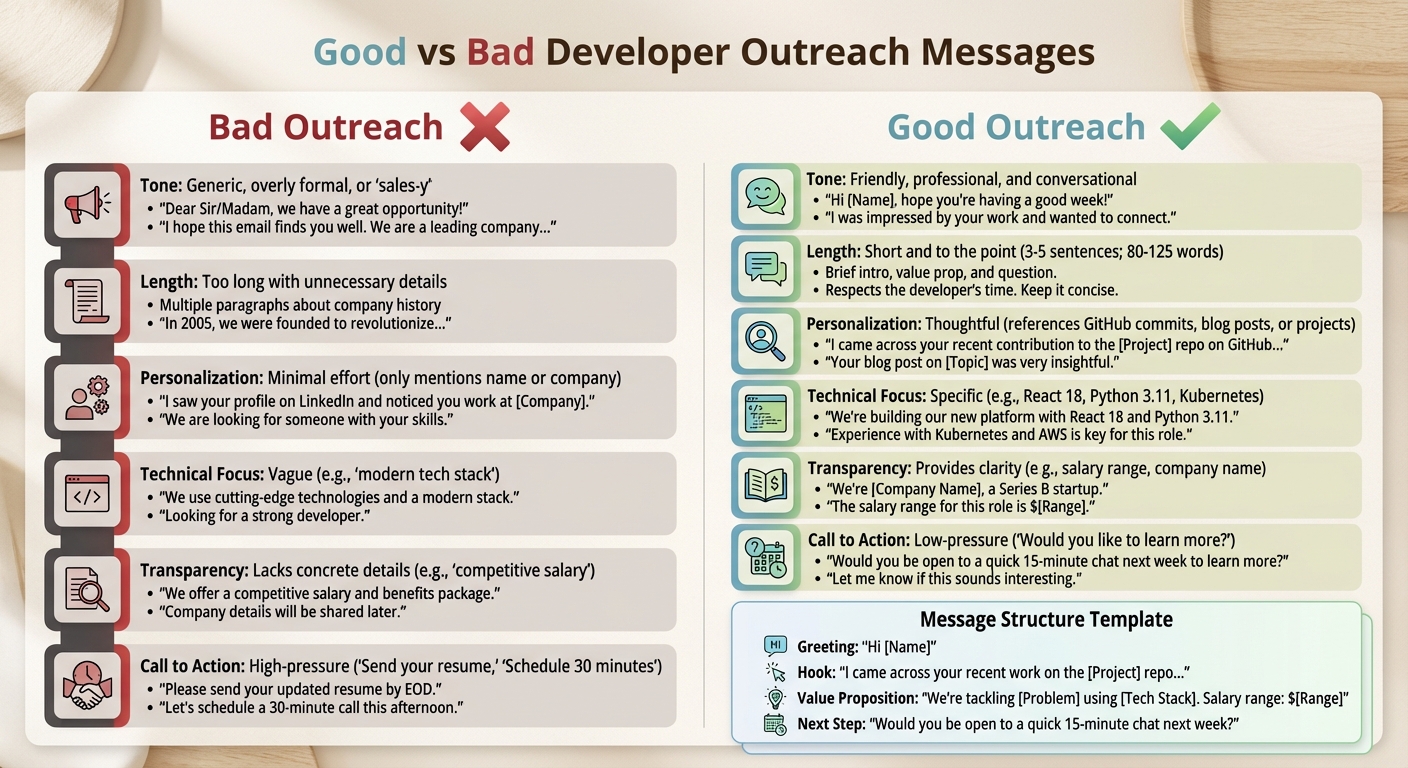 {Good vs Bad Developer Outreach Messages Comparison}
Crafting a clear and engaging message is easier when you follow a straightforward formula: greeting, hook, value proposition, and next step. This structure keeps your outreach focused and concise. Aim for 80–125 words - short enough to respect their time but detailed enough to show genuine effort.
Keep the tone professional yet conversational, creating a sense of connection on a peer-to-peer level. Below, we’ll break down this formula with a practical template and show how effective messages differ from lackluster ones. Following a developer hiring checklist can help ensure your outreach remains consistent and effective.
Message Template: Greeting, Hook, Value Proposition, and Next Step
Here’s how each part of the message works:
| Message Component | Purpose | Example |
|---|---|---|
| Greeting | Start with a personal touch to establish rapport | "Hi [Name]", |
| The Hook | Show you’ve done your homework | "I came across your recent work on the [Project] repo and was impressed..." |
| Value Proposition | Explain why they should care, with specific details like salary range | "We’re tackling [Problem] using [Tech Stack]. This role offers a salary range of $[Range]." |
| Next Step | End with a low-pressure call-to-action | "Would you be open to a quick 15-minute chat next week?" |
The key is to personalize your outreach: use their name, reference something specific about their work, clearly explain how your opportunity aligns with their expertise, and finish with a simple, non-intimidating ask.
Good vs. Bad Messages: A Comparison
What makes one message stand out while another gets ignored? It’s all in the details. Let’s compare effective and ineffective outreach:
| Feature | Poor Outreach (Bad) | Effective Outreach (Good) |
|---|---|---|
| Tone | Feels generic, overly formal, or "sales-y" | Friendly, professional, and conversational |
| Length | Too long, with unnecessary details | Short and to the point (3–5 sentences; 80–125 words) |
| Personalization | Minimal effort (e.g., only mentions name or company) | Thoughtful (e.g., references GitHub commits, blog posts, or projects) |
| Technical Focus | Vague ("modern tech stack") | Specific (e.g., React 18, Python 3.11, Kubernetes) |
| Transparency | Lacks concrete details (e.g., "competitive salary") | Provides clarity (e.g., salary range, company name) |
| Call to Action | High-pressure ("Send your resume", "Schedule 30 minutes") | Low-pressure ("Would you like to learn more?") |
Poor outreach often feels like a mass email - impersonal and vague. Effective outreach, on the other hand, is tailored and specific. Mentioning their actual work, using precise technical terms, and being upfront about details like salary makes all the difference. It shows you’ve taken the time to understand their background and aren’t just sending out a generic pitch.
Using daily.dev Recruiter for Better Outreach
Making a strong first impression is crucial, but connecting with developers where they’re already engaged takes it to the next level. That’s exactly what daily.dev Recruiter offers - introductions to prequalified developers through a double opt-in process. No cold emails. No spam. No guesswork.
Here’s how it works: instead of relying on static resumes or outdated profiles, the platform uses real-time behavioral signals - like what developers are reading, following, or building - to match them with your role. Your job listing is seamlessly integrated into their daily content feed, making it feel like a natural fit rather than an interruption. And because both parties must explicitly opt in, every conversation starts with mutual interest and intent . This approach ensures your message lands in the right place, at the right time.
Features That Improve Developer Response Rates
daily.dev Recruiter goes beyond hiring tools for technical roles by combining smart matching with verified candidate insights. It uses behavioral data to pinpoint developers based on their current activities. For example, if someone is exploring Rust or diving into GenAI trends, your role shows up when it’s most relevant .
Before any introduction, candidates answer up to three custom screening questions. This, paired with automated verification of their activity - like GitHub stars or their reading history - ensures you’re only connecting with individuals who meet your hiring criteria . The platform also syncs with your Applicant Tracking System (ATS), eliminating duplicate candidates and keeping your workflow efficient .
The numbers are impressive: over 1 million engineers from more than 13,000 companies are active on daily.dev. Of those, 40% are senior individual contributors or technical leaders . Even more striking, 90% of developers on daily.dev won’t respond to outreach on other platforms . They’re open to opportunities, but only when they’re personalized and relevant.
How daily.dev Builds Trust with Developers
Developers are often skeptical of recruiters. With an average trust score of just 2.5 out of 5.0, and 43% ignoring recruiter messages because they feel like spam, it’s clear trust is a major barrier . daily.dev flips the script by embedding your opportunity within a trusted, educational environment where developers already go to learn and grow.
"We built a place where engineers can turn off the noise. To enter this space, you don't need a hack. You need trust." - Nimrod Kramer, CEO & Co-Founder, daily.dev
On daily.dev, developers aren’t actively job hunting - they’re reading, learning, and focusing on professional growth. When your role appears in their feed, it’s aligned with their interests and activities, not buried in an overcrowded inbox. This context not only builds trust but also elevates your brand’s credibility within the engineering community . With over 1 billion developer sessions logged and recognition as Product of the Year on Product Hunt (with a 4.8/5 rating), daily.dev has proven itself as a platform developers rely on .
Even the pricing model reflects this trust-first philosophy: you pay for results, not seats, and there are no traditional placement fees . It’s a recruiting solution designed for alignment and effectiveness, not volume.
Hiring engineers?
Connect with developers where they actually hang out. No cold outreach, just real conversations.
Common Outreach Mistakes to Avoid
Even with the best intentions, certain missteps can cause your outreach efforts to fall flat. Often, the difference between a positive response and complete silence lies in steering clear of a few predictable errors.
Why Generic and Sales-Heavy Messages Fall Short
Developers can recognize a template a mile away. Starting with phrases like "I came across your profile and think you'd be a great fit" screams lack of effort and research. Superficial personalization not only fails to resonate but also chips away at trust. Leaving out key details - like salary ranges or a clear breakdown of the tech stack - turns your message into a frustrating guessing game. Even worse, technical missteps, such as confusing Java with JavaScript or requesting a decade of experience in a framework that’s only been around for five years, can instantly discredit you in the eyes of your audience. These mistakes signal a lack of understanding about the developer's world, making your outreach feel irrelevant and untrustworthy .
Beyond personalization, failing to address the actual needs and priorities of developers can further derail your efforts.
Overlooking What Developers Care About
To grab a developer's attention, your outreach needs to align with what they value: meaningful work, clear expectations, and flexibility. Leaving out essential details - like salary ranges, remote work options, or precise job descriptions - forces developers to guess whether the opportunity fits their goals. This uncertainty can quickly cause even the most qualified candidates to disengage.
Another common misstep? Disrupting their focus time. Developers are highly protective of their workflow, so suggesting an unplanned midday phone call instead of offering asynchronous options, like email or scheduled chats, can feel intrusive. While it’s true that 75% of developers are open to hearing about new opportunities , they prefer these conversations to happen on their terms. Respecting their time and providing all the necessary information upfront can significantly improve your chances of getting a response.
| Mistake | Negative Outcome | Correct Approach |
|---|---|---|
| Superficial personalization | Messages ignored; trust eroded | Reference specific GitHub projects or technical blog posts |
| Ignoring technical context | Low reply rates; perceived as spam | Match roles to the developer's verified tech stack |
| Hiding key details | Disinterest from top candidates | Share salary, remote policies, and job specifics upfront |
| Vague job descriptions | Wasted time during screening | Clearly outline technical requirements and project context |
| Over-automation | Triggers spam filters; damages credibility | Combine automation with genuine, tailored messaging |
Conclusion: Write Messages That Build Trust and Get Responses
Crafting a message that gets noticed starts with trust and relevance - it’s not about using cookie-cutter templates. The key is authenticity. Take the time to personalize your outreach: mention their actual work, include essential details like the salary range and tech stack, and offer a low-pressure way for them to respond. Make it easy and respectful of their time.
Here’s the formula: personalize your message, clearly communicate the value, and wrap it up with a straightforward call-to-action . Effective developer recruitment isn’t about blasting out emails; it’s about having meaningful conversations with the right people . As Nimrod Kramer, CEO & Co-Founder of daily.dev, puts it: “In tech recruiting, attention isn’t earned by volume. It’s earned by trust” . This approach shifts the focus from quantity to quality - target developers who genuinely align with your opportunity instead of sending out hundreds of cold emails.
Tools that foster trust-based connections naturally complement these principles. For example, daily.dev Recruiter allows you to engage with developers where they naturally spend time - learning, reading, and participating in their professional community. With this tool, you can connect with passive talent based on their real-time interests . The result? Warm, double opt-in introductions that feel like tailored opportunities, not spam.
Here’s something to consider: 90% of developers on daily.dev say they rarely respond to outreach on traditional platforms . This statistic highlights the need to rethink your recruitment strategy. Developers value transparency, respect for their workflow, and opportunities that align with their career goals. When you meet these expectations, you’ll see better response rates and stronger hiring outcomes.
Thoughtful communication builds trust, and trust opens doors. Pair that with the right tools, and you’ll connect with developers who are genuinely interested in what you have to offer.
FAQs
How can you make your first message to a developer stand out?
When reaching out to a developer for the first time, aim to make your message personal, relevant, and clear. Mention their specific skills, past projects, or interests to show you’ve done your homework. This effort not only grabs their attention but also demonstrates that you genuinely understand their expertise.
Be upfront about the role by outlining key details like responsibilities, expectations, and the tech stack involved. This transparency helps establish trust and shows the opportunity is worth their time.
Skip the generic, overly formal tone. Instead, strike a balance - keep it professional but approachable. A well-thought-out, customized message is much more likely to spark interest and lead to a positive response.
How can I make my outreach to developers more personalized and effective?
When reaching out, make it personal by focusing on specific aspects of the developer's work, skills, or passions. Take the time to reference their projects, contributions, or technical expertise. This shows you've done your homework and genuinely appreciate their experience.
Steer clear of generic messages or shallow personalization, like just addressing them by name. Instead, craft your message to align with their career aspirations. Highlight how the role you're offering connects with their interests and goals.
For instance, you could mention the tech stack they’d be working with, the unique challenges they’d tackle, or the growth opportunities available in the position. This thoughtful effort not only builds trust but also establishes credibility, making your outreach far more engaging and impactful.
Why should I include specific job details, like salary, in my first message to a developer?
Including clear job details, like salary, in your initial outreach is a smart move. It signals respect for the developer's time and ensures transparency. Developers are often inundated with messages, so sharing key information upfront helps them quickly decide if the role aligns with their goals and expectations.
When you address critical factors, such as compensation, early in the conversation, it shows you value their time and expertise. This thoughtful approach not only boosts the likelihood of a response but also lays the groundwork for a more meaningful and productive dialogue.
.png)