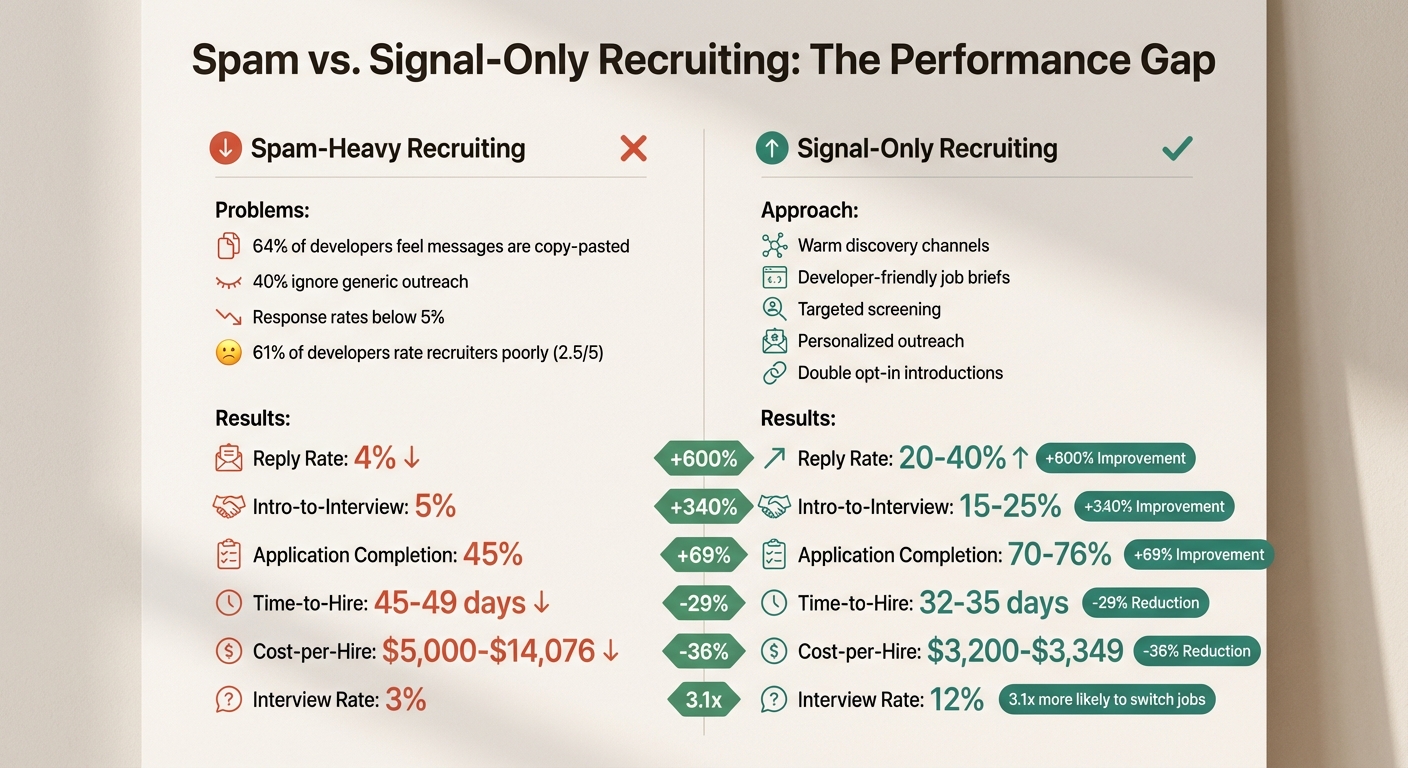
Recruiting developers through spammy, generic outreach doesn’t work anymore. Here’s why:
- 64% of developers feel recruiter messages are copy-pasted.
- 40% ignore generic outreach, leading to response rates below 5%.
Switch to a signal-only recruiting funnel to target developers who show interest or align with your role. Here’s what you gain:
- 20–30% reply rates (vs. 5%).
- Faster hiring: 35 days vs. 49 days.
- Lower cost-per-hire: $3,349 vs. $14,076.
The key steps:
- Define developer personas: Understand skills, goals, and motivations.
- Use warm discovery channels: Engage developers where they’re already active, like daily.dev.
- Write developer-friendly job descriptions: Be specific - tech stack, salary, and role scope matter.
- Screen effectively: Use clear, targeted questions and streamline the process.
- Personalize outreach: Reference their work and send thoughtful, low-volume messages.
This approach builds trust, improves engagement, and helps you find the right hires faster.
Step 1: Define Your Developer Personas
Creating a signal-only funnel starts with a crystal-clear understanding of who you're trying to reach. Every step that follows hinges on this foundation. Think about it: a backend engineer focused on scaling infrastructure has entirely different priorities than a frontend developer who’s all about user experience. Your developer persona should capture their technical skills, career goals, and preferred ways of communicating.
Identify Key Attributes
Begin by mapping out technical stack, role preferences, and experience level. Then dig deeper into what drives their career decisions. Are they aiming to transition from being an individual contributor to a leadership role? Or do they value work-life balance over climbing the career ladder? Knowing these motivations allows you to create messages that truly connect.
To organize this, try the "Think-See-Feel-Do" framework. This tool helps outline how developers make decisions by breaking it into four parts: rational thought processes, research habits, emotional needs, and daily workflows. For instance, a senior engineer might focus on architectural impact, research companies by exploring GitHub activity, and feel frustrated by ongoing technical debt at their current job.
A key step here is crafting a precise screener question to pinpoint your target persona. Skip vague criteria - go for specifics. For example: "How many production deployments did you lead last quarter?" This kind of detail makes it easier to identify the right candidates quickly.
Once you’ve nailed down the key attributes, it’s time to refine them with real-world data.
Use Data-Driven Insights
Defining personas isn’t a one-and-done task - it requires constant updates based on fresh data. Use both qualitative and quantitative insights to validate and improve your personas, following a data-driven recruitment checklist to ensure accuracy. Talk directly with developers in your network to gather qualitative feedback. Pair that with quantitative data from developer communities to spot trends and behaviors.
Pay attention to where your top hires find new opportunities, the type of content they engage with, and the metrics they care about most. For example, a DevOps engineer might prioritize deployment frequency and system uptime, while a data engineer could focus on pipeline reliability and query performance.
Finally, remember to separate your User Persona from your Buyer Persona. The developer you’re reaching out to has different concerns than the hiring manager who’ll make the final call. Tailor your outreach to what developers care about: tech stack, growth potential, and team dynamics.
Step 2: Use Warm Discovery Channels
Reaching out to developers without any prior connection often leads to low engagement. A better approach is to focus on warm discovery channels, where you can interact with developers who are already exploring new opportunities. These channels allow you to connect with candidates on platforms where they’re active and attentive. This shift from cold outreach creates a more natural and effective way to engage, especially when using tools like daily.dev Recruiter.
daily.dev Recruiter as a Warm Discovery Tool
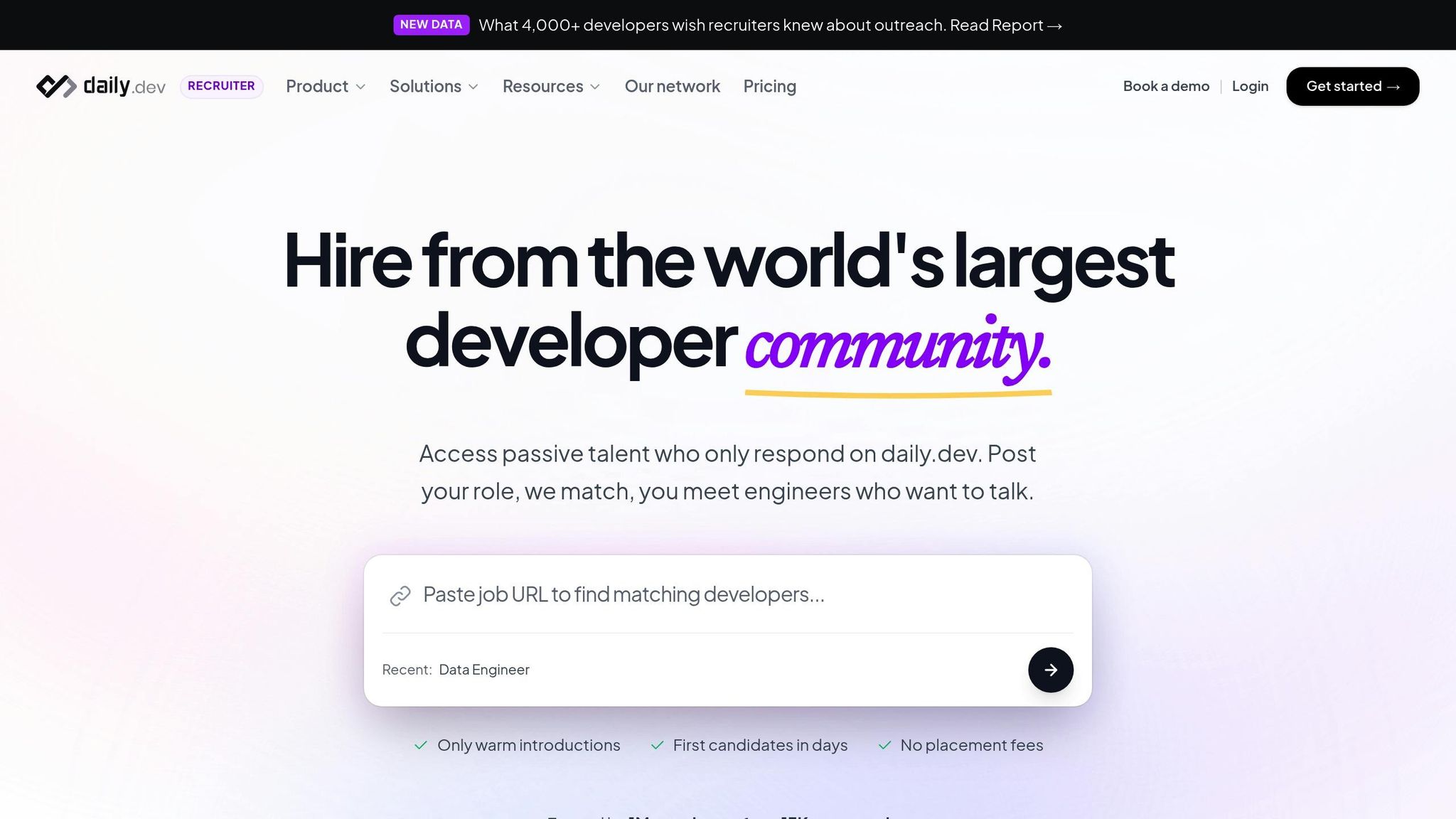
Unlike traditional sourcing platforms, daily.dev Recruiter connects with developers in a more organic way - while they’re consuming technical content and staying updated on industry news. These moments are ideal because they often coincide with a developer’s openness to career opportunities. By engaging with developers who actively opt in, the platform eliminates the trust issues often associated with unsolicited outreach.
What makes this tool stand out is its real-time behavioral matching. Instead of relying on outdated resumes or generic keywords, daily.dev tracks what developers are reading, learning, and building. For instance, if a developer is frequently engaging with Kubernetes-related content, it’s a clear signal of their current interest in container orchestration, making them a more relevant match for related roles.
Additionally, the platform’s double opt-in mechanism, known internally as "TinDev", ensures that both you and the developer agree to connect before any interaction takes place. This mutual agreement fosters trust and sets the stage for meaningful, high-quality conversations.
Benefits of Double Opt-In Introductions
The typical trust level with cold outreach is abysmal - less than 1%. In contrast, daily.dev’s double opt-in introductions boast a trust rate of 100%. Developers only engage after reviewing your job brief, ensuring that every interaction starts with mutual interest.
This approach eliminates the need for generic, impersonal messages. You can even include tailored screening questions during the opt-in process to verify technical qualifications before scheduling a call.
The result? Your candidate pipeline is filled with pre-qualified, engaged developers rather than a random mix of unresponsive contacts. Response rates shift dramatically, climbing from the usual 5–15% seen with cold outreach to 40–60% or higher. Plus, since developers expect your message, conversations are far more productive. Once a developer opts in, their details are automatically synced to your ATS, streamlining your recruitment workflow.
Step 3: Write Developer-Friendly Job Briefs
Once you've established effective discovery channels, it's time to clearly communicate why your opportunity stands out. In a signal-only recruiting funnel, your job brief is often the first impression that determines whether a developer engages or moves on. According to research, 40% of developers ignore outreach that feels like generic spam. The difference between being ignored and starting a conversation comes down to how well you present the role. Developers want specifics, not vague descriptions.
Focus on Impact and Growth
Developers want to know how their work will make a difference. Skip the buzzwords and highlight the real challenges they'll tackle and the measurable outcomes of their contributions. For instance, if the role involves redesigning a critical system or delivering features that directly impact users, spell that out.
Career growth is another key factor. Be specific about what they can gain from the role - whether it's learning to build scalable distributed systems, stepping into leadership, or collaborating with seasoned engineers. Developers are not just looking at what they'll do today - they're evaluating how the role aligns with their long-term goals.
Optimize for Developer Preferences
Developers have clear priorities when considering job opportunities. For example, 71% want upfront details about the tech stack and role scope, and 69% expect a transparent salary range. Don’t make them dig for this information. If the role uses React 18, Go, and Kubernetes, list those tools. If the salary range is $140,000–$170,000, include it.
Another key factor? Work model. About 63% of developers want to know if the role is remote, hybrid, or onsite. Make this clear right away. The table below shows how to align your outreach with what developers value:
| Outreach Element | Traditional Approach (Avoid) | Developer-First Approach (Adopt) |
|---|---|---|
| Subject Line | "Exciting Opportunity at Acme Inc" | "Question about your [Project Name] on GitHub" |
| Job Details | "Modern tech stack", "Competitive pay" | "React 18, Go, Kubernetes", "$140,000–$170,000 range" |
| Call to Action | "Apply here" or "Send resume" | "Interested in a 15-minute technical discussion about our API scaling?" |
| Tone | Corporate/Formal or Overly Familiar | Professional, peer-to-peer, and transparent |
Keep your job brief short and to the point - developers don’t have time to read lengthy descriptions. Start with the essentials: tech stack, salary, work model, and what makes the role exciting from a technical perspective. By prioritizing these details, you'll grab their attention and lay the groundwork for deeper engagement in the next stages of the recruiting process.
Step 4: Screen with Targeted Criteria
Once you've drawn in developers with a well-crafted job brief, the next step is to screen candidates efficiently. It's worth noting that the average job application completion rate is just 10.6% . In a signal-only hiring funnel, the goal is to filter effectively without adding unnecessary obstacles.
Focus on specific, role-centered criteria to streamline this process. Instead of overwhelming candidates with demands like full resumes, exhaustive work histories, or lengthy questionnaires, hone in on two or three key screening questions. For example, if you're hiring a backend engineer with distributed systems experience, you might ask: "Have you built or maintained distributed systems in production?" or "What’s your experience with Go and Kubernetes?"
Use ATS Integrations for Screening
To further refine your screening process, leverage your Applicant Tracking System (ATS). When developers opt in for an introduction, their profile data - such as skills, experience level, and tech stack preferences - can sync directly to your ATS. This eliminates the need for manual data entry and creates a unified candidate profile.
You can also set scoring thresholds within your ATS to prioritize candidates automatically. For instance, assign scores like +25 for candidates with a senior title or +50 for those with relevant technical expertise. Applicants who meet or exceed the threshold can move directly to the interview stage, while others may receive follow-up screening questions. This approach allows you to focus your time on candidates who are most likely to succeed, without manually reviewing every profile. It’s a practical way to maintain the signal-only approach while advancing the best-fit candidates quickly.
For a fairer evaluation, consider blind hiring or merit-based skills tests to minimize unconscious bias . Some recruiters also assign brief technical tasks - not extensive take-home projects, but targeted problem-solving exercises. Jack Underwood, CEO of Circuit, highlights the value of these exercises:
Some excellent candidates don't interview well, this activity [homework] is a good equalizer .
These tasks can provide deeper insights into how a developer tackles real-world challenges, often revealing more than a standard interview.
Track Funnel Metrics
With your screening process in place, keeping an eye on key metrics will help ensure everything runs smoothly. Start by monitoring the assessment completion rate, which measures how many candidates finish your screening questions or technical tests. If this rate is low, it could mean your process has too much friction - try simplifying it by reducing unnecessary steps or time commitments.
Another key metric is the technical pass rate, which shows how well your sourcing aligns with the role's requirements. Additionally, track the screening-to-interview ratio. A high drop-off here might indicate that your criteria aren’t filtering the right talent or that candidates are losing interest due to slow follow-up.
Finally, pay close attention to lead response time - how quickly you engage with candidates after they complete screening. Faster follow-ups lead to higher connection rates. If candidates get stuck in the screening stage for days, look for bottlenecks like slow scheduling, delayed feedback, or unclear next steps. Auditing your process to reduce delays can make a big difference in keeping candidates engaged.
Step 5: Nurture Relationships with Personalized Outreach
Once you've screened candidates, the next step is to focus on building meaningful, long-term connections - not just filling a single position. Developers often receive 50 to 100+ spam messages every week, and 90% of generic outreach is ignored . The key? Send fewer, more thoughtful messages that show genuine effort and understanding. This approach aligns with a "signal-only" strategy, ensuring every interaction feels intentional and relevant.
Personalize Communication
A great way to stand out is by referencing specific details about a developer's work. Instead of a generic message like, "I saw your profile and think you'd be a great fit", craft something that shows you've done your homework: "I noticed your recent work on React optimization in your latest repo, and it aligns perfectly with our team's focus on performance engineering" . This shows you're interested in their expertise, not just matching keywords. Explore their GitHub contributions, blog posts, or conference talks for inspiration. For example, if they presented at JSConf on state management, mention it: "Your talk at JSConf on state management really influenced how our team approaches similar challenges" .
Keep your messages short - around five sentences - and centered on the candidate. Here's an example of an effective outreach message:
"Hi [Name], I really enjoyed your post on scalable APIs. Our team at [Company] is tackling similar challenges with our e-commerce backend and GraphQL federations. I'd love to hear your thoughts on our approach!" .
Instead of sending generic follow-ups like "Are you still interested?", provide value by sharing case studies or technical articles. Nick Geifman from ZoomInfo highlights this principle:
Making outreach about the candidate rather than the employer
This strategy has proven to drive better engagement, especially in competitive markets . Once you've personalized your message, it's equally important to manage how often you reach out to avoid overwhelming candidates.
Maintain Low-Volume, High-Quality Outreach
Avoid blasting mass messages. A low-volume approach - three to five touches per candidate over several months - can triple response rates compared to high-frequency campaigns . Stick to one or two messages per quarter per candidate, using event-based triggers like, "Following up on our daily.dev intro - saw your new article" . If a candidate doesn’t respond after four attempts, take a break and move on. Over-messaging can erode trust and reduce re-engagement rates by 50% .
To scale this approach without losing the personal touch, segment your talent pool based on developer personas you’ve already defined. Use tools like your ATS or CRM to automate data collection, then customize each message before sending. Reaching out weekly to 10–20 carefully selected candidates can yield open rates of 25–40%, compared to just 5% for mass emails . Symphony Talent clients, for example, reported 80% efficiency improvements in recruitment by focusing on tailored, data-driven outreach rather than mass campaigns . Keep an eye on metrics like response rates (aim for 20–30%) and engagement scores to ensure your strategy is hitting the mark .
With personalized and well-timed outreach in place, you're ready to track key performance indicators and refine your recruitment funnel further.
Track and Optimize Funnel Performance
Once you've built a high-quality, signal-focused recruitment funnel, the work doesn't stop there. Maintaining its effectiveness means consistently tracking and fine-tuning its performance. This isn't a "set it and forget it" situation - ongoing analysis is key to ensuring your funnel delivers strong results. By keeping an eye on the right metrics at each stage, you can quickly spot where candidates are dropping off and address any weak points before wasting time on unproductive efforts.
Key Metrics to Monitor
Start by focusing on reply rates, which serve as a strong indicator of quality. For example, platforms like daily.dev can yield response rates between 20–40%, a huge leap compared to the underwhelming sub-5% rates typical of cold LinkedIn outreach . Next, measure intro-to-interview conversions, aiming for a range of 15–25% . If your funnel isn't hitting these benchmarks, it might be time to revisit your job descriptions or screening process. (Poorly written job descriptions often fail to attract developers).
Pay close attention to application drop-off rates. If a high percentage of candidates abandon the process midway, it could signal unnecessary friction. Simplifying the application process can dramatically improve completion rates - aim for over 70% . Finally, track time-to-hire. A well-optimized funnel can cut hiring timelines by 24%, reducing the process from 45 days to about 32 days .
To streamline this tracking process, use ATS tools integrated with CRM or AI analytics. Dashboards that visualize candidate flow through each stage can help pinpoint sudden drops in volume, acting as early warnings for potential issues . Set up alerts for low reply rates or conversion dips to pivot quickly, directing resources to more effective channels like opt-in platforms rather than traditional job boards . These tools make it easier to stay agile and ensure your recruitment process stays on track.
Compare Before and After Performance
The best way to measure the success of your signal-only funnel is through side-by-side comparisons. Start by establishing baseline metrics with your old methods, then revisit those numbers after three to six months of using signal-focused strategies. Here's an example of what this transformation might look like:
| Metric | Before (Spam-Heavy) | After (Signal-Only) | Improvement |
|---|---|---|---|
| Reply Rate | 4% | 28% | +600% |
| Intro-to-Interview | 5% | 22% | +340% |
| Application Completion | 45% | 76% | +69% |
| Time-to-Hire (days) | 45 | 32 | -29% |
| Cost-per-Hire | $5,000 | $3,200 | -36% |
These numbers highlight the kind of results you can achieve by moving away from spam-heavy tactics to a signal-driven approach . To keep improving, review your funnel quarterly. Experiment with A/B testing for new channels, and gather input from your team to identify and resolve bottlenecks . This ongoing refinement ensures your recruitment process remains efficient and effective.
Conclusion
The recruiting game has changed. Developers are tuning out traditional outreach methods, with 61% rating recruiters poorly and giving an average score of just 2.5 out of 5 . This isn't about struggling to find candidates anymore - it’s about earning their attention and trust .
Switching to a signal-only funnel can turn things around. By focusing on warm introductions, clear and developer-friendly communication, and targeted screening, you cut through the noise and engage with intent. The impact is clear: interview rates leap from 3% to 12% when you prioritize behavioral signals over generic outreach . Even more compelling, candidates are 3.1 times more likely to make a job switch when approached through high-signal channels instead of outdated methods like "Open to Work" flags .
These numbers highlight why refining your recruitment strategy matters. By implementing the steps outlined earlier, you can shift from chasing activity metrics to focusing on outcomes, like hiring quality candidates who stay and thrive .
Start small. Test a warm channel, such as daily.dev Recruiter, alongside your current process. Track key metrics like reply rates, conversions, and time-to-hire over three months. Compare the results. The contrast between spam-heavy and signal-driven recruiting is striking - it shows up in stronger candidate engagement, happier hiring managers, and better retention rates.
Approach developers where they already are, with messages they actually want to read. Signal-only recruiting isn’t just a trend - it’s a strategy that works right now.
FAQs
What counts as a “signal” in recruiting developers?
A "signal" in developer recruiting refers to specific online actions and behaviors that hint at someone’s interest in exploring new job opportunities. These might include things like updating their professional profiles, interacting with technical content, joining specialized communities, earning new certifications, or subtly researching roles through technical platforms. These clues allow recruiters to identify candidates who are actively or passively considering new opportunities, helping them prioritize outreach and build more relevant connections.
How can I create developer personas without guessing?
To create developer personas that truly reflect their needs, skip the guesswork and rely on actual data and observed behaviors. Use tools like interviews, surveys, and analytics to understand their genuine challenges and preferences. Pay attention to trends, such as how developers find new tools or decide which ones to use. Begin with basic profiles and continuously improve them through ongoing research. This way, your personas remain accurate and useful over time.
What metrics prove my funnel is working?
Key metrics to watch include strong conversion rates at every stage of the hiring funnel - like moving from outreach to interest or from interviews to offers. Keep an eye on low drop-off rates, shorter time-to-fill, and higher quality of hires to gauge overall efficiency.
Also, pay attention to developer engagement. This means looking for thoughtful responses and meaningful interactions, which signal that you're successfully reaching and connecting with the right candidates. These metrics together paint a clear picture of how well your hiring process is performing.
.png)