Open source contributions are becoming a critical factor in hiring developers. They provide transparent proof of technical skills, problem-solving abilities, and collaboration in practical scenarios. Employers increasingly value public code contributions over traditional resumes because they showcase real-world coding, teamwork, and communication skills.
Key insights:
- 93% of hiring managers find open source talent scarce, and 46% plan to hire more in this space.
- Open source work highlights a developer’s ability to solve complex issues, write quality code, and handle feedback.
- Companies spend $7.7 billion annually on open source, with 90% of Fortune 500 companies relying on it.
- Public repositories offer direct evidence of skills, unlike resumes, which are often unverifiable.
Hiring managers evaluate contributions like accepted pull requests, issue discussions, and project management. They also value developer soft skills like clear communication and teamwork, which are evident in open source activity. Tools like daily.dev Recruiter simplify finding and assessing open source contributors, connecting employers with skilled developers actively engaged in the community.
Open source work isn't just about coding - it's a way to demonstrate initiative, build networks, and contribute to innovation, making it a key asset in today’s hiring landscape.
::: @figure 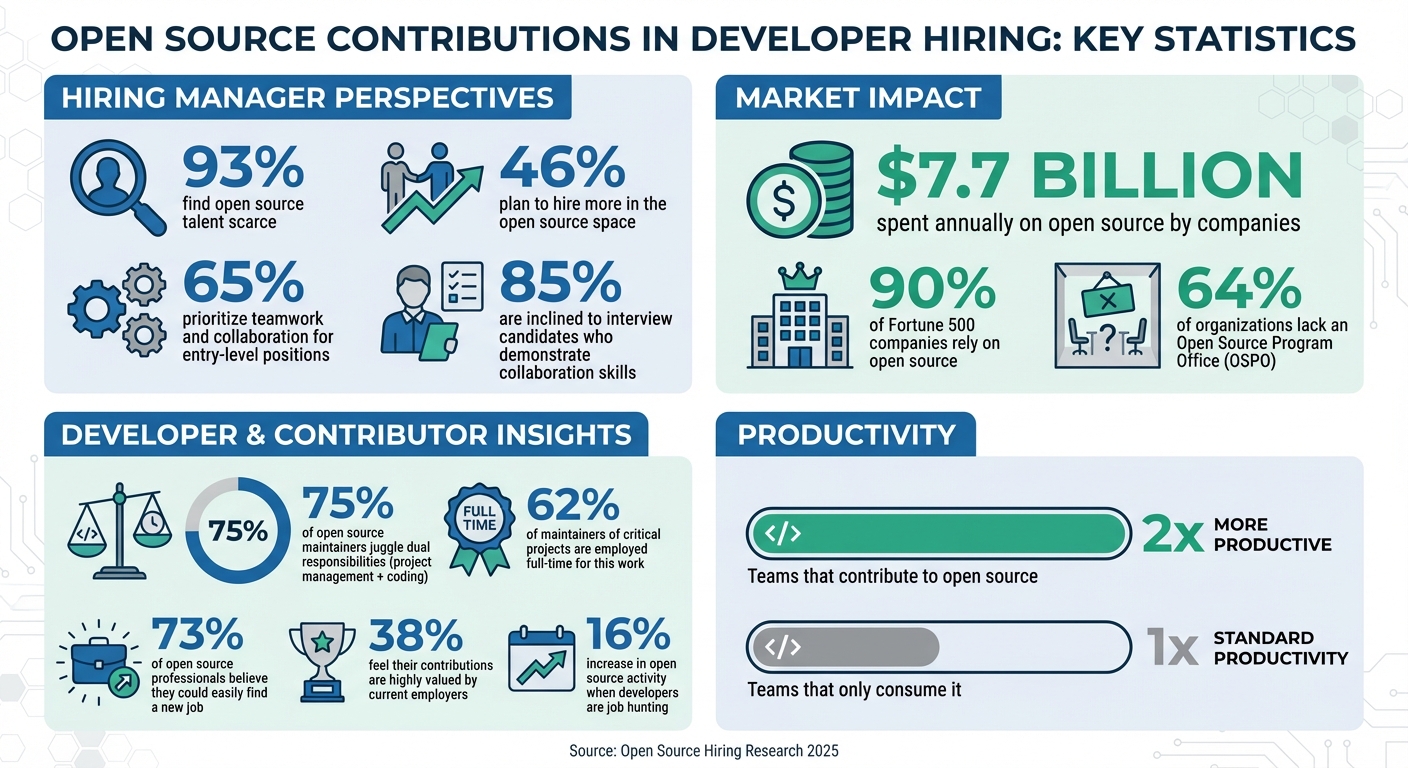 {Open Source Contributions in Tech Hiring: Key Statistics and Impact}
Open Source as Proof of Technical Skills
Verifying Skills Through Code Contributions
Public repositories offer a clear and measurable way to evaluate developer skills. Unlike resumes, which often rely on self-reported achievements, open source contributions leave behind a permanent and public trail of how someone writes code, solves problems, and responds to feedback . Recruiters can dive into commit histories, pull requests, and code reviews to confirm whether a candidate's claims align with their actual abilities.
This level of transparency provides insights that traditional coding tests often miss. For instance, when a developer addresses issues across multiple modules, proactively writes unit tests, or updates documentation alongside their code, it showcases a commitment to best practices. These habits often distinguish seasoned engineers from less experienced ones. Many hiring managers use a benchmark of solving 6 to 10 issues of varying complexity - including at least one labeled "medium" or "hard" - as a baseline for moving candidates forward in the interview process .
Open source contributions also shed light on soft skills that are harder to evaluate through other means. For example, developers who gracefully handle constructive feedback on pull requests or provide thoughtful, actionable code reviews demonstrate strong collaboration skills . Writing clear, detailed pull request descriptions that explain technical decisions further highlights their communication abilities. These contributions not only reflect technical expertise but also indicate teamwork and adaptability - qualities that are often critical in hiring decisions. As a result, open source work provides a rich context for understanding how quality contributions influence recruitment choices.
Research on Code Quality and Decision-Making
Studies back up what many hiring managers have already noticed: developers seeking jobs often contribute to projects written in programming languages that are in high demand, using these contributions as a way to showcase their skills .
However, the focus is on quality over quantity. A single, well-documented fix for a complex bug - one that required exploring multiple solutions and is accompanied by a detailed pull request or blog post - can carry far more weight than dozens of minor typo fixes . Beyond coding itself, top contributors often take the time to engage with the community by answering questions, improving documentation, or helping onboard new contributors. These efforts demonstrate initiative and a deep understanding of the product, qualities that employers find particularly valuable - even if they're not easily captured in a standard interview . This broader involvement highlights a developer's ability to think beyond just writing code, signaling the kind of well-rounded skill set that companies actively seek.
Collaboration and Communication Skills from Open Source Work
Contributing to open source projects isn't just about showcasing technical expertise - it’s also a powerful way to sharpen essential soft skills that are crucial for thriving in today’s remote and collaborative work environments.
Learning Through Global Team Collaboration
Open source projects provide a unique platform for mastering remote teamwork. Contributors work alongside peers from around the globe, navigating different time zones, diverse cultural perspectives, and varying organizational practices . This mirrors the dynamics of modern remote workplaces, where asynchronous communication and cultural sensitivity are part of daily operations.
Interestingly, 75% of open source maintainers juggle dual responsibilities as both project managers and code contributors . For senior developers, the focus often shifts from coding to activities like mentoring, code reviews, and coordination . This change aligns closely with professional roles, where senior engineers spend more time guiding teams and less time writing code themselves.
Measurable Improvements in Communication Skills
The global collaboration inherent in open source work doesn’t just build teamwork - it leads to tangible improvements in communication skills.
A 2025 study revealed that 65% of hiring managers prioritize teamwork and collaboration when hiring for entry-level positions (often compared to Stack Overflow Jobs alternatives) . Even more striking, 85% of hiring managers are inclined to interview candidates who demonstrate these traits .
These skills are often evaluated through concrete examples. For instance, evaluators look for evidence such as accepted pull request feedback and examples of incorporating critical feedback. A researcher at California State University, Monterey Bay, detailed the criteria:
"2 examples of comments on a PR that is not their own, where their feedback is accepted by the other person. 2 examples of a pull request where the candidate received critical feedback and they incorporated the feedback."
Open source contributors also develop practical communication habits that translate directly into workplace success. They learn to craft clear pull request descriptions, explain the reasoning behind technical decisions, and handle disagreements professionally . This ability to adapt and respond constructively - often referred to by hiring managers as "coachability" - can significantly reduce onboarding time and make team integration smoother .
Beyond Skills: Innovation, Networks, and Retention
Beyond mastering technical and communication skills, open source contributors play a vital role in fostering innovation, building extensive networks, and enhancing employee retention.
Driving Innovation Through Open Source Work
Open source projects give developers a front-row seat to cutting-edge technologies. By collaborating with peers from around the world, they bring fresh ideas and perspectives to their organizations, often sparking new approaches to internal projects . Notably, 62% of maintainers of critical open source projects are employed full-time to focus on these efforts , showcasing how companies are leveraging this innovative potential.
The autonomy inherent in open source work encourages creative problem-solving. Contributors often have direct control over their projects, which fuels their drive to innovate . As Shuah Khan, a Linux Kernel maintainer, puts it:
"Open source, it is a life-changing experience for me. Coming from a closed-source world, I feel like I am in the driver's seat... I feel like I can control my career; I have direct control over what I do and what my contributions are."
This sense of ownership translates directly into workplace innovation. Many companies hire open source maintainers for their expertise and their ability to shape the direction of critical projects, ensuring they stay ahead of industry trends . However, while financial incentives can boost output, they sometimes risk overshadowing the intrinsic motivation that drives community-focused innovation .
Professional Networks as a Hiring Advantage
When a company hires an open source contributor, they gain not just technical skills but also access to a vast professional network. These networks can act as talent pipelines, connecting organizations with highly skilled passive developer candidates who might not be actively seeking new roles but are open to the right opportunities .
Open source contributors often collaborate across company boundaries, sharing insights on industry standards and tackling shared challenges. These interactions not only enhance their expertise but also facilitate referrals from trusted peers with proven skills . As Stephen Hendrick from The Linux Foundation points out, "Learning new skills and connecting with other developers are key to career growth" .
Retention Benefits of Hiring Open Source Contributors
Strong networks and the collaborative nature of open source work don’t just drive innovation - they also help retain talent. Contributors tend to stay with organizations that support their work, finding fulfillment in the sense of community, camaraderie, and the opportunity to work alongside highly skilled peers . However, there’s a disconnect: while 73% of open source professionals believe they could easily find a new job , only 38% feel their contributions are highly valued by their current employers .
For many, the intrinsic rewards of open source work - autonomy, purpose, and impact - are deeply satisfying. Brian Granger, co-creator of Project Jupyter, encapsulates this sentiment:
"If I step back... and just ask, 'Okay, what could I do that would have the greatest impact on society, technology, humankind?' as a whole, I'd be hard-pressed to find something better than working on open source."
Organizations that explicitly recognize and support open source contributions often see higher retention rates. This can include integrating open source work into job descriptions, creating systems to acknowledge contributions, or even setting up an Open Source Program Office (OSPO) to coordinate efforts. However, 64% of organizations involved in open source lack such a program . While two-thirds of open source professionals cite higher salaries as a key factor in staying with a company, it’s the intrinsic rewards - like community and working on groundbreaking technologies - that truly keep them engaged .
Hiring engineers?
Connect with developers where they actually hang out. No cold outreach, just real conversations.
How to Assess Open Source Contributions in Hiring
When evaluating open source contributions, it’s important to look beyond surface-level indicators. For example, a GitHub profile filled with green activity squares might seem impressive but can be misleading. These metrics can be artificially inflated through automated scripts or minor updates to README files .
Evaluating GitHub Profiles and Public Repositories
Start by examining accepted pull requests in well-established projects. When a candidate’s code is merged into respected repositories, it’s a strong indicator of their technical skills. Maintainers of these projects have already reviewed and approved the code, validating that it meets quality standards and effectively addresses real-world issues .
Take note of candidates who manage their own repositories. This demonstrates their ability to set a project’s direction, handle contributions from others, and respond constructively to feedback . Dive into issue discussions and pull request comments to assess their collaboration and communication skills, as well as their ability to explain technical decisions clearly .
Don’t overlook non-code contributions. Documentation updates, bug reports, and README improvements reflect a candidate’s initiative and commitment to making software more accessible . As Brad Collette, CTO at Ondsel, explains:
"Having a GitHub account and forking even one project is the bare minimum someone can do to show they have experience here" .
However, it’s crucial to verify whether forked repositories show meaningful activity or are simply idle copies. Original projects often provide deeper insights into a candidate’s abilities. Use these observations to refine your job criteria and make your evaluation process more targeted.
| Assessment Area | Criteria | Significance |
|---|---|---|
| Accepted Commits | Pull requests merged into third-party projects | Validates technical skills through peer review |
| Issue Discussions | Tone and helpfulness in public threads | Highlights collaboration and communication |
| Project Ownership | Management of patches and feedback | Demonstrates leadership and project management |
| Documentation | README and wiki contributions | Reflects initiative and focus on accessibility |
Updating Job Requirements to Include Open Source Experience
To effectively assess candidates, align your job requirements with open source benchmarks. Instead of vague phrases like "strong coding skills", specify expectations such as active contributions to open source projects relevant to your tech stack or experience managing community-driven repositories. Research indicates that open source involvement signals traits like honesty and a willingness to share knowledge .
Teams that actively contribute to open source are shown to be twice as productive as those that only consume it . By emphasizing this in your job postings, you can attract candidates who value transparency and collaborative work. For those with robust public profiles, consider assessing technical skills without coding tests by reviewing their GitHub activity. Their existing contributions often provide a more authentic representation of their skills .
Reducing Screening Time Through Open Source Indicators
Open source contributions offer a practical way to streamline your hiring process. Instead of relying heavily on lengthy phone interviews or coding tests, recruiters can review a candidate’s commit history, pull request descriptions, and issue resolutions to gauge their technical skills and problem-solving approach .
Pay attention to the consistency of contributions. A steady history of activity suggests reliability and follow-through, while sporadic bursts may indicate less commitment . Thoughtful and clear pull request descriptions can also reveal a candidate’s ability to articulate complex ideas . To further simplify the screening process, consider using aggregation tools that combine data from platforms like GitHub and Stack Overflow, giving you a more comprehensive view of both technical and interpersonal skills .
Using daily.dev Recruiter to Source Open Source Talent
Finding developers with a strong open source background doesn’t have to involve painstakingly sifting through countless GitHub profiles. daily.dev Recruiter connects you directly with pre-qualified developers who are already active in professional communities - not just browsing job boards. By analyzing public code contributions, daily.dev Recruiter streamlines the hiring process, helping you identify highly engaged developers. This approach complements traditional evaluations by focusing on candidates who actively participate in open source communities.
Accessing a Developer-First Network for Passive Talent
Passive candidates - those not actively searching for jobs - make up a large portion of the tech workforce. These individuals often have their skills validated through ongoing open source contributions . Reaching them through conventional methods can be tough, but daily.dev Recruiter bridges the gap by engaging with talent where they naturally spend their time: reading technical articles, learning new tools, and collaborating with peers.
As Barney Pell, Founder of Powerset, puts it:
"Online open-source communities like GitHub bring large numbers of developers together and are thus a natural place for recruiting" .
Streamlining Hiring with Warm, Trust-Driven Introductions
One of the platform’s standout features is its trust-focused approach to connecting with passive talent. Unlike cold outreach, which is often ignored , daily.dev Recruiter uses a double opt-in system. This means both the recruiter and the developer agree to connect before any conversation starts. It’s a simple yet effective way to eliminate unsolicited messages and respect developers’ time.
This method not only improves response rates but also allows recruiters to tailor their outreach. By referencing specific repository contributions or technical interests, interactions feel personal and meaningful rather than transactional.
Targeting Engaged Contributors with High Intent
Data indicates that developers’ open source activity increases by about 16% when they’re actively job hunting . With daily.dev Recruiter’s precision targeting, you can zero in on developers who are contributing regularly to open source projects - an indicator of high intent and potential availability.
The platform also lets you filter candidates based on custom criteria and evaluate soft skills like collaboration and communication by reviewing public discussions and code reviews . These insights, backed by public commit logs, give you a clear picture of a developer’s skills and reliability. With real-time access to engaged, community-validated talent, daily.dev Recruiter ensures you’re connecting with developers who are ready to make an impact.
Conclusion
Open source contributions offer a transparent way to assess a developer’s abilities. Instead of relying on resumes that often list unverifiable skills, you can dive into actual code, see how candidates respond to feedback, and evaluate their problem-solving skills in action. As experts often point out, real-world code contributions reveal far more than a traditional resume ever could .
The data backs this up: well-documented contributions - whether it’s tackling tough bugs or improving documentation - highlight essential qualities like problem-solving and teamwork, areas where resumes often fall short. These insights are invaluable for building a hiring process that’s rooted in real, measurable performance.
To make the most of this approach, it’s important to set clear standards for meaningful contributions. Seek out candidates who go beyond the basics - those who include unit tests, update documentation, or tackle performance issues . Review their pull request comments to get a sense of their communication style and how they handle feedback . These records provide a window into soft skills that resumes simply can’t capture.
If you’re ready to streamline this process, tools like daily.dev Recruiter can help. It connects you with developers who are actively participating in technical communities, offering warm, double opt-in introductions and precise targeting based on open source activity. This approach ensures you connect with developers at the right moment and in the right context, fostering trust and efficiency.
FAQs
Why are open-source contributions important for a developer's career?
Open-source contributions serve as a public portfolio, showcasing a developer's skills in a way that traditional résumés often can't. Research indicates that developers who actively participate in open-source projects are more likely to land interviews and job offers than those who don’t. Why? Because contributing to open-source highlights key qualities like technical expertise, problem-solving skills, and the ability to collaborate effectively - traits that are highly valued but difficult to demonstrate on paper.
Recruiters appreciate the transparency that open-source work offers. They can review actual code submissions, observe how developers engage in discussions, and assess their ability to collaborate with diverse teams. Developers who contribute to popular or in-demand projects also gain greater visibility, turning their efforts into a smart career move. Tools like daily.dev Recruiter make this process easier by helping employers spot talented developers who are already proving their skills and commitment through open-source contributions.
What skills can employers evaluate from open source contributions?
Employers often turn to open source contributions as a way to evaluate both technical skills and personal attributes. On the technical side, these contributions reveal coding quality, familiarity with programming languages and tools, problem-solving approaches, and decision-making in software architecture.
Equally important are the insights into soft skills. Open source work highlights a contributor's ability to collaborate, communicate effectively, work within a team, and demonstrate their drive and values.
By examining tangible examples of a developer's work, employers can get a clearer picture of their strengths and how they tackle challenges. This makes open source contributions a powerful tool for assessing potential hires.
Why do employers prioritize open source contributions over traditional résumés?
Employers place a high value on open source contributions because they reveal a developer's practical skills in ways that traditional résumés simply can't match. Open source work puts coding abilities, teamwork, and problem-solving skills on full display, offering a level of transparency and credibility that a résumé often lacks.
While résumés rely on self-described achievements, open source contributions act as concrete evidence of what a developer can do. They showcase initiative, active participation in the developer community, and experience working on a variety of projects - qualities that hiring managers are always on the lookout for.
.png)