Recruiters struggle with trust. Developers often ignore unsolicited messages, with 43% muting recruiters entirely due to irrelevant outreach. Opt-in recruiting platforms solve this by letting developers control when and how they engage. These platforms use a double opt-in model, where developers and recruiters only connect if both parties agree. This approach prioritizes consent, reduces spam, and improves communication.
Why developers prefer opt-in platforms:
- Control: Developers review job details privately and decide if they want to engage.
- Less spam: Messages are targeted based on real-time data, not outdated resumes.
- Trust: Interactions start with mutual interest, not cold pitches.
Benefits for recruiters:
- Pre-qualified talent: Engage with developers already interested in specific roles.
- Higher response rates: Transparency upfront leads to more meaningful conversations.
- Efficiency: Save time by automating tasks and focusing on serious candidates.
Platforms like daily.dev Recruiter take this further by analyzing developer activity, ensuring connections align with current skills and interests. This model creates a better hiring experience for both developers and recruiters.
::: @figure 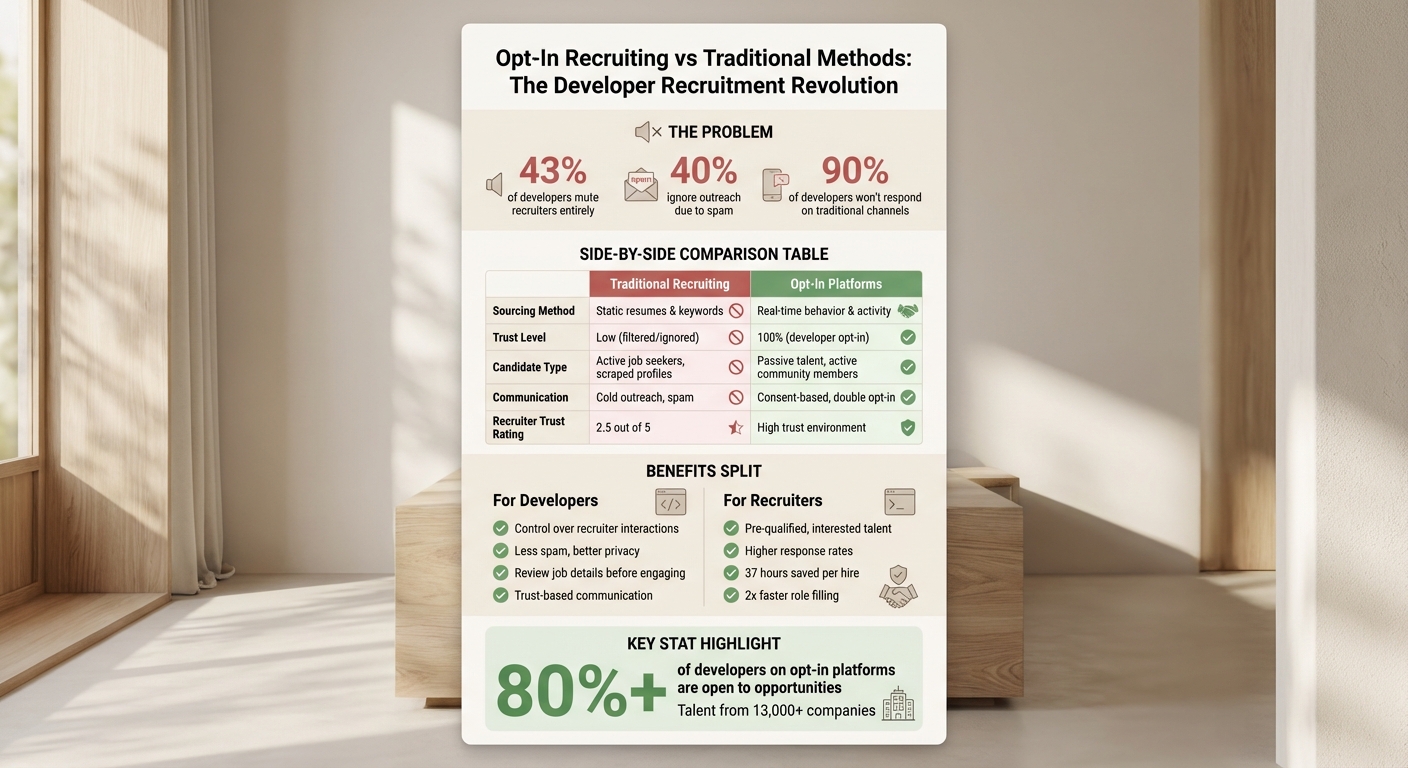 {Opt-In vs Traditional Recruiting: Key Differences and Benefits}
What Are Opt-In Recruiting Platforms?
Opt-in recruiting platforms are changing the way hiring works. Instead of recruiters sending countless cold messages, context builds trust as developers take control of when and how they engage. These platforms follow a consent-first model, where developers join communities to grow professionally - whether that’s learning new skills or staying updated on industry trends - and decide if they want to hear about job opportunities. This mutual opt-in approach ensures both developers and recruiters are genuinely interested before any interaction happens . The result? A smoother and more respectful hiring process.
Here’s how it works: developers sign up, customize their preferences, and control their visibility to recruiters. When they’re ready to explore opportunities, they opt in to signal interest . Recruiters can then share job details privately, but conversations only start if the developer agrees to connect . It’s all about giving developers the power to decide.
What makes these platforms stand out is their core principle: "trust as a moat" . They shield developers from the spammy messages that often flood traditional recruiting channels. Instead of relying on outdated resumes, these platforms use up-to-date data on developers’ activities - like their recent projects or learning habits - to create matches that align with their current interests . This approach shifts hiring from generic keyword searches to building connections in spaces developers already trust .
By prioritizing privacy and targeted matching, opt-in platforms move away from the old-school, mass outreach tactics. Some even use a "TinDev" model, similar to dating apps, where both parties must agree before connecting . This creates a high-trust environment where developers feel respected rather than overwhelmed.
This model also addresses a big issue for developers: while many are open to new opportunities, they’re tired of irrelevant and intrusive messages that ignore their skills and interests . By making consent the foundation of every interaction, opt-in platforms solve this problem and create a better experience for everyone involved.
Hiring engineers?
Connect with developers where they actually hang out. No cold outreach, just real conversations.
Why Developers Prefer Opt-In Platforms
The disconnect between developers and recruiters - fueled by frustration with unsolicited messages and lack of trust - has created a demand for a better way. Opt-in platforms meet this need by addressing the key pain points that developers face.
Control Over Recruiter Interactions
The consent-first model reshapes how developers interact with recruiters. Instead of enduring constant interruptions, developers can now explore job opportunities on their own terms. Opt-in platforms allow them to privately review detailed job information - such as tech stack, salary, and work model - before deciding whether to engage. This double opt-in system ensures that conversations only happen when developers explicitly agree, removing the pressure and follow-ups that often come with traditional outreach.
This method aligns with how developers prefer to work. Instead of receiving generic pitches on social platforms, they come across opportunities in spaces they already value, like developer communities and educational resources. When they choose to respond, it's because the role genuinely interests them.
Less Spam and Better Privacy
Traditional recruiting methods often overwhelm developers with irrelevant messages: 40% of developers ignore recruiter outreach because it feels like spam . This leads many to disengage completely.
"We're done letting spam define tech recruiting. Developers deserve better, and so do the people trying to hire them."
- Nimrod Kramer, CEO & Co-Founder, daily.dev
Opt-in platforms tackle this issue by eliminating unsolicited contact. Instead of outdated keyword searches, these platforms use "Verified Signals" - real-time insights into what developers are reading, building, or learning. This ensures outreach is based on current, relevant data, creating a cleaner inbox and a more respectful experience. By prioritizing consent, these platforms build a foundation of trust between developers and recruiters.
Building Trust Through Consent-Based Communication
Trust begins with permission. When developers express interest first, the entire interaction changes. Opt-in platforms enforce accountability by removing recruiters who spam or fail to follow through, protecting the integrity of the community. This "Recruiter Compact" ensures only serious, transparent recruiters remain active.
The difference compared to traditional methods is striking: unsolicited outreach often starts with skepticism, while consent-based communication begins with mutual interest. Developers can review full job details upfront, eliminating the doubts that vague pitches create. This shared intent transforms interactions into meaningful, career-focused conversations.
Benefits of Opt-In Platforms for Recruiters
Opt-in platforms don’t just make life easier for developers - they also transform how recruiters find and engage talent. By moving away from cold outreach and warm intros and embracing a consent-driven model, these platforms help recruiters save time, focus their efforts, and see better hiring outcomes.
Access to Pre-Qualified Developers
One of the standout advantages is access to developers who have already expressed interest in specific roles. Instead of wading through countless profiles with little to no response, recruiters interact with candidates who’ve actively reviewed job details and opted in. This approach relies on behavioral signals rather than static resume keywords, offering insights into what developers are currently working on, reading, or learning in real-time .
Here’s an eye-opening stat: 90% of developers on these specialized platforms admit they won’t respond to recruiters on traditional channels . These candidates - often passive and highly skilled - typically avoid job boards and ignore cold outreach, giving recruiters a unique chance to connect with top-tier talent.
Higher Response and Engagement Rates
The double opt-in model flips the script on traditional recruiting by removing the exhausting "chasing" phase. Developers initiate contact, ensuring that both sides are genuinely interested from the start.
Key details like tech stack, salary range, and work model are disclosed upfront , which helps build trust early on. This transparency reduces the likelihood of ghosting and leads to more productive conversations. Plus, custom screening questions further refine the process, ensuring recruiters spend time only on meaningful interactions.
More Efficient Hiring Process
Opt-in platforms significantly cut down the time recruiters spend on manual tasks. On average, recruiters save 37 hours per hire by skipping tedious sourcing and follow-ups.
These platforms often integrate seamlessly with Applicant Tracking Systems (ATS) like Greenhouse, Lever, and Ashby, automating data entry and avoiding duplicate candidate records . Warm introductions are automatically added to existing workflows, making the process smoother. And with performance-based pricing models - no placement fees or monthly commitments - recruiters only pay for actual results, not speculative efforts .
daily.dev Recruiter: A Developer-First Opt-In Platform
daily.dev Recruiter brings developer-focused features that resonate with engineers. Over 80% of developers on the platform are open to exploring new opportunities . It connects recruiters with engaged talent from a pool that spans more than 13,000 companies .
Recognized as Product of the Year on Product Hunt and boasting over 20,000 GitHub stars , daily.dev Recruiter has gained strong support within the developer community. The platform is built on the idea that developers should lead the conversation, ensuring recruiters only connect with candidates who are genuinely interested. Below, we’ll explore its standout features, benefits for developers, and how recruiters can make the most of it.
Core Features of daily.dev Recruiter
At its heart, daily.dev Recruiter uses a matching engine based on real behavior that tracks real-time developer activity, moving beyond static resume keywords . This pre-intent sourcing feature allows recruiters to identify candidates who are actively engaging with new technologies , giving them a head start on connecting with developers sharpening their skills.
The platform’s double opt-in system, called "TinDev", ensures both developers and recruiters express mutual interest before initiating contact . This eliminates cold outreach and fosters a more intentional, positive interaction.
To streamline hiring, daily.dev Recruiter integrates seamlessly with popular Applicant Tracking Systems (ATS) like Greenhouse, Lever, Ashby, and Workable. Two-way synchronization ensures candidate data is automatically updated, avoiding duplication and aligning with existing workflows . Recruiters can also use custom screening questions to filter candidates based on specific project needs or technical expertise .
The pricing model is success-based, meaning recruiters only pay when they successfully connect with qualified candidates. There are no traditional placement fees or long-term contracts, offering flexibility and cost-effectiveness .
How daily.dev Recruiter Benefits Developers
For developers, the platform offers complete control over who can reach out to them and when. Instead of dealing with irrelevant opportunities tied to outdated profiles, they receive roles aligned with their current interests and learning activities . Every introduction comes with context, making the opportunities more relevant and personalized.
Privacy is a key focus. Participation is voluntary, and there’s no scraping of profiles . Developers can explore opportunities on their own terms, with clear insights into roles and technologies before engaging.
How Recruiters Can Use daily.dev Recruiter
Recruiters gain access to a global network of passive talent that is highly qualified that’s often unresponsive to traditional outreach methods. The platform’s behavioral matching engine ranks developers most likely to engage based on real-time activity , enabling recruiters to fill roles twice as quickly compared to conventional methods .
Detailed job briefs that highlight real projects help capture developers' interest . Screening questions further refine the process, ensuring alignment on technical requirements or project complexities before conversations even begin . This means recruiters can focus their time on meaningful, productive interactions with developers who are genuinely interested.
Here’s a comparison of daily.dev Recruiter’s approach versus traditional tools:
| Metric | daily.dev Recruiter | Traditional Tools |
|---|---|---|
| Sourcing Basis | Real-time behavior and intent | Static resumes and keywords |
| Trust Level | 100% (Developer Opt-In) | Low (Often filtered/ignored) |
| Candidate Type | Active community members/passive talent | Active job seekers/scraped profiles |
This trust-driven, real-time recruiting model ensures better matches and stronger engagement, making the hiring process smoother for both developers and recruiters.
How to Get the Most From Opt-In Platforms
Opt-in platforms thrive on respectful, targeted recruitment. To see strong outcomes, you’ll need to shift from the traditional scattershot approach and focus on engaging developers who’ve already shown interest. Here’s how to make the most of these platforms.
Writing Targeted Job Briefs
Generic job descriptions don’t cut it anymore. Phrases like “JavaScript experience” or “fast-paced environment” are too vague to grab attention. Instead, be specific about the technologies and tools your team uses - mention versions like React 18, Python 3.11, or OAuth 2.0. Developers want to know exactly what they’ll be working on. For example, instead of saying, “You’ll work on authentication,” try: “You’ll redesign our authentication system to support OAuth 2.0 and integrate with third-party identity providers.” This level of detail helps developers quickly determine if the role aligns with their skills and interests.
Transparency is equally important. Include details like salary ranges, team size, and interview timelines. Developers increasingly expect salary transparency, and leaving it out might suggest you don’t value their time. Go beyond buzzwords like “rockstar” or “ninja” and instead describe your tech stack and methodologies, such as TDD (Test-Driven Development) or CI/CD (Continuous Integration/Continuous Deployment). After crafting a detailed brief, reduce time-to-hire by using effective screening to further refine your candidate pool.
Using Screening and Custom Criteria
Precise screening is key to narrowing down candidates who are genuinely interested and qualified. Role-specific questions help filter applicants before any conversations take place. Use straightforward yes/no or multiple-choice questions to identify deal-breakers, like work authorization requirements or certifications. For technical skills, ask about specific frameworks, deployment experience, or how they approach problem-solving using STAR-based behavioral questions.
Take Unilever’s example: in 2025, the company reduced its time-to-hire by 90% using AI-driven screening. By analyzing responses and filtering 80% of candidates early, they saved an estimated 50,000 recruiter hours and over $1.3 million annually. This shows how smart screening can eliminate mismatches and let you focus on high-potential candidates. Regularly review your screening criteria, though - outdated filters can lead to missed opportunities as technology evolves.
Maintaining a Positive Developer Experience
How you interact with developers leaves a lasting impression. Respond promptly and be transparent at every stage. If you’re rejecting a candidate, offer clear feedback instead of leaving them wondering. For those moving forward, outline the next steps and provide a timeline. Timing matters too - mid-week outreach tends to perform better than messages sent on Monday mornings or Friday afternoons.
Credibility isn’t just about individual interactions; it’s about the bigger picture. Engage with the developer community by sharing resources or answering technical questions, even when you’re not actively hiring. Building trust this way positions you as someone who respects the profession. Then, when you reach out about a role, it feels like a natural continuation of a relationship rather than a cold, impersonal pitch.
Conclusion: The Future of Developer Recruitment
The landscape of developer recruitment is shifting. It's moving away from impersonal, high-volume outreach toward a model centered on trust, consent, and meaningful engagement. Opt-in platforms are addressing what developers have long sought: control over who reaches out, clarity about job opportunities, and respect for their time. For recruiters, this means access to a pool of engaged, qualified candidates, improved response rates, and a more streamlined hiring process.
daily.dev Recruiter takes this a step further by using real-time behavioral matching. Instead of relying on outdated resumes, it analyzes what developers are actively reading and building. This ensures every connection is both intentional and mutually beneficial. As Nimrod Kramer, CEO & Co-Founder of daily.dev, explains:
"We built a place where engineers can turn off the noise. Gaining access requires not a trick, but trust."
The numbers speak volumes. With recruiters earning only a 2.5 out of 5 trust rating and 90% of developers relying exclusively on daily.dev, it's clear that credibility and context are essential . This trust-driven approach is paving the way for deeper, more effective relationships between recruiters and developers.
By shifting focus from "sourcing" to earning and holding developers' attention, this new model emphasizes transparency and trust over volume-driven tactics . Recruiters who embrace these principles are better positioned to succeed in this evolving landscape.
The future of developer recruitment is already unfolding. Grounded in mutual consent and real-time insights, platforms like daily.dev Recruiter are not just improving how hiring happens today - they're shaping the future of talent acquisition as a whole.
FAQs
How does double opt-in work?
Double opt-in ensures developers actively agree to engage before any outreach happens. Developers must first show interest, which eliminates cold outreach and minimizes spam. On the daily.dev Recruiter platform, this means recruiters can only reach out to developers who have explicitly given their consent. This process builds trust and promotes a recruitment experience rooted in respect and mutual agreement.
What data is used to match developers to roles?
Matching developers to roles depends on a few key elements: their expressed interest through double opt-in introductions, insights from behavioral data (like the content they engage with, the projects they follow, and what they build), and detailed job descriptions provided by recruiters. Together, these factors ensure matches that align closely with developers' preferences and professional activities.
How do opt-in platforms protect developer privacy?
Opt-in platforms put developers in the driver’s seat by requiring explicit consent before any interaction or data collection takes place. This means developers actively decide to participate, giving them control over their personal information and cutting down on spam or unwanted outreach.
What’s more, these platforms prioritize clarity by openly explaining how data is being used, stored, and shared. This level of openness not only aligns with privacy regulations like GDPR and CCPA but also helps prevent the misuse of sensitive data, building a stronger sense of trust between developers and platforms.
.png)