Passive software engineers - those not actively job hunting - make up over 70% of the talent pool but are notoriously hard to engage. Why? Most recruiters rely on impersonal cold messages, leading to dismal response rates of 3–5%. Developers are flooded with over 50 recruiter messages monthly, and 64% believe these are copy-pasted. The result? Ignored outreach and eroded trust.
Here’s how to connect with passive developers effectively:
Go where they are: Platforms like GitHub, Stack Overflow, and technical blogs showcase their skills and interests. Engage with their open source contributions instead of relying on LinkedIn.
Personalize your outreach: Reference their specific work (e.g., GitHub contributions or blog posts) and include key details like salary, tech stack, and work model upfront.
Focus on quality, not quantity: Sending 50 personalized messages can yield a 30% response rate, compared to 1,000 generic ones with just 3%.
Build trust over time: Use low-pressure follow-ups and share useful content to maintain long-term relationships.
Recruiting passive engineers isn’t about sending more messages - it’s about earning their attention with respect and relevance. Start small, measure your results, and prioritize meaningful connections.
::: @figure 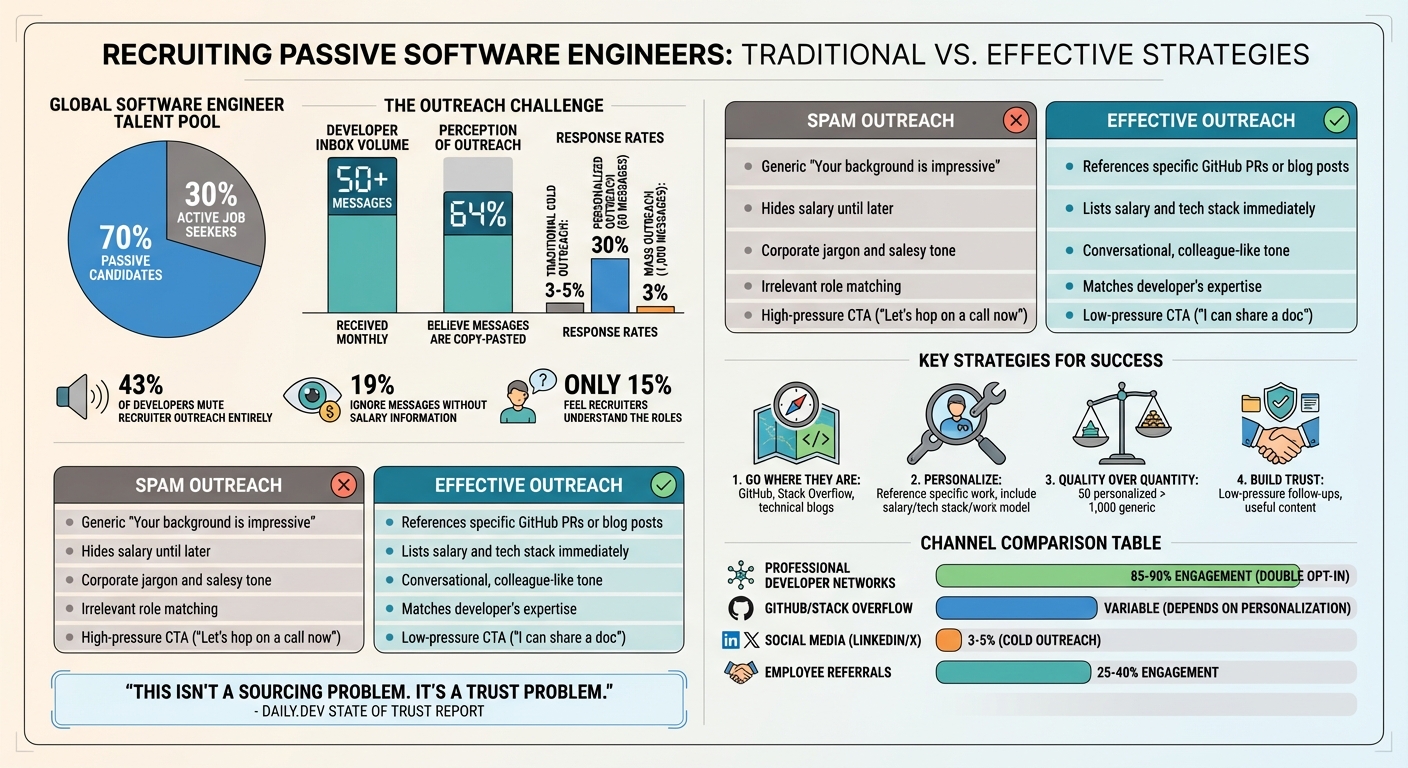 {Traditional vs Effective Recruiting: Response Rates and Best Practices for Passive Software Engineers}
Why Traditional Passive Recruiting Fails
The challenge with traditional passive recruiting isn't that developers aren't open to new opportunities - it’s about trust. A widespread lack of trust is at the heart of the problem, with nearly half of developers blocking non-spammy recruiter messages. This trust gap undermines every aspect of passive recruiting, making it harder to connect with talent.
Cold Outreach: Lacking Context, Losing Responses
Cold outreach, like LinkedIn InMails, has dismal response rates of just 3–5%, and most of those responses are polite rejections. Why? Because these messages often fail to address what developers care about most: salary range, tech stack, and work model (remote, hybrid, or in-office). Without these details, messages are dismissed almost instantly - especially when salary is missing, which leads nearly 1 in 5 developers to ignore the outreach altogether.
On top of this, many recruiters lack the technical knowledge needed to engage meaningfully. Only 15% of developers feel that recruiters truly understand the roles they’re trying to fill. A senior backend engineer summed it up perfectly:
"We want to skip the business BS and just have an honest conversation."
Without context and genuine understanding, cold outreach falls flat. But the alternative - mass outreach - doesn't fare much better.
Mass Outreach: Quantity Over Quality
Sending out 1,000 generic messages might seem like a productive strategy, but it usually results in the same 3% response rate as cold outreach. On the other hand, sending just 50 highly personalized messages can achieve a 30% response rate. The difference is clear: quality beats quantity. Yet, many recruiters still approach sourcing as a numbers game.
Worse, aggressive follow-ups can backfire. Developers often view repeated messages as harassment, leading them to block not just the recruiter but sometimes even the company. Adding to the problem, 55% of developers suspect that so-called "personalized" messages are actually AI-generated. This reinforces the idea that these communications are impersonal and, frankly, spam.
How Spam Overwhelms Developers
Passive developers often receive over 50 recruiting messages a month, drowning them in noise. This constant barrage doesn’t just annoy - it damages the employer's brand. With 43% of developers muting recruiter outreach entirely, companies risk alienating potential candidates.
"This isn't a sourcing problem. It's a trust problem. Stop optimizing filters. Start optimizing value. The candidates are there, but they just don't trust you enough to reply."
- daily.dev State of Trust Report
Recruiting today isn’t just about finding candidates - it’s about earning their attention. Traditional "spray-and-pray" methods don’t just fail; they actively harm future efforts by eroding trust. To succeed, recruiters need to adopt approaches that are personal, respectful, and focused on building genuine connections.
Hiring engineers?
Connect with developers where they actually hang out. No cold outreach, just real conversations.
Where to Find Passive Developers
Recruiters need to move beyond outdated job boards and focus on platforms where developers naturally showcase their skills and passion. Passive developers aren’t spending their time updating LinkedIn profiles or browsing job listings - they’re in technical spaces, contributing to projects, and sharing their knowledge. To connect with them, you need to meet them where they already are.
GitHub, Stack Overflow, and Developer Communities
Platforms like GitHub and Stack Overflow give you a direct look at a developer's abilities in action. These platforms are far more insightful than a LinkedIn profile. Look for signs of engagement, like consistent pull request reviews, active repository management, or detailed answers to technical questions. These contributions highlight not only technical expertise but also a willingness to collaborate and engage with others.
In addition to these well-known platforms, consider Discord and Slack communities that are centered around specific technologies or frameworks. These spaces are filled with developers who are actively discussing and solving problems. However, keep in mind that generic outreach won’t work here - developers in these communities value authentic interaction. Beyond these forums, developers often leave another trail of their expertise through their own digital content.
Content Platforms and Technical Blogs
Developers who write on platforms like Dev.to, Hashnode, or their personal blogs are deeply invested in their craft. Their articles and technical posts offer a natural way to start a conversation. Instead of sending a bland message like, “I saw your profile,” you could say, “I read your article on distributed caching - it’s a challenge we’re tackling right now.” This approach shows you’ve done your homework and genuinely value their expertise.
Another rich source of talent lies in open source projects. Developers who contribute to these projects demonstrate not just technical skill but also a collaborative mindset.
Open Source Projects as Talent Sources
Open source contributions are a goldmine for identifying skilled and committed developers. A developer who actively maintains a project or regularly contributes to major repositories is likely at a pivotal point in their career. Watch for milestones like the release of a major update or the completion of a long-term project - these can signal that they’re ready for a new challenge. Additionally, external factors such as leadership changes, company acquisitions, or approaching equity vesting periods may indicate that a developer is becoming open to new opportunities .
Here’s a quick comparison of different channels for reaching passive talent:
| Channel | Access to Passive Talent | Engagement Rate | Typical Use Case |
|---|---|---|---|
| Professional Developer Networks (e.g., daily.dev) | Excellent | 85–90% (Double opt-in) | Sourcing senior or specialized roles |
| GitHub / Stack Overflow | High | Variable (Depends on personalization) | Assessing technical skills and contributions |
| Social Media (LinkedIn/X) | Good | Low (3–5% for cold outreach) | Broad candidate discovery |
| Employee Referrals | High | 25–40% | High-quality, long-term retention hires |
The key to effective sourcing is understanding the context. When you reach out to developers in spaces where they’re already active and engaged, you’re far more likely to start a meaningful conversation - one that stands out from yet another cold message in their inbox.
How to Write Outreach That Gets Replies
Successful outreach is all about building trust through personalized and respectful communication. With reply rates sitting below 5% and a trust score of just 2.5 out of 5, recruiters face an uphill battle in standing out from the crowd . Crafting tailored outreach messages can help break through the noise and address why developers ignore recruiters and how to fix poor alignment.
Personalize With Real Research
Saying something vague like, "Your background is impressive", won’t cut it. Instead, make your message stand out by referencing specific examples of the developer's work - whether it’s a merged pull request, a technical blog post, or an open-source project. This shows you’ve done your homework and aren't just firing off generic messages.
Be upfront about the details that matter most: tech stack, salary, and work model. For example, starting with, "We’re building a real-time payment system using Go and Kubernetes, fully remote, $160,000–$190,000 plus equity", immediately establishes credibility. This approach addresses the fact that 19% of developers will ignore your message if salary information isn’t included .
Respect Their Time and Preferences
Once you’ve demonstrated that you’ve done your research, the next step is to respect their time. Passive developers aren’t actively job hunting, so asking them to "hop on a quick call" can feel intrusive. Instead, provide a concise role summary they can review at their convenience . This gives them control over how and when to engage.
Keep your message brief - three to four sentences at most. Focus on what they’ll be building, what the role pays, and how they can learn more. Avoid using corporate jargon or overly "salesy" language. Write as if you’re reaching out to a colleague, not pitching a product. If they don’t respond, follow up once after 5–7 days. Sending multiple messages in a week can come across as pushy or even harassing .
Good Outreach vs. Spam: Examples
The difference between effective outreach and spam lies in the details:
| Feature | Effective Outreach | Spam |
|---|---|---|
| Research | References specific GitHub PRs or blog posts | Generic "Your background is impressive" |
| Transparency | Lists salary and tech stack immediately | Hides salary until later conversations |
| Tone | Conversational, like a colleague | Corporate jargon and overly "salesy" |
| Relevance | Matches developer's expertise | Irrelevant (e.g., backend role for a frontend dev) |
| CTA | Low-pressure (e.g., "I can share a doc") | High-pressure (e.g., "Let’s hop on a call now") |
The structure of your message is just as important as its content. Start with the hook - a specific project or contribution that caught your attention. Follow with the role in one concise sentence, explaining what they’ll be building. Then include the essentials: salary range, equity, and location. Finally, make the ask simple and low-pressure, like offering to share more details via a document instead of immediately pushing for a call . This approach makes it easier to build meaningful relationships with passive developers.
Building a Long-Term Passive Talent Pipeline
Recruiting isn’t just about making initial contact - it’s about creating ongoing, meaningful connections. With 70% of job seekers being passive and passive hires boasting retention rates 20% to 30% higher, investing in a long-term talent pipeline can deliver real results. The secret? Treat it like a relationship, not a one-off transaction.
Stay in Touch Without Overwhelming Them
Think of nurturing as a marathon, not a sprint. Over the first three months, share content that’s genuinely helpful - like a new Rust update if they’re active in Rust-related GitHub repositories. Between months three and six, engage in a thoughtful way, like acknowledging milestones such as GitHub anniversaries or conference presentations. By the six-month mark, your outreach will feel natural, and when they’re ready to make a move, you’ll already be in their corner.
Keep communication light and spaced out - touch base every 4–8 weeks with just 2–4 meaningful check-ins per year. Make it personal: a quick note like “Congrats on your recent [project] pull request” paired with a relevant resource or job opportunity works wonders. According to daily.dev, double opt-in introductions combined with shared content can increase long-term engagement by 25%. This kind of steady, low-pressure approach can lead to 83% of passive hires, positioning you as a trusted name in the developer community.
Use Referrals and Network Effects
Your current employees are goldmines for ways to find passive developer candidates. They can refer colleagues from open-source projects or developer communities, while developer advocates can host webinars or AMAs to connect with passive talent organically. To sweeten the deal, offer referral bonuses - like $5,000 for a successful senior engineer hire. Referrals not only fill roles 55% faster but also result in 4x higher retention rates, which is critical given the 1.2 million U.S. software professional shortage projected by 2026.
Don’t forget about alumni networks. Former employees can act as warm connectors, offering insights into company culture and sharing job opportunities via private Slack groups or newsletters. Keep track of alumni on platforms like LinkedIn or GitHub, and send them biannual updates, such as tech trend reports or company news. Alumni referrals can be 30% more effective at uncovering hidden talent compared to traditional sourcing methods.
Common Mistakes to Avoid
Building a long-term pipeline requires attention to detail, and there are common pitfalls that can undermine trust. Avoid sending generic messages or pitching irrelevant roles - offering a backend position to a frontend developer shows a lack of effort. Similarly, don’t give up after one unanswered message. Instead, focus on behavioral signals like recent Stack Overflow activity, tailor every interaction, and aim for 3+ touchpoints spaced 3–6 months apart. Generic, mass outreach typically yields less than 5% response rates, while personalized efforts convert 20–30% to interviews.
Here’s an example of an approach that worked:
"Hi [Name], I really enjoyed your comment on that AWS Lambda thread - here’s a post by one of our engineers on serverless scaling that you might find interesting. No pressure, just thought I’d share!"
Eight months later, this casual, thoughtful message led to a hire. Behavior-driven engagement keeps 40% of candidates interested over 12 months, compared to just 2% for generic outreach.
Conclusion
When it comes to hiring top passive engineers, the key is to stop treating developers like entries in a database and start engaging with them as individuals. Sending 50 personalized messages, backed by genuine research, can lead to a 30% positive response rate. Compare that to the mere 3% response rate from mass outreach, which not only performs poorly but can also harm your employer brand. The difference is clear: a tailored, thoughtful approach pays off.
Employee referrals also shine in this area, boasting a 61% response rate and converting 48% of contacts into hires - far surpassing the results of LinkedIn outreach. Companies that consistently nurture talent pipelines through respectful and ongoing engagement report that 50–70% of their hires come from passive sources. It’s not about working harder; it’s about working smarter by meeting developers where they already spend their time - on GitHub, in open source projects, and within technical communities.
The numbers speak for themselves: roughly 73% of top engineers are passive candidates. These engineers aren’t actively browsing job boards; they’re reading technical articles, contributing to projects, and networking with peers. Building genuine relationships and showing authentic interest can turn you from just another recruiter into a trusted connection. As daily.dev emphasizes, "This isn't a sourcing problem. It's a trust problem."
Start small. Focus on one channel, measure response rates (target 20% or higher), track pipeline engagement (aim for 25–35%), and prioritize quality over quantity. Use real feedback to refine your strategy. The goal isn’t to reach more developers - it’s to connect with the right ones and build lasting relationships.
FAQs
What are the best non-LinkedIn places to find passive engineers?
Finding passive engineers outside of LinkedIn? Some of the best places include GitHub, Stack Overflow, developer communities, content platforms, and open-source projects. These spaces are where developers actively share their expertise and collaborate. To connect meaningfully, take the time to explore their work, understand their interests, and craft messages that feel personal and relevant.
How do I personalize outreach fast without sounding fake or spammy?
To connect with developers in a meaningful way, zero in on details that matter to them. Mention their GitHub contributions, highlight their tech stack, or reference recent projects they’ve worked on. Keep your outreach short, clear, and tailored to their profile. Skip the generic, cookie-cutter messages - focus on their interests or recent activity to show you’ve done your homework and value their time. This thoughtful approach can help establish trust and boost your chances of getting a response.
What metrics should I track to show passive sourcing is effective?
To gauge how well your passive sourcing efforts are working, focus on tracking key metrics like:
Reply rate: The percentage of recipients who respond to your outreach.
Quality of replies: How relevant and meaningful the responses are to your sourcing goals.
Time to first response: The time it takes for a candidate to reply after initial contact.
Conversion to screen: The number of replies that lead to initial screening calls or interviews.
These metrics give you a clear picture of how engaging and effective your outreach strategies are.
.png)