Passive sourcing is a game-changer for hiring. Instead of waiting for active vs passive job seekers, it targets the 70% of professionals who aren't actively looking but are open to the right opportunity. This approach helps companies reduce costs, hire faster, and improve employee retention.
Key Takeaways:
- 70% of the workforce is passive talent - not browsing job boards or updating resumes.
- Sourced candidates are twice as efficient to hire and need 17% less training.
- Companies using passive sourcing save $10,000 per hire and cut hiring time by 25%-40%.
- Traditional hiring methods waste resources, with 98% of resumes going untouched.
- Tools like AI and personalized outreach improve targeting and engagement with passive candidates.
By focusing on pre-qualified professionals through platforms like GitHub and Stack Overflow, recruiters can build stronger pipelines, reduce turnover, and optimize hiring ROI. Passive sourcing isn't just about finding candidates - it's about finding the right candidates.
::: @figure 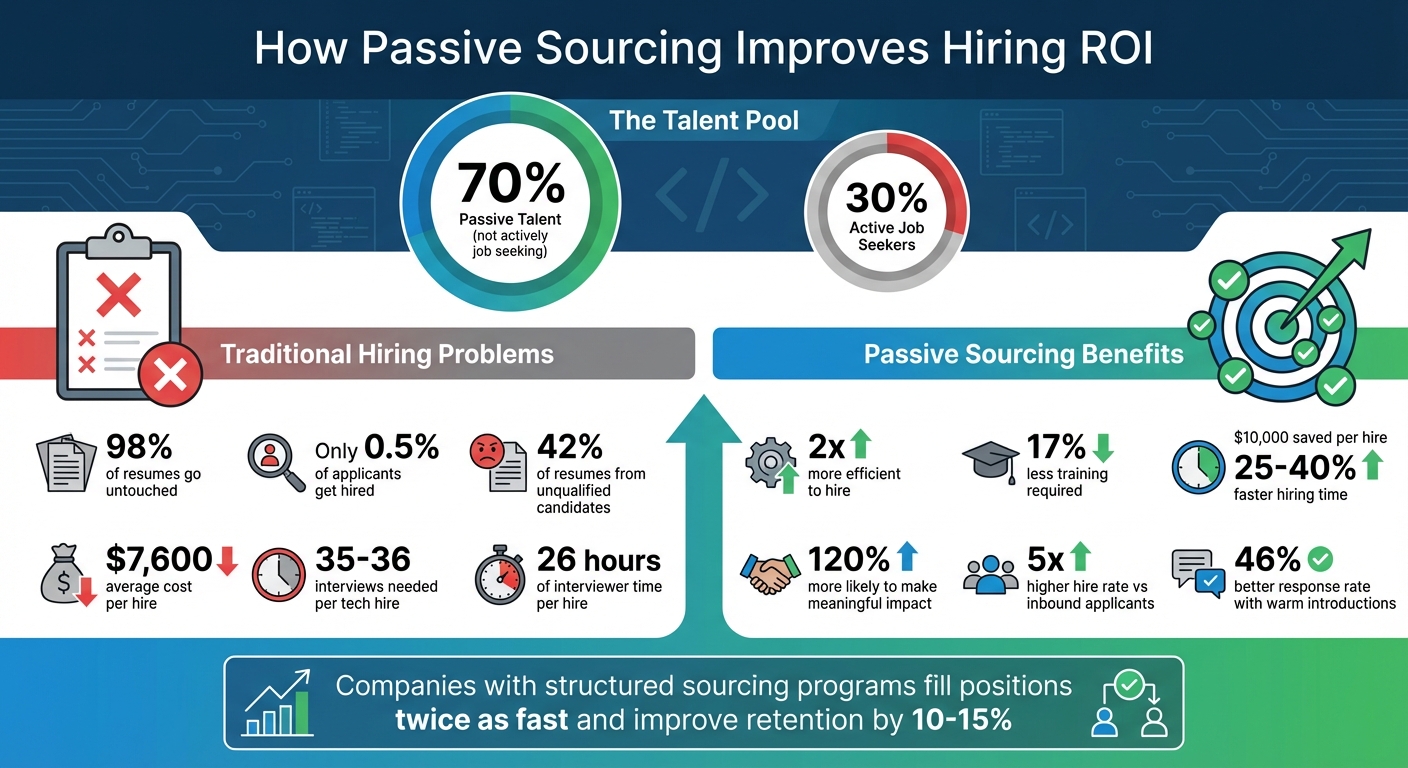 {Passive Sourcing vs Traditional Hiring: Cost Savings and Efficiency Statistics}
Problems with Traditional Hiring Methods
The traditional approach to hiring - posting job ads and waiting for applications - has proven to be riddled with inefficiencies, especially in the tech industry. Only 0.5% of applicants actually land the job, while a staggering 98% are filtered out before even reaching an interview stage . This means recruiters spend a disproportionate amount of time screening candidates who don’t progress, leading to wasted effort, rising costs, and higher turnover rates.
High Costs and Low Efficiency
The inefficiencies of traditional hiring come with a hefty price tag. On average, companies spend 7,600 per hire , with job boards alone costing around $1,250 per position . When it comes to technical roles, the process becomes even more resource-intensive, requiring 35–36 interviews and 26 hours of interviewer time for each hire .
Adding to the strain, recruiters are now dealing with 93% more applications than they did in 2021, despite their teams being 14% smaller . This imbalance has led to a 43% drop in hires per recruiter .
"73% of potential candidates are passive job seekers... if you're not practicing passive recruiting, you're putting your organization at a significant disadvantage." - Sierra Rogerson, Software Advice
Another major issue is the quality of applications. A whopping 42% of resumes come from candidates who aren’t qualified for the role . This flood of unsuitable applications not only clogs the pipeline but also prevents recruiters from engaging with passive candidates - those who aren’t actively job-hunting but could be a great match. Meanwhile, active candidates are often juggling offers from multiple companies, forcing recruiters into a competitive rush that can lead to hasty decisions or missed opportunities .
High Turnover and Poor Quality Hires
A significant portion of active candidates apply to jobs out of necessity rather than genuine interest. Whether driven by unemployment, dissatisfaction in their current roles, or financial pressures, these candidates are often more focused on securing a job quickly than finding the right fit . This urgency can lead to higher turnover as these hires may not align well with the company’s long-term needs.
This pressure-filled environment also encourages resume exaggeration, making it harder to assess candidates accurately . On top of that, active job seekers often require more skill development compared to passive candidates, who are typically thriving in similar roles elsewhere . Passive candidates, in fact, are 120% more likely to be motivated to make a meaningful impact within a business .
How Passive Sourcing Solves Hiring Problems
Passive sourcing flips the script on traditional hiring. Instead of waiting for applications from the 30% of workers actively seeking jobs, recruiters can tap into the other 70% - those who aren’t actively browsing job boards but are open to the right opportunity . This proactive approach not only sidesteps the fierce competition for a small pool of active candidates but also opens doors to professionals who are currently employed and excelling in their roles. It’s a smarter, more targeted way to recruit.
Access to Hidden Talent Pools
Job postings typically reach only those actively searching - a small slice of the talent pie. Passive sourcing changes this by targeting professionals in the spaces where they already spend their time, like developer communities. Instead of relying on outdated profiles, recruiters can evaluate candidates based on their real, ongoing contributions. This strategy saves both time and money: 82% of talent leaders say proactive sourcing is key for filling specialized tech roles . Companies with structured sourcing programs fill positions twice as fast and save about $10,000 per hire .
Advanced tools like Boolean search and AI-driven targeting make it possible to uncover candidates who might not show up in standard searches. By focusing on specific project work and skill sets, rather than generic keywords, recruiters can identify the right talent more effectively.
Better Candidate Quality and Retention
Passive candidates often come with a proven track record from their current roles, which means they require about 17% less skill development during onboarding . Since they’re selective about aligning with a company’s mission and culture, they tend to stick around longer, reducing turnover costs. And when you consider that a bad hire can cost up to $240,000 in recruitment, compensation, and retention expenses , the importance of finding the right fit becomes crystal clear. With passive sourcing, recruiters can focus on quality over quantity, resulting in better outcomes for both the company and the candidate.
Higher Efficiency with Warm Introductions
Cold outreach often falls flat, but warm introductions are a game changer. Candidates are 46% more likely to respond to an InMail if they already have a connection at the company , and personalized opening lines boost reply rates by 35% . AI-assisted messages take it even further, achieving a 40% higher acceptance rate .
Platforms like daily.dev Recruiter make this process even smoother by facilitating warm, double opt-in introductions. Developers only engage when they’re genuinely interested, which cuts down on cold outreach and unnecessary screening. This approach shifts recruiting from impersonal outreach to meaningful, trust-based conversations. The result? Outbound-sourced candidates are hired at five times the rate of inbound applicants .
How Passive Sourcing Improves Hiring ROI
Switching from reactive job postings to proactive passive sourcing can significantly impact hiring costs, speed up onboarding, and enhance employee retention - delivering measurable financial benefits.
Lower Costs Through Targeted Outreach
Traditional hiring methods often waste resources. On average, only 2% of active applicants make it to the interview stage, leaving 98% of screening efforts unproductive . Passive sourcing flips the script by focusing on pre-qualified candidates right from the start. This approach allows recruiters to save time by engaging with professionals who already meet the job requirements.
The data backs this up: sourced candidates are twice as efficient to hire . Plus, passive candidates are typically not juggling multiple job offers, meaning you’re negotiating with someone in their current role rather than competing with inflated market offers.
Tools like daily.dev Recruiter make this process even more efficient. By connecting recruiters with developers who are already engaged and pre-qualified through their daily activities, recruiters can focus on warm, double opt-in introductions. This ensures time is only spent on candidates genuinely interested in new opportunities, creating a cost-effective foundation for faster and smoother onboarding.
Better Fit and Faster Productivity
Passive candidates don’t just save money - they also ramp up faster. Because they’re already excelling in similar roles, they require less training during onboarding. This can significantly cut down onboarding costs, which typically range from 25% to 50% of a new hire’s annual salary .
These candidates are also 120% more likely to aim for meaningful contributions to your business . Their proven track record and thoughtful career decisions mean they adapt more quickly and align better with company values, reducing the risk of early-stage turnover.
Retention and Long-Term Savings
The benefits of passive sourcing extend well beyond initial hiring. Passive candidates tend to make deliberate career moves, leading to longer tenures. Companies that adopt strategic hiring practices have seen retention rates improve by 10–15% . Considering that a bad hire can cost up to $240,000 in recruitment, compensation, and retention expenses , making the right choice upfront is critical.
"The cost of a mis-hire in these critical functions far exceeds the cost of a slightly longer, more thorough search process." - Evan Cave, Author, SCOPE Recruiting
Lower turnover translates to fewer backfills, reduced retraining, and the retention of valuable institutional knowledge. Over time, these savings compound, making proactive sourcing a smart investment that pays off in both the short and long term.
Techniques for Effective Passive Sourcing
Engage Developers in Their Communities
Tech professionals often spend their time on platforms like GitHub, Stack Overflow, Reddit, Dev.to, and Kaggle . The key to effective passive sourcing is connecting with candidates in these spaces where they naturally engage, rather than interrupting them with unsolicited outreach.
A great example of this approach is Atlassian's "Talent Community." By offering regular newsletters that members could opt into, they grew the community by 47.5% annually, reaching 13,000 active members. This effort resulted in an impressive 62% average open rate and nearly 300 hires from passive candidates . Nikoletta Bika from Workable highlights the value of this strategy:
"The benefit of sourcing talent from online communities is that you see prospects in environments where they're active and engaged" .
Platforms like daily.dev Recruiter make this process even easier by allowing recruiters to connect with developers in their daily routines. Whether they're reading technical content, picking up new skills, or participating in discussions, these platforms provide a natural way to build relationships through thoughtful, personalized interactions.
Build Relationships Through Personalized Outreach
Once you've connected with candidates through their communities, personalized outreach is the next step to establishing trust and sparking interest. This means referencing specific technical achievements, like a standout GitHub project, a detailed Stack Overflow answer, or a completed coding challenge . Emails tailored to these details boast an 86% open rate , and using AI tokens for personalization can boost reply rates by 46% (35.3% compared to 24.1%) .
A three-touch strategy - reaching out at least three times if there's no response - can help cut through the noise . Timing matters too, with outreach sent between 12 PM and 6 PM local time yielding the best results . On the flip side, emails with spelling or grammar errors are 26.3% less likely to get a reply .
Spreetail offers a compelling case study. The company scaled to over 1,000 hires by providing personalized feedback to every interviewee, even those who were initially passive leads. This approach, combined with tracking Net Promoter Scores, helped them maintain long-term relationships with top talent .
Use AI and Data for Better Targeting
AI and data tools are game-changers when it comes to targeting the right candidates efficiently. Modern AI leverages semantic analysis to match candidates based on fit and intent, analyzing profiles across platforms like GitHub, Stack Overflow, and LinkedIn. These tools create detailed profiles that include technical skills, career history, and social connections .
The impact is clear: 37% of jobs now involve at least one AI-sourced candidate, and 32% of these passive candidates progress to the interview stage . Lucas Botzen, CEO of Rivermate, explains:
"AI can detect hidden talent not apparent in traditional recruitment processes, making the funnel of potential hires larger and thereby increasing the possibilities to get the right person for the job" .
AI also excels at predictive timing. By analyzing activity patterns and identifying "intent signals" - like increased engagement on professional forums - it helps recruiters reach out at the right moment . Kiera Cox from Liveflow shares her experience:
"Using Ashby's AI helps us source more quickly while still sending out way higher quality emails" .
Additionally, recruiters can set engagement alerts to track when high-priority candidates interact with industry content. Automated workflows, such as "snooze" features, make it easy to re-engage with candidates who aren't ready to move right away, typically within 6–12 months .
Conclusion
Passive sourcing offers a smart way to cut costs while improving hiring results. By tapping into the talent pool of individuals who aren’t actively job hunting, you gain access to high performers who are 17% less likely to require extensive training and come with proven experience. These candidates often stay longer in their roles because they’re making thoughtful career moves rather than acting out of urgency.
This approach doesn’t just save time - it saves money. Companies with structured sourcing programs report an average savings of $10,000 per hire and reduce their time-to-fill by 25% to 40% . Plus, passive candidates aren’t juggling multiple job offers, which means you can avoid expensive salary bidding wars. Instead, you can focus on building genuine relationships that emphasize fit over financial incentives.
To connect with developers, meet them where they already spend their time. Platforms like GitHub, Stack Overflow, and daily.dev Recruiter offer opportunities to build trust through personalized, context-driven outreach. When combined with AI-powered targeting and relationship-building strategies, these efforts create a pipeline of pre-qualified talent, cutting down hiring timelines significantly.
"Passive candidate sourcing enables you to get to them first. It puts your recruiters in touch with experienced professionals before they become actively available, thus enhancing the quality of hire, lowering competition, and cutting down on costs."
– Cadient
FAQs
How does passive sourcing help cut hiring costs?
Passive sourcing can significantly cut hiring expenses by zeroing in on pre-qualified and engaged candidates. This approach reduces the reliance on costly advertising, hefty recruiter fees, and time-consuming screening processes. By reaching out to professionals who are already a strong match for the role, it speeds up the hiring process and simplifies onboarding.
Tools like daily.dev Recruiter make this process even more efficient. By automating warm, double opt-in connections, it ensures recruiters interact only with developers who have expressed genuine interest. This not only saves valuable time and resources but also boosts the overall return on investment (ROI) for hiring efforts.
Why is sourcing passive candidates more effective than focusing only on active job seekers?
Sourcing passive candidates can greatly expand access to a broader, highly skilled talent pool. In fact, nearly 70% of the U.S. workforce falls into the "passive" category - professionals who aren’t actively job hunting but are open to the right opportunity. These individuals often bring substantial experience to the table, which means they typically require less training. This not only trims onboarding costs but also speeds up the time it takes for them to start delivering results.
Another advantage? Passive candidates are usually not bombarded with multiple job offers, giving recruiters the chance to establish stronger relationships and secure niche expertise. Tools like daily.dev Recruiter make this process even smoother. By connecting employers with pre-qualified developers already active on the platform, it eliminates the need for cold outreach. These warm, double-opt-in introductions streamline hiring, fostering trust and efficiency while keeping costs in check.
How does AI improve passive sourcing and hiring efficiency?
AI-powered tools simplify passive sourcing by taking over tasks that would normally eat up a recruiter's time. They can quickly identify potential candidates, evaluate their skills and experience, and even gauge their openness to new opportunities. These tools scan professional networks, forums, and code-sharing platforms in just seconds, removing the need for manual searches or crafting intricate Boolean strings.
Using predictive analytics, AI fine-tunes candidate matches over time and improves how recruiters engage with prospects. It can create personalized outreach messages, handle follow-ups, and manage opt-in workflows, all designed to make the hiring process more precise and efficient. This approach cuts sourcing costs, reduces time-to-fill, and boosts hiring ROI, helping recruiters connect with top talent exactly when it matters most.
.png)