Hiring developers based on resumes and interviews alone often leads to poor decisions. Studies show 46% of new hires fail within 18 months, primarily due to poor job fit, not lack of technical skills. Traditional methods like resume reviews and coding tests are unreliable - recruiters only predict success from resumes with 55% accuracy, and technical interviews can produce false negatives.
Behavioral data changes this by focusing on how candidates work, collaborate, and solve problems in real-world scenarios. Metrics like coding patterns, communication in pull requests, and open-source contributions reveal deeper insights into a developer’s potential. Companies that use behavior-based hiring practices report 80%-90% success rates in identifying the right candidates, along with increased productivity and profitability.
Platforms like daily.dev Recruiter simplify this process by providing real-time behavioral data, helping hiring managers make better decisions, reduce failure rates, and build stronger teams.
::: @figure 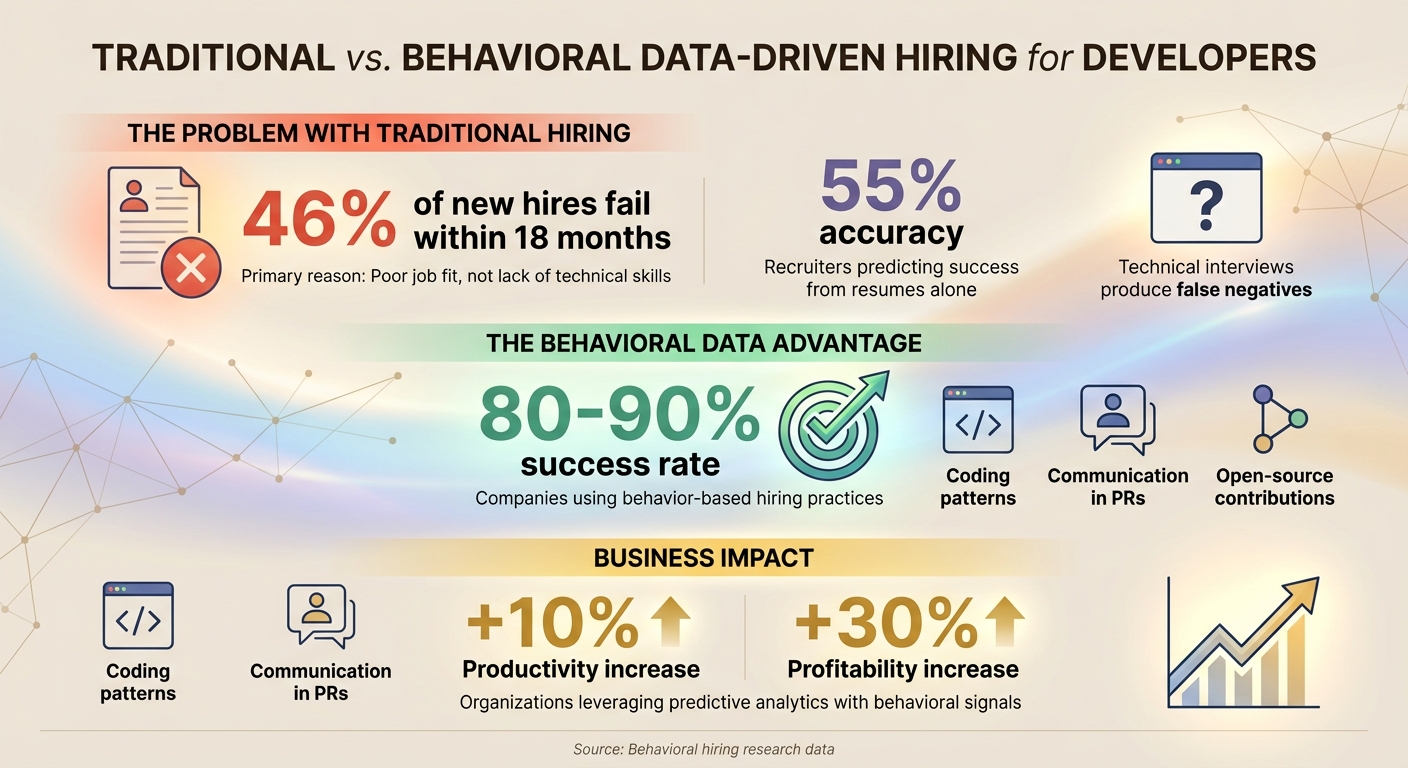 {Behavioral Data vs Traditional Hiring: Success Rates and Business Impact}
Why Behavioral Data Matters in Hiring Decisions
Understanding Behavioral Data
Behavioral data offers a window into how developers actually work, moving beyond the surface of resumes and job titles. It sheds light on work habits, such as how developers debug a tricky codebase, their strategy for refactoring, or how they articulate technical decisions during pull request reviews. This kind of data provides insights into collaboration skills too - how someone responds to feedback, their effectiveness in pair programming, and their ability to break down complex ideas clearly .
Think of it as the difference between viewing a roadmap and watching someone navigate in real-time. Developers' participation in open-source projects, contributions on platforms like GitHub, and involvement in technical discussions also reveal valuable patterns. Even the "distance traveled" - what someone has achieved relative to where they started - can be telling. For instance, a self-taught developer who climbs to a senior engineering role within three years demonstrates a level of problem-solving and determination that a polished resume alone might not capture .
"Behavioral assessment data... is the secret ingredient that helps you understand the 'why' behind the way people work and not just the 'what.'" - MeritTrac
This kind of insight can transform hiring decisions, making them far more accurate and informed by following a developer hiring checklist.
How Behavioral Data Predicts Better Outcomes
Incorporating behavioral metrics into hiring decisions isn't just a nice-to-have - it’s a game-changer. Companies that use behavior-based hiring practices report an 80% to 90% success rate in identifying the right candidates . Beyond that, organizations leveraging predictive analytics, which factor in behavioral signals, see measurable benefits: a 10% rise in productivity and a 30% increase in profitability .
Behavioral data also helps address compatibility issues before they arise. Research shows that 46% of new hires fail within 18 months, and poor job fit - not technical shortcomings - is often to blame . By understanding how a developer handles challenges like ambiguity, processes feedback, and collaborates under pressure, hiring managers can better align candidates with team dynamics and role demands. The result? A more engaged, productive team member from day one.
Hiring engineers?
Connect with developers where they actually hang out. No cold outreach, just real conversations.
Which Behavioral Signals Matter for Developer Hiring
Understanding a developer's behavior can provide a deeper look into their skills and potential. Let’s explore some key signals that can help identify a developer's true capabilities.
Coding Patterns and Problem-Solving Approaches
Sometimes, one standout project speaks volumes about a developer’s abilities. Take Carlos Becker’s env library, for example. With 5,672 stars and zero dependencies, it showcases exceptional technical judgment. Similarly, his domain_exporter project solved a real-world issue - monitoring SSL certificate expiration - highlighting his ability to create practical tools with clean API design .
Another important factor is the documentation-to-code ratio. Developers who prioritize detailed documentation demonstrate a commitment to maintainability and effective communication. For example, Fabiana Campanari increased her interview success rate by 85% using GitFolio, which showcased her strong documentation practices alongside her technical designs . Developers who explain design choices, rather than just presenting code, stand out.
Learning patterns also reveal technical growth. Diego Pacheco’s portfolio, which spans 16 years and 781 repositories, illustrates a journey from mastering Java basics to tackling advanced AI/ML projects with tools like PyTorch and Langchain . This progression reflects continuous learning and the ability to adapt to new challenges. Additionally, the skill to improve existing codebases is just as crucial as building new ones, especially since most collaborative work revolves around refining legacy systems.
How Developers Collaborate and Communicate
Great developers don’t just write good code - they work well with others. Pull request interactions can shed light on their collaboration style. How they respond to feedback, resolve disagreements, and incorporate suggestions shows their ability to work in a team and their openness to growth. Research even suggests these interaction patterns provide a clearer picture of collaboration dynamics than simple metrics like commit counts .
Communication extends beyond code reviews. Psycholinguistic models can analyze developer communication to infer personality traits, such as agreeableness (a focus on harmony) or extraversion (social engagement). Filtering out technical jargon improves the accuracy of these insights, which can help predict team compatibility .
Behavior on issue trackers is another telling signal. Developers who break down complex bugs into manageable tasks, explain technical decisions clearly, and engage with both technical and non-technical stakeholders demonstrate strong problem-solving and communication skills. Additionally, frequent, detailed peer reviews suggest a collaborative nature and a willingness to mentor others. These traits are often reflected in active participation within developer communities, where real-world problem-solving skills shine.
Developer Community Participation
A developer’s involvement in broader communities offers valuable insights into their ongoing learning and problem-solving abilities. Open-source contributions, discussions on GitHub, and activity on platforms like Stack Overflow reveal their dedication to sharing knowledge and staying current with industry trends. Such activities highlight initiative and a commitment to growth.
Modern recruiting tools now aggregate data from various platforms - GitHub, Stack Overflow, and others - to provide a comprehensive view of both technical expertise and soft skills . These profiles don’t just show what a developer knows; they also reveal how they engage with the tech community. For instance, analyzing communication patterns can help infer personality traits, which in turn predict work preferences and team fit .
Community engagement also demonstrates a developer’s ability to solve real-world problems. Developers who create tools like monitoring systems, automation scripts, or widely-used libraries show engineering judgment that extends beyond theoretical knowledge. These behavioral signals are crucial for identifying candidates who not only excel technically but also integrate seamlessly into team dynamics.
Using daily.dev Recruiter to Access Behavioral Data
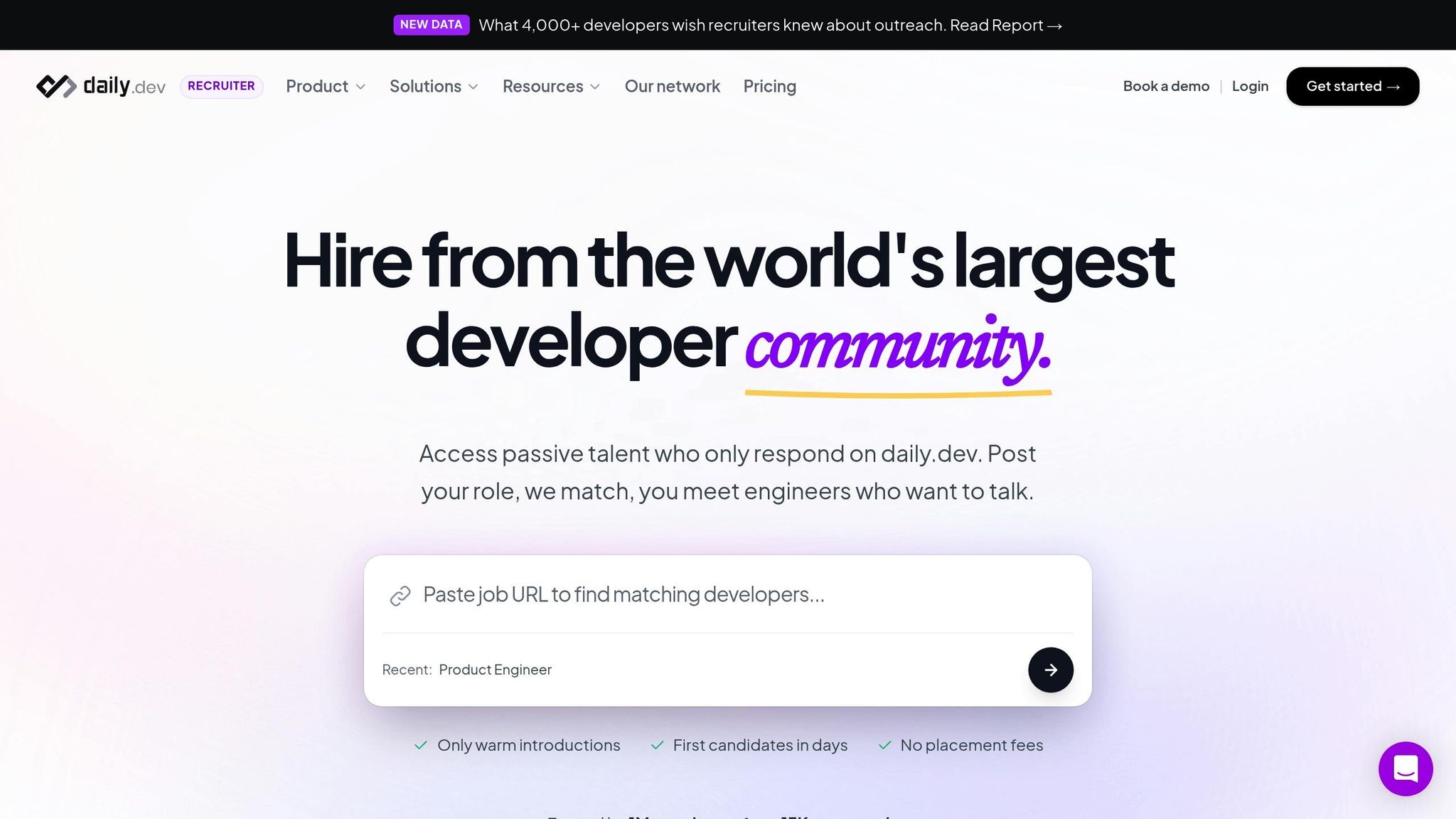
daily.dev Recruiter simplifies the way you access behavioral data for hiring. Instead of juggling fragmented insights from GitHub, Stack Overflow, or personal blogs, this platform connects you directly with developers where they engage daily with technical content. This means you get real-time behavioral signals, not outdated snapshots from resumes.
Connecting Through Warm Introductions
The platform uses a double opt-in system to ensure meaningful connections. Developers must first express interest in your role, so you're only reaching out to candidates who are genuinely open to opportunities. This sets the stage for conversations built on mutual interest instead of cold outreach.
You can also create up to three custom screening questions that candidates answer before a match is confirmed. This feature helps you filter for specific skills or traits - like experience with distributed systems or mentoring junior developers - without wasting time on unsuitable profiles. The process is automated, saving you from sifting through irrelevant candidates. Additionally, dynamic filtering tools refine your candidate pool even further.
Filtering Candidates by Behavioral Criteria
With daily.dev Recruiter, static resumes are replaced by live signals that showcase a candidate's current learning and engagement. Instead of relying on outdated information, you gain insights like "actively learning Rust" or "exploring AI/ML frameworks", allowing you to target candidates who are upskilling in areas your team needs most.
The platform's activity-based verification offers proof of a developer's technical curiosity and up-to-date skills. By tracking their engagement with technical content on daily.dev, you can see how they stay informed about industry trends. This approach highlights the 40% of senior contributors who might not be active on traditional job boards but are deeply involved in learning and community discussions. These real-time insights integrate seamlessly into your hiring process.
Connecting daily.dev Recruiter with Your ATS
Integrating daily.dev Recruiter with your Applicant Tracking System (ATS) is quick and hassle-free. Using one-click OAuth, you can connect platforms like Greenhouse, Lever, and Ashby, or choose from over 30 other supported systems, including Workday, BambooHR, and Workable. Once linked, your ATS syncs automatically with daily.dev Recruiter, keeping your sourcing pipeline updated.
When a developer accepts your request, their profile - including resume, contact details, GitHub link, tech stack, and portfolio - is transferred directly into your ATS. This eliminates manual data entry, thanks to auto-deduplication and tagging candidates as "daily.dev" for easy tracking. According to industry data, recruiters using non-integrated platforms lose over 3 hours per week to context switching, while 86.1% of recruiting professionals report that ATS tools help them hire faster and more efficiently . Make sure to check the "Export Queue" regularly to confirm all matches are successfully added to your hiring workflow.
How to Implement Behavioral Data in Your Hiring Process
Using behavioral insights in your hiring process can lead to better decisions and stronger teams. The key is to start small and scale gradually. Begin with a pilot program in one department or for a specific role to showcase clear results before rolling it out across the company. Build a system that directly connects behavioral insights to hiring outcomes, turning data into measurable success.
Setting Behavioral Standards
To define what success looks like, analyze the behaviors of your top performers. Go beyond technical skills - focus on how they problem-solve, collaborate with teammates, and adapt to new technologies.
Research shows that many hiring failures stem from poor job fit, not a lack of technical ability. By identifying behaviors that drive success - like how developers handle debugging, mentor junior colleagues, or participate in technical communities - you can create specific, measurable standards. Companies that use behavior-based hiring methods have reported improving their chances of a successful hire to 80%-90%.
Revamp job descriptions to emphasize these proven behavioral traits instead of generic qualifications. For example, if your data reveals no link between a computer science degree and on-the-job performance, consider removing that requirement. Instead, focus on behaviors that align with success in your organization.
Once you've established these standards, use metrics to track their effectiveness in improving hiring outcomes.
Measuring Your Hiring Results
Evaluate your hiring process at multiple levels using a data-driven recruitment success checklist to ensure your behavioral approach is working. Look at short-term metrics like time-to-fill and candidate experience, medium-term metrics such as 90-day reviews and time-to-productivity, and long-term metrics like retention and revenue per employee.
Structured interview scoring systems, for instance, can boost the accuracy of predicting new hire success by 40%. Create a feedback loop by correlating behavioral scores from the hiring process with actual job performance. This evidence-based refinement will help you continuously improve your standards.
Shift your focus from just filling roles quickly to evaluating the quality of hires. For example, a developer who becomes fully productive in 30 days instead of 90 adds significant value, making the investment in behavioral screening worthwhile.
Conclusion
Relying solely on resumes for hiring decisions often leads to missed opportunities. These documents, typically scanned in seconds, lack the depth needed to predict how developers solve problems, work with others, or handle new challenges effectively. This approach leaves hiring decisions based on incomplete and often unreliable information.
Behavioral data flips the script. It allows hiring managers to evaluate candidates based on how they actually code, communicate, and engage in in their professional communities. This shift from guesswork to data-driven decisions can have a tangible impact: companies that hire high-performing candidates report a 10% boost in productivity and a 30% increase in profitability. Incorporating behavioral insights bridges the gap between raw data and confident hiring decisions.
Enter daily.dev Recruiter - a platform designed to transform the hiring process. Instead of relying on outdated resumes or cold outreach, it connects you with developers based on their real-time behavior - what they read, how they interact, and where they contribute. Every connection is warm and double opt-in, ensuring you engage only with candidates genuinely interested in your opportunities. This approach eliminates unnecessary screening calls and focuses on how to identify qualified technical candidates in minutes. By prioritizing these behavioral signals, your team aligns with hiring strategies that reduce the 46% failure rate of new hires due to poor job fit.
In today’s fast-evolving landscape, hiring based solely on credentials is outdated. Embracing behavioral insights helps build stronger, more engaged teams that deliver better results and stick around longer.
FAQs
What counts as behavioral data in developer hiring?
Behavioral data in developer hiring focuses on the actions and patterns that reveal a candidate's soft skills, problem-solving abilities, and teamwork. This includes things like coding habits, how they collaborate with others, their approach to communication, conflict resolution, or even contributions to open-source projects. Such data is often gathered from past projects, responses to behavioral interview questions, or coding assessments. It provides a more practical view of how candidates perform in real-world situations, moving beyond the traditional reliance on resumes.
How do you collect behavioral signals without invading privacy?
We gather behavioral signals using non-intrusive methods that prioritize candidate consent. This involves analyzing data that individuals willingly share, such as coding practices or participation in online communities, through opt-in and anonymized processes. Tools like voice-behavioral mapping and natural language processing (NLP) focus on identifying patterns and tone, without capturing sensitive or private content. By emphasizing transparency, securing explicit consent, and anonymizing data, we ensure privacy is safeguarded while extracting meaningful insights.
How can I start using behavioral data without changing my whole process?
To get started, try incorporating brief, focused assessments that gauge essential behavioral traits like teamwork, flexibility, or decision-making. These evaluations can serve as a useful addition to your current methods - like resumes or technical tests - without overhauling your existing workflow.
Options like quick online quizzes or voice-based mapping tools can help identify behavioral patterns effectively. These simple, scalable approaches can improve hiring precision while keeping your processes intact.
.png)