When hiring for technical roles, the key question is: Can this candidate handle the challenges of the job? Problem-solving is critical - whether it’s debugging code, improving systems, or collaborating with AI tools. Yet, traditional hiring methods often fail to measure this skill effectively.
Here’s how to assess problem-solving abilities:
- Define Role-Specific Skills: Tailor assessments to the job, focusing on challenges like API design, system architecture, or AI collaboration.
- Use Realistic Tests: Replace abstract puzzles with coding challenges, live coding, or take-home projects that reflect actual work scenarios.
- Scenario-Based Interviews: Ask candidates to solve real-world issues, explain their decisions, and demonstrate their thought process.
- Leverage Tools: Platforms like HackerRank or CodeSignal streamline testing, while sourcing tools like daily.dev Recruiter connect you with active developers.
- Standardize Evaluation: Use scoring rubrics to ensure fair and consistent assessments.
These strategies help identify candidates who can solve problems effectively, ensuring they’re ready to contribute from day one.
Identify Problem-Solving Skills for the Role
Pinpoint the exact problem-solving skills required for the role you're hiring for. Technical roles vary widely, and so do the challenges they present. For instance, a frontend developer working on React component architecture faces entirely different hurdles compared to a backend engineer designing scalable APIs or a cybersecurity specialist focused on safeguarding data systems . Your assessments should align closely with the specific challenges of the job.
"Before you begin interviewing tech candidates, it's important to identify the technical skills and skill levels necessary for the role. Depending on the position, this could be things like expertise in specific programming languages, experience managing cloud platforms, or knowledge of system architecture. Outline both the essential and 'nice-to-have' skills to ensure that your interview process is aligned with the job requirements." - INSPYR Solutions
Seniority plays a big role too. Entry-level developers might excel at identifying problems and brainstorming solutions but often need help with execution. Mid-level developers can handle most challenges independently, though they may occasionally need direction. Senior-level experts, on the other hand, can manage problems from start to finish, foresee potential obstacles, and work with minimal oversight . Tailor your expectations based on the seniority level you're hiring for.
The nature of the role also influences what you should prioritize. Does the position require strategic alignment and managerial oversight, or is it more hands-on and technical? These distinctions should shape your assessments and help determine which competencies matter most. By defining these clearly, you can create a structured evaluation process that aligns with the job's demands.
Build a Skills Matrix for the Position
Once you've identified the required skills, a structured skills matrix can help ensure consistent and fair evaluations. Start by auditing your team’s current practices to align your assessments with real-world challenges . This approach ensures you're evaluating practical abilities, not just theoretical knowledge.
Break down problem-solving into key areas like analysis, research, creativity, decision-making, communication, and adaptability . Then, identify which of these areas are most critical for the role you're filling.
For technical positions, focus on domain-specific skills. For example:
- Frontend developers should be proficient in responsive design, API integration, and state management.
- Backend developers need expertise in database integration, system architecture, and security implementations .
- AI/ML or cloud development roles often require candidates to demonstrate their ability to solve project-based problems and build functional applications .
With AI tools becoming integral to modern technical roles, include AI collaboration skills in your matrix. This might involve interpreting AI-generated code or debugging suggestions from AI tools . Clearly define acceptable AI usage during assessments to set expectations for candidates.
Finally, distinguish between essential skills and "nice-to-haves." This prevents you from disqualifying strong candidates who lack less critical abilities while ensuring core competencies are non-negotiable . Document each criterion thoroughly to maintain consistency across all evaluations.
Create Effective Problem-Solving Tests
Using your clearly defined skills matrix as a foundation, design tests that reflect the actual challenges candidates will face in the role. These tests should go beyond simple technical exercises - they need to evaluate how well candidates can tackle real-world problems. Whether it’s debugging software errors or optimizing system performance, the goal is to assess skills like analytical thinking, research abilities (such as analyzing logs or data), and creative problem-solving. Along with writing code, candidates should explain their thought process, define the problem, and justify their solution - skills that are essential in technical roles . Use formats like live coding sessions or take-home projects that mimic on-the-job scenarios to get a clearer picture of a candidate’s abilities. Tailor these assessments to include work-simulated challenges for a more realistic evaluation.
Design Coding Challenges Based on Actual Work
Craft coding challenges that align closely with the technical issues your team handles every day. For instance, a backend engineer might work on debugging API performance or implementing security measures, while a frontend developer could tackle tasks related to responsive design or state management. The closer these challenges resemble real tasks, the better you’ll be able to gauge how candidates will perform on the job .
Structure these challenges to follow a logical problem-solving process. Start with a scenario that requires candidates to identify the main issue, gather relevant information, brainstorm possible solutions, and then choose and implement the best approach. For example, instead of asking candidates to simply write a sorting algorithm, present them with a data processing bottleneck. Have them diagnose the problem, propose solutions, and implement the most effective fix.
In addition to tailored challenges, real-time exercises can provide further insights into a candidate’s approach.
Use Live Coding and Whiteboard Exercises
Live coding sessions are a great way to observe how candidates solve problems in real time. Watching how they break down complex tasks, structure their code, and handle unforeseen challenges can reveal a lot about their technical and analytical skills . To make these exercises more meaningful, base them on practical business scenarios rather than abstract puzzles . Encourage candidates to explain their reasoning as they work, which also highlights their communication abilities.
For roles that require teamwork, consider incorporating pair programming into these sessions. This setup not only evaluates technical skills but also shows how candidates respond to feedback, adapt their approach, and collaborate within a team. You can also test their ability to pivot by presenting scenarios where they need to revise an initial solution. Keep time constraints realistic to see how candidates prioritize and make decisions without adding unnecessary pressure .
Assign Take-Home Projects for Detailed Analysis
Take-home projects allow you to assess aspects of problem-solving that might not come through in live exercises, such as independent work habits, efficiency, and creative thinking . Design these projects to cover the entire problem-solving process - from defining the problem and brainstorming ideas to implementing a solution and evaluating the results .
Instead of requiring a fully implemented solution, you can ask for a detailed plan, prototype, or model. This approach helps you evaluate the candidate’s thought process and design skills without demanding an excessive time commitment . Be clear about constraints, such as time limits, available resources, or specific technical requirements, to keep the project focused and manageable . Breaking larger tasks into smaller components can also give you insight into how systematically candidates approach challenges .
"Problem-solving skills are the abilities employees use to understand challenges, evaluate potential solutions, and take effective action to resolve issues." - Metaview
Evaluate how candidates make decisions, prioritize tasks, and balance competing demands. Asking them to define success metrics for their solution can provide insight into their strategic thinking and results-oriented mindset . A well-designed take-home project doesn’t just show what candidates can build - it reveals how they think through problems from start to finish, mirroring the problem-solving demands of real technical roles.
Use Tools to Simplify Assessment
After designing your problem-solving tests, the next step is to leverage tools that streamline and scale the evaluation process. The right tools not only save time but also make it easier to manage large applicant pools. Technical assessment platforms handle tasks like test distribution and result tracking automatically, leaving you free to focus on analyzing candidate performance. This is especially useful when you're hiring for multiple roles or dealing with a high volume of applicants, where manual evaluations can quickly become overwhelming.
It's important to choose tools that align with your assessment strategy. For instance, if you're using standardized coding challenges, platforms with built-in test libraries and automated scoring are ideal. On the other hand, if you're looking to connect with developers who are already engaged and open to opportunities, a targeted sourcing approach with warm introductions can improve both response rates and candidate quality. Let’s take a closer look at some tools that can help.
Technical Assessment Platforms for Large-Scale Testing
Platforms like HackerRank and CodeSignal are designed for large-scale testing, allowing you to send standardized coding challenges to many candidates at once. These platforms come equipped with pre-built test libraries, automated scoring, and useful metrics like completion time and plagiarism detection. This makes it easier to objectively compare candidates, even when you're evaluating talent across time zones or hiring for similar roles in different locations.
Another advantage is automated reporting. Results are consolidated into dashboards that highlight performance trends, such as candidates who consistently write clean, well-documented code or those who struggle with specific types of problems. This level of efficiency is crucial for high-volume hiring, as it significantly cuts down the time needed for initial screenings.
Connect with Pre-Qualified Candidates Using daily.dev Recruiter
Beyond assessment platforms, sourcing tools like daily.dev Recruiter can help you find candidates who are already active and engaged in their professional development. Unlike static resume databases, daily.dev Recruiter connects you with a network of over 1,000,000 developers who are actively learning and engaging on the platform . Each introduction is warm and double opt-in, meaning candidates have already expressed interest in exploring new opportunities.
This approach reduces the inefficiencies of traditional recruiting. Instead of chasing outdated profiles or sending generic messages, you’re matched with developers who meet your criteria and are genuinely open to new roles. The platform also pre-screens candidates based on skills, experience, and career interests, ensuring that the people you connect with are well-suited to your requirements. By combining these sourcing tools with your assessment methods, you can build a more efficient and effective hiring pipeline. This targeted strategy not only saves time but also increases the chances of finding strong, well-matched candidates for your team.
Hiring engineers?
Connect with developers where they actually hang out. No cold outreach, just real conversations.
Run Scenario-Based Interviews
After refining your hiring process with tests and challenges, scenario-based interviews can offer deeper insights into how candidates handle real-world problems.
Once you've filtered your candidate pool through technical assessments, these interviews help uncover how candidates approach complex challenges. They aren't just about testing knowledge - they're about understanding how someone analyzes situations, weighs trade-offs, and explains their reasoning under pressure. By discussing real-world scenarios, you can better gauge their practical problem-solving abilities, as past performance often hints at future success .
Focus on questions that reflect the actual challenges of the role. For example, instead of abstract puzzles, ask about debugging production issues, optimizing slow queries, or evaluating architectural strategies. Research shows that 66% of developers favor practical coding challenges over abstract algorithmic puzzles during interviews . This makes scenario-based questions not only more insightful but also a better experience for candidates. They also provide a window into how candidates make decisions under pressure.
Test Decision-Making with Situational Questions
Good situational questions introduce real-world constraints, trade-offs, and testing considerations . For instance, instead of a generic question like, "How would you build a caching system?" you could ask:
"Imagine your API response times double during peak hours as a product launch nears. Walk me through your approach."
This type of question pushes candidates to demonstrate their thought process, prioritize solutions under time pressure, and explain their reasoning clearly. Pay attention to how they break down the problem, gather context, and weigh their options. Strong responses often include strategies for monitoring performance, addressing edge cases, and validating solutions. Candidates who acknowledge gaps in their knowledge while outlining a logical plan show both humility and critical thinking.
Review Past Projects and Code
Looking at candidates' past work - such as GitHub repositories, open-source contributions, or portfolio projects - provides another layer of insight. Ask them to explain the toughest technical decision they made in a project, why they took that approach, and what they might do differently now. This not only evaluates their technical skills but also their ability to reflect, learn, and adapt .
You can also use project-based scenarios during interviews. For example, give candidates access to a realistic codebase and ask them to add a feature, fix a bug, or improve performance . This allows you to observe how they navigate unfamiliar code, ask clarifying questions, and make incremental changes. Using the same codebase across multiple interview rounds - with increasing complexity - can reveal how they handle evolving requirements and technical debt .
Set Up Consistent Evaluation Standards
::: @figure 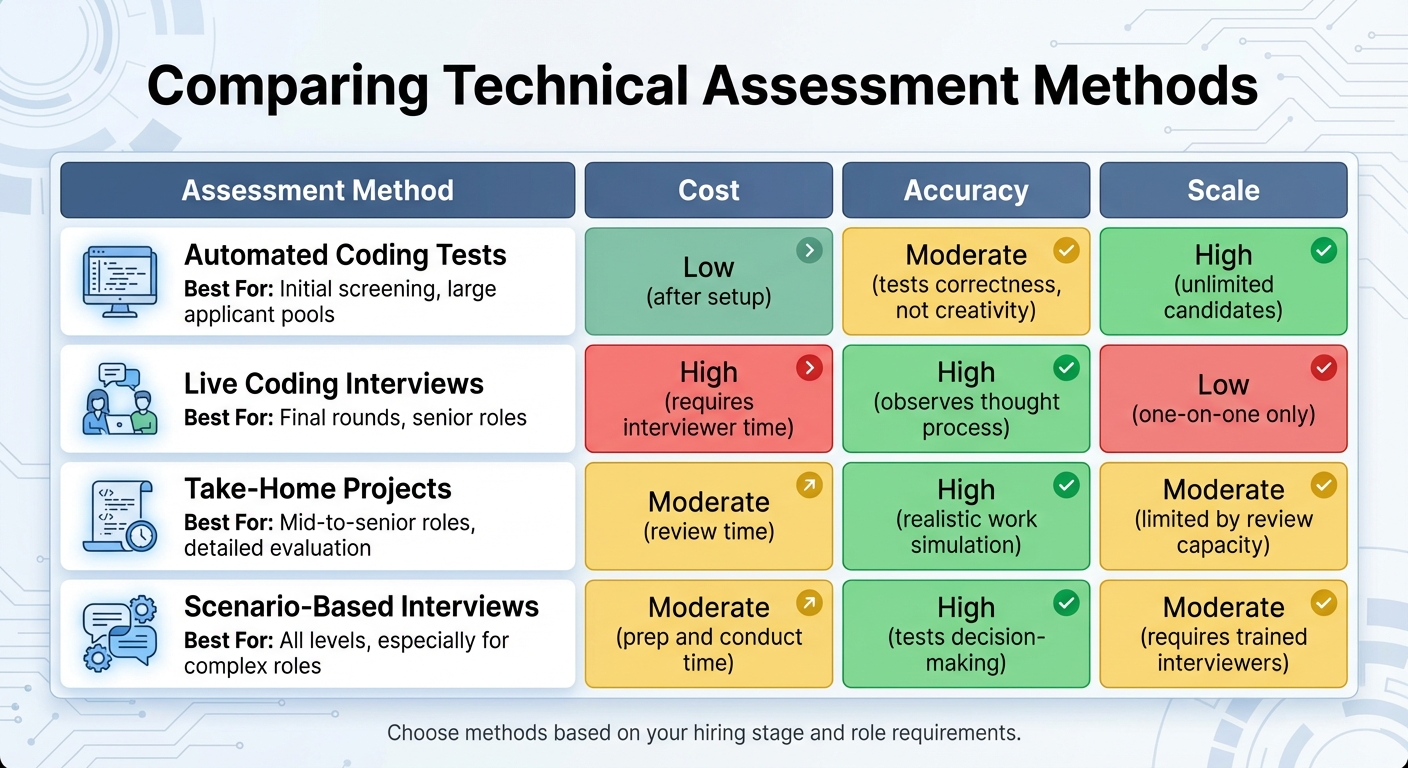 {Technical Assessment Methods Comparison: Cost, Accuracy, and Scale}
Without clear evaluation criteria, interviews can become subjective and prone to bias. Two interviewers might assess the same candidate differently, leading to inconsistent hiring decisions. By using standardized, research-backed scoring systems, you can ensure a more reliable and fair process [19].
Before conducting interviews, define what success looks like for the role. Develop rubrics that focus on specific competencies needed for the position . For example, when assessing problem-solving skills, break it into measurable components like analyzing requirements, addressing edge cases, optimizing performance, and explaining decisions. These clear standards help create precise scoring systems that evaluate candidates fairly and consistently.
Create Scoring Systems for Key Metrics
Start by pinpointing the technical and soft skills required for the role and build evaluation rubrics around them. For coding assessments, scoring should go beyond just functional correctness. While automated systems can evaluate submissions for accuracy and runtime efficiency [19], a thorough evaluation should also consider factors like code quality, readability, maintainability, and efficiency .
"The limitation of functional correctness evaluation is that sometimes it is cost prohibitive to set up an execution environment for implementing generated code. Additionally, functional correctness evaluation does not take into account the following important factors of the generated code: Readability, Maintainability, Efficiency." - Microsoft Learn
Design rubrics that account for varying skill levels. For instance, a junior developer might write functional but inefficient code, while a senior developer produces optimized, maintainable solutions. Your scoring system should reflect these differences. To ensure consistency, train interviewers on how to use the rubrics and hold regular calibration sessions to align their evaluations .
Compare Assessment Methods: Cost, Accuracy, and Scale
Once your scoring criteria are in place, assess the trade-offs of different evaluation methods to find the best fit for your hiring needs.
| Assessment Method | Cost | Accuracy | Scale | Best For |
|---|---|---|---|---|
| Automated Coding Tests | Low (after setup) | Moderate (tests correctness, not creativity) | High (unlimited candidates) | Initial screening, large applicant pools |
| Live Coding Interviews | High (requires interviewer time) | High (observes thought process) | Low (one-on-one only) | Final rounds, senior roles |
| Take-Home Projects | Moderate (review time) | High (realistic work simulation) | Moderate (limited by review capacity) | Mid-to-senior roles, detailed evaluation |
| Scenario-Based Interviews | Moderate (prep and conduct time) | High (tests decision-making) | Moderate (requires trained interviewers) | All levels, especially for complex roles |
Keep in mind that metrics can sometimes be manipulated when they become targets. As Keith Hoskins observed, "every measure which becomes a target becomes a bad measure" . To avoid this, design scoring systems that combine multiple metrics and periodically review them to ensure they align with your hiring goals .
Conclusion
Evaluating problem-solving skills without coding tests doesn’t have to be complicated. By centering assessments around practical scenarios, you gain a better understanding of how candidates might perform within your team . Tasks like debugging production issues, improving outdated code, or building new features provide a clear window into the abilities that truly count. This hands-on approach ensures a fair and effective evaluation process.
Using consistent and standardized criteria helps remove bias from interviews. For instance, IBM Consulting has shown that structured evaluation systems can effectively measure talent based solely on merit and relevant skills . Incorporating streamlined tools into the process further supports unbiased and efficient assessments.
Strong technical tests go beyond checking if the code works. They examine critical aspects like problem analysis, logical reasoning, adaptability, and even the ability to measure impact . There’s a big difference between a developer who delivers functional but inefficient code and one who provides optimized, well-documented solutions.
Blending quick assessments with more in-depth evaluations creates a well-rounded hiring process. Align your methods with your goals: automated tests work great for initial screenings, while live coding sessions or take-home projects offer deeper insights. By combining different evaluation techniques and regularly refining how your team scores candidates, you’ll create a process that consistently identifies top technical talent while ensuring every candidate is treated with fairness.
FAQs
How can I create problem-solving assessments that match specific technical roles?
To design problem-solving assessments tailored to specific roles, it's important to align the tasks with the core responsibilities and challenges of the job. Include scenarios and questions that mirror situations the candidate is likely to face in their day-to-day work. For instance, you could create coding challenges that test their expertise in the programming languages or tools essential for the role. Similarly, use case studies to gauge how candidates tackle problems in a relevant context. This approach keeps your assessments practical and directly tied to the demands of the position.
What are the advantages of using live coding sessions during technical interviews?
Live coding sessions provide an excellent way to assess a candidate's problem-solving abilities, critical thinking, and how they perform under real-time conditions. These sessions reveal not only how candidates approach and break down challenges but also how effectively they communicate their thought process and manage pressure.
Watching their approach firsthand allows hiring teams to gain deeper insights into both technical skills and interpersonal dynamics, helping them gauge how prepared a candidate is to handle practical, on-the-job situations.
What makes scenario-based interviews effective for evaluating technical candidates?
Scenario-based interviews work well because they mimic actual job-related challenges, giving you a chance to evaluate a candidate's problem-solving abilities, critical thinking, and ingenuity in action. Watching how candidates tackle and resolve these scenarios reveals their approach to decision-making, adaptability, and communication - skills that are often crucial for success in the role.
This method goes beyond surface-level qualifications, offering a clearer picture of a candidate's technical know-how and how they apply it in real situations. It helps pinpoint those who not only have the right skills but also align well with your team and the broader goals of your organization.
.png)