A proven track record in software development isn’t about job titles or years of experience - it’s about measurable results. Hiring based on vague credentials or inflated resumes often leads to costly hiring mistakes, with bad hires potentially costing companies up to $500,000 in just eight weeks. Instead, focus on clear outcomes, such as reducing system latency by 40% or improving uptime from 88% to 99.7%.
Key takeaways:
- Years of experience ≠ expertise: Repeated experience doesn’t guarantee growth.
- Measurable results matter: Look for achievements like improved performance metrics or cost savings.
- Avoid shallow evaluations: Titles and GitHub commits can be misleading without context.
- Practical evaluation methods: Use case studies, technical assessment tools, and peer reviews to assess skills effectively.
Platforms like daily.dev Recruiter simplify the process by connecting you with pre-screened developers who’ve demonstrated real impact through verified achievements. This approach reduces hiring costs and ensures better matches for your team.
::: @figure 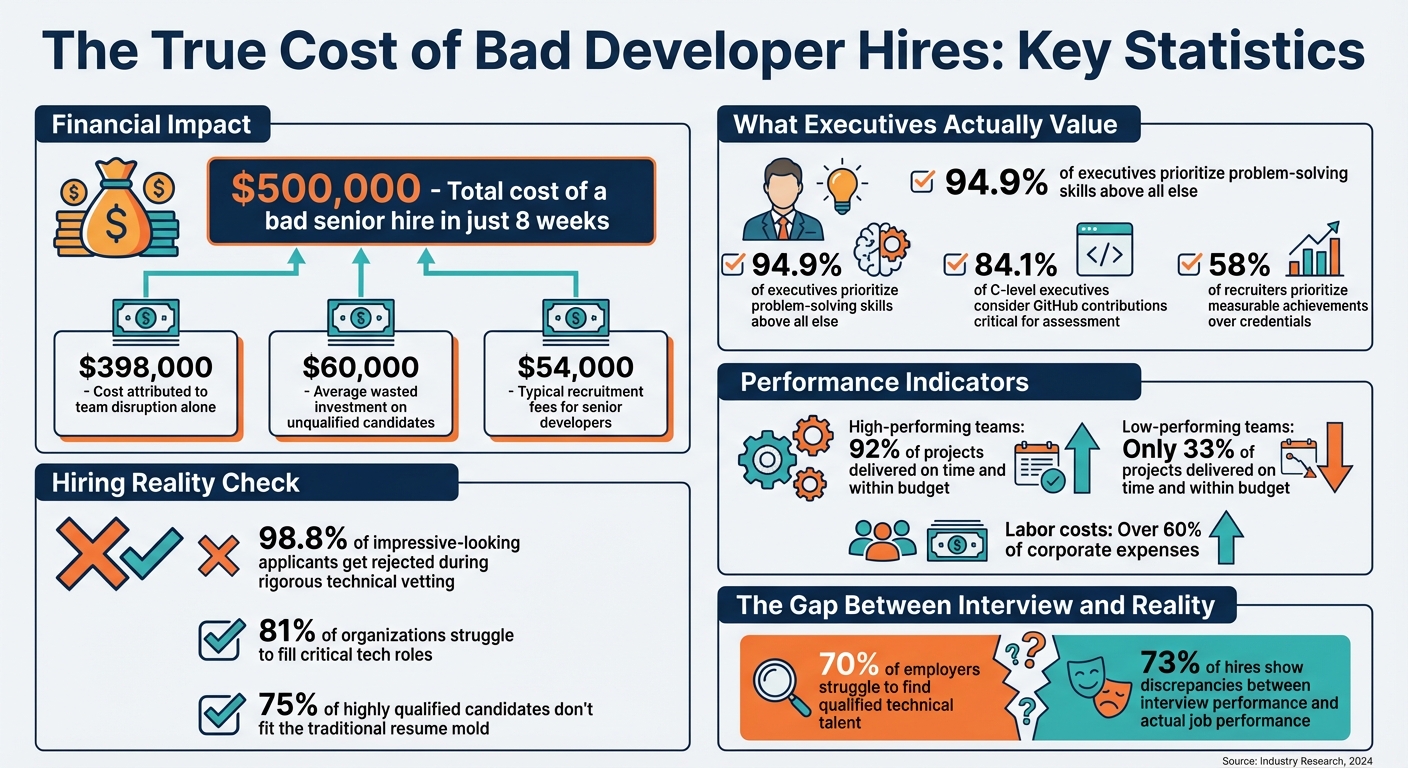 {The True Cost of Bad Developer Hires: Key Statistics and Hiring Insights}
The Problem: Weak Indicators Lead to Bad Hiring Decisions
Recruiters often treat resumes like scorecards, adding up years of experience and checking for big-name companies. But here's the kicker: 98.8% of applicants who seem impressive on paper get rejected during rigorous technical vetting . Why? Because resumes don’t just exaggerate - they also obscure what truly matters. Hiring based on surface-level signals is a gamble, and it could cost you $60,000 on a candidate who hasn’t proven their worth . These shallow indicators frequently lead to recurring evaluation mistakes, which are outlined below.
Common Mistakes When Evaluating Developer Experience
Misjudging developer experience often boils down to systematic errors in how candidates are evaluated. Simply put, years of experience and flashy labels don’t guarantee actual skill. In fact, these superficial measures can be incredibly misleading.
One of the biggest pitfalls is assuming that more years of experience automatically equates to expertise. Many so-called "senior" resumes reflect the same year of experience repeated over and over, rather than showcasing real growth . Ira Prokopiv, Tech Interviewers Coordinator at Lemon.io, notes that candidates with inflated titles often struggle to explain basic system design decisions in their own work .
Another common trap? Taking job titles or GitHub profiles at face value. Recruiters often fail to dig deeper into what a title represents or what those GitHub commits actually mean. Thousands of commits might seem impressive, but many could be automated dependency updates rather than original contributions . And then there’s the buzzword problem - scanning for terms like React, Kubernetes, or microservices without verifying whether the candidate knows why those tools were used or when they might not be the right choice.
"Knowing what you were supposed to do doesn't tell a reader how well you did that thing." - Jacob Kaplan-Moss, Software Engineer and Author
Evaluations driven by patterns or memorization can also lead to bad decisions. Developers might know framework syntax by heart or rely on Stack Overflow for quick fixes, but they falter when systems crash at 3 a.m. or when sprint requirements change unexpectedly . Standard algorithmic tests don’t help much either - they assess rote memorization rather than the practical problem-solving abilities your team needs .
The Cost of Hiring the Wrong Developer
Ignoring measurable outcomes when hiring has both financial and team-wide consequences. A bad senior hire doesn’t just underperform - they can disrupt your entire engineering team. Lemon.io’s 2024 analysis estimates that a single bad hire can cost nearly $500,000 in just eight weeks, with $398,000 of that tied to team disruption alone . Projects stall, deadlines slip, and your best developers waste time compensating for someone who can’t deliver.
The cultural damage is just as serious, though harder to quantify. When a so-called "senior" developer fails to mentor junior team members or make sound architectural decisions, frustration spreads. Your top engineers may begin to question leadership’s judgment, leading to increased turnover. Worse, your company’s reputation as an employer could take a hit .
And then there’s the opportunity cost. While you’re busy managing a mis-hire, you’re missing out on the 75% of highly qualified candidates who don’t fit the traditional resume mold . With 81% of organizations already struggling to fill critical tech roles , you can’t afford to waste months on someone who looked good on paper but can’t handle real-world challenges like corrupt data, memory leaks, or unexpected traffic surges . Relying on weak indicators isn’t just inefficient - it’s a costly mistake that could cripple your team.
What Counts as a Proven Track Record in Software Development
A proven track record in software development is all about real, measurable accomplishments - not just tasks completed or titles held. It’s the difference between developers who can point to tangible results and those who simply went through the motions.
The numbers back this up: 58% of recruiters prioritize measurable achievements when evaluating resumes, or recruit developers through open source projects to see their skills in action , and 94.9% of executives value problem-solving skills above all else when hiring . Yet, many hiring decisions still hinge on job titles rather than actual impact. A “senior” designation means little if a developer can’t provide concrete examples of challenges they’ve tackled and the outcomes they’ve delivered.
Key Traits of a Proven Track Record
A solid track record is built on three pillars: measurable results, technical expertise applied to real challenges, and external validation.
Quantifiable Results: Developers with proven track records don’t just describe what they did - they show how it made a difference. For instance, Drew Eckhardt’s "Policy Driven Observability" helped a 500-member team detect 80% of site issues and pinpoint 60% of root causes . At Zetta, he improved performance by as much as 107x through client-side metadata caching, allowing six-figure customers to handle 20x larger systems in overnight backup windows .
Operational Excellence: Especially in reliability-focused roles, a history of meeting SLAs, minimizing downtime, and improving incident response is invaluable. At Allocity, Eckhardt led a team of 12 to develop scale-out block storage with 10ms transaction snapshots for "instant" restores, matching the speed of direct-attached disks .
Peer Validation: External recognition is a strong indicator of competence. 84.1% of executives, CTOs, and founders consider GitHub contributions and repository experience critical for assessing skills . Open-source contributions, positive feedback on platforms like Stack Overflow, and well-documented repositories demonstrate that a developer’s work has been reviewed and validated by their peers .
These traits are more than just buzzwords - they come to life through documented, verifiable evidence.
Types of Evidence That Demonstrate a Proven Track Record
Concrete, verifiable evidence is key. Well-documented GitHub repositories often top the list, as clear documentation makes code not only functional but usable .
"I like to see work accomplishments described in terms of situation, action, and results. What was the business or technical problem to be solved? What unique actions did you take to resolve them, and what was the resulting improvement?" - Merilee Krebs, Technical Recruiter at New Relic
Case studies that follow this structure are especially compelling. Consider Robert Mudry, who developed spacecraft command and control software for the Pioneer 10 and 11 missions - software that continues to function as the spacecraft travel beyond the solar system . That’s the kind of achievement that stands the test of time.
Other forms of evidence include performance metrics. Examples might include achieving stability with fewer than 10 crashes per 10,000 users, keeping repaints under 100ms, or improving uptime from 88% to 99.7% . Financial results also speak volumes: cutting infrastructure costs by 70%, handling $1.5 million in sales during peak Black Friday traffic, or automating processes to save 10 hours a week .
Lastly, 360-degree assessments, peer reviews, and client testimonials provide qualitative validation . When multiple sources confirm a developer’s ability to mentor, communicate effectively with non-technical stakeholders, and take ownership from start to finish, you’re looking at someone who consistently delivers results .
How to Evaluate a Developer's Track Record: Practical Methods
When assessing a developer's track record, it’s essential to go beyond surface-level metrics. By using practical, evidence-based approaches, you can gain a deeper understanding of their skills and achievements.
Reviewing Open-Source Contributions
A great starting point is evaluating the impact and reach of the open-source projects a developer contributes to. Metrics like GitHub Stars, fork counts, and affiliations with established organizations (e.g., CNCF) can provide valuable insights. For instance, the Kubernetes project saw 80,000 commits from 2,760 developers across 1,181 companies in just three years - a testament to its high level of collaborative activity.
Dig deeper by analyzing their activity and consistency. Look at commit rates, release frequency, and the developer's involvement in project communications. Leadership roles, like maintainers, often reflect higher levels of responsibility and influence, whereas casual contributions - such as typo fixes or translations - make up around 28% of contributions.
"Documentation is the gateway for the project." - Hila Fish, Senior DevOps Engineer, Wix
Assess code quality by checking adherence to coding standards (e.g., PEP 8, ESLint), the presence of unit tests, and the clarity of commit messages. Reviewing pull request (PR) history is also crucial. Look beyond merged code to see how they handle feedback - do they engage constructively or abandon unresolved PRs? Active participation in project-specific communication channels like Slack or Discord can also highlight teamwork and community involvement.
Checking Work History and Project Results
A developer's work history can reveal how they’ve applied technologies to solve real-world challenges. Pay attention to the complexity of features they’ve built, the efficiency of their solutions, and the quality of their documentation. Clear documentation is a strong indicator of long-term maintainability.
Consider the broader context: high-performing development teams deliver 92% of their projects on time and within budget, compared to just 33% for low-performing teams. When evaluating past work, focus on tangible outcomes like completed tasks and shipped features rather than hours worked. Test the performance of their portfolio projects - evaluate loading speeds, responsiveness, and error handling to ensure they meet practical standards. Skills like secure payment integration or regulatory compliance can also highlight transferable expertise.
Conducting Technical Assessments and Code Reviews
Set clear objectives for technical evaluations. Focus on algorithmic thinking, language proficiency, and system design. Instead of relying on generic puzzles, use real-world scenarios that mimic production environments. This approach addresses a common challenge: while 70% of employers struggle to find qualified technical talent, 73% of hires show discrepancies between interview performance and actual job performance.
Leverage realistic tools during assessments. For example, use full-featured IDEs rather than whiteboards to create a more authentic working environment. Companies that adopt standardized remote technical assessments have reported 37% lower hiring costs and 42% better retention rates. Keep take-home assignments reasonable - limit them to 3–4 hours to avoid overwhelming candidates.
"The most expensive line of code is written by the wrong engineer." - Full Scale
Follow up on take-home tests with a discussion. This ensures candidates can explain their solutions and the trade-offs they made. Pair programming is another valuable tool - it provides insight into how candidates communicate, handle feedback, and solve problems collaboratively. While automated scoring can help streamline evaluations, human code reviews capture nuances and creativity that algorithms might miss.
Collecting References and Testimonials
Peer evaluations are an excellent way to assess a developer's communication and teamwork skills. Balance objective metrics like code quality and project completion rates with subjective qualities such as creativity, collaboration, and problem-solving ability. These qualitative insights align with the quantitative methods discussed earlier, creating a well-rounded evaluation.
"Describe, Don't Evaluate" - Dave Snowden, Management Consultant
Seek feedback from various sources, including former colleagues, managers, and clients. Consistent praise for skills like mentoring, effective communication with non-technical stakeholders, and taking ownership of projects indicates a reliable and results-driven developer. Research shows a 20:1 range in initial coding times and a 25:1 range in debugging times among professional programmers, making peer validation critical for understanding individual productivity. Testimonials from those who’ve worked alongside the developer provide invaluable context and confirmation of their abilities.
Hiring engineers?
Connect with developers where they actually hang out. No cold outreach, just real conversations.
Solution: Using daily.dev Recruiter to Find Developers with Real Track Records
Evaluating developers manually takes up a lot of time and drains engineering teams of valuable hours they could spend building and improving products. With labor costs making up over 60% of corporate expenses, dedicating internal resources to vetting candidates becomes a costly and inefficient process. This is why a more streamlined, evidence-driven approach is needed - one that saves time and ensures better candidate quality.
Enter daily.dev Recruiter, a platform that connects you with pre-screened developers who have proven themselves through real, measurable achievements. Instead of slogging through endless resumes, daily.dev Recruiter offers warm, double opt-in introductions to developers who are actively showcasing their expertise.
How daily.dev Recruiter Simplifies Developer Evaluation
Forget relying on vanity metrics like lines of code or commit counts. daily.dev Recruiter focuses on what truly matters: verified project histories and tangible outcomes. Developers’ profiles highlight key performance indicators like deployment frequency, cycle time, and change failure rates - metrics used by top-performing teams to gauge success.
"Everybody's resumes these days claim all kinds of skill sets that they have... It's hard for a hiring manager to differentiate." - Abhijit Tamhane, VP of Products, HackerRank
Leading talent networks reject up to 98.8% of applicants to ensure only the best developers make it to recruiters. Similarly, daily.dev Recruiter pre-screens candidates, helping you avoid the frustration of sorting through unqualified applicants or inflated titles that often clutter traditional hiring channels. The result? Better-quality introductions to developers who excel at problem-solving - a skill that 94.9% of executives rank as the most critical for success.
By prioritizing verified skills and achievements, daily.dev Recruiter doesn’t just save time; it ensures a near-perfect match between job requirements and candidate capabilities.
Aligning Job Needs with Proven Developer Achievements
daily.dev Recruiter takes a systematic approach to matching job requirements with developers’ documented accomplishments. This is based on the behavioral consistency principle, which suggests that past performance is the best predictor of future success.
Getting this wrong can be expensive: recruitment fees for senior developers often climb as high as $54,000. By focusing on verified track records, daily.dev Recruiter helps you avoid these costly mistakes while shortening the time it takes to hire the right person.
"Experience isn't just about time served... I've seen developers with three years of deep, intentional practice outperform those with a decade of surface-level exposure." - Greg T., Interviewer
The platform also recognizes what 84.1% of C-level executives already value: real-world contributions matter more than years on paper. Whether it’s open-source projects, Stack Overflow engagement, or demonstrated problem-solving abilities, daily.dev Recruiter zeroes in on developers’ actual impact rather than outdated job titles or polished LinkedIn profiles.
Conclusion: Hire with Confidence by Focusing on Proven Results
Making hiring decisions based on measurable achievements rather than vague credentials isn’t just smart - it’s financially necessary. A single bad senior hire can rack up nearly $500,000 in costs within just eight weeks. That’s why it’s crucial to move away from outsourcing technical hiring to specialized recruiters and focus on past performance as the clearest indicator of future success.
The industry is already shifting in this direction. A whopping 75% of hiring managers have successfully brought on highly qualified candidates without relying on traditional credentials. Meanwhile, 81% of organizations acknowledge facing major tech skills gaps. Concrete, quantifiable results - like cutting help desk tickets by 30% or delivering projects six weeks ahead of schedule - clearly demonstrate a candidate’s value to stakeholders.
With daily.dev Recruiter, the guesswork is gone. This platform connects you with developers who have already proven their expertise through verified contributions and solving real-world challenges. Instead of risking $60,000 on a bad hire, you’ll receive warm, double opt-in introductions to pre-screened talent with a track record of success. It’s a streamlined, results-driven approach to hiring that ensures you’re choosing developers who can deliver.
FAQs
What defines a strong track record in software development?
A solid history in software development shines through tangible achievements and measurable results. This could mean showcasing a portfolio filled with noteworthy projects, such as open-source contributions or successfully launched products, along with clear details about the developer’s role and the outcomes they delivered.
Other important signs include a career that reflects steady growth, highlighting increased responsibilities and expanded skill sets over time. Examples of problem-solving and teamwork in collaborative environments are also crucial. Specific accomplishments - like enhancing system performance, creating scalable solutions, or tackling tough technical challenges - help paint a clear picture of the developer’s skills and credibility.
What’s the best way to evaluate a developer’s real-world contributions?
To gauge a developer’s contributions effectively, focus on measurable outcomes instead of just listing the technologies they’ve used. The best candidates showcase achievements that tie directly to business results. For example, accomplishments like “launched a mobile app ahead of schedule, increasing monthly active users by 15%” or “reduced API latency by 30%, saving $120,000 annually in infrastructure costs” clearly highlight both their skills and the impact of their work.
Examining a developer’s portfolio or open-source contributions is another great way to assess their technical abilities, problem-solving approach, and teamwork. Look closely at the quality of their code, the complexity of their projects, and the roles they played - whether they led a project, contributed as a team member, or reviewed others’ work. Pairing this with structured coding tests and behavioral interviews - such as asking how their efforts benefited users or the business - can provide a comprehensive understanding of their capabilities.
It’s also important to evaluate their career progression and consistent track record of success. Signs of growing responsibility, delivering production-ready features, and achieving measurable outcomes across various roles or teams indicate a reliable ability to drive value for your organization.
Why aren’t job titles and years of experience enough to evaluate a developer’s skills?
Job titles and years of experience often don’t tell the full story when it comes to a developer's skills or contributions. These metrics can paint an incomplete - or even misleading - picture, as they overlook factors like the quality of work, the complexity of past projects, and the tangible impact a developer has made.
A better way to evaluate talent is by focusing on real accomplishments. Look at things like contributions to open-source projects, creative solutions to tough problems, or measurable outcomes from previous roles. This gives you a more accurate sense of their abilities and ensures their expertise matches what your team actually needs.
.png)