Hiring developers is tough - 70% of talent leaders say growing their candidate pipeline is a priority. Traditional methods like job boards and cold outreach often fall short because developers are more active in technical communities than on standard job platforms. Plus, static resumes fail to show current skills or availability.
The right sourcing tool can solve these problems by automating repetitive tasks, integrating with existing systems, and helping recruiters connect with developers where they already engage, like GitHub or Stack Overflow. Tools that prioritize skill-based matching over keyword searches and enable warm introductions are especially effective in reaching passive talent - the 90% of developers open to opportunities but not actively job hunting.
Key takeaways:
- Developers prefer platforms like GitHub and Stack Overflow over job boards.
- AI-powered tools improve candidate matching by understanding skills contextually.
- Warm introductions and double opt-in connections lead to better engagement.
- Integration with developer hiring platforms vs ATS saves time and reduces administrative work.
- Metrics like cost-to-hire, time-to-hire, and candidate quality determine ROI.
One standout option is daily.dev Recruiter, which connects recruiters with developers through a network of 150,000+ active users. It uses live activity data, like coding habits and tech interests, to provide accurate insights into candidates’ skills. With double opt-in connections and ATS integration, it simplifies the hiring process while respecting developers’ time.
To choose the best tool, focus on solving your specific hiring challenges, test features during a trial, and prioritize platforms that enable meaningful connections over volume-driven outreach.
::: @figure 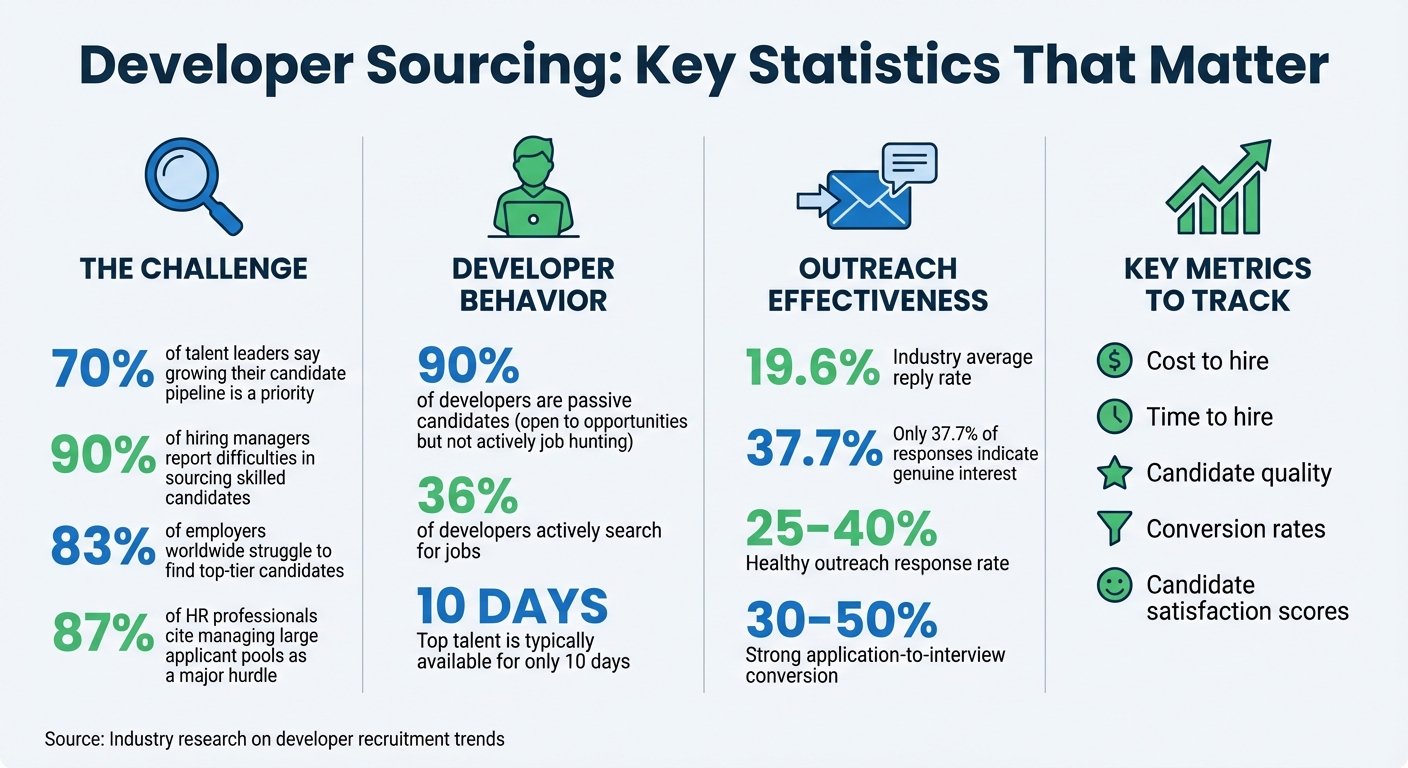 {Key Statistics for Developer Sourcing and Recruitment ROI}
What to Look for in a Developer Sourcing Tool
Finding the right developer sourcing tool can be a game-changer, especially when 90% of hiring managers report difficulties in sourcing skilled candidates . To overcome these challenges, focus on tools that truly understand developers, prioritize meaningful connections over volume, and integrate effortlessly into your workflow.
Built for Developers
Developers don’t spend their time on traditional job boards - they’re active on platforms like GitHub and Stack Overflow . A sourcing tool that pulls data from these spaces ensures you’re tapping into environments where technical talent thrives. This approach aligns with the growing trend of meeting candidates where they are most engaged.
Modern tools often leverage AI to provide context-based matching . For instance, if you’re searching for a Python developer, a smart tool might also identify candidates skilled in frameworks like Django or Flask, even if “Python” isn’t explicitly listed on their profile. This kind of semantic understanding is essential because developers often showcase their expertise through projects or contributions to technical communities rather than traditional resumes.
Quality Candidate Matching
Volume isn’t everything. While advanced tools can connect you to a larger pool of candidates, the real value lies in finding the right fit. The industry average reply rate for outreach is just 19.6%, and only 37.7% of those responses indicate genuine interest. That’s why focusing on quality matches is critical - especially when top talent is typically available for only 10 days .
"The new areas of TA technology investment that have the most potential for business value are passive candidate sourcing, AI-enabled candidate skills matching, interview-related automation, and the overall candidate experience."
- Gartner, Market Guide for Talent Acquisition (Recruiting) Technologies, September 2024
Look for tools that use semantic AI to understand relationships between skills and experiences, rather than relying solely on keywords . This ensures you’re connecting with candidates whose abilities align with your needs.
Additionally, tools that enable warm, double opt-in connections can elevate engagement. When developers willingly choose to connect, it creates more meaningful conversations and respects their time and interests.
Integration and Ease of Use
A sourcing tool’s ability to integrate with your existing systems can significantly impact efficiency. Features like automatic profile enrichment and seamless data flow into your ATS save time and maintain momentum in your hiring pipeline . This level of automation helps overcome the challenges of managing large applicant pools, which 87% of HR professionals cite as a major hurdle in hiring technical talent .
Browser extensions that let you capture and enrich candidate data directly from technical communities can be a huge time-saver . Plus, keeping candidate profiles updated ensures you’re not reaching out to outdated information .
Finally, don’t overlook usability. A tool with an intuitive interface reduces training time and provides clear visibility into performance metrics, enabling your team to act quickly and efficiently. A user-friendly design paired with robust integration capabilities can make all the difference in maximizing your developer hiring ROI.
Hiring engineers?
Connect with developers where they actually hang out. No cold outreach, just real conversations.
How daily.dev Recruiter Solves Common Hiring Problems
Hiring tech talent isn’t just about finding developers - it’s about connecting with the right ones. While only 36% of developers actively search for jobs versus those open to opportunities, a whopping 90% are open to the right opportunity . Traditional hiring tools often create more noise than meaningful connections, making it tough to engage this passive yet promising talent pool. That’s where daily.dev Recruiter steps in.
Reaching Passive Talent
daily.dev Recruiter taps into a community of over 150,000 developers who actively engage with technical content like articles and tutorials. These developers aren’t necessarily job hunting - they’re focused on professional growth. This makes them passive candidates, but ones who are deeply immersed in their craft. Instead of relying on outdated resumes, daily.dev leverages real-time engagement to provide a clearer picture of their current skills and interests.
For instance, if a developer is diving into React hooks or exploring Rust tutorials, that activity says far more about their expertise than a static resume ever could. By meeting developers where they already are, daily.dev eliminates the need for intrusive cold emails, creating a more natural and effective way to connect.
But the platform’s real strength lies in its foundation.
Built on a Developer Network
What truly sets daily.dev Recruiter apart is its foundation: it’s built on an active, thriving developer community - not just a scraped database. Every interaction is double opt-in, meaning both parties are genuinely interested in connecting. This eliminates the spammy feel of traditional outreach and ensures your messages land with developers who actually want to hear from you.
The platform also encourages job briefs tailored to developers, focusing on technical challenges, specific tech stacks, and growth opportunities. Forget generic corporate jargon - this approach speaks directly to what engineers care about, building rapport from the very first interaction. The result? A secure, trusted network that fosters meaningful connections.
Trust-Based Matching
daily.dev Recruiter takes a trust-first approach to matchmaking. Developers who express interest in your opportunities create a warm introduction, making it easier to start meaningful conversations. Plus, the platform integrates seamlessly with popular ATS systems like Greenhouse and Lever, ensuring these warm leads flow smoothly through your hiring pipeline.
This focus on trust and intent transforms recruiting from a numbers game into a quality-driven process. Instead of cold emails and endless screening calls, you’re connecting with developers who are genuinely interested, creating a better experience for both recruiters and candidates alike.
Measuring ROI for Developer Sourcing Tools
When choosing a sourcing tool, it’s not enough for it to look good on paper - it needs to deliver tangible improvements to your hiring process. With 83% of employers worldwide struggling to find top-tier candidates , understanding your return on investment (ROI) is essential. The right metrics can help you separate tools that perform from those that merely promise. To make an informed decision, consider both the direct costs and the broader value a tool adds to your recruitment efforts.
Cost vs. Value
The true worth of a sourcing tool lies in how it streamlines your recruitment process, reduces the cost of unfilled positions, and improves key hiring metrics. Instead of focusing solely on the price tag, assess how a platform impacts these five critical areas: cost to hire, time to hire, candidate quality, conversion rates, and candidate satisfaction scores . Compare these improvements to the expenses of traditional methods like recruitment events or external search firms, which can often rack up costs in the hundreds of thousands annually .
To really gauge value, look at your recruitment funnel. Metrics like "sourced-to-screen" and "screen-to-interview" ratios reveal whether you’re attracting quality leads or simply a high volume of applicants . For example, a healthy outreach response rate typically ranges from 25–40%, while a strong application-to-interview conversion rate falls between 30–50% . Beyond financial savings, the quality of hires directly impacts your company’s long-term success.
Quality of Hires
When it comes to ROI, the quality of hires often outweighs the speed of filling positions. A poor candidate experience can tarnish your employer brand, making it harder to attract talent in the future . Over time, this kind of reputational damage can cost far more than any sourcing tool could save.
The best platforms don’t just focus on speed - they prioritize meaningful interactions. Tools that facilitate genuine connections with candidates lead to better retention rates, stronger performance, and fewer costly mis-hires. Including candidate satisfaction scores alongside traditional metrics offers a more complete picture of a tool’s long-term value .
Long-Term Impact
The most effective sourcing tools provide benefits that grow over time. Platforms that integrate seamlessly with your applicant tracking system (ATS) reduce administrative work, allowing your team to focus on building relationships with candidates. AI-powered tools can even rediscover past high-quality applicants, offering added value without additional sourcing expenses .
For developer-specific platforms like daily.dev Recruiter, the advantages go beyond individual hires. These tools transform recruiting from a reactive, role-by-role process into a proactive strategy. By tapping into a developer network, daily.dev Recruiter helps build lasting talent pipelines. Candidates become familiar with and trust your brand long before you reach out, creating a recruitment process that consistently delivers better ROI over the long term.
Making the Right Choice
Selecting the right sourcing tool starts with understanding your unique hiring challenges. Before committing to any platform, take a moment to identify your biggest obstacles - whether it’s low response rates, outdated candidate data, or wasted time on ineffective outreach . With 90% of hiring managers reporting difficulty in finding skilled candidates , it’s clear that settling for a tool that doesn’t address your specific needs isn’t an option.
A trial period can be a game-changer. Use it to evaluate the accuracy of the candidate data and how seamlessly the platform integrates into your team’s workflow . Check how often candidate data is updated and whether it works smoothly with your ATS (like Greenhouse or Lever) . These practical considerations are far more critical than flashy features that don’t solve your core hiring problems.
For example, if you’re hiring developers, one platform stands out: daily.dev Recruiter. This tool tackles one of the toughest challenges - connecting with passive developer candidates. These are individuals who aren’t actively job hunting but are open to the right opportunity. With its double opt-in process, daily.dev Recruiter ensures you’re introduced to engaged candidates with up-to-date skills, creating warm, high-context connections. By operating within an active developer network, it shifts recruiting from a numbers game to a trust-driven process where both companies and candidates benefit. The result? No more ineffective cold outreach. Instead, you’re building a sustainable talent pipeline that consistently delivers high-quality hires.
During your trial, put these capabilities to the test. Does the platform address your hiring pain points? Does it align with your goal of building authentic relationships with top-tier technical talent? The right sourcing tool isn’t just about affordability - it’s about finding a solution that matches your hiring philosophy. When you prioritize platforms built around developer needs and trust-based matching, you’re setting yourself up for long-term success.
FAQs
How do sourcing tools work with applicant tracking systems (ATS)?
Sourcing tools work hand-in-hand with applicant tracking systems (ATS) by simplifying the process of moving candidate profiles into the hiring pipeline. Many modern ATS platforms offer APIs or pre-built connectors, making it easy for sourcing tools to transfer candidate information - like names, contact details, skills, and job-related tags - straight into the ATS with a single click.
Getting this integration up and running is usually a straightforward process. Recruiters simply enable the connection in their ATS settings. Once activated, profiles found using the sourcing tool can be sent directly to the ATS in real time. This keeps candidate records up-to-date and eliminates the need for repetitive data entry, making tasks like interview scheduling, gathering feedback, and managing offers much more efficient.
Why is semantic AI essential for finding the right candidates?
Semantic AI is transforming modern recruitment by moving beyond simple keyword matching. It dives into the context, intent, and relationships between skills, offering a smarter way to connect candidates with roles. Through natural language processing, it can recognize synonyms, transferable skills, and subtle connections. For example, it can link experience with "React.js" and "Node.js" to a "Full-Stack Developer" position - even if those exact terms aren’t explicitly mentioned.
This advanced approach not only boosts match accuracy but also minimizes the risk of missing out on qualified candidates. Plus, it speeds up the hiring process by 30–50%, allowing recruiters to focus on candidates whose experience truly aligns with the role. daily.dev Recruiter takes advantage of semantic AI within its developer network, helping hiring teams connect with pre-qualified, engaged developers. The result? Trustworthy, high-quality matches that make sourcing faster and more effective.
What are the benefits of using double opt-in connections in recruitment?
Double opt-in connections require candidates to actively confirm their interest before engaging with recruiters. This extra step helps establish trust and reliability, cuts down on spam, and paves the way for more meaningful and productive interactions.
By focusing only on candidates who are genuinely interested, recruiters can streamline their efforts, work more efficiently, and create a better experience for everyone involved. This method not only strengthens professional relationships but also lays the groundwork for successful hiring results.
.png)