Is LinkedIn Recruiter worth the investment? For businesses spending thousands annually on LinkedIn Recruiter, measuring its ROI is critical. This tool can help hire top-tier talent, especially developers, but only if its performance is tied to key business outcomes. Here's what you need to know:
- Why ROI matters: Recruitment budgets are under pressure, with permanent recruitment revenue for large firms down 13% in 2025–26. Leadership demands clear proof of value.
- Key metrics to track:
- Cost Per Hire (CPH): Tracks total hiring costs divided by hires.
- Quality of Hire (QoH): Measures performance, retention, and satisfaction.
- Time to Fill (TTF): Tracks how fast roles are filled.
- Actionable strategies: Use personalized outreach, advanced search filters, and talent pipelines to improve results.
To make LinkedIn Recruiter pay off, focus on meaningful metrics like retention rates, performance, and hiring speed - not vanity stats like profile views. By aligning recruitment efforts with measurable business goals, you can justify costs and improve hiring outcomes.
Key Metrics for Calculating Recruitment ROI
::: @figure 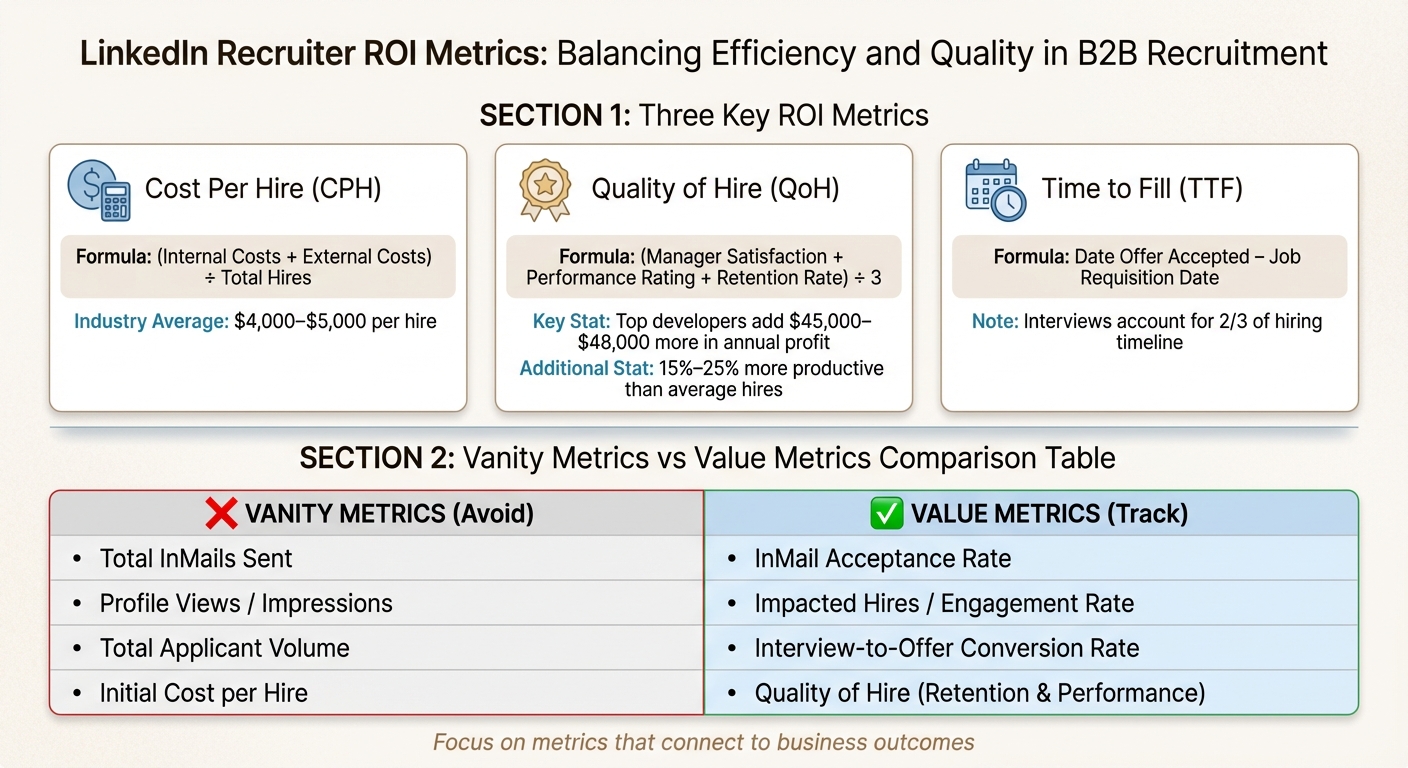 {LinkedIn Recruiter ROI Metrics: Key Formulas and Value Metrics vs Vanity Metrics}
To measure the return on investment (ROI) of LinkedIn Recruiter, focus on three key metrics: Cost Per Hire, Quality of Hire, and Time to Fill. These metrics connect your recruiting expenses to measurable results, providing a clear framework for analysis.
Cost Per Hire (CPH)
Start by breaking down your recruiting expenses to determine the cost of each hire.
CPH = (Internal Costs + External Costs) ÷ Total Hires .
- External costs include LinkedIn subscriptions, job ads, and InMail credits.
- Internal costs cover recruiter salaries, benefits, overhead, and the hours spent sourcing candidates. Time devoted by leadership to calibration meetings and technical interviews also factors in .
Industry averages suggest a CPH of $4,000–$5,000 per hire, depending on the role's seniority . If your LinkedIn-sourced hires exceed this range, it might indicate inefficiencies, such as spending too much effort on unqualified candidates or an ineffective InMail strategy. Tracking CPH monthly instead of annually allows for quicker identification of cost spikes.
Quality of Hire (QoH)
For developer roles, assessing the connection between technical skills and financial contributions is essential. Quality of Hire measures whether LinkedIn Recruiter helps you secure high-performing developers who stay with your company.
QoH = (Manager Satisfaction + Performance Rating + Retention Rate) ÷ 3 .
This metric evaluates technical performance, alignment with company values, and retention beyond the typical 6–12 month guarantee period . LinkedIn's "Impacted Hires" metric is particularly helpful - it identifies hires whose profiles were viewed, saved, or contacted via InMail within a year of joining .
The financial stakes are high. A top-tier developer can add $45,000–$48,000 more in annual profit compared to an average hire . Additionally, top performers are 15%–25% more productive than their peers . If LinkedIn Recruiter consistently delivers these high performers, the productivity boost alone can justify its cost.
Monitoring your replacement rate (placements requiring replacement ÷ total placements) is also crucial. High early turnover in developer roles often points to mismatches in technical skills or company culture .
Time to Fill (TTF)
Time to Fill tracks how long it takes to close a role, from job opening to offer acceptance .
TTF = Date Offer Accepted – Job Requisition Date
For LinkedIn Recruiter, you can start the clock when a saved search or project begins and end it when the candidate accepts the offer . Proactive outreach on LinkedIn often shortens TTF by using strategies to convert passive candidates by uncovering passive candidates faster than waiting for applications .
In the competitive tech industry, speed is critical. Top developers frequently juggle multiple offers within days. If your TTF is longer than your benchmarks, examine your compensation packages and hiring process for delays . Building talent pipelines in advance with LinkedIn Recruiter can also save time, as pre-vetted candidates can be approached immediately when a role opens. This strategy is especially effective since interviews typically account for two-thirds of the hiring timeline .
| Metric | Formula / Calculation Method | Why It Matters for Developer Hiring |
|---|---|---|
| Cost Per Hire (CPH) | (Internal + External Costs) ÷ Total Hires | Helps compare LinkedIn costs to traditional methods |
| Quality of Hire (QoH) | (Manager Satisfaction + Performance + Retention) ÷ 3 | Ensures hires are skilled, aligned, and retained |
| Time to Fill (TTF) | Date Offer Accepted – Job Requisition Date | Measures efficiency in a fast-paced hiring market |
Next, we’ll explore how these metrics can guide actionable strategies to maximize your LinkedIn Recruiter ROI.
How to Measure LinkedIn Recruiter ROI Accurately
To measure ROI effectively, you need to tie recruitment data directly to business outcomes. Recruitment success isn’t just about activity levels - it’s about how those efforts impact the organization’s bottom line .
Connect Metrics to Your Business Goals
Start by identifying what success looks like for your company. If cutting costs is a priority, track Cost Per Hire and compare it to other sourcing methods. If you're focused on hiring quality, monitor metrics like retention rates and performance scores for LinkedIn-sourced hires at 90- and 180-day intervals. For speed, measure Time to Fill against your internal benchmarks.
For example, one company reported a 176% ROI and a 22% reduction in its sales cycle by comparing LinkedIn-attributed revenue to an annual investment of $102,000 . In the B2B tech space, LinkedIn ROI often falls between 300% and 500% . Another scenario showed a 368% ROI per hire, with a cost per hire of $6,250 and a net benefit of $23,000 . These benchmarks can help you gauge whether your LinkedIn Recruiter investment aligns with industry standards.
Once you’ve defined your goals, the next step is gathering precise data to ensure your metrics reflect actual outcomes.
Collect the Right Data
Accurate data collection is key to translating goals into measurable results. Record all direct costs, such as LinkedIn seats and ads, as well as indirect costs, like recruiter hours and leadership involvement. For technical hiring, include time spent on interviews and team discussions.
Track engagement and conversion metrics, such as InMail acceptance rates, application completion rates, and offer acceptance rates. Focus on outcome-based metrics, like Impacted Hires, which measure profiles engaged within 12 months of joining your company.
Use a 90–180 day window to attribute LinkedIn Recruiter’s influence, as technical hiring often takes longer than 30 days. Since candidates frequently interact with multiple channels, multi-touch attribution can clarify LinkedIn’s role. For instance, you might assign 30% credit to initial awareness and 20% credit to direct InMail engagement .
Finally, ensure your Applicant Tracking System (ATS) tags applicants by their source to streamline data analysis.
Avoid Vanity Metrics
Once your data is collected, focus on meaningful metrics and discard superficial ones. Vanity metrics, like profile views, impressions, or total InMails sent, reflect activity but don’t necessarily translate into business value. For example, a high InMail response rate means little if it doesn’t lead to qualified interviews or offers.
| Metric Type | Vanity Metric (Avoid) | Value Metric (Track) |
|---|---|---|
| Outreach | Total InMails Sent | InMail Acceptance Rate |
| Visibility | Profile Views / Impressions | Impacted Hires / Engagement Rate |
| Sourcing | Total Applicant Volume | Interview-to-Offer Conversion Rate |
| Cost | Initial Cost per Hire | Quality of Hire (Retention & Performance) |
Instead of focusing on profile views, prioritize Impacted Hires. Similarly, don’t celebrate large applicant volumes - track conversion rates from InMail to interview and interview to offer. This will help you identify weak points in your recruitment funnel.
"Measuring LinkedIn ROI goes beyond likes and followers - it requires connecting social media activities to actual business outcomes."
- LinkIntel
With permanent recruitment revenue at major firms projected to drop by up to 13% year-over-year in 2025, every recruiting dollar must deliver clear and measurable business impact .
How to Improve LinkedIn Recruiter ROI for Developer Hiring
Once you’ve established your baseline ROI metrics, you can make targeted improvements to enhance your results. Small tweaks can make a big difference, especially when recruiting technical talent.
Write Personalized, Targeted Messages
Personalized outreach is a game-changer, accounting for 50% of the LinkedIn Recruiter Index (LRI) . On the flip side, generic messages can damage the candidate experience .
To stand out, use a candidate's profile details - like their work history, technical skills, or contributions to open-source projects - as the foundation of your message. For instance, mention their work with a specific framework or a notable project highlighted on their profile.
Instead of focusing on how many messages you send, track InMail acceptance rates and interested rates - the percentage of candidates who respond positively to your outreach . These metrics give you a clear picture of how effective your personalization efforts are. Over time, this approach not only improves response rates but also strengthens your talent brand, creating long-term value .
Once you’ve nailed personalized outreach, the next step is to refine how you search for candidates.
Use Advanced Search Filters Effectively
LinkedIn Recruiter Corporate offers over 40 advanced search filters, while Recruiter Lite provides more than 20 . Using these tools effectively can save time and improve the quality of candidates you find.
Features like Spotlights help you focus on active candidates, while Boolean operators (AND, OR, NOT) allow you to fine-tune searches. For example, searching "Java AND Spring" narrows the field to developers skilled in both .
The Keywords filter lets you search entire profiles for specific technical expertise, and you can adjust experience filters to include candidates with internships or apprenticeships . Additionally, broadening your geographic search to include metropolitan areas (like "Greater Boston Metropolitan Region") can help you find candidates open to commuting or hybrid work .
Another trick? Use the "People Also Viewed" feature on strong candidate profiles to discover similar talent that might not have appeared in your initial search .
Once you’ve identified top candidates, the next focus should be on building lasting relationships for future hiring needs.
Build Talent Pipelines for Future Hiring
Building a talent pipeline can transform your recruitment process from reactive to proactive, helping you manage hiring cycles more predictably . The real value of LinkedIn Recruiter isn’t just in filling immediate roles - it’s in fostering long-term relationships with developers.
Use project folders to save candidate profiles for up to a year, allowing you to nurture those connections over time . By maintaining regular contact, you create a pool of engaged candidates ready for future opportunities.
"Recruitment ROI demonstrates where true value is created."
- Ayusmita, B2B Storyteller, Recruiterflow
Keep your pipeline warm by sending personalized InMails, sharing company updates, and distributing technical content that showcases your company’s expertise . While this approach might not immediately reduce Time to Fill, it is one of several strategies for reducing time to hire in the long run, it can improve Quality of Hire by ensuring you’re connecting with developers who align with your company’s values and technical needs . To measure the pipeline’s success, track retention rates beyond the 6–12 month mark .
Conclusion: Use Data to Make Better Hiring Decisions
To measure the ROI of LinkedIn Recruiter, connect your recruiting efforts to tangible business outcomes like quality hires, retention rates, and developer productivity.
"Recruitment ROI connects recruiting activity to business outcomes, not just recruiting volume."
- Ayusmita, B2B Storyteller, Recruiterflow
One key metric to track is Impacted Hires, which directly reflects LinkedIn's contribution to your hiring success. Additionally, keep an eye on your LinkedIn Recruiter Index (LRI) score. The Engage component, which emphasizes personalized conversations, accounts for 50 out of 100 points, making it a priority area for improvement .
When calculating ROI, don't overlook hidden costs like the time spent by recruiters and hiring managers . With permanent recruitment revenue projected to decline by up to 13% year-over-year in 2025–26 at major firms , every dollar spent on recruitment must deliver measurable value. Leveraging detailed data allows you to adjust strategies in real time.
Think of your data as a tool for active decision-making, not just a way to look back at past performance . For example, if you notice a decline in InMail acceptance rates or an increase in Cost Per Hire, take immediate action to refine your approach. The aim isn't flawless metrics - it’s making smart, data-driven decisions that lead to stronger hires and a more capable technical team. This requires a comprehensive LinkedIn strategy for passive tech candidates that prioritizes long-term engagement over simple volume.
FAQs
What’s the best way to measure the ROI of LinkedIn Recruiter?
To gauge the return on investment (ROI) of LinkedIn Recruiter, start by defining specific hiring objectives. These could include targets like the number of qualified candidates sourced or the number of hires made through the platform. Once your goals are clear, monitor critical metrics such as candidate engagement rates, time-to-hire, and the overall quality of applicants.
When it's time to calculate ROI, use this straightforward formula: (Revenue generated from LinkedIn hires - Cost of LinkedIn Recruiter) ÷ Cost of LinkedIn Recruiter. This percentage will give you a clear picture of your return. To put your results into context, compare them against industry benchmarks to see how your investment measures up.
What key metrics should I track to evaluate LinkedIn Recruiter's performance?
To gauge how well LinkedIn Recruiter is working for you, it’s important to look at both activity-based and outcome-based metrics.
On the activity side, keep an eye on things like how many qualified candidates you’re sourcing, the number of profiles you’re viewing, and how often you’re engaging in personalized interactions with candidates. These numbers give you a sense of how effectively you're connecting with potential hires.
For outcomes, focus on metrics such as time to fill (how long it takes from first contact to offer acceptance), cost per hire, and quality of hire. These will help you understand the overall efficiency and success of your hiring process. By combining these two types of data, you’ll get a well-rounded picture of how LinkedIn Recruiter is contributing to your hiring goals and making informed, data-backed decisions.
How does personalized outreach improve results with LinkedIn Recruiter?
Personalized outreach can make a huge difference in how candidates respond to your LinkedIn Recruiter messages. By customizing your communication to highlight a candidate's specific skills, experience, or interests, your message feels more authentic. This personal touch not only grabs their attention but also increases the chance they'll reply instead of ignoring your message.
When candidates see that you've taken the time to understand their background, it builds trust and creates a connection right from the start. This rapport encourages them to seriously consider the opportunities you're presenting. Plus, by engaging the right talent more effectively, personalized outreach doesn’t just improve the quality of your interactions - it also speeds up the hiring process. The result? Better outcomes and a stronger ROI for your recruitment efforts.
.png)