Recruiting developers today is challenging - not because talent is scarce, but because trust is. Over 61% of developers distrust recruiters, and many ignore outreach that feels generic or intrusive. Data scraping, AI-driven tools, and cold outreach often cross ethical boundaries, damaging relationships before they even start.
Here’s how to ethically recruit developers while respecting their privacy and preferences:
- Audit your process: Avoid collecting excessive personal data or using tools that introduce bias.
- Follow privacy laws: Ensure compliance with GDPR, CCPA, and local regulations. Conduct Data Protection Impact Assessments (DPIAs) for any AI tools.
- Use consent-based platforms: Platforms like daily.dev Recruiter connect you with developers who actively opt-in to opportunities, improving response rates and trust.
- Be transparent: Share clear job descriptions, including salary, tech stack, and work model. Outline the interview process upfront to reduce uncertainty.
- Protect candidate data: Use secure Applicant Tracking Systems (ATS) with encryption, role-based access, and automated data deletion policies.
Developers want respect, clarity, and fairness in hiring. By following an ethical tech recruitment guide, you’ll build trust, attract better candidates, and strengthen your employer brand.
::: @figure 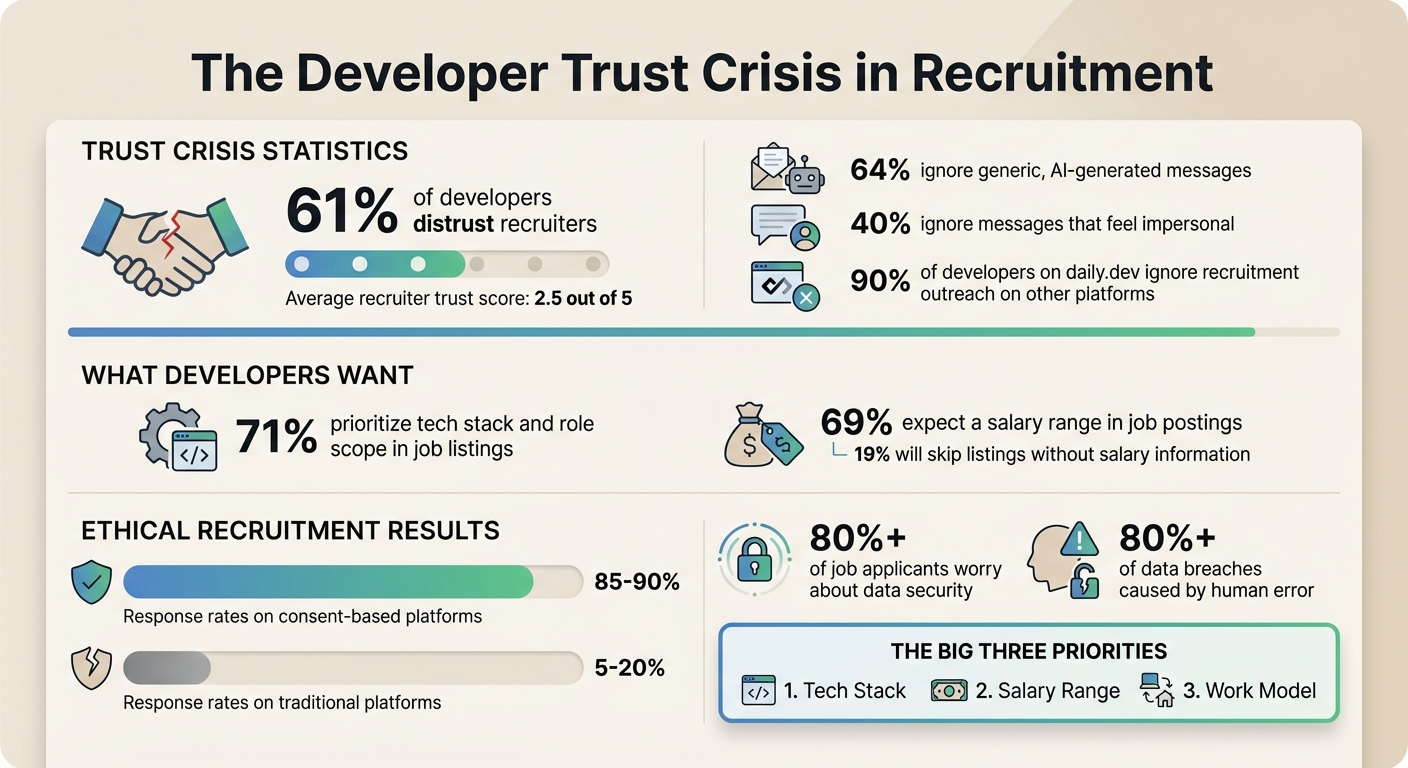 {Developer Trust in Recruiters: Key Statistics and Ethical Recruitment Impact}
Review Your Current Recruitment Methods
Take a close look at your hiring process to uncover any unethical practices. Many recruitment pipelines rely on tools or methods that compromise candidate privacy or introduce bias. A detailed audit can help pinpoint these shortcomings and guide necessary changes using a checklist for data-driven recruitment success. Let’s dive into some common unethical practices that can erode trust in your hiring process.
Spot Unethical Practices in Your Process
Begin by evaluating how you source candidates and what kind of data you collect. One red flag is collecting excessive personal information - gathering more data than necessary for the role and holding onto it indefinitely without candidates’ awareness . For example, scraping data from GitHub profiles, LinkedIn, or conference speaker lists without explicit consent crosses ethical boundaries.
Automated recruitment systems also carry risks. Be cautious of instant rejections that happen within minutes of application submissions, mandatory personality tests (like those assessing "optimism"), or the use of facial and emotion analysis during video interviews without clear consent . Some AI tools even attempt to infer gender or ethnicity from names, which can lead to inaccuracies and fairness issues .
A real-world example comes from the UK Information Commissioner’s Office (ICO). In November 2024, the ICO audited several AI recruitment tools and found serious problems. These tools were collecting too much personal data and retaining it indefinitely to build large databases - often without candidates knowing. Following the audit, the ICO issued nearly 300 recommendations, which the companies either fully or partially adopted. This led to changes in privacy policies and the introduction of bias-monitoring measures .
"AI can bring real benefits to the hiring process, but it also introduces new risks that may cause harm to jobseekers if it is not used lawfully and fairly." - Ian Hulme, Director of Assurance, ICO
Spotting unethical practices is just the beginning. Ensuring compliance with legal standards is the next critical step.
Align with Privacy Regulations
Ethical hiring starts with respecting candidate rights. Laws like the CCPA and GDPR grant individuals the right to know what data is collected about them, access it, correct errors, and request deletion . Your recruitment process must honor these rights from the outset.
Before adopting any AI-driven hiring tool, conduct a Data Protection Impact Assessment (DPIA) to identify and mitigate privacy risks . This assessment should establish a valid reason for processing candidate data - whether through consent or legitimate interest - especially when handling sensitive details like health or ethnicity . Additionally, contracts with recruitment platforms must clarify whether you or the platform acts as the data controller, along with specific instructions for managing the data .
State laws in the U.S. impose further requirements. For instance, Illinois demands consent for AI video analysis, Maryland requires waivers for facial recognition, and New York City mandates notifications for automated evaluations . Regular bias audits are also critical to ensure tools don’t unintentionally disadvantage candidates based on protected traits or replicate historical biases .
Implement clear data retention policies, setting expiration dates for any collected information, especially if invasive practices were previously used . Request technical documentation - commonly referred to as "Model Cards" - from vendors to verify that their tools perform accurately across diverse demographic groups . Finally, ensure your team is trained to interpret and, when necessary, override AI-generated decisions to maintain accountability .
Use Consent-Based Recruitment Platforms
Traditional methods like scraping and unsolicited outreach can damage trust. Consent-based platforms, on the other hand, focus on connecting you with developers who actively choose to engage. This approach not only respects privacy regulations but also boosts response rates and improves candidate quality. It’s a practical solution to the trust issues we discussed earlier.
The Case for Consent-Based Platforms
Developers often have a dim view of recruiters, rating them just 2.5 out of 5. A staggering 61% question recruiter performance, and 64% ignore generic, AI-generated messages. By starting every interaction with mutual consent - no spam, no cold messages, and no ambiguity about a candidate’s interest - you create a better experience for everyone. This double opt-in approach ensures developers feel respected, while recruiters engage only with candidates who genuinely want to connect.
Moving away from outdated databases to vibrant, active communities marks a major shift in recruitment. Platforms like daily.dev Recruiter use real-time behavioral data - tracking what developers are reading, learning, and building right now - instead of relying on static resume keywords. This means you can reach developers when they’re actively engaged with technologies relevant to your role, leading to more productive conversations.
daily.dev Recruiter is a great example of this ethical, consent-first model.
How daily.dev Recruiter Works
At its core, daily.dev Recruiter thrives on trust. The platform connects recruiters with a thriving community of over 1 million engineers from more than 13,000 companies. Developers visit daily to explore technical content, learn new skills, and stay updated on industry trends. Posting a job here means reaching developers who are already engaged.
What sets this platform apart? Cold outreach is replaced with double opt-in interactions - developers must express interest in your role before you can view their profile or contact them. Additionally, the platform enforces a Recruiter Compact, where recruiters who spam, ghost candidates, or fail to follow up are removed. This accountability ensures high standards and protects the community.
Clear job details, including tech stack, salary, and work model, paired with custom technical questions, help ensure a strong match before the first conversation. This eliminates the guesswork and frustration that often plague recruitment. The results speak for themselves: 90% of developers on daily.dev say they ignore recruitment outreach on other platforms, while response rates here consistently hit 85–90%, compared to the usual 5–20% on traditional platforms.
"We built a place where engineers can turn off the noise. To enter this space, you don't need a hack. You need trust." – Nimrod Kramer, CEO & Co-Founder, daily.dev
daily.dev Recruiter’s impact is reflected in its accolades. It won Product of the Year on Product Hunt and has earned over 20,000 GitHub stars. By focusing on what developers are actively learning and doing, rather than outdated credentials, the platform helps you connect with candidates who are not just qualified but also highly relevant to your needs.
Write Clear, Developer-Focused Job Descriptions
Once you've embraced consent-based recruitment, the next step is crafting job descriptions that truly speak to developers. Here's a key insight: 71% of developers prioritize the tech stack and role scope when reviewing job listings. Yet, many job postings still rely on vague language and skip over important details. This lack of clarity not only wastes time but can also erode trust with potential candidates. By creating clear and detailed job postings, you reinforce the trust built during the sourcing process and extend ethical practices into recruitment communication.
Elements of a Developer-Friendly Job Brief
Precision matters when addressing developers. Focus on the "Big Three" essentials: tech stack, salary range, and work model. Research shows that 69% of developers expect a salary range in the job listing, and 19% will skip listings that don't include one. Make these details easy to find by placing them at the top of the posting.
When listing technical requirements, be specific. For instance, write "Python 3.10 with Django" instead of a broad "backend experience." This helps developers quickly determine if they align with the role. Beyond the tech, emphasize the role's broader impact - whether it’s the user base size, the problems they'll help solve, or how their work contributes to the company's goals. Operational details like code review processes, deployment frequency, and team structure can also give candidates a better sense of fit.
Avoid terms like "rockstar", "ninja", or "guru", which can alienate applicants. Instead, use straightforward, professional language. Developers are also wary of generic outreach - 64% feel recruiter messages often seem copy-pasted or AI-generated. Personalizing your job descriptions can make a big difference. Additionally, consider including exclusion criteria, such as skills or experience that aren't relevant, to help refine your applicant pool. Finally, outline the interview process clearly - mention the number of rounds, types of assessments, roles of the interviewers, and expected timelines.
Share Your Screening Criteria Upfront
Transparency doesn't stop at the job description. Developers want to know how they'll be evaluated, so it's important to share your screening rubric early on. Highlight the skills that are essential versus those that are nice-to-have, and explain what evaluators will focus on during technical assessments. This openness fosters trust and reassures candidates that the process is fair.
Clear evaluation criteria also help reduce anxiety and improve preparation. Whether you're using a take-home coding challenge or a live system design interview, let candidates know what success looks like. This level of transparency not only aligns with ethical hiring practices but also sets a positive tone for the entire candidate experience. From the first interaction, candidates will feel respected and informed, which makes all the difference.
Hiring engineers?
Connect with developers where they actually hang out. No cold outreach, just real conversations.
Protect Candidate Privacy and Data
After ensuring job descriptions are transparent, the next critical step is safeguarding candidate data. This isn’t just about compliance - it’s about trust. Over 80% of job applicants worry about the security of their personal information, and human error is responsible for more than 80% of data breaches. As Pranali Sawant from Infojini Consulting emphasizes:
"In the world of talent acquisition, data privacy is not an afterthought but a fundamental aspect of building trust and ensuring compliance."
Protecting candidate data starts with collecting only what’s absolutely necessary at each hiring stage. For instance, there’s no reason to request social security numbers or references during the initial screening. This approach, called data minimization, not only reduces unnecessary risks but also limits your liability. Even interview notes count as personal data and must be stored securely, just like résumés. Another step to consider? Anonymizing candidate data to reduce bias.
Anonymize Candidate Data
Taking data privacy a step further, anonymizing candidate information helps curb unconscious bias. This process removes personally identifiable details - like names, photos, email addresses, and demographic data - during the initial screening phase. By doing so, candidates are evaluated based solely on their skills and qualifications, not their background or identity.
One effective method is blind résumé screening, where personal identifiers are replaced with unique reference codes. Only authorized team members can trace these codes back to the original candidate. As Noel Diem from Mitratech explains:
"Bias doesn't start in the model, it starts in the history we feed it."
While anonymization is vital, securing the systems that manage candidate data is equally important.
Integrate Secure ATS Systems
A secure Applicant Tracking System (ATS) is key to protecting candidate information. Look for platforms with role-based access control (RBAC), ensuring team members only access the data they need for their specific tasks.
Key features to prioritize include:
- Multi-factor authentication (MFA) to strengthen login security
- Data encryption for both stored and transmitted information
- Automated data retention policies that remove candidate data after it’s no longer needed
- Comprehensive audit trails to track every action taken on candidate data
Automating data deletion schedules is another critical step. If a candidate isn’t hired, their information should be anonymized or deleted after a reasonable period - usually 6 to 12 months, depending on local regulations. By taking these measures, you not only comply with legal requirements but also demonstrate respect for candidate privacy.
Track Results and Refine Your Approach
Recruitment isn't a "set it and forget it" process - it demands constant evaluation and adjustment. Right now, recruiters face a trust challenge: the average recruiter trust score is just 2.5 out of 5, and 40% of developers ignore messages that come across as generic. Clearly, there's a disconnect between intentions and how they're perceived.
To bridge this gap, start by measuring key metrics that reflect how candidates view your process. For instance, response rates can reveal whether your outreach feels genuine or off-putting. Metrics like time to productivity (ideally 30 to 90 days) can show whether your screening process effectively matched the candidate's skills to the role. Similarly, a 90-day retention rate can signal if your job description accurately portrayed the position.
It's also vital to ensure fairness in your screening tools. Regularly audit them for bias across demographics like gender, ethnicity, age, and disability. If you're using AI in your hiring process, ask for "Model Cards" to better understand the limitations and potential biases of those tools. These steps provide a foundation for deeper insights into candidate engagement.
Monitor Response and Engagement Rates
Response rates offer a quick snapshot of how well your outreach efforts are landing. Pair this with metrics like offer acceptance rates to gauge whether candidates feel respected and valued during the process. A drop in acceptance rates often points to a mismatch between the job description and what candidates learn during interviews. This could mean you're not being clear enough about key details like salary, tech stack, or work model.
But numbers alone don’t tell the full story. Qualitative feedback is just as important.
Collect and Act on Candidate Feedback
Recruitment is a two-way street - candidates are evaluating your company just as much as you’re evaluating their fit. Think of your hiring process like a product that needs regular updates based on user feedback. Build feedback loops into your system by scheduling check-ins or sending email updates to keep candidates informed about their status. This simple step can make a huge difference in how candidates perceive your process.
Don’t stop at internal metrics. Pay attention to what people are saying on platforms like Reddit's r/recruitinghell, Glassdoor, or even TikTok. These unfiltered reviews can highlight issues that might not show up in formal surveys.
Before rolling out new AI tools or recruitment platforms, test them with a diverse group to catch potential biases or usability problems. It’s worth noting that 61% of developers believe recruiters aren’t doing a good job. Bridging this trust gap starts with listening - not to what you hope candidates feel, but to what they’re actually experiencing.
Conclusion
With 61% of developers distrusting recruiters and an average trust score of just 2.5 , it’s clear that rebuilding trust isn’t optional - it’s essential.
The strategies discussed earlier point to one undeniable truth: developers engage when they feel respected and valued. Focusing on the "Big Three" - tech stack, salary, and work model - instead of sending out generic pitches is key. Trust grows when your hiring process aligns with their priorities, not just your company’s goals.
"Trust isn't a buzzword. It's your competitive edge." - daily.dev
The payoff? Better response rates, stronger candidate pipelines, reducing drop-offs throughout the process, and a more appealing employer brand. Adopting a consent-driven approach immediately sets you apart in a recruitment space where developers routinely tune out impersonal outreach.
Ethical practices aren’t just the right thing to do - they work. daily.dev Recruiter is designed with this in mind. By using double opt-in introductions and prioritizing privacy, it bridges the gap, connecting you with developers who are genuinely open to the right opportunity. It’s a smarter, more respectful way to recruit.
FAQs
How can I make sure my recruitment process respects privacy laws like GDPR and CCPA?
To keep your recruitment process in line with privacy laws like GDPR and CCPA, focus on three core areas: consent, transparency, and data security. Make sure you get clear, informed consent from candidates before collecting or using their personal information. Be upfront about how their data will be used, and ensure candidates have the option to access, delete, or opt out of data collection.
Stick to best practices by collecting only the data you absolutely need, encrypting sensitive information, and anonymizing data whenever possible. Regular audits of your processes can help maintain compliance, and using platforms or tools with strong data protection features can make this easier.
By integrating these steps into your hiring process, you can safeguard candidate privacy, foster trust, and meet legal obligations effectively.
What are the advantages of using consent-based recruitment platforms?
Consent-based recruitment platforms bring a fresh approach to hiring by focusing on transparency and prioritizing candidate privacy. This approach helps establish trust, making it easier to engage with potential hires. When candidates feel they have control over their data and interactions, they’re more likely to respond positively, leading to stronger, more meaningful connections.
Another advantage is compliance with privacy laws like the CCPA. By adopting consent-driven practices, you not only reduce legal risks but also enhance your organization's image. Respecting candidate preferences creates a positive experience that aligns with their expectations, addressing common issues like low response rates and skepticism. Over time, this method helps build lasting talent relationships grounded in mutual respect and honesty.
How can I ensure candidate privacy and reduce bias when hiring developers?
To respect candidate privacy and promote fairness in hiring, it’s crucial to adopt clear and consent-focused practices. Be upfront about how you collect, use, and store candidate data. Make sure to comply with all applicable data protection laws, and only gather information that is absolutely necessary. On top of that, implement robust security measures to keep this data safe.
Reducing bias requires structured and consistent evaluation methods. Use standardized criteria to assess candidates, and consider tools or frameworks designed to address unconscious bias. These steps help ensure every applicant is treated fairly. By prioritizing both privacy and fairness, you can foster trust and establish an ethical hiring process that candidates feel confident in.
.png)