Recruiting DevOps engineers in 2026 is tough due to rising demand, fragmented skill sets, and evolving tools. Here's what you need to know:
- High demand, limited supply: With the DevOps market projected to grow from $10.4 billion in 2023 to $25.5 billion by 2028, companies struggle to find talent. Over 37% of IT leaders cite DevOps as the largest skills gap.
- Specialized roles: DevOps now includes Platform Engineering, SRE, DevSecOps, and MLOps, requiring distinct expertise.
- Lengthy hiring cycles: Senior roles take 49–62 days to fill, and outdated salary benchmarks cause offers to fall through.
- AI-driven recruitment: Tools analyze real-time developer activity to match skills with job needs, reducing reliance on outdated resumes.
- Key skills: Kubernetes, Terraform, Python, multi-cloud experience, and DevSecOps practices are essential.
- Soft skills matter: Collaboration, problem-solving under pressure, and continuous learning are critical for success.
Recruiters must refine job descriptions, stay updated on market trends, and adopt AI tools to attract and retain top talent. Speed and clarity in the hiring process are key to staying competitive.
How to Define What You Need in a DevOps Engineer
::: @figure 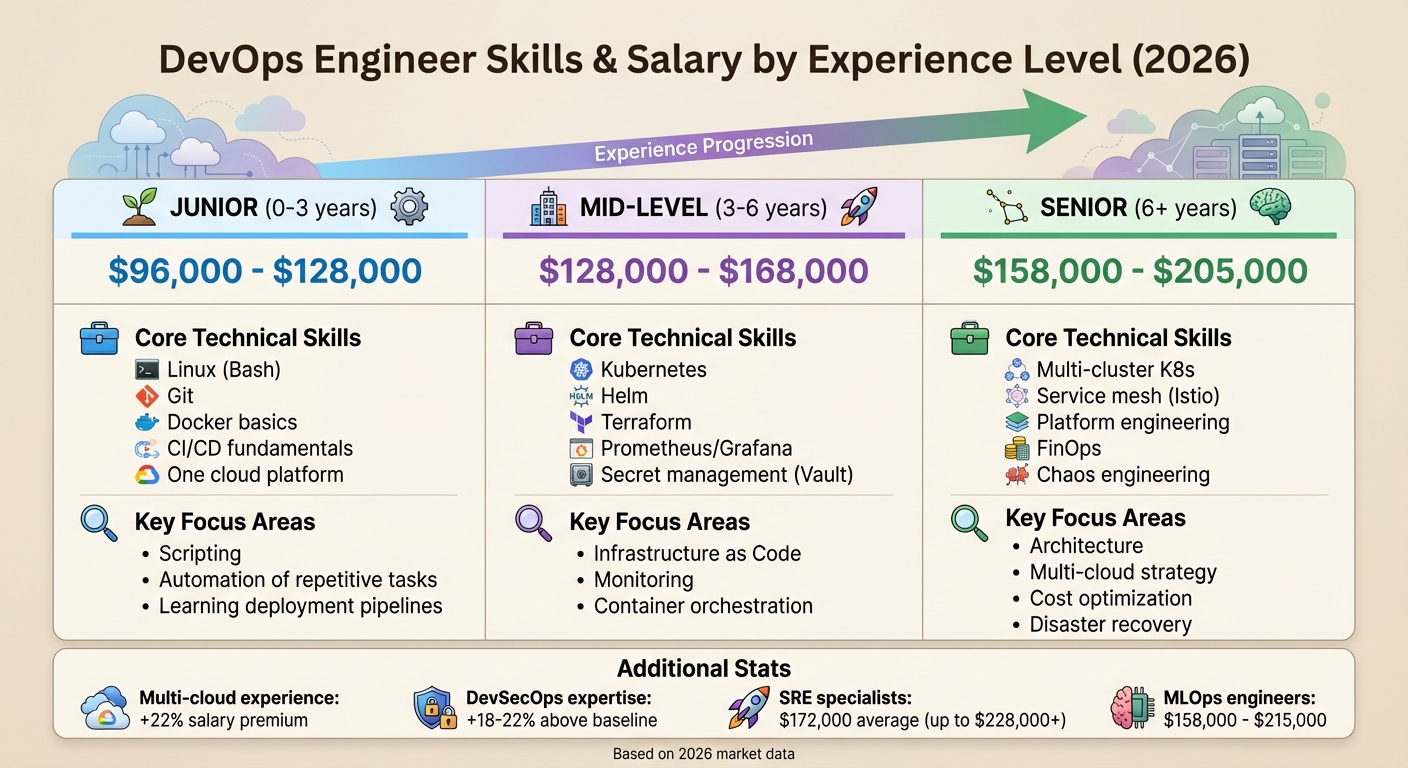 {DevOps Engineer Skills and Salary by Experience Level 2026}
Before diving into your search for a DevOps engineer, take the time to define exactly what you need. A vague job description listing 15+ skills when only five are critical can scare away qualified candidates who would otherwise thrive in the role . A clear and focused candidate profile ensures your search - whether AI-driven or manual - targets the right talent.
Start by pinpointing the specific DevOps sub-discipline your organization requires. The field has evolved into niche areas like Platform Engineering, Site Reliability Engineering (SRE), DevSecOps, and MLOps . A generic "DevOps Engineer" job posting might attract candidates who don't align with your needs, delaying your hiring process. For instance, are you looking for someone to build internal developer platforms, handle incident response, or embed security into CI/CD pipelines? Be specific.
"A DevOps engineer is often chosen as the technical leader in the process of transformation, which is based on implementing the so-called 'DevOps culture.' It relies on automation, CI/CD processes, and migration to the cloud." - Piotr Korlaga, Senior DevOps Engineer, monday.com
You should also outline the scope of your infrastructure and the primary cloud platform involved. Managing 10 services on ECS is a different ballgame from orchestrating 200 services on EKS . Additionally, clarify whether the role involves application coding or focuses exclusively on infrastructure and platform engineering . Once these details are nailed down, you can move on to defining the technical and non-technical skills required.
Required Technical Skills and Tools
Certain tools and skills are non-negotiable for modern DevOps roles. Core competencies include Docker (featured in 42.77% of job postings), Kubernetes (28.02%), Terraform, Python, and Bash . Familiarity with cloud platforms - AWS, Azure, or GCP - is also expected. Interestingly, engineers with multi-cloud experience earn a 22% salary premium in the U.S. .
Observability has become a must-have skill set. Candidates should know how to monitor distributed systems using tools like Prometheus, Grafana, or the ELK stack . For senior roles, add expertise in service mesh technologies, chaos engineering, and FinOps to the list.
Security is no longer optional. DevSecOps practices, including integrating SAST/DAST scanning and compliance automation into CI/CD pipelines, are now standard for most mid-level and senior positions . This "shift-left" approach to security ensures vulnerabilities are addressed early in the development lifecycle.
| Experience Level | Core Technical Skills | Key Focus Areas |
|---|---|---|
| Junior (0-3 years) | Linux (Bash), Git, Docker basics, CI/CD fundamentals, one cloud platform | Scripting, automation of repetitive tasks, learning deployment pipelines |
| Mid-Level (3-6 years) | Kubernetes, Helm, Terraform, Prometheus/Grafana, secret management (Vault) | Infrastructure as Code, monitoring, container orchestration |
| Senior (6+ years) | Multi-cluster K8s, service mesh (Istio), platform engineering, FinOps, chaos engineering | Architecture, multi-cloud strategy, cost optimization, disaster recovery |
Non-Technical Skills That Matter
While technical expertise is essential, soft skills often determine success in DevOps roles. Collaboration and communication are critical because these roles aim to bridge the gap between development and operations teams . Candidates must be able to explain technical concepts in simple terms to non-technical stakeholders and influence decisions without direct authority.
Problem-solving under pressure is another key trait. When production systems fail, engineers need to troubleshoot methodically and remain calm. During interviews, ask candidates to detail how they’ve handled real-world system failures to gauge their approach.
An ownership mentality often outweighs years of experience. The best DevOps engineers take responsibility for the entire software delivery lifecycle, identifying and resolving bottlenecks before they escalate .
Finally, continuous learning is crucial in a field that evolves rapidly. Look for candidates who stay up-to-date with the latest tools and practices. For example, someone with three years of experience at a fast-paced startup may bring more relevant skills than someone with six years in a slower-moving IT environment .
How to Categorize Skills by Experience Level
Breaking down requirements by experience level ensures you attract candidates who fit your needs. For junior roles (median salary: $96,000–$128,000), focus on Linux administration, basic scripting, and CI/CD fundamentals . Prioritize curiosity and a willingness to learn over mastery.
Mid-level engineers (median salary: $128,000–$168,000) should be comfortable managing Kubernetes clusters, writing Terraform modules, and monitoring systems with tools like Prometheus . They should also work effectively across teams without constant supervision .
Senior engineers (median salary: $158,000–$205,000) take on strategic responsibilities like designing deployment architectures, creating multi-cloud disaster recovery plans, and mentoring junior team members . Specialists in SRE or platform engineering often command even higher salaries, with SRE experts earning $172,000 on average and up to $228,000+ for top performers .
For roles requiring MLOps expertise, expect to pay between $158,000 and $215,000. These engineers need to manage machine learning pipelines and data infrastructure . Additionally, distinguish between "managed" Kubernetes experience (e.g., EKS, GKE) and "self-managed" Kubernetes, as the latter demands a deeper understanding of operations .
Lastly, keep your salary benchmarks current. Using outdated 2024 data could lead to offers that fall 12-18% below market expectations, causing you to lose top candidates . Engineers with multi-cloud certifications or DevSecOps expertise typically earn 18-22% above baseline salaries .
Hiring engineers?
Connect with developers where they actually hang out. No cold outreach, just real conversations.
Using AI Tools to Find DevOps Engineers
traditional hiring methods often rely on outdated, static profiles, making it necessary to audit your tech hiring stack for better efficiency. For instance, a candidate might list Kubernetes experience from 2023, but their profile won’t reveal whether they’re currently diving into service mesh solutions or expanding into platform engineering. AI-powered recruitment platforms change the game by analyzing real-time developer activities to pinpoint the skills you need today .
This shift from broad, impersonal outreach to intent-driven matching is redefining how recruiters connect with DevOps talent. Instead of sending out mass messages that usually fail to engage, modern AI tools focus on building mutual interest and trust. This approach reduces noise, cuts screening steps in half, and creates a more efficient recruitment process based on real-time behavioral analysis .
"We're turning real developer behavior (what people read, follow, and build) into high-signal matches." – Nimrod Kramer, CEO of daily.dev
AI-driven platforms that tap into active developer networks also unlock access to passive talent - those who aren’t actively job hunting but are consistently engaging in learning and community activities. These candidates are often ideal for roles when the right opportunity presents itself.
How daily.dev Recruiter Connects You with Developers
daily.dev Recruiter leverages real-time data insights and a double opt-in system to make introductions warm and relevant. Both you and the candidate must agree to connect before any conversations begin . This eliminates the frustration of cold outreach and reduces the likelihood of being ignored. Instead of sending generic messages to hundreds of profiles, you’ll only engage with DevOps engineers who have reviewed your role and chosen to connect.
The platform uses behavioral signals - like articles about Terraform or discussions on Kubernetes troubleshooting - to identify developers whose current interests align with your role . This dynamic, "living network" approach ensures you connect with engineers based on what they’re actively learning, not outdated resume details.
Every connection is high-context. For example, candidates who receive offers within 48 hours of their final interview have a 23% higher acceptance rate . Starting with a trust-based introduction gives you an advantage from the very first interaction.
Finding Candidates with Specific Skills
If you’re looking for a DevOps engineer with expertise in multi-cluster Kubernetes or DevSecOps pipeline integration, traditional keyword searches often fall short. AI-driven platforms go beyond simple mentions of "Kubernetes" to analyze whether a developer is actively engaging with advanced topics like service mesh implementation .
Let’s say your team needs a Platform Engineer with experience in building internal developer platforms. AI tools can identify candidates who are reading about or working on similar systems - even if their current job title doesn’t fully reflect their skills. This contextual analysis ensures you find engineers with real, hands-on expertise rather than those who simply list trendy buzzwords.
You can also use up to three custom screening questions to validate technical skills before scheduling an interview . For example, ask candidates about their experience with CI/CD tools, how they optimize infrastructure costs, or how they’ve handled production incidents. These targeted questions ensure you’re only speaking with candidates who meet your core requirements, streamlining the process even further.
Saving Time with Automated Screening
Reviewing resumes manually can eat up hours that could be spent on meaningful conversations with candidates. AI-powered matching engines take over the repetitive tasks, automatically aligning a developer’s current interests and activities with your role requirements. This eliminates the need to sift through hundreds of irrelevant profiles .
For example, the system can flag candidates who are actively engaging with containerization and microservices. It also handles tasks like filtering profiles, removing duplicates from multiple sources, and routing candidate details directly to your applicant tracking system (ATS) .
How to Evaluate DevOps Candidates
Once you've defined the ideal candidate profile, the next step is conducting thorough evaluations to ensure they’re the right fit. With the DevOps market expected to grow from $10.4 billion in 2023 to $25.5 billion by 2028 - and with 90% of tech leaders acknowledging talent shortages - efficient and detailed assessments are more important than ever . Here’s how to evaluate candidates effectively by testing their skills and mindset in realistic scenarios.
Testing Practical DevOps Skills
Skip the abstract whiteboard puzzles. Instead, focus on real-world tasks like debugging a broken deployment or analyzing an infrastructure diagram . These exercises provide insight into how candidates apply modern practices in practical situations. For example:
- Present a failing CI/CD pipeline and ask them to pinpoint the bottleneck.
- Share a misconfigured Kubernetes cluster and observe their troubleshooting process.
Key areas to evaluate include CI/CD implementation, Infrastructure as Code tools (like Terraform and Ansible), container orchestration (Docker, Kubernetes), and scripting languages (Python, Bash, Go). To gauge their DevSecOps expertise, ask how they proactively integrate security into workflows. Additionally, explore their familiarity with AIOps tools such as Splunk or platforms designed to analyze logs and metrics at scale - especially as 73% of enterprises are projected to adopt AIOps by 2026 .
While technical skills are critical, a commitment to continuous learning often signals long-term success.
Identifying Candidates Who Keep Learning
Certifications can help, but they’re not the whole story. For instance, mentions of AWS certifications in job postings are predicted to drop from 31% to 17% by 2026. However, certifications like AWS Certified DevOps Engineer, Certified Kubernetes Administrator (CKA), and HashiCorp Certified Terraform Associate still demonstrate dedication .
Look for indicators of ongoing growth, such as:
- Contributions to Git or GitLab repositories.
- Active participation in DevOps communities.
- Experience creating "Golden Paths", which streamline platform engineering workflows .
Ask about their experience with emerging tools and how they’re adapting to shifts, such as moving from manual scripting to leveraging AI for anomaly detection and failure prediction.
"The future DevOps engineer is as much a 'data ops' engineer comfortable with analytics and AI as a pipeline mechanic." – Refonte Learning
Focus on evaluating systems thinking rather than tool-specific knowledge. A candidate’s ability to design pipelines and manage distributed systems often matters more than familiarity with individual tools, as tools can be learned relatively quickly, but systems thinking requires years to develop .
Assessing Communication and Collaboration Abilities
Strong collaboration skills are just as crucial as technical expertise. Present candidates with real-world challenges - like a production outage or a CI/CD bottleneck - and ask them to propose solutions while explaining their thought process. Pay attention to how well they communicate technical ideas in plain language that non-technical stakeholders can grasp.
Ask them about past failures. Do they focus on systemic improvements or shift blame? Discuss their experience with "blameless post-mortems" to understand whether they value a collaborative, blame-free culture. You can also ask about documentation they’ve created or mentoring they’ve provided, as these demonstrate a commitment to team development.
"The engineers who create the most damage aren't the ones with weak technical skills. They're the ones who can't work with other humans." – KORE1
Finally, assess their approach to system design and incident management. DevOps engineers need to work across teams, clearly communicate deployment risks, and collaborate effectively during incidents. These interpersonal skills are just as important as their ability to write code.
Building a Sustainable DevOps Hiring Process
Creating a strong and effective hiring process is essential for keeping top DevOps talent on your team. By 2027, it's predicted that around 80% of organizations will incorporate DevOps platforms into their workflows. At the same time, nearly 90% of tech leaders identify hiring and retaining talent as one of their biggest challenges . Once you've refined your evaluation methods, a streamlined and developer-friendly hiring process can give you a significant advantage.
Making Your Hiring Process Developer-Friendly
By 2026, the best DevOps candidates will often be weighing several offers at once. Companies that can move from the initial conversation to a signed offer within three weeks are usually the ones that succeed - even if their offer isn't the highest . To stay competitive, keep interview rounds to four or fewer. Lengthy processes often result in losing candidates to faster-moving competitors .
"The company that moves fastest wins - even when they're not the highest bidder. Speed signals confidence. Delays signal dysfunction." – Devin Hornick, Senior Partner, KORE1
Transparency is another key factor in building trust during the hiring process. One of the top reasons DevOps engineers leave their roles within 18 months is misaligned expectations. For example, they may be hired to work on cloud-native projects but end up maintaining outdated systems . Be upfront during interviews about whether the role involves working on new systems or maintaining legacy infrastructure. Clearly outline the level of architectural autonomy they’ll have. Providing new hires with a 30/60/90-day roadmap that includes measurable goals and success criteria helps set clear expectations and fosters loyalty from day one .
Using Data to Improve Your Hiring Decisions
Data can do more than just streamline interviews - it can make your hiring decisions smarter. Pay close attention to your time-to-offer metrics. Delays of more than 10 days between interview rounds often signal inefficiencies that can deter candidates . Review your feedback processes to identify bottlenecks, whether they stem from slow responses or unnecessary layers of approval.
It’s also worth rethinking which qualifications truly predict success. For instance, mentions of cloud certifications in job postings have dropped significantly. AWS certifications, once highlighted in 31% of postings, fell to 17%, and Azure certifications declined from 27% to 14% by early 2026 . This suggests that basic cloud certifications are no longer reliable filters for top talent. Instead, focus on practical assessments and evidence of continuous learning to identify high-quality candidates.
Tools like daily.dev Recruiter can help refine your hiring approach. By analyzing job briefs and targeting criteria, it reveals what resonates most with developers. Use this data to adjust your messaging and requirements, ensuring they align with the expectations of your ideal candidates.
Why Warm Introductions Work Better Than Cold Outreach
The numbers speak for themselves: referrals account for just 1.6% of total applications but result in over 17% of hires . In 2024, recruiters reviewed an average of more than 2,500 applications, highlighting the importance of referrals .
"Referrals are not only more likely to be hired - they're also often better-qualified candidates." – Gabriela De Luca
Building relationships within the DevOps community before you start hiring can reduce the flood of generic applications from job boards. Many companies now use service level agreements (SLAs) to ensure referred candidates are prioritized, requiring recruiters to review and contact them within a specific timeframe .
Platforms like daily.dev Recruiter are designed with this approach in mind. It facilitates warm, double opt-in introductions based on mutual interest. This ensures developers feel respected and recruiters engage with candidates who are genuinely interested. By focusing on trust and intent, this approach replaces cold emails and endless screening calls with a more meaningful and efficient hiring process.
FAQs
What should my DevOps job description include in 2026?
By 2026, a DevOps job description will need to spotlight skills that align with the rapidly evolving tech landscape. Candidates should demonstrate expertise in modern cloud infrastructure, automation, security, and observability.
Some key focus areas include:
- Kubernetes: Proficiency in managing containerized applications at scale.
- Infrastructure as Code (IaC): Hands-on experience with tools like Terraform or Pulumi.
- GitOps: Familiarity with deploying and managing infrastructure using Git-based workflows.
- Platform Engineering: Knowledge of building and maintaining developer platforms that enhance productivity.
Additionally, experience with AI-assisted decision-making, automated testing, and self-healing systems is becoming increasingly relevant. These capabilities reflect the growing integration of artificial intelligence into DevOps workflows.
On the security front, responsibilities like vulnerability management and compliance automation are now critical. As organizations prioritize operational resilience and governance, DevOps professionals must be equipped to address these challenges seamlessly.
How can AI spot real DevOps skills beyond a resume?
In 2026, AI takes a hands-on approach to evaluating DevOps skills by focusing on practical experience, project contributions, and technical expertise. Instead of just scanning resumes for keywords, AI digs deeper. It reviews open-source projects, infrastructure automation efforts, and real-world problem-solving examples.
Beyond technical skills, AI also examines behavioral patterns, the quality of code, and how well candidates collaborate with others. This approach paints a more accurate picture of a candidate's abilities, helping recruiters find professionals with proven, real-world skills - going far beyond what traditional resumes can reveal.
What interview tasks best predict DevOps performance?
The best interview tasks for evaluating DevOps performance emphasize practical, hands-on skills. These include assessing a candidate's ability to solve problems, troubleshoot complex systems, and demonstrate a solid understanding of automation and CI/CD pipelines. The focus isn't just on familiarity with tools but on evaluating how well candidates can tackle the real challenges faced in today's DevOps roles.
.png)