Recruiting senior backend engineers in 2026 is tough. The talent pool is limited, and competition is fierce. Here’s how companies are succeeding:
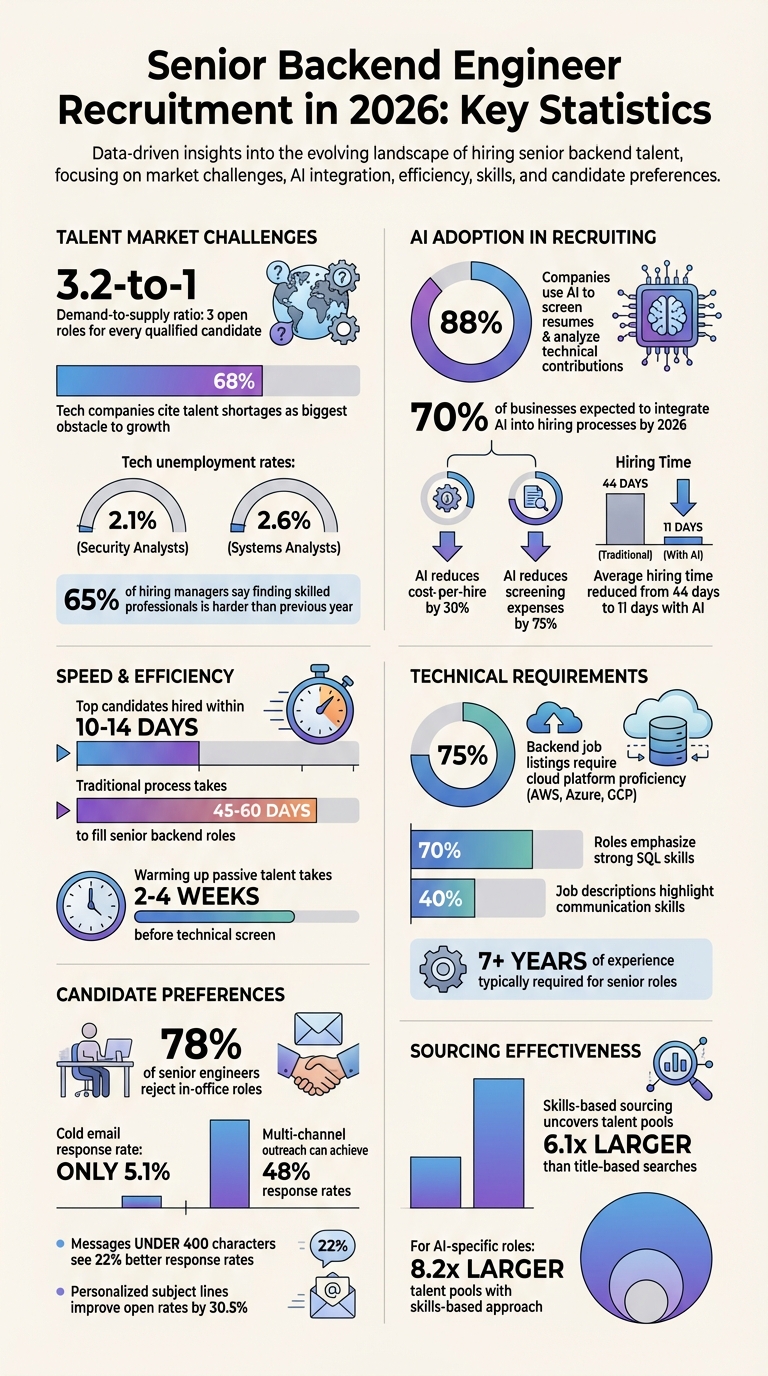
- AI Tools Dominate: 88% of companies use AI to screen resumes and analyze GitHub activity, Stack Overflow contributions, and technical blogs to find candidates.
- Evolving Skills: Senior engineers need expertise in cloud infrastructure, AI/ML integration, event-driven systems, and security. System design and managing large-scale distributed systems are critical.
- Global Hiring: Companies tap into global talent pools, with emerging hubs offering competitive salaries compared to the U.S.
- Passive Candidates: Most senior engineers aren’t actively job hunting. Recruiters follow a developer hiring checklist focusing on developer communities, personalized outreach, and double opt-in introductions to connect with them.
- Speed Matters: Top candidates are often hired within 10–14 days, so acting quickly is key.
Recruitment strategies now prioritize proactive talent discovery, AI-driven assessments, and creating a seamless candidate experience. Companies that adapt to these methods are filling roles faster and more effectively.
What Makes a Senior Backend Engineer in 2026
The idea of what makes someone "senior" has shifted significantly. It’s no longer just about writing more code or being familiar with a wide array of frameworks. Today’s recruiters are looking for engineers who can reduce risk: those who can be trusted with systems serving millions, make cost-conscious architectural decisions, and solve ambiguous challenges without needing constant supervision. As The Concurrent Mind explains:
Senior is not writing more code. Senior is deleting uncertainty before it reaches customers.
By 2026, senior backend engineers are typically those with 7+ years of experience, capable of managing entire service layers and understanding the ripple effects of their architectural choices. This level of expertise requires a deep understanding of production systems and sets the stage for the technical skills expected from them.
Required Technical Skills
Cloud expertise is now a basic requirement. Around 75% of backend job listings demand proficiency in platforms like AWS, Azure, or Google Cloud . Beyond simple usage, senior engineers are expected to design architectures and manage infrastructure through code .
A standout skill in 2026 is the ability to integrate AI and large language models (LLMs) into production systems. Engineers must know how to implement workflows around LLM APIs, including advanced concepts like Retrieval-Augmented Generation (RAG) pipelines and Model Context Protocol (MCP) servers .
Event-driven architecture has also become a must-have skill. Tools like Apache Kafka, RabbitMQ, and Redis Streams are essential for building asynchronous systems, decoupling services, and handling real-time data streams . System design now goes beyond CRUD operations, focusing on creating distributed systems that can handle millions of simultaneous users while ensuring high availability and fault tolerance .
Database management remains a cornerstone of backend development. About 70% of roles emphasize strong SQL skills, with an expectation of expertise in systems like PostgreSQL or MySQL. This includes optimizing queries, designing efficient schemas, and managing concurrency. As Bhumika R. aptly puts it:
You can't out-code a bad schema.
Security has taken center stage, too. Senior engineers must be well-versed in zero-trust principles, OAuth2, JWT, and the OWASP Top 10 to protect systems from vulnerabilities. They are also expected to excel in observability, using tools like Prometheus, Grafana, and Jaeger to monitor metrics, logs, and traces effectively .
| Skill Category | Senior-Level Expectation |
|---|---|
| Cloud Infrastructure | Make architecture decisions and take full ownership of infrastructure, not just deployment |
| AI/ML Integration | Build RAG pipelines and integrate LLM APIs into production workflows |
| Databases | Design robust schemas, optimize queries, and manage migrations |
| System Design | Engineer distributed systems with high availability and fault tolerance at scale |
| Security | Implement zero-trust architectures and adhere to OWASP Top 10 standards |
| Observability | Monitor production environments using tools like Prometheus, Grafana, and Jaeger |
Efficiency is also driving the adoption of Protocol Buffers and gRPC. For instance, LinkedIn reported a 60% reduction in latency and an 8% improvement in resource utilization after deploying Protobuf with their Rest.li framework across 50,000+ REST endpoints in early 2026 .
Recruiters are increasingly valuing depth over breadth. Engineers with a deep understanding of one ecosystem - whether Go, Java, or Python - are preferred over those with a surface-level familiarity across multiple languages. Regardless of the language, seniors are expected to apply core principles like SOLID, DRY, and KISS . While technical skills are crucial, the ability to lead and communicate effectively often distinguishes great engineers from good ones.
Experience and Soft Skills
Technical expertise alone doesn’t define a senior engineer. Communication is just as important - about 40% of backend job descriptions highlight this skill . Senior engineers must be able to explain complex technical issues, such as performance bottlenecks or the safety of a proposed fix, to non-technical stakeholders. Clear communication helps align teams and prevents costly misunderstandings.
Leadership is another key trait. Seniors are expected to mentor junior team members, lead architecture discussions, and design cross-team API contracts . They also take charge of resolving production issues and conducting incident reviews .
Framing technical work in terms of business outcomes is increasingly valued. For example, instead of simply stating they "dockerized a microservice", top candidates explain how this reduced deployment time by 40%, enabling faster feature releases. As Hayk Simonyan, a Software Engineering Educator, points out:
Saying you "dockerized a microservice" tells a hiring manager nothing they care about. Explaining that you reduced deployment time by 40%... that's a different conversation entirely.
Problem-solving in ambiguous situations is another hallmark of seniority. These engineers excel at making informed architectural decisions without complete information and can clearly articulate trade-offs, such as why they opted for Layer 4 load balancing instead of Layer 7 .
Finally, senior engineers in 2026 thrive in global-first environments. They work across time zones in asynchronous, outcome-focused teams, often prioritizing roles that offer measurable impact over titles or prestige .
Using AI Tools to Find and Screen Candidates
The challenge of hiring senior backend engineers in 2026 is steep, with a demand-to-supply ratio of 3.2-to-1 - three open roles for every qualified candidate actively searching for a job . Traditional manual screening methods simply can’t keep up, especially when a single job posting can attract hundreds of applicants, many of whom exaggerate their qualifications. That’s where AI-powered recruitment platforms step in, making it easier to cut through the noise and find the right talent quickly.
How AI Matches and Screens Candidates
Traditional screening processes often rely on keyword matching, but modern AI platforms go far beyond that. These tools now assess candidates’ actual technical contributions. For example, they analyze GitHub activity, real-world code submissions, and technical project work to verify claims like "production-experienced" rather than just scanning resumes for buzzwords . This is critical in fields like AI and machine learning, where skills for cutting-edge techniques - such as agent frameworks or frontier model APIs - can become outdated in as little as six months . A candidate with years of experience in machine learning may still lack expertise in the latest approaches.
Advanced AI systems also take the screening process a step further by conducting interactive technical interviews. As InterviewFlowAI describes:
Standard automated tools just check if a candidate says the right keywords. InterviewFlowAI uses advanced Large Language Models to conduct a two-way technical conversation .
These AI-driven interviews don’t just stop at generic questions - they dive into specifics. For instance, they might ask candidates to explain their indexing strategies or decisions around database sharding, ensuring a thorough assessment of their technical depth.
The results speak for themselves. Companies using AI for screening have reported a 30% reduction in cost-per-hire and a 75% drop in screening expenses. Even more impressively, they’ve slashed average hiring times from 44 days to as few as 11 days . By 2026, 70% of businesses are expected to integrate AI into their hiring processes, up from 65% the previous year . These advancements allow recruiters to focus on identifying top-tier, production-ready talent.
Getting Warm Introductions With daily.dev Recruiter
While AI excels at assessing candidates, daily.dev Recruiter takes a different approach by streamlining how recruiters connect with candidates. Instead of relying on outdated profiles or cold outreach, this platform offers warm introductions to developers who are already active in the daily.dev network. These developers engage with technical content and stay updated on backend trends, making them more likely to align with specific technical needs .
Each introduction follows a double opt-in process, ensuring both parties are genuinely interested. This eliminates the spam problem that traditional recruiting often faces - developers aren’t flooded with irrelevant messages, and recruiters only interact with candidates who are actively open to opportunities. For instance, when a senior backend engineer with the exact skill set you need signals their interest, you receive a warm introduction that includes detailed context about their expertise, interests, and career goals. No cold emails or guesswork required.
Reaching Passive Candidates Through Developer Communities
In 2026, senior backend engineers are rarely unemployed, and traditional recruiting methods have become less effective. Platforms like LinkedIn and email outreach now see response rates in the single digits for most senior-level tech roles . These professionals aren’t actively updating their profiles or browsing job boards. Instead, they’re fully employed, receiving passive outreach from numerous companies. To connect with them, recruiters need to take a proactive approach before candidates even consider entering the job market .
Developer-focused communities provide what’s often referred to as a "third channel" for recruitment. These spaces allow recruiters to connect with developers where they already spend time - platforms they trust and use daily for professional development . With the recruiting software market reaching $3.2 billion in 2026 , the focus has shifted to engaging talent where they are most active. This requires moving beyond conventional outreach methods to more dynamic, community-driven platforms.
Finding Talent in the daily.dev Network
The daily.dev network offers recruiters a unique opportunity to engage developers based on their real-time learning habits rather than their job-seeking status. For example, when a senior backend engineer bookmarks an article about Rust concurrency or dives into topics like distributed systems architecture, these actions provide stronger signals of interest and expertise than a LinkedIn profile that hasn’t been updated since 2023 .
This contextual data makes outreach more personalized and relevant. Instead of sending generic messages, recruiters can reference specific technologies a candidate is actively exploring - whether it’s Go microservices, Kubernetes optimization, or LLM API integration. Nimrod Kramer from daily.dev highlights the challenge:
The bottleneck is replies. Getting a passive senior engineer to actually respond to your outreach is the hardest part of technical recruiting today .
To address this, the daily.dev Recruiter platform ensures all interactions are warm and double opt-in. This approach prevents developers from feeling spammed while connecting recruiters with candidates who are genuinely interested. By leveraging these real-time insights, recruiters gain a competitive edge in today’s tight labor market.
Reviewing GitHub Activity and Open-Source Work
In addition to community engagement, technical repositories like GitHub have become essential for evaluating a candidate’s expertise. Many founding teams now identify their first engineering hires by analyzing GitHub contributions rather than combing through outdated LinkedIn profiles .
When reviewing GitHub activity, focus on the complexity of repositories and the frequency of contributions rather than simply matching keywords . Contribution graphs, often referred to as "green squares", are a reliable indicator of a candidate’s consistency and reliability, particularly for remote roles . Additionally, the quality of a README file can reveal a lot about a developer’s communication skills. Clear documentation and well-written commit messages often signal strong collaboration abilities, especially in asynchronous work environments .
Building relationships with passive candidates takes time. Start engaging them 6–12 months before you anticipate hiring, allowing trust to develop and keeping your company top of mind . On average, warming up passive backend talent can take 2–4 weeks before even initiating a technical screen . The investment in patience and preparation pays off.
Solving Common Recruitment Problems
Recruiting senior backend engineers in 2026 comes with two major hurdles: a limited talent pool and low response rates. For example, unemployment rates in tech are strikingly low - 2.1% for security analysts and 2.6% for systems analysts . Adding to the challenge, 65% of tech hiring managers say it's harder to find skilled professionals compared to the previous year . Cold email outreach isn't exactly winning the day either, with an average response rate of just 5.1% . To top it off, filling a senior backend role typically takes 45 to 60 days .
The solution? It’s not about working harder - it’s about working smarter. Rethink how you connect with talent by focusing on how developers prefer to be approached. For instance, skills-based sourcing can uncover talent pools that are 6.1 times larger than title-based searches. For AI-specific roles, that number jumps to 8.2 times . And when done right, multi-channel outreach can boost response rates to as high as 48% . The trick is to match the right candidates with the right opportunities in a way that feels authentic, not spammy.
Handling Talent Shortages With Double Opt-In Matching
The biggest time drain in recruiting isn’t conducting interviews - it’s sourcing candidates. Warming up passive backend talent often takes 2 to 4 weeks before you can even schedule a technical screen . Meanwhile, traditional job postings tend to attract a flood of unqualified applications, forcing recruiters to sift through irrelevant resumes instead of engaging with strong prospects .
Double opt-in matching flips this script. Instead of relying on cold outreach or open job boards, both the recruiter and the candidate express interest upfront. This ensures recruiters spend their time only on candidates who are both qualified and genuinely open to discussions. For senior engineers - who are often inundated with irrelevant outreach - this approach cuts through the noise and respects their time.
The daily.dev Recruiter platform is a great example of this. It connects recruiters with developers using real-time data on learning activity and stated preferences. When a senior backend engineer signals interest in a role that aligns with their expertise - like cloud architecture or distributed systems - the introduction is already warm. No spam, no wasted effort - just meaningful conversations that matter.
With this pre-vetting process in place, recruiters can focus on crafting personalized outreach that elevates the candidate experience.
Building a Better Experience for Developer Candidates
Once you’ve identified qualified and interested candidates, the next step is to create a standout candidate experience. Senior backend engineers aren’t drawn to generic job descriptions filled with buzzwords - they’re looking for roles that challenge them architecturally and have a measurable business impact. For example, framing an opportunity around outcomes like "reducing deployment time by 40%" resonates far more than a laundry list of technologies . Shorter, more focused messages also help - those under 400 characters see 22% better response rates, while personalized subject lines improve open rates by 30.5% .
Start by simplifying your job descriptions. Instead of listing 15+ technologies, stick to five or six must-haves. This prevents strong generalists from opting out unnecessarily . Highlight critical skills using a backend developer checklist that covers SQL expertise, cloud architecture knowledge, and the ability to design scalable, reliable systems. As Poorna Soysa, Senior .NET Architect, explains:
"Senior roles are less about knowing one tool and more about designing reliable, scalable systems - and now, knowing where AI fits."
Transparency is another key factor. Be upfront about time zone overlap requirements (typically 4 to 6 core hours), compensation ranges, and whether the role is permanently remote or just temporarily so . Developers also value mature engineering practices, like technical RFCs and asynchronous communication, which signal a respectful and efficient work culture. In today’s hiring landscape, the best candidates aren’t just strong coders - they’re strategic thinkers who appreciate clarity and respect for their time .
Conclusion
Recruiting senior backend engineers in 2026 requires actively seeking talent using AI-powered tools that scan platforms like GitHub, technical blogs, and developer networks. With 68% of tech companies citing talent shortages as their biggest obstacle to growth, recruiters must shift from passively reviewing resumes to proactively identifying and engaging skilled professionals .
The approach is straightforward: leverage AI to assess candidates' system design expertise and production experience, then connect with passive candidates through developer communities. Personalize your outreach and ensure it’s a double opt-in process to build trust. Speed is crucial - top candidates are off the market within 10 to 14 days .
To stand out, focus on transparency. Clearly communicate compensation, remote work options, and your organization's engineering practices. This is critical in a market where 78% of senior engineers reject in-office roles . Tailor every interaction to show genuine respect for developers' time and priorities.
Elton Chan, Co-Founder of Second Talent, emphasizes the urgency:
"The senior engineering talent market in 2026 favors startups that move fast. The best candidates get multiple offers."
FAQs
What signals best predict a senior backend engineer’s real production experience?
A senior backend engineer's true expertise shines through in a few key areas: a solid technical foundation, the ability to design and implement practical architectures, and a track record of delivering successful real-world projects. These aspects provide a much clearer picture of their capabilities than just their performance on coding tests or the length of their career.
How can we use AI screening without filtering out strong candidates unfairly?
To make sure AI screening processes are fair and don't unintentionally exclude qualified candidates, it's important to regularly review the AI's performance. This means looking for and addressing potential biases tied to factors like gender, race, or intersecting identities. Another key step is ensuring the data being used is both relevant to the hiring goals and free from bias. These practices help promote fairness while accurately identifying the best candidates for the role.
What should we streamline to hire a senior backend engineer in 10–14 days?
To bring a senior backend engineer on board within 10–14 days, you’ll need to fine-tune your sourcing and screening process. Start by targeting candidates who meet at least 70% of the job requirements. Leverage AI-powered platforms and developer-focused networks to quickly pinpoint skilled professionals. Use streamlined technical assessments to evaluate their abilities efficiently. Additionally, shorten the interview process and make your offer more appealing by including perks like remote work options. These steps can help you secure top talent in record time.
.png)